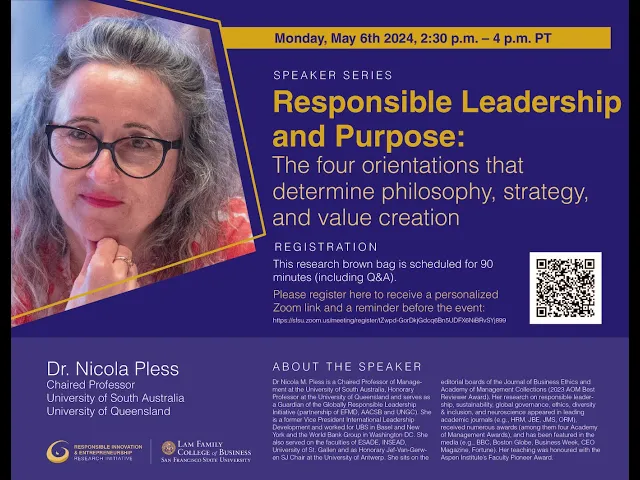
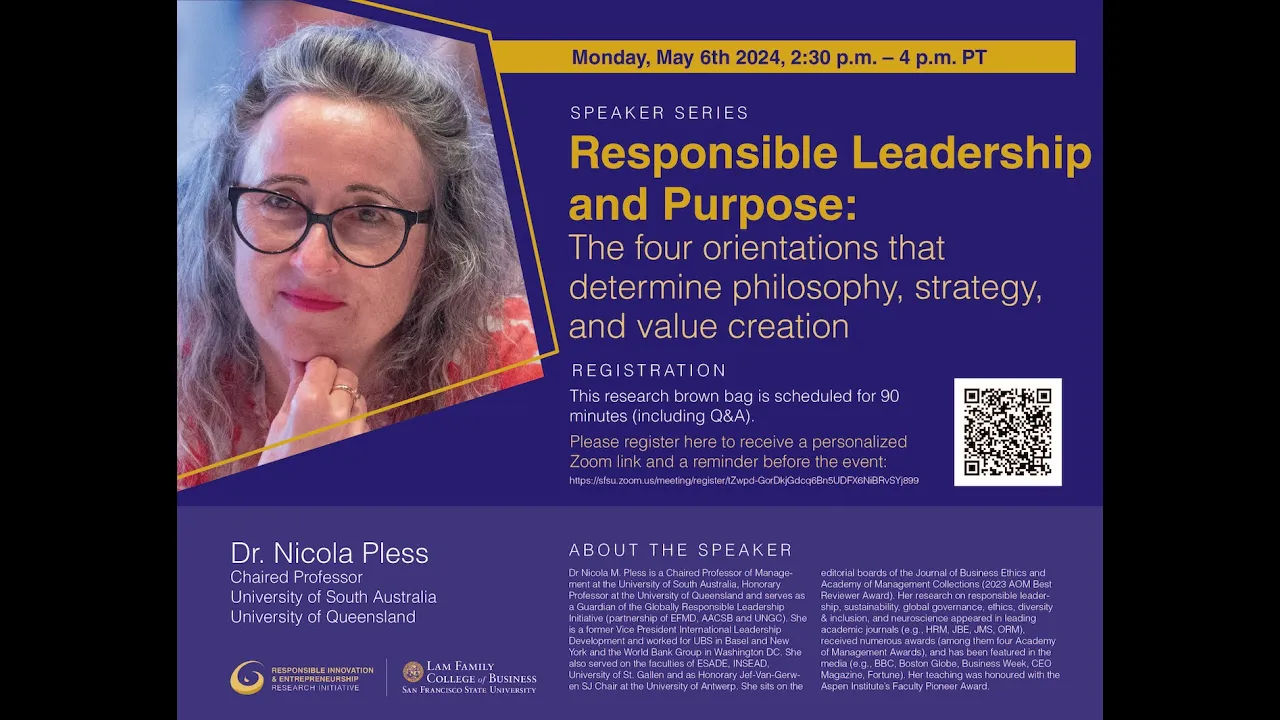
Like the oh okay great minu is also here minu welcome minu is the founding director of our research uh initiative hi Nia hi everybody uh welcome ni good to meet you good to see like this yes I yes let's let's start uh it is my honor to introduce doc CL uh today uh I am chenway associate professor management from San Francisco State University and I'm the associate director of R research initiative and who also you know kind of constantly spam email your employees with our events and uh conference informations and today it is my honor
to introduce Dr class you know who is from uh University of South South Australia to be with us uh for her talk on responsible leadership and uh uh this talk will be recorded and we will also upload it to our YouTube channel later uh so uh If you oh wait sorry about that I think I I have a technical glitch here kind of stop my screen here oh okay so Dr deola PL is a chaired professor of management uh at the University of South Australia and she's also a professor at the University of Queensland and
served as uh a guardian of the globally responsible leadership initiative uh the globally responsible leadership initiative exists to Kickstart the Development of globally responsible leadership and practice in organizations and societies worldwide it is a leading incubator for Innovation and new practice in Business Schools and for collaboration with business in the space of Ethics responsibility and sustainability actually I'm quite fascinated you know about this re uh initiative uh if Dr PL can introduce us a little bit more about this it'll be great and she's also executive coach uh Certified by The Institute for Executive coaching and
the leadership uh Dr PL is a former vice president International leadership development and work for Union Bank of Switzerland uh in basil and New York and also the World Bank group in Washington DC and she also served on the faculties of assade inet University of St Gan and as honorary jenan Goan SJ chair at the University of ENT worth hopefully you know I pronounce everything in the correct way and she Has lived in seven countries on three continents and combines her Multicultural background with multi seor business experiences which she translates uh into her academic work
uh in her coaching practice she also focuses on leadership coaching and applies positive psychology and conducts narrative coaching and developmental coaching towards responsible and inclusive leadership and re revolving ethical dilemas uh her Research is focused on diversity Equity inclusion leadership uh neuroscience and ethics and she is also a Pioneer in responsible leadership her most recent book on responsible leadership was launched at the world economic forum and reviewed by Harvard Business School uh actually you know I I was uh like uh searching for like responsible leadership related book and that's how I found found you and
reach out to you invited DRC PL to talk to us and I Really enjoyed the reading her book and she also sits on the editorial Boards of the journal business ethics and Academy of management collection uh she won the a best reviewer award congrats her research appeared in leading academic journals including uh Journal business ethics Human Resource Management uh Journal management uh studies and organization research methods uh among others and she received numerous Awards uh and has been Featured in the me media such as BBC uh Boston Global Business Week CEO magazine fortune and her
her teaching was honored with the Asen institute's faculty Pioneer award Let's uh let's give Dr plus a very very warm welcome for her talk today and if you have any questions you know feel free to leave them in the chat or unmute yourself and ask after the presentations uh I I will I will be sure monitoring you other questions uh in the chat and I will let her uh take It from here thank you so much for being here with us Dr PL thank you so much sh why for the kind and nice and warm
introduction and also minu thank you so much for um the invitation it's really wonderful to be here and to give this InterContinental talk um via Zoom which is really nice on responsible leadership and purpose so what I'm going to do is I'm going to share um one of the Frameworks um that I've developed with my research team on A for orientations on responsible leadership and um we I try to show today how they determine the philosophy of leadership the strategy of the firm and approaches to Value creation so let me start with um one of
these inspirational quotes by Simon Sy who says the responsibility of leadership is to give people a course to belong to and then give them the permission to find ways to advance that course so there is definitely this this purpose side in Responsible leadership and I'm going to talk about that a little bit in more detail during the course of my presentation now responsible leadership has emerged as a topic since 2005 so it has become of great practical relevance so it started basically also with a call for engagement by the European Foundation of management development together
with a globally responsible leadership initiative and you see this picture here to the left That was the initial call uh from the the Practical side and um we so my research team and I then continued with the release of the book um shangai that you just mentioned on responsible leadership published by Rd and we just released the second edition in 2022 and then it became step by step um a topic that really um entered corporate boardrooms to the extent that at 2017 the world economic Forum dedicated a whole Summit to the topic of Responsive and
responsible leadership so what you see here to the right and that is actually CLA Schwab here uh the founder of the world economic Forum responsible leadership has also become a mo one of the most widely discussed topics in the broader public debate on leadership it dominates the discourse um on the worldwide web so as you can see here from this slide um U um Google search that I did uh in March 2022 um there it had 2.7 Billion Hits And then ethical leadership was second uh with 1 billion fewer hits and as you can see
the other leadership styles while also being quite relevant are less get less attention currently in the broad broader public discourse and that is due to the particular nature of the topic of its multi-level um impact that it has and I will come to that so this demonstrates how the discourse on responsible leadership has emerged and how it has Impacted the broader debate and as anui Professor anui prolific researcher re recently said the world has changed giving urgency and legitimacy to the idea of responsible leadership now you may ask what is responsible leadership well I will
provide a brief overview of the concept so that we have um a common base and common understanding so the concept links leadership research and the discussion on corporate social Responsibility it is also a moral leadership construct that is rooted in business ethics thereby acknowledging the different philosophical traditions that underline uh and influence the understandings of leadership and of responsibility it also acknowledges that leaders are accountable for their actions so it has um this consequential perspective and consequential view it is also largely grounded in stakeholder Theory and therefore influenced by Edward Freeman and his work on
stakeholder management however we are here on a different level so why stakeholder management is discussing relations at the organizational level responsible leadership is an individual level concept and in contrast to other moral leadership constructs here followers are understood as stakeholders so so they are not simply understood as Subordinates within an organization but as constituents inside and outside the organization with whom leaders need to build relationships and whom leaders need to mobilize in order to achieve objectives together and make a positive impact in business and Society so leaders in this broad stakeholder environment has quite a
daunting task because they have basically to integrate stakeholders from different backgrounds with different Interest with different values and they need to be able to make decisions that consider the interests and needs of these different contitions and this can be quite difficult because often uh there are conflicts that arise um among the stakeholders or with stakeholders that leaders need to mitigate and they need to balance these different interests so quite an extended scope of responsibilities that comes with It furthermore responsible leadership is a multi-level construct or phenomenon so at the individual level we talk about let
me just share that so multi- level construct touching the micro level so leading South the Meso Level leading teams and the more micro level leading organizations uh leading stakeholders to together achieve objective and leading in a global business environment and so the question is often um if one talks About responsibilities leadership to to look into the intention so what kind of purpose do leaders pursue in order to mobilize these different constituents and in order to mobilize them to achieve for instance the United Nations sustainable development goals or to work together with stakeholders to create social
Innovations or responsible Innovations so briefly we understand responsible Leadership from an academic perspective as an intentional and purpose-driven approach and also understand it as a relational influence process between leaders and stakeholders geared towards the establishment of accountability pertaining to matters of organizational value creation so this is the working uh definition and purpose and intention play an important role in responsible leadership Particularly in how business Executives Drive the business and what kind of value they create and for whom so an important question here and in the end um this also has an effect on the kind
of solutions that are developed in light of grand societal challenges so our approach is that we propose and suggest that the intentional basis of leadership has an impact on organizational level and societal outcomes So and if we look into purpose let me just share definition here so it can be defined as an aspirational reason for being which in inspires and provides a call for action for an organization and its Partners as well as their stakeholders and provides benefit to local and the global Society so in this sense there is a strong connection between purpose and
Responsible leadership and and in essence it is a part of our construct now in the following I will draw on an article that we publish in Academy of management perspectives that has become quite relevant recently um and I will describe this landscape of responsible leadership um by actually outlining the different responsible leadership orientations that we have identified so Our research shows that there is not only one responsible leadership approach but that leaders have different understandings about what leadership is and responsible leadership means so and I will also by doing that show how this field has
evolved over time in business practice so this landscape that we have developed is based actually on qualitative research so we use an Unobtrusive approach by conducting content analysis of speeches of presentations of blogs and where the opinion of CEOs was shared um this was a group of um International uh leaders representing Asia the US and Europe and um also owners of firms as well as uh CEOs of publicly listed firms and this landscape um so what has emerged through the content analysis are two Dimensions so this is on the xaxis what you see the Breaths
of constit groups so you how many stakeholders do um leaders actually um a knowledge in what they are doing and then on the y axis you see the degree of accountability towards others so to what extent do they feel responsible for stakeholders and the consequences of the actions on them and within this space that these two xes um create uh we were able to um actually locate for different responsible leadership Prototypes so the idealist the traditional Economist the opportunity seeker and the integrator now I will go through that because it shows a bit of the
discussion that we have and um it also provides a bit of an understanding why they are different approaches towards this construct so I will start by going through these different prototypes and provide some ideas how individual level leadership is related to CSR strategies To the purpose of the firm and also to Value creation so the first type that I'm going to talk about is the idealist so the idealist as you can see here from this framework has narrow focus on stakeholders and these are particularly stakeholders in need as represented by this um photo here and
they have a high degree of accountability towards others so this is an interesting um prototype this is not exactly the norm So it is a particular type of responsible leader who cares about the needs of marginalized stakeholders those in need and those who are usually excluded from the broad up discourse of business so respons Leaders with an idealistic orientation have a very narrow Focus as I said and high degree of responsibility now I have studied a number of Business Leaders on different continents and I found that it was Mostly social entrepreneurs who represent this idealistic
type of a responsible leader and if you look into um social entrepreneurs their purpose is to create value values for stakeholders in Need for Society at large and to generate solutions for them and so the idealistic leader idealistic responsible leader is driven by humanitarianism they are motivated by Altruism they care for stakeholders in need they actually their motivation often they achieve a Psy ological fulfillment through their engagement and through their value creation for this particular stakeholder group and we found that their leadership style is often a servant one so a style that is caring compassionate
service oriented towards followers and I do have an example here to share so one is um and quite Fascinating uh social entrepreneur is Dr dadat from gr Vias um so that is a social Enterprise um honored by awards from the Schwab foundation so which is an arm of the world economic Forum by a shoka and others and their purpose is to promote processes which are sustainable socially inclusive gender equitable and to enable critical masses and marginalized rural people or communities to achieve a dig dignified quality of life so it's Interesting they use business as a
means to help people in need so um this organization provides actually um Consulting Services uh to under privileged Villages helps them to get access to clean drinking water thereby um helping people to be healthy have a dig um more dignity in life and particularly support women uh because in many parts of the world women are the water holers um of their Nations um go to remote areas um try to bring uh back Clean um drinking water often not possible because um sources are often poed this is a cause of disease um so child mortality is
related to that but also um mortality um of women and so by BR bringing access to clean drinking water and helping villages to construct their own water and sanitation systems this organizations helps to um get people out of poverty enabling them to have a better life so for in it frees up time for women to set up their own Little Enterprises it helps uh girls to go to school because they no longer need to actually engage in getting water for their communities so this is really a true entrepreneurial um Spirit um a very altruistic approach
but with quite substantial impact so they achieve um or touched and helped more than uh 100,000 households and are also now internationally active so to sum up um these idealistic Responsible leaders understand that for them business success means long-term value creation for stakeholders in society particularly those in leads and also so they aim at obviously um staining their own organizational viability but they have pretty different business models than the other leaders in the other quadrants now having talk about the idealist let me come to the second prototype with is which is the Traditional Economist so
what while they are both very different from each other what they they have in common is a narrow focus on stakeholders so while the idealist looks at stakeholders in need the traditional Economist is focused on shareholders and in contrast to the ideal is they have they are very much driven by self-interest so have a rather low degree of accountability towards others let's take a look into that but Before that again the idealists they engage in social issues because it's the reason for their being traditional Economist and opportunity Seeker have a quite different approach towards that
an example of um a leader that pursues this rather economic approach is um can be seen here so it's TJ Rogers so he is the founder and CEO of Cypress semiconductors um they may also sit in uh the San Francisco region So um he is actually um quite engaged in trying to find Solutions uh for businesses but also engage in um CSR to a certain extent um he is um very much understanding himself as a in the approach of Milton fredman and if you're familiar with his approach then you know it's the business of businesses
business the social responsibility of business is to improve profits and it is suggested that Business Leaders do not engage in CSR however there are ways to do it um in a different way um which um he does so he supports his employees for instance to go get engaged in um the Harvest Food Bank competition um to engage some of their time there and they were quite successful in doing that over the years won this award and he experienced that this has a positive effect also for business so while not needing to invest it still helps
the organization to build employee morale to Attract new employees and it's also good for PR and also to a certain extent it helps um one of the UN sustainable development goals and that is zero H hunger to contribute to that but in contrast let me just come back to this example here you see through the engagement of gr vas they actually deliver on 11 of the United Nations sustainable development goals so there is quite a bit of difference and this is Going back to the purpose of the firm and to the particular approach so in
a nutshell when we talk about um the traditional Economist and I understand them also as a responsible leadership orientation um yet rather an an minimalistic one but still I mean they focus on creating jobs paying taxes and doing business in line with the law the customs of a particular country however they are quite self-interest Driven in their approach they are driven by profit maximization um mainly feel accountable towards stakeholders and their leadership style as such is rather r goal based and pass goal oriented in the sense of putting business goals first and as I said
the social resp CSR approach is very much influenced by Milton fredman so it's rather reactive reactive CSR strategy reduced to paying taxes creating jobs uh And complying with laws and customs in society yet we see some examples exles that are quite sustainable we also see um that some of these um economic leaders make quite substantial Decisions by for instance saying we um stay within the country in which we are headquartered have our production there in order to be able to create jobs now having said that there is also a certain um downside connected to um
this approach Um as you can see here over the PA from this slide over the past decade we have seen um quite a number of substantial um either accidents or corporate WR wrongdoing or individual wrongdoing that is very much related with the risks that are associated with this approach so the risk is in fact um an extensive self-interest driven behavior on extensive pursuit of greed that can actually turn good leaders into what Su goal has called um an excessive Self-interest um driven leader ruthless hard driving strictly top- down command and control focused shareholder value obsessed
win at any cost business leader so this is a bit of the downside that uh an economic responsible approach can turn through too much drive from greed into um Drive business leader outside of the responsible leadership uh landscape and these experiences over time had led to a shift in mindset and a redefinition of purpose Beyond profit Maximization so in essence we see an evolutionary shift from shareholder Focus sorry to a stakeholder perspective and um we see that more and more Business Leaders try to pursue um broader stakeholder approach um take accountability for achieving sustainable development
goals set up um for instance the global business Coalition against um HIV AIDS tuberculosis malaria founded the world Business Council for Sustainable development um engage in the Business Roundtable Institute for corporate ethics um and so we see this evolutionary shift from from a shareholder Focus to a stakeholder perspective even in those institutions like the US business round table that was spare heading the Milton Freedman approach until 2019 where they came out with a new statement a new mission statement Committed to uh applying a stakeholder perspective and the statement was signed by 181 um us CEOs
uh who committed to leading their companies for the benefit of all stakeholders now let let us take a closer look into this shift um first why it has happened and then what this means so it is a shift actually from this traditional Economist prototype into This opportunity Seeker quadrant and this is really quite a substantial Evolution that we are seeing here so this is due to the fact that Business Leaders are actually pushed by stakeholders to engage more in doing good and and reducing their negative impact and it is also due to Rising expectations in
the broader Public public so coming from different stakeholders so firstly I mean promoting Human rights providing a fair and healthy and safe work environment is expected by employees and not only in developed countries but also in developing countries we also see that through these accidents there is a much environmental accidents a much higher sensitivity in the broader public and it is expected that um Business Leaders take a forward-looking perspective take care of the impact that their production processes have and also build Fair Relationships within the supply chain we also see um that particular those uh
organizations that are doing business internationally engage in activities that contribute to alleviating poverty we also see that there are that future Generations are now um voicing their concerns about what is going on think about um the new generation of um Genet so business leaders are called to act as corpit Citizens and take a more active role Visa V pressing societal challenge And to achieve United Nations sustainable development goals and this is reflected basically in the responses of just come here in the responses of the instrumentalist the opportunity Seeker so this group of leaders has a
broader stakeholder perspective considers the needs of key business stakeholders uh also because I mean they often have a strategic perspective they Scan the environment for risk and opportunities and since these expectations are there they know they have to respond but at the same time they share with the um traditional Economist a rather low accountability as such for uh a broader range of stakeholders now so as said they share a similar basis with the economists who rather self-interest and profit driven but they have a different motivation so their Motivation is not purely to increase short-term shareholder
value but their motivation is strategic in nature to achieve a competitive advantage to build build a positive reputation of the organization so in doing that they know they have to consider the interest of needs of a broader range of stakeholders uh and they particularly look into the what um Edward Freeman calls the primary stakeholders so those that are close to the business like the customers the Suppliers the shareholders maybe Auditors right and their particular approach in terms of leadership style is more rule-based more transactional and they have in terms of strategy a responsive approach so
creating shared value is one of the keywords that you may know so this approach is very much driven by the work of um Michael Porter and his colleague Kramer from uh Harvard Business School and so they introduce the concept of Creating shared value and in this approach the purpose is still understood to be profit maximization um it is still predominantly about economic value but um it also considers St so it is a approach that I would call profit plus so it means it also integrates creating benefit and value for society and reducing the environmental footprint
and these leaders are particularly inclined to do that if there is a tangible Benefit for business uh coming with it so as said the main motivation is competitive Advantage um and also to enhance public relations and firm reputation and there is where we see a certain risks and that is if leaders are mainly driven for instance by increasing their corporate reputation this can lead uh to the perception that they are doing green washing so if they if it's not really backed with Substantial um engagement in sustainability in corporate social responsibility this may uh raise some
question marks among stakeholders so now also the focus on business outcomes as such is still very much rooted in the Trad I of economic thinking however due to stakeholder pressure instrumental Business Leaders is are more responsive toward CSR they comply with laws and regulation but they Also pursue societal issues that are beneficial for um business particularly if they can um realize a quick win right and so what um Kramer and Porter suggest for this particular um approach is to basically identify social issues and engage in them that are close to the strategy uh so that
one can really um have um a concerted strategic effort here a very um good example of a CEO that actually drove um sustainability initiatives from this rather Instrumental responsible leadership um perspective is Jeff imil so uh former C of General Electric you may remember he was the one who drove this Eco imagination initiative at um General Electrics that for instance zero emission hybrid uh buses they invested in clean energy they um were active in reducing greenhouse gas emissions early on in from 2005 and at the same time we're very much focused to also um increase
growth and make money with that And um this is all fine um it simply shows us here what is actually the approach of the instrumental leader and I have this quote here which very much uh brings that to light and he said we are investing an environmentally cleaner technology because we believe it will increase our Reven Revenue our value and our profits not because it's trendy or moral but it will incre uh will accelerate our growth and make us more competitive so very much um really a Blueprint for this approach and um they through this
approach basically also touched here um and uh delivered on four of the UN um development goals that are listed here at the bottom now the strength of this instrumental approach is then when large multinational companies adopted and you have we have other examples like Nestle or Walmart they have a chance to actually generate Broad and positive impact and To really scale that and um this is if it goes into the right direction one can really um have good and substantial positive effects however there are also some weaknesses um aligned to this particular approach and one
is that those solutions that come out of this approach since they are so closely linked to the strategy of the firm um often remain and are driven by this business Case Logic and not um driven by systemic thinking Which which is often necessary in order to develop really profound solutions for instance towards the environmental uh problem so just to give you an example um we see currently this development with the electric cars which is fantastic because it helps to um reduce um the CO2 emission uh quite short term now however we have the longer term
effects all these questions what to do with the batteries once we do not need them so there is a waste Problem and then there is another problem because the um obviously cars need to be charged with um there is electricity needed so the question then is where does the electricity come from does it come from clean energy does it come from nuclear does it come from coal and particularly is obviously um very very um um closely linked to CO2 emission and to global warming so these are also then the additional systemic questions that need To
be asked so not always are um unfortunately electric cars the solutions and not in all context and this brings me basically this responsible leadership mindset if I uh summarize that um so this means here societal engagement becomes a driver for competitive Advantage for growth and business success so we have here you see already three different mindsets and now I come to the final one so to the Integrator um the most recent one that um has been developed so what we see here uh the integrator has um the same broad breads of stakeholder Focus like the
opportunity Seeker yet they have like the idealist High degree of accountability and they also have um a particular sense for the economic bottom line which is necessary when driving and leading for business companies so here what we see is um a truly a paradigm shift so while we had a tra From the traditional Economist to the opportunity Seeker that was an evolution but from the opportunity Seeker to the integrator we see that a paradigmatic shift is taking place so this is a normative shift from a profit driven approach to a social Purpose Driven approach so
again the integrator has the humanitarian drive from the idealist they have a sense for the economic bottom line from the traditional Economist and um strategic thinking from the opportunity seeker and they try to bring it all together so they have a broad stakeholder Focus High accountability towards all legitimate stakeholders and this is quite challenging it's also a new narrative that has emerged and this is aligned with the discussion around conscious capitalism right so at uh the broader level um a discussion that is linked uh to Responsible leadership and also uh to the discussion around the
development of new for benefit corporations and hybrid organizations also a very um recent development and discussion so integrative Business Leaders are driven by a pro-social Motivation by humanistic values and try to translate them into a substantial business purpose so they do not see profit making as a purpose for business as do the traditional Economist And the opportunity Seeker so unlike these two pro prototypes they see profit making rather as an outcome so you see this kind of shift that is taking place there so and this is an example for uh this new understanding of business
purpose so it was Paul pman former CEO of unil L who stated I don't think our fiduciary duty is to put shareholders first I say the Opposite what we firmly believe is that if we focus our company on improving the lives of the world's citizens and come up with genuine Sustainable Solutions we are more in sync with consumers and society and ultimately this will result in good shareholder returns so it's a little bit like switching the equation here right so it's not the focus on profit first here it is the the focus on stakeholders first
and then the Realization that shareholder return will come from undertaking this kind of um considerate business approach so it was quite interesting because at the very start um of poorman's tenure what he did was to abolish short term reporting so they took some steps to create a new reality so in general the mission of Integrative Business Leaders is dedicated to a higher purpose they are motivated to create value for shareholders inside and outside the Organization and to create change for the better so that is their main driver and when making decisions they try to balance
the economic the social and uh environmental considerations so here um in summary so they feel accountable towards all legitimate state quarters and in terms of uh responsible leadership style they have a relational approach pursue shared and transformational Leadership are compassionate and try to really drive an inclusive style and have a collaborative approach towards stakeholders meaning in contrast to the instrumentalist who rather use stakeholders to achieve their objectives we see here that stakeholders and the relationship towards them become an end in themselves so there is an emphasis on creating valuable and trustworthy relationships with different Stakeholders
this is seen as being important for achieving positive societal outcomes and to do that together so this is also quite a part of the narrative so together pursuing economic viability social value creation together finding ways to reduce the environmental food print and at the time same time develop social Innovations to change the world for the better so in in essence the integrative leader pursues a proactive CSR approach Right so it's a proactive strategy and they partner with stakeholders to create societal Innovation and this then goes along with certain behaviors that we have specified in the
roles model of responsible leadership so here you see um particular behaviors particular styles that can be observed in leaders and this roles model um is composed of nine different roles that you see here um so the inner part these are the more Normative roles so the leader as Visionary servant steart and citizen then the more operational roles um the architect the change agent the coach and the Storyteller and you see then here the Weaver as well so that is the boundary spanner so actually core roles are the one in the center so the for instance
responsible leader pursues a servant style serving the Desires and needs of different stakeholders they are also Visionaries for positive change they are stewards of the environment and of society and they are citizens who try to create value for their different groups of stakeholders and to tackle Grand societal challenges so these are some of the roles that we have identified in responsible leaders that are Particularly pertaining to an integrative style and the goal of these integrative leaders is to fulfill a higher purpose through business so reconciling profit and purpose and examples are various so finds them
on all continents so in the US I think about John MC from the Whole Foods Market think about um Ivon shua former CEO of Patagonia think about Ray Anderson a former uh founder and former CEO of Ray and um of interface so quite A number of examples and leaders that adopt this approach are usually Guided by ethics including moral values and their priority is doing the right thing so they are not primarily guided or driven by reputation or competitive Advantage they try to embed their actions in an integrative approach to actually achieve positive outcomes and
they combine often quite paradoxical uh opposites so they try to Uh combined uh commercial logic with the social valare logic or the business case with um ethical reflection or competitive approach with cooperation and care for stakeholders so it is this interconnected thinking that is one of uh the major characteristics here so really trying to bring that together so here we have some statements from some of them so take the example examp Le here the quote by Ray Anderson he said for Those who think business only exists to make a profit I suggest to think again
business makes a profit to exist surely it must exist for another higher purpose so it's quite interesting if one does these um speech analysis um to see actually uh the way of thinking um here I like to share an example with you I'm not sure if you know Anita rodic s she was the founder of the body shop so this um International Cosmetics brand that um was founded in the UK and started with one shop in Brighton then became a large um International franchise um system was acquired by L'Oreal um L'Oreal more streamlined the organ
ganization and now it was um again sold to latura so Brazilian organization that is um as the name says L focused more on uh the environmental and social side so probably a home for um this organization that is a quite good fit now n rodic uh Very early on already in the 80s uh decided she wanted to do something different from the traditional Cosmetics industry so for her it was important to think about uh broader issues like social and environmental ones so she was basically setting up her business first um to avoid animal testing and
they used recycling um very early on and build actually never never heard of positive relationships towards different Stakeholders so they were the first in the UK to set up a child care facility for employees um they had um great client relationships so in the shops ran campaigns like for instance for building up self-esteem um they also were at the Forefront of fair trade by building responsible relationship towards indigenous communities from which they sourced some of their ingredients and Paid them a fair price so that they the communities were less dependent on the free market economy
um and help them to become self- sustainable through these relationships um her style was servant and um inclusive as well and so there's a lot of learning from that particular case um that we saw in the past also um CEOs like Paul pman were referring to her in some of their speeches which is um interesting but understandable when one thinks about um having a positive Environmental impa learning from build from her in terms of building sustainable devel relationships towards different stakeholders was also quite interesting when they went public um at the London Stock Exchange she
and her husband took that as an opportunity to actually um refine that purpose to actually contribute um to uh the betterment of the planet so quite interesting um to look into these examples that are out There so in the approach of responsible leadership includes building sustainable relationships with different stakeholders and integrative leaders try to contribute through business to STC value creation and positive social change they also often engage in cross- sector collaborations uh which they understand as part of their business approach they inclusive often having a whole person approach a collaborative and engage in Co-creation
processes now what we see and this is quite interesting is that here business is seen as a driver for Value creation and one may look into other examples as well here and can link it perhaps to developments also like the benefit Corporation um B Corps um that are now by more an approach um that more and more organizations pursue in order to uh get an accreditation for their approach We see now that um there are large multinational companies that are B and can be identified as integrators like for instance Denon so the yogur uh manufacturer
um that had um through under the um leadership of their former CEO basically transformed their mission and their whole um product sortment uh by selling unhealthy food Like Biscuits or uh their beer line uh produ uh the beer products so in order to make it health oriented Organization so the strengths of the integrative responsible leadership approach is that they focus on generating these Sustainable Solutions and try to generate substantive problems to societ of problems so they are not looking into providing a remedy but uh a true source of solution and they can be quite influential
if they achieve as large scale organizations to have uh an impact Through scaling and thereby then uh considerably contribute to un sustainable development goals however we also see a particular weakness that comes with this new approach and that is that leaders who are Trend Setters and that's what we often see integrators are have a higher risk of failure they also have to balance competing bottom lines and this can be difficult and they often require more Time and resources to develop systemic and sustainable solution yet this is a new and promising approach to leadership at the
Strategic organizational level that has emerged over the past 10 years and that I think can generate um or has the potential to generate profound Innovations for tackling societal challenges and hopefully contributing to saving our planet now let me summarize this landscape here so I idealists engage in social issues Because it's the reason for their being traditional economists engage in social issues because it is legally required and perhaps immediately relevant for the economic bottom line then opportunity Seekers began to use societal engagement to generate a competitive Advantage but this also sparked a shift from a shareholder
Focus to a broader stakeholder perspective and then there has been a groundbreaking Revolution that is Happening right now towards the integrative approach which is a normative shift where business is seen as a driver of social value creation and positive change so in conclusion there are different responsible leadership mindset they exist side by side in different Industries in different countries and in different context and these mindset have implication at the individual organization and Society level there's a lot of research that Needs to be done what do these different mindset mean for decision making what does it
mean for leadership uh development what it does it mean for the quality of stakeholder relationships what does it mean for social Innovation what does it mean for other business Innovations right so I think it's a very very interesting time that we are in it is probably historic and as such I mean it is a great place right now to do research and also research in Collaboration with business so thank you for your attention thank you so much for your wonderful presentation Dr PL uh so if you have any questions unmute yourself and please ask I
have seen uh some questions in the chat already uh I myself have a a quick question here to Dr plaz is like when you when I heard you you know talk talking about the uh integrators uh type of you know responsible leaders in Today's world how would you describe the most significant challenges you know this type of leaders might encoun like in today's business environment particularly when the profit objectives you know are in conflicting with the ethical purposes it's always hard like you know leaders are being puted by different directions they they need to kind
of you know like have like these you know towards all those different concerns from different directions i' Would love to hear what you think yeah there are quite a number of challenges I mean up until recently um leaders have not really been educated in coping with different stakeholders with different interests um to balance um different important aspects in decision making business consideration ethical ones um other interest and so it is uh one of the key challenges therefore it's important uh for Business Leaders to have actually to be aware of um their um True NOS that
they have a moral compass that can guide them when making decisions particularly in those gray areas um of Ethics so where they need forsel know what are their values what are their principles that guide their decisions another um challenge is obviously I mean integrators need to balance um these different objectives that are there and it is difficult to really respond to all the stakeholders now we saw that recently um in uh the Den case where the CEO uh had to step down uh because shareholder pressures became came so strong so he was criticized that while
pursuing a strong social and environmental agenda uh the return uh for investment was not high enough and so that was unfortunate and it shows one of the challenges that um those leaders at the Helm of the organization are confronted with and since this is such a new Environment um they have most deep to develop these approaches for themselves so there is not the blueprint that they can follow there is not um the real one way to go and so it is important to really be aware of that that there are these um conflicting stakeholder interests
are a reality and so it is important to have advisers to uh can actually um also um assess the situ ation and provide these different perspective in a condensed way for a CEO That he or she can make um um a really informed decision and can set the direction for the organization thank you so much oh Lia thank you so much I think that the framework you presented it was very neat I I have never thought from that perspective I myself did um Corporate social responsibility research for quite a number of years uh so I
I really like that framework I have a few questions um Which might be related to that framework one is uh have you seen any quantitative studies that try to or you yourself did it try to cat ize a sample of firms firms into those four categories and look at the outcome uh or antients of this and I'm the first thing that come into my mind was like if you have a social Enterprises sample that would be all on the top and if you have forun 500 companies then it will be like on the bottom mostly
a lot of them so I just uh Um would like you to uh just elaborate a little bit of what Insight you have on that one can I say another one maybe I I'll ask later so yeah just this one first yes so um basically you touched on an interesting point Thank you for this um question um this framework can be used as at the individual level so like here um responsible business leader landscape I also use it at the organizational Level so in fact yes um I analyze um organizations um according uh to a
questionnaire that I have developed in line uh with this approach and one can systematically yeah make a link uh to certain Innovation approaches that are there um it is more qualitative research in that sense um quantitative um in the sense of um developing a scale yes it is um also happening but that is more at the individual level so but this is interesting because um I approach Responsible leadership as a multi-level phenomenon so um the responsible leadership Behavior and the impact that it has at the organizational level now to date what I um did was
I collapsed the traditional and opportunity Seeker into one dimension because they share the same Paradigm and operationalize that and then the idealist and the integrator into um an opposing one or an in they are both independent in that sense because they have different Paradigms and to relate that to see Sr outcomes in a quantitative way and I can show that um the integrative idealistic driven approach has a stronger effect on CSR outcomes than uh the tra then the traditional list and the instrumental list combined so um it is positive to see that um also at
um the lower level here so the opportunity Seeker or instrumentalist Dimension that they achieve quite uh Substantial outcomes but the integrative approach can achieve uh a more subst or a higher level of outcome so more significant um higher level outcome that's very interesting do you have the paper draft or it's a progress or it's published it's in review oh it's under review I love to read that paper I think the like I I think more like at organizational level because I'm The Strat strategy and organization Theory type uh so have you seen again have you
seen like at organizational level this kind largest sample quantitative study not um basically related to this particular uh framework right yeah I mean if you if you uh sent me an email I can perhaps share with you some um articles regarding um outcomes okay thank you framework sounds good I let others ask question if we Have extra time I can ask a few other questions that's great JP you mentioned yeah oh thank you thank you hi uh Professor P thank you so much for that presentation and I really appreciate the clarity of your framework and
the argument behind it it's really helpful for trying to understand this complex space so thanks thanks very much I wanted to ask you about how you think that these um high growth Technology Innovation firms and Leaders that like we have around here in San Francisco how it relates to your framework in particular there's this argument that we run into a lot and and chenway am meu just had this great seminar about responsible AI recently we run into this argument that you know any any kind of restrictions or regulations or accountability to stakeholders slows down the
pace of technological innovation which is bad for society as a whole and so you should give us maximum Breathing space and breathing room um I was wondering you know how how you fit that vision of of technological innovation in your framework or how you interpret it wow that is a complex question one could write a book around that I guess um yeah it's quite interesting I mean it is really this um tension uh between time and principles that are there um I mean we know from other technological innovation That it is important to know about
the consequences of Innovations first so think about the the nuclear bomb for instance uh think about asbestos um so um my position and I can only talk from my position here is um that we need to consider um the concerns raised by some of the founders of AI themselves and um so so there is no easy answer I mean reality is happening so the incredible speed and pace is there um obviously internationally there there Is a need um for certain rules and regulations Um this can hinder obviously the Innovative development that is there but often
times particular if Innovations can they produce their own life and that is I think happening with AI um the question is if AI is currently seen as supporting us and in many ways it does think about uh the health industry but it can also uh comes with this incredible danger that it can Actually extinct uh human itself which some of um the founders raise so I don't have an answer here I can only say it would be good if um the leaders in the tech industry would take an integrative approach here and really think about
what are their different responsibilities and think about the consequences of their actions not only in terms of business but in terms of soci Society in terms of future generations and I mean we all already See now an impact on changing um work places uh which we see an impact on employees who are scared if they can keep their jobs and I think these things need to be aligned I mean the question is really do we need to have this speed or are the victims of our understanding that there is only competitiveness and speed that helps
the survival of great companies so I mean as human beings we are the creator of reality now Business Leaders have a lot Of power and influence so if they see what the future should look like and think from the future then there are a lot of answers for the present and how to approach that thanks so much and if you need to continue this conversation I'm sure there are some wineries around Adelaide we can all gather at oh fantastic please drop me an email wonderful Elden are you here do you want to unmute yourself and
ask the Question um so I am actually wondering if uh the responsibility mindset that you refer to as the traditional isn't actually an irresponsible mindset uh and you know we see um some real problems uh coming out of a mindset that is focused on profit only and profit Above All Else and um you know I mean I've just gone through uh several articles on on uh Boeing uh and and really it's it's a it's a hollowing out of of a Company um offloading and Outsourcing and all kinds of things um and and a company that
that you you know spent far more money on um buying back their shares to increase share price rather than doing R&D or you know whatever um so I I want to call it irresponsible mindset not a responsible mindset um anyway any any comments on that uh sure I think this is um quite interesting point and I think how the traditional Economist started um it is I think not that this mindset was supposed to do harm I think the intention was uh to contribute uh to the larger number of uh or to the welfare of the
larger number of people um through um this let's say U more neoliberal approach but as you said there are quite a number of risks associated with that um and I said this if under certain Conditions um namely if it is adhering to the norms and standards of societ iy if taxes are paid if no crime is committed if um under those ifs um it can be within the responsible leadership landscape perhaps just thinking about your comment perhaps the Box needs to be smaller here that it is not equally um large as the other ones so
I think um the there are I think really thinkers or traditional Economists that have contributed substantially to positive developments within Society by creating their businesses and by making profit and also paying taxes I mean it's a contribution to society um and not I mean um yeah investing or um evading it to to other to other countries where they don't have to pay taxes right so um I think um in a in a limited way I personally Define it as a responsible Approach but there are there's certainly a lot of research needed and you brought this
example of Boeing what are the uh boundaries here where organization or leaders already shift outside of this framework um and I think it's quite an important discussion because I recently had a conversation with a colleague who actually asked me if a leader the CEO of a tobacco company could sit in this framework and my first reaction was um No I think there are certain industries that I would not necessarily say represent this framework right like um yeah but it's always a discussion there what if the tobacco company now if the CEO decides to use tobaco
for medical reasons right so a shift in their own business model in their purpose so then all of a sudden we see a movement there and perhaps this is also something that uh the framework as such and now I'm deviating a little bit from your Original question but the framework is not as static as um it may seem because we see that leaders are moving leaders are developing themselves so there can be uh perhaps a leader outside that was sitting perhaps rather outside of this responsible leadership landscape so think about Ray Ander who had a
truly hugely puting business and he said in one of his speeches today um I would be put in prison for doing that but then he had this Epiphany and he Turned around this toxic business into the one of the first one to become um zero an zero emission company and set an example in this Industries for others to follow so I think there is one really needs to look then into the individual case um but I appreciate your concerns there and this sharpens the discussion so there is more research needed here under what conditions does
the largely criticized traditional Economist has a Justification to sit in this landscape right uh if I can just add to this I think you know I mean a lot of neoliberals will quote Adam Smith um but when you think of Adam Smith's um you know conversation if you will uh it happened in a very different time with a societal context that was um I would say far more uh congruent or coherent across the board um uh highly infus used with you know okay you can say Victorian England Uh you know morals and so on but
anyway a moral framework on which you then built if you will some level of self-interest so yes I'm interested in making shoes and so I'll make shoes but I'm going to make shoes within a context that is actually an ethical context and if I don't then I will certainly um not be in business or I'll be thrown in jail or whatever the case is but as that erodes now we're in a real a Real predicament you know where where the the earlier question of does profit what happens when profit and ethics uh um you know
bump into each other and my question in that context is I was since when has it been okay to do business unethically do business ethically and make a profit of course um but anyway so I'll stop there that it's a it's a soap box for me and I'll I'll just quit but thank you Very much for this presentation and for your answer I appreciate it very much thank you thank you very much I also like JP JP's uh comments yeah that cadant is called traditional list economics because there's a new model irresponsibility where even that
minimal level following laws paying tax and job creation and not the goals yeah Meu thank you Nica for wonderful presentation so I I have a I have several question but we don't have time but I'm just going to focus on one maybe one lack of time here U so first a a clar clarification question on the quadrant here um so you have uh on the left hand side uh the what is it it's called the degree of of accountability um towards others so is there so this is at the individual level right am I am
I right about this right so the individual Level so do you see any sort of uh parallels of this type of framework perhaps in at the leadership like the CEO SE Suite level because the the interest of a CTO versus a CFO versus a CEO might be clashing quite a bit so um so do you see any sort of like uh more group level uh framework have you seen anything like that before maybe even uh like a seite level uh framework for this kind of quadrant based approach that's interesting but first Let me ask a
clarification question when you say CPO you mean chief purpose officer uh chief chief technology CTO is what I meant CTO versus uh you know CFO you know all the SE sweet people um also here um not seen yet it's in the making what we see it's quite interesting um particularly at the board level um there is quite um diversity of thinking there um I think there are quite uh a number of opposing views uh that need to be reconciled as well if You think about the CTO but then also the the chief purpose officer not
many of that are sitting um on the board yet but but I think it's it's coming um we also see um um Chief Human Resource officers um they may have quite different understanding so CFO and CTO in contrast to um Chiefs of um HR or um other domains so I think there is probably quite substantial discussion there if an organization wants to uh develop itself Obviously it needs to know about yeah what what are the different mindsets there where which of the members of the board can help us to best achieve our purpose so if
there is a shift in um organizational purpose obviously this needs to be reflected in in the composition of the board as well to instrument uh to then operationalize such a framework can help in terms of um yeah selection of board members s Etc and this is this is why I Wanted to kind of some more clarification on your idealist uh thing here you know um so you mentioned in the when you were discussing the idealist that this person is more focused on others especially marginalized people is that right uh am I getting that right yeah
and social issues and in in general could be also environmental issues um Etc but since this is at the individual level are isn't so they should that be more on myself versus others meaning Others in my team or why is it why is it marginalized people specifically um that's simply what our um research most um showed that yeah CEOs in in that area and we had other examples look into really helping underprivileged stakeholders or those stakeholders that are marginalized you may also think for instance about Mohammed uh yunus and uh gine bank so when he
set it up he his uh mission was To actually bring Finance to those that would never have access uh to to aone and so to um have new solution approaches towards that so nobody uh when he started actually supported him so his mentor said oh you are crazy don't do that um I mean you will never succeed in that but he he saw that I mean he was an um a professor of Economics himself and he had this vision and he had this drive to create something new this entrepreneurial Spirit um that then helped him
to uh be quite successful in that to the extent that nowadays even uh large uh Banks actually have Micro Finance uh loans in their portfolio right I'm not sure if that answers your question no no no thank you no no I I was just wondering if if you know I don't want we're all used to like 2 by two matrices right so I'm just thinking maybe there's another dimension that's not being captured maybe stakeholder variety stakeholder You know like like the how much there's a clash between stakeholders you know that type of thing that's not
being captured here I I'm just thinking in those lines one other thing I want to quick I know we're running out of time um so you know there's this often Clash do you think do you think integrative leadership is ever possible uh by in a firm that's driven by Wall Street you know uh expectations yeah I mean I think it is uh possible um If you look at uh as I would not necessarily only say uh Wall Street but perhaps by um yeah when they are publicly listed I mean it's it's more difficult uh but
I mean let's let's put it that way it's always a big change process that is happening um for instance uh uni L I think Paul pman has started this kind of change if you now look into uni L A and Z so Australia and New Zealand uh the CEO Nikki spot had Achieved um uh B Corp status for uni L and is pretty much um um I think trying to bring and to balance these different objectives um with a positive social impact in mind so there are examples I there are few examples because I mean
it's obviously always it's it's new it's Innovative um who has the spirit um to go onto this mission right and so but but there are examples and if you look into B Corps you cannot necessarily say that all B Corps are integrators right So one has to do an additional study to differentiate between instrumentalists and integrators and to that in that space But I think there is a development going on here that should be closely observed um it's not the I mean someone said earlier I mean most people are or most multinationals and leaders of
multinationals probably sit in the um traditional Economist or instrumentalist space and I agree with that but we see this movement and aspirations to get Into that into that so there's this book and I I I posted a link for the book uh but the author of that book hmon tan he wrote a book in 2017 it's called unscaled and he he argues that there's a fundamental fundamental tension between scale and and purpose you know so uh and then and you know um you you know there's a tension that not everything that you have to create
impact needs to be at a very high scale you could have impact at A very small scale and still be profitable you know so so I don't know how you see that is there a tension between scale and and impact how do you see that is there is there what do you think um I mean probably the some sort of of of tension that is there um you see that in the idealist quadrant so social entrepreneurs try to scale to have a broader impact um um but I mean one can it it Depends on the
context it depends on the industry it um on the product um to to answer this question I think you probably can have an impact uh let's say with a pharmaceutical product uh that is needed for smaller group of of patients and don't need to have the scale but then obviously the question is how uh what's the price of the product so there's always I mean you can have economies of scale to bring obvious the a product to Lower price to the market so uh ideally you have more scale to have a higher impact well that's
the traditional traditional Viewpoint right so that that you have to have scale equals impact right but the point that he was making in that book is you can have more smaller more focused product like you just mentioned maybe a bespoke product or more you know more I guess um you know specified customized service customized pharmaceutical uh for a Particular audience that can then uh create more impact at theual level so uh while you know we might think traditionally that uh a large scale is needed for uh access to Capital Access to investors and such you
know um so there's that's the tension he was exploring it's just a point that I I thought was interesting that he made he wanted what you think and um I think it would be great if you could share the the name of the author as well um Because I think me know I think it's not an either or we probably need both depending on the particular problem that we try to solve and so I think therefore I I think we also need all of these um different approaches um and this is also someone also mentioned
that for um earlier depending on the context where one in is in so there are quite um um economies or countries where you have still a dominance of the traditional Economist So you need to uh try to find ways to actually Foster the responsible side of that um so then you have other economies where you perhaps already are pretty much um in favor of this um opportunity Seeker approach and can leverage it there but then there is the um other areas where you can actually support the the integrator and the idealist so it is very
much dependent on different factors industry country um then also I think um the Aspirations obviously of of the leader who is driving that access uh to a motivated Workforce and what we currently see is that uh generation that younger Generations are very much looking into uh that they can actually make a positive contribution there is a lot uh of talk around values and and social purpose so we also need to consider this this time Dimension so this intergeneration intergenerational side as well so it's a very complex Topic here while it is a a simp simp
Le framework there are a lot of um things that one can do with it make it more Dynamic expand it have derive research questions so yeah so that's the idea around it to inspire research thank you Nicole thank you for the inspiring talk thank you so much I will stop recording now and the uh the talk will be upload to our I YouTube channel so all you can check it out later and I would like to thank all for uh you know Being part of our events today thank you thank you so much for having
me and uh for the great conversation I very much appreciate the discussion and the new points that were really raised here and would like to continue so whenever you like to drop me an email please do so at nicola. plus ata.edu Au awesome we'll be in touch thank you so much thank you byebye