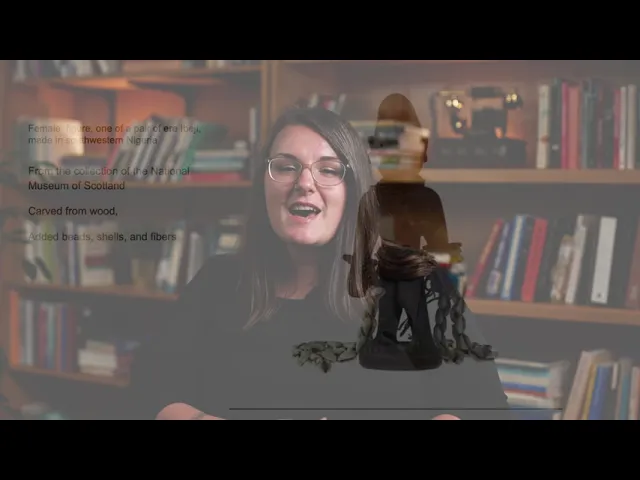
[Music] this week for visual art we're going to look at some work from the yoruba peoples of nigeria i'm really excited to share the area beijing figures with you because i think they're some of the most fascinating and beautiful objects we see in europa culture nigeria or officially the federal republic of nigeria is located on the continent of africa in the west it's bordered by cameroon niger and benin and has a southern coast on the gulf of guinea and the atlantic ocean there are over 250 ethnic groups that speak more than 500 languages in nigeria
each group has specific cultural practices and values about 211 million people live there making it the seventh most populated nation in the world nigeria has huge populations of practicing christian and muslim believers and there are also elements of traditional indigenous religion and cultural practices integrated into their daily lives prior to british colonization in the 19th century there were indigenous kingdoms and states from around second century bc many periods of political change occurred before nigeria became a fairly stable democracy in 1999. currently as many as 40 percent of nigerians live in economic poverty and the republic
is still considered to be a developing nation but their economy is also considered to be in a state of economic growth the largest city in nigeria lagos is the second most populous city on the continent of africa and it's a major economic focal point of the country itself and the region in general it's a major contemporary metropolitan area with wonderful examples of architecture and really thriving cultural and educational centers within the wider country many people live in large urban centers and regions and a significant population are still in rural areas small towns villages the three
main ethnic groups in nigeria are the hausa the eurovo and the igbo culturally something all these groups have in common and this is common for this part of the world in general is how faith and family drive lifestyle commitments and cultural practices nigeria has become an important center of art with wonderful examples of contemporary visual and performing arts that show up globally however much of the visual art that's produced in west africa is specific to watershed life moments and coming of age ceremonies as well as daily ritual and belief structure such are the erie ibegi
figures which are commonly known as ibegi the words translate eerie sacred image eb born and agey ii something really fascinating about the yoruba people is that they have one of the highest incidents of twin birth in the world somewhere around 40 twins are born for every 1 000 births this rate is not associated with any fertility drugs or in vitro procedures that you might think of in the west it's just part of the way the population's developed and it's comet been common for most of their documented history culturally twins are really powerful and significant and
they're thought to either bring double the blessing or double the misfortune to a family in many countries and cultures of the world children and family lineage are terribly important this is definitely the case in nigeria and in most parts of africa a thriving family legacy is one of the biggest values of the europa people the area baiji figures have been an art form of this people group for a long time they're not made for the sake of decoration like some art forms they're strictly utilitarian and ritualistic they're made when a twin birth occurs and one
or both babies die historically a mother would seek counsel in her community and be led by an elder to connect with a craftsperson who would carve the ibeiji from wood then the mother would care for the figure as if it was the child themselves washing bathing dressing sometimes wearing the figure on her body giving the figure gifts they don't look like babies but they take on cultural identity markers of the people group as idealized adults with body elements representing robust and healthy people in the prime of their lives this is a nod to that value
of fertility and family lineage it expresses the potential of the child if they were to have lived to that age the europa believe that the deceased child or children will be cared for in the spiritual world or their afterlife by a spirit mother sometimes the figures are touched and washed so much that their facial features rub away these figures are totally different in terms of their sensibility than other figurative sculptures you might have seen in a western context like for example classical greek or roman statuary they're not trying to represent a human figure like a
photograph or a replica of a person it's really important to remember that the formal elements and features of the pieces are cultural expressions that are purposeful and laden with meaning and significance for example the hair is always an important part of the figure and it's connected to the cultural importance of hair which speaks to community status of a person their age and time of life and conventions of beauty in the culture their eyes are large and exaggerated because they symbolize wisdom and knowledge and a belly that looks rounded and swollen and breasts that are larger
and distended speak to fertility and the ability to nurture which is so important to this culture that prizes children and does everything possible to ensure family thriving lineage and ethnic heritage in contemporary context this practice of commissioning figures is somewhat less common but you sometimes still see mothers doing the same nurturing or of representing of a lost twin by substituting a manufactured doll instead of a commissioned car figure i came to these works when i was developing a collection of african art pieces gifted to the college i used to teach at the cj hudgens memorial
african art collection at houghton college the collected works included ibaji figures that were stunningly carved with beautiful details and the quefura the figures had a beautiful patina from being rubbed and touched so much the facial features had almost disappeared because of how much the objects were loved through cleaning and caressing it made me think about how much i love touching my own babies faces when they were small and the delight you can take in holding and caring for a baby and their basic needs i felt a lot of sympathy for the mom who lost her
babies in this case there were two figures which meant that both twins had died i felt like this woman was both in mourning and in some way the figures must have really helped her cope so what does that mean for our scripture this week blessed are the poor in spirit for theirs is the kingdom of heaven based on what we understand about the cultural values of the yoruba we know they value family and children so highly their own value as a family unit and as individuals and the ability to produce and raise children brings status
and notions of wealth are strongly tied to the ability to have a family less so money and possessions i think when we look at what christ is saying in the beatitudes he's calling us to live in empathy for others if we can imagine that a child is the most important gift to someone losing that gift would be so devastating yet christ is saying that those who are poor in spirit or if you look at the same verse in luke just plain poor altogether theirs is the kingdom of heaven i think that the europe is showing
values of nurturing and caring and that wealth is not always synonymous with money but rather family community and children this feels so in line with christ's ministry the practice of commissioning or acquiring a figure that you care for as you mourn as you have possibly the poorest spirit imaginable but to still practice faithfulness to that child and to gain some comfort from caring for that object knowing the spirit of the child is nurtured even after their passing that's just a wonderful notion in my time in west africa serving and doing research in the country of
sierra leone i had my notions of wealth and value flipped radically because i noticed how much people prize relationships over efficiency and money to the point of losing out economically to help someone in your family or community i would say the yoruba people are showing us those values in this artwork that people are of the highest value and even if you lose what you value in life you will see god you will be comforted if you're faithful that's the upside down kingdom jesus came to realize blessed are the poor in spirit or blessed are the
poor for theirs is the kingdom of heaven