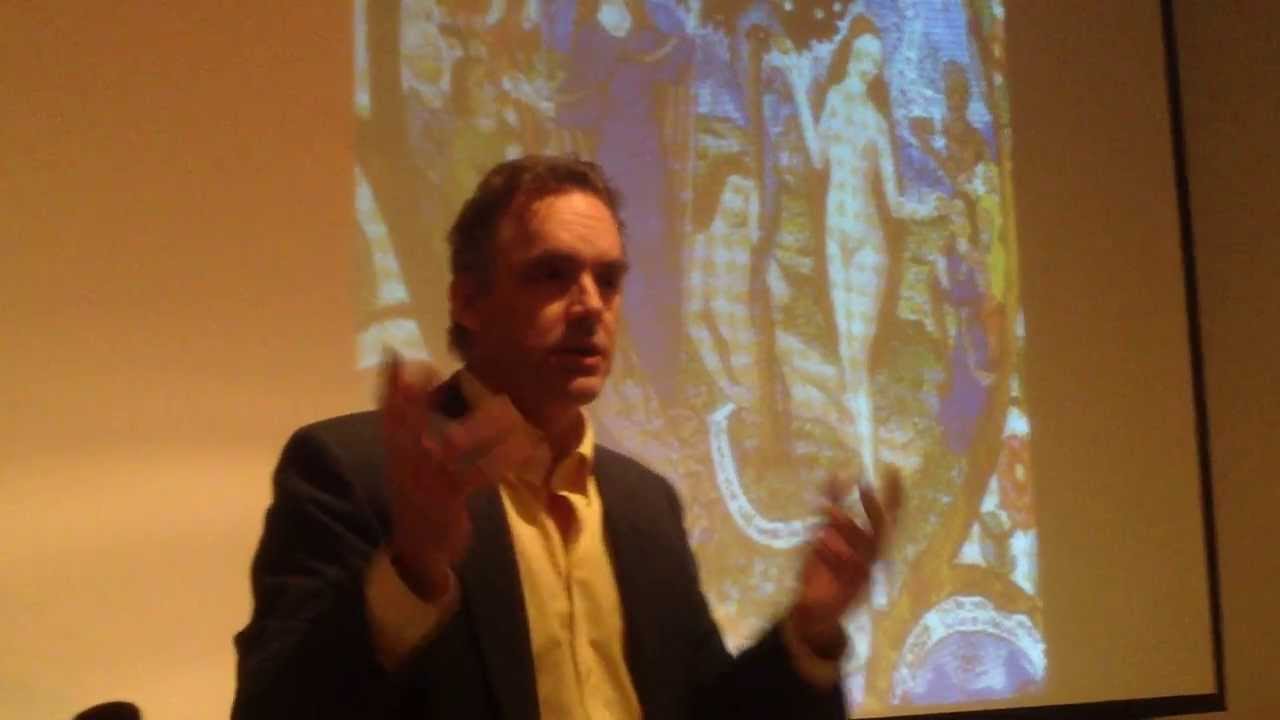
Today we're going to talk a little bit about I guess you could call them the underlying structures of perception I picked this image it's a very old image it's it's an it's an image that that portrays man being cast up on the beach by a whale it's Jonah biblical figure and in this in the story of Jonah Jonah was out on a rough ocean storm and he had been commanded by God To do something which he was ignoring and uh the storm was sufficiently rough so that he got cast overboard he was eaten by this
giant this is a whale as far as the medieval medieval people were concerned it's obviously not what we would think of as a whale but they didn't know much about whales anyways he was swallowed up by whale and then cast back up on shore a number of days later it's a death and rebirth story and the reason I use it as An image is because it represents something of psychological import that you're all familiar with but that you might not know that you're familiar with symbols are often like that um a symbol often stands for
something that you know but that you don't know that you know there's lots of things that you know know that you don't know that you know almost everything is like that in fact and it's rather obvious if you think About it because if you were transparent to yourself and you knew everything you knew you wouldn't have to study anything about psychology because you'd understand yourself completely and we understand ourselves poorly and so we have to study ourselves as individuals and then you know as as as phenomena in the world as as other people and and
as mammals and as animals and as living things and as political actors and so on just to get some minor Notion of what's actually going on and what that means in part is that you're more complicated than you can understand and when when you hear say psychoanalytic thinkers talking about ideas like the unconscious the unconscious is actually a representation in some ways of the fact that there's far more to you than you know about and that what that means also is that there are different kinds of unconscious and we certainly know that to be the
case There different kinds of memory for example so a lot of your procedural knowledge is unconscious and so your procedural knowledge is what allows you to do things like ride a bike or walk for that matter because you don't really know how you walk you it's actually a controlled fall so you lean forward and then you use your legs to stop you from falling on the ground it's it's it's it's encoded in your architecture rather than something That's apprehensible to your conscious understanding now there are lot lots of there are lots of phenomena that are
procedural and unconscious and then there are sort of borderline phenomena that you have some idea about that you can represent but you still don't completely understand so those sorts of representations tend to be more imagistic and those are the sorts of things maybe that pop up in your fantasies and your dreams and those Are also the sorts of unconscious sources of knowledge that allow you to understand say complex work works of literature or art that draw their meaning from multiple sources simultaneously and attempt to inform you at a deep level about how things are connected
and how they're different now this particular image is a journey to the underworld image and that's a very very old idea Journey to the underworld um it's it's maybe the oldest myth it's One of the oldest mythological ideas or one of the oldest archetypal ideas and the underworld is it's a difficult it's a difficult phenomena to grasp although you you certainly encountered the concept particularly in movies so for most of you how many of you have seen all the Harry Potter movies right so right of course and so in the second movie I believe it's
the second movie where Potter encounters a basilisk underneath Hogwarts is that Right is that the second one yeah well that story is a journey to the underworld story and the the the architectural setup of the of the of the movie my architectural setup I mean the relationship of Hogwarts the castle to the underground structures is a symbolic representation of the representation of Consciousness embedded in culture and so that would be poter and his friends embedded in the the the realm of magical knowledge so to speak that's outside of Them and that's that's represented by the
castle which is you know a a a it's a representation of knowledge cast in stone so that's a form of memory to cast something in stone and so Potter and his friends are being enculturated in this enclosed environment and this safe enclosed environment it's like a university it's like the university more on the other side of the campus than on this side for for various reasons now underneath the the well in the Background of course in the Potter series there's a battle between good and evil going on and that's also an extremely old archetypal idea
I mean that's an idea that's probably as old as human beings and that's partly because human beings are very strange creatures and they're capable of very uh what would you call profound acts of deception and one of the things that separates human beings from most other animals is our capacity to use deception And it's associated with our imaginativeness right because we can imagine a variety of alternative potential realities and move towards them that opens the door for us to deceive ourselves and others because we can replace our accurate vision of the world in so far
as it's accurate with whatever vision and representation we wish to choose one of the things you find in childhood development for example is that the smarter the child The earlier they learn to lie and and it's an offshoot of the ability to use fantasy and so the the idea of good versus evil part comes out of that to some degree because if you're dealing with people you're always dealing with phenomena that can trick you in some way they can represent reality as other than it is and that that's a tremendous problem for human beings because
it makes other people extremely difficult to figure out now if you're honest and Straight forward then you're easy to figure out because you don't have to be figured out I can just take you at your word which means you'll tell me something and it'll be relatively straightforward I'll be able to understand it and then you'll go do it no problem I don't have to know anything about you on the other hand if you don't do things according to what you say you'll do then you're a bottomless pit of incomprehensibility and God only Knows what you're
going to be up to and so that that's an archetypal problem for human beings and that's the problem of having to deal with the latent deceptive capacity of other people and of course of ourselves so that's all going on in the background of the Potter series but underneath the castle for example there's remember what's under the castle in the second in the second film what is it it's it's a basilisk right yeah and what happens when you look at a Basilisk Stone right and so what what might that mean if you're thinking about it intelligently
say what what phenomena might that that represent what happens to prey animals when they encounter a predator freeze they freeze EX exactly yeah so it's a representation of the fact that there are certain classes of phenomena that will freeze you on sight and you freeze because there are parts of your brain that respond to phenomena in the external world as if you are prey And the reason for that is well per first you are and second from an evolutionary perspective your your ancestry going back say tens of millions of years is an ancestry that was
composed of predecessors that were continually praying upon and we have entire systems in our brain that react to the class of potentially predatory events now for human beings that system has differentiated cognitively so that many of the things that we would Experience as predatory threats in the modern world don't come in the shape of say crocodiles and and bears and you know giant cats and so forth the sorts of things that would necessarily prey on you in the night but they're analogous in that the outcome is the same you can be prayed upon by many
things you can be prayed upon by you know a corrupt corporation and so it's perfectly reasonable to symbolize the actions of Of a corrup corporation as a form of predation and also to categorize that even more deeply as a reflection of the underlying consequences of the fact that people can deceive each other and those sorts of representations get deep very very rapidly but they're they're Act active and living representations in that they still represent something that's profoundly true which is not so much what things are in and of themselves which is what science does But
what things are in relationship to you which is more like what things mean and things generally have a motivational or emotional meaning and that meaning is generally quite tightly tied to the necessity that you have to survive and to thrive and to you know to find someone to be with and to reproduce and all the darwinian things that you're supposed to be up to so a lot of these more archaic categories are they're meaningful categories they're categories Of meaning that's that's a that's a perfectly reasonable way of looking at it now in the Potter situation
which is related to this image the one that's up here the the idea is that everything that's stable rests on something that's unstable and dangerous and that's underneath in the Potter series and then the other thing that happens continually in the series but particularly in the second Episode particularly in the second episode is that Potter has to go down beneath things to encounter something that's terrifying and deadly that's that's actually praying on his friends and on the community so it's uh it's very much like for example The Hobbit having to go off and and and
uh steal treasure from from smog I think the dragon's name is and except that in the in the Potter sequence the dragon which is the Basilisk they they equivalent It's the same thing as this um in the in The Hobbit the dragon Hoards gold whereas in the Potter representation what does the basilis guard what's it what has it captured it's the little redheaded girl Jenny right Jenny Jenny right and that's a very that's a very old story now now Potter's kind of in love with her right now I mean it's it's they're young and sort
of platonic but you know you can see the relationship sort of burgeoning Now he has to confront this thing that's terrifying that exists underneath everything in order to free this virginal figure from the clutches of something terrible in reptilian now it's a very very interesting story that and what it means a whole variety of things and what it means to some degree is that uh a male human being can't really become mature until he confronts the terrible things that lie underneath the Civilized veneer of society that's one Thing means uh another thing it means is
that it's the capacity it's the capacity of the male in that situation to do that that makes him attractive enough to wake up the females that he might be associated with so that's like a Sleeping Beauty Motif um it has e e e evolutionary Echoes because much of what we've battled with for the last 60 million years say because I think you can trace the development of our cognitive structures Quite straightforwardly back 60 million years there's been an endless battle between human beings and predators and many of those Predators were reptilian and so you know
were the result of a very very long battle between mammals and reptiles and in our case particularly it appears that part of the reason we evolved our tool using capacity and our great capacity for vision was because our ancestors were continually prayed upon by predatory Snakes when they lived in trees and that's a long time ago and so these these symbolic representations are unbelievably archaic and they're kind of as archaic as the underlying biological systems in your brain that that provide you with motivation and emotion and those are extremely old you share those with well
you share those with any animal that you have any hope whatsoever of understanding at all and that even means lizards you know my daughter had These lizards that were called I can't remember unfortunately they're a desert kind of lizard and they make a good initial pet but they're they're very F little creatures cuz they they you know they're very lizard likee being that they're lizards and they have points all over them and uh if you put them in water they puff themselves up which is quite fun and then they Zoom around on the water but
more importantly they like to Stack on top of each other they're very very social and they're friendly and which is not exactly something that you'd expect from a lizard but but my my point is that even something that's as distant as that from you in the evolutionary hierarchy shares enough commonality of biological structure with you so that you can understand a fair bit of its motivation so for example it's pretty easy to tell with when one of those lizards even though they're Basically friendly gets angry because it'll puff up and hiss and you know right
away you don't have to have a discussion with the rest of your family to figure out that that's an angry lizard right you it maps onto your body immediately and you know the same thing applies to snakes it even applies to insects and lots of insects have developed the kind of warning behavior that will immediately signal to you that you're about to be bitten or or it's Usually bitten with insects so so this is all to say that there are levels of understanding that are underneath say your your your normative mundane day-to-day comprehension that inform
everything that you do with deep levels of meaning and and lot a lot of the activities that you pursue that you might regard as entertaining actually draw on those representations and you find them entertaining because they're actually Deeply meaningful now the idea that a man can be swallowed or a human being because there are myths like myth of prapan where the protagonist is clearly female where they the there's an underground journey and then a reemergence and and that's the journey to the underworld that's the journey that Harry Potter undertakes continually by the way throughout the
Potter series um the underworld taking different forms um as the as the series progress Um now that's also a death and rebirth idea and and that's that's a very old and profound idea it's actually one of the most profound ideas that human beings have and it's the idea that um you will spend time in your life underground now you might think what does that mean well it means what the Potter movie the second Potter movie was trying to represent which is that there will be times in your life where you are faced with things that
will terrify you Into paralysis and that will take you underneath your normal set of assumptions because when your normal set of assumptions are functioning you don't end up facing something that's terrifying enough to to freeze you when your normal set of assumptions are working the world stays happily predictable around you and most of the time that's where you are and that's the normal world but that's blown apart whenever something that you're Attempting to do fails in in a dramatic or less dramatic way the more dramatic the way the deeper you go into the underworld and
the underworld is in some sense the substructures of your presuppositions now you you know this already because I don't suppose there's a single person in here who hasn't spent some time in the Underworld so to speak because this is what happens when something terrible happens to you unpredictable and terrible and you know There's sort of classic categories of events that send you to the underworld you know um the death of someone you love a serious illness of some sort either for you or for someone you you love um the death of a dream of some
sort you know so you've got some goal that you think is really important and all of a sudden you find out for one reason or another that there's just no way you're going to be able to pursue it um betrayal that's a really good one People that's a really rough one and that'll send you for that'll throw you for a loop for sure so they're all they're all elements of the part of the world that you can't control that in some sense always remains beyond your control that has in some sense a predatory relationship ship
to you because it can devour you at least metaphysically and when that happens you go somewhere and the place that you go is very dangerous it's underneath Everything and maybe you come back out and if you come back out what that means is that you've reconstructed your erroneous presupposition so that you can function once again in the world and but maybe you don't maybe you don't so people who have post-traumatic stress disorder for example they go into the underworld they just stay there you know and if you're if you're chronically depressed or if you can't
get over your grief or if you're in a state of Continual anxiety and upset or if you're nihilistic for that matter you exist essentially in an underworld domain because you can't master the perceptual apparatus the culturally informed perceptual apparatus that would help you um Orient yourself in the world so that the things that you want to have happen and that you need to have happen actually happen so that's what that picture means it also means at least in Principle that you know people have the capacity to die and be reborn at different levels of analysis
so you know there are minor disappointments that you encounter when you have to drop some presupposition that you have and let it die and then put a new one in its place and that's painful but it's nowhere near as painful as holding on to the things when they don't work because then you just end up wandering around as sort of a clattering collection of dead Presuppositions and you know nothing that you ever want will happen under that circumstance because you're you're armed with tools that don't fit the world and you know when you try to
apply them the world won't do what you want it to do and then that's endlessly anxiety-provoking and frustrating so part of pain is is part of the price that you pay in some ways for being updatable you know because the world Transforms around you and as a consequence you have to be able to transform with it otherwise it runs ahead of you and you get left behind and you know that happens to people to some degree anyways as they age that's actually one of the evolutionary explanations for why people die CU it's a mystery right
there are elements of you that are Immortal you know the the cells that that that that give give rise to you are Immortal they're you know the DNA that produced you is at least 3 and a half billion years old it might be older than that so structures can maintain themselves over unbelievably vast expanses of time so it's not self-evident why human beings have to die but we do and we die at about after you're done being a grandparent is kind of when you're when you're done and the the hypothesis is is that at that
point in some sense it's too costly to keep you updated and you have to be Replaced by a younger version which would of course be your grandchildren or whatever you know you've sort of exhausted your plasticity and flexibility and uh then it's cheaper just to replace you than to update you so that's kind of a drag but yeah all right so here's a funny question for you this is the question that scientists are always devoted towards answering what's the world made of well That's a complicated question I mean the simple answer is that it's made
out of matter um and that matter is made out of atoms and that theory was originally formulated by democrati but democrati didn't exactly say that the world was made out of atoms he said the world was made out of atoms and space and that actually happens to matter because the way that atoms are arranged in space gives rise to another property which is information and so if you have Adams in Space you also have information and you can think of the world as being made of information just as easily as you can think of it
as being made of matter now in fact I think that and and you know I'm I'm not alone in this hypothesis that it's actually more useful to conceive of the ground of reality as being something like information rather than being something like matter but we don't have to discuss that at length at the moment what we'll say instead is That one one way of looking at the world is the materialistic perspective and the materialistic perspective is a very powerful perspective and it's basically been dominant for about since the time of G Galileo that's that's about
when that perspective got thoroughly going and and for many reasons bacon and dayart as well were major players in the establishment of the materialistic framework and it came about because in many ways because people were suffering From their inability to understand objective reality and so and you know we still suffer from that because there are all sorts of diseases we don't know what to do with and we age and you know things don't work out exactly like they're supposed to and so we pay a big price for our ignorance and so we're motivated to overcome
it and one way we have overcome it was by developing materialistic philosophy and that materialistic philosophy enabled us to Specify the structure of certain elements of the world and then to learn to predict and control it at least to some degree now you know you learn to predict and control something and sometimes you generate more monsters doing that so that's problematic but all things considered I think it's a lot better to live now than it than to live 3 or 400 years ago so or maybe even 30 years ago for that matter so it looks
like the whole materialistic thing has Been doing a lot of good for us but there it also has some serious problems and the problems have to do with another fundamental problem that human beings have to solve which is what you should do about what is and because human beings are Dynamic and active creatures and so we do not only we're not Machines of representation we don't just care what the world is we care what you should do with the world and the reason we care for that well the fundamental Reason if you're thinking about it
from a scientific perspective is essentially darwinian and I think that you can you can imagine the conflict between the moral worldview and the materialistic worldview as a battle in some sense between Newton and Darwin so Newton was the was the author the fundamental author of The idea that the world was made out of material and that it operated like a machine you know which was a pretty powerful perspective um That perspective came about during the time of clocks you know when when when Europeans in particular were starting to build things that would function in a
very predictable manner once they were set in motion and so Newton in some sense was influenced by that and assumed that the entire Cosmos could be understood as a deterministic machine um and that that it would be ultimately predictable and controllable and in in a famous statement and I I don't think This was Newton although I can't remember might have been decart um anyways the idea is that if you knew the position of every subatomic or every atomic particle in existence if you knew the position and the momentum of those particles that you could then
predict the entire outcome of the future it was strictly deterministic and the only thing that stopped you from being able to describe everything in terms of Machinery was your ignorance it was There was nothing at the bottom of the cosmos so to speak that was fundamentally unknowable well that turned out to be wrong it wasn't really discovered to be wrong until you know the first couple of Decades of the 20th century but it definitely turned out to be wrong we now know that in under no conceivable conditions could we gather enough information to predict the
outcome of what appears to be a relatively unpredictable Cosmos there Are levels of resolution that remain relatively constant and that you can manipulate but our hope for toal knowledge is is is gone and that was mostly a consequence of the development of quantum mechanics and the quantum theories have never failed in experimental tests they're the most powerful theories that human beings have ever designed so in some ways they seem well they're probably not final but they're they're pretty final So now okay so so that's sort of the materialist end of things now now there's a
darwinian end of things and and the reason I'm telling you about both of these things is because part of what we need to solve in order to progress properly with this course we need to solve the problem of exactly what constitutes truth now the first thing that I might say is that truth in some ways whether or not something is true is a question that's sort of like Whether or not a tool that you have does the job that it has it's not so much a question about the ultimate nature of reality because you can't
get a truth that completely informs you about the ultimate nature of reality so you're sort of stuck with partial truth and so then you might ask well how do you tell a useful partial truth from a nonuseful partial truth or maybe a partial truth from a lie or from fiction it's very complicated to do that but one Way you can progress towards that is to start thinking about things in terms of their tool like capability and that's a pragmatic approach by the way from a philosophical perspective the pragmatists who were very influenced by Charles Darwin
by the way came to the conclusion at the beginning of the 20 Century that truth was bounded by claims of practicality so if you're trying to determine whether a statement is true the implicit question That goes along with that is true in relationship to what end so and and the question then is sort of like is your tool that you're using to represent the world or to act on it good enough to do what you're trying to do with it and then if it's good enough then your claim is true enough now this is tightly
tied to darwinian philosophy and the pragmatists recognized this right away the pragmatists were American group of Philosophers who worked on the East Coast particularly in Boston and they were they immediately took darwinian the darwinian hypothesis to their to their to their heart so to speak because the darwinian hypothesis is also pragmatic the darwinian hypothesis says whatever reality is is and also becomes so it's something but it's something that's changing too and changes in a way that's actually not predictable it's it technically it's not predictable it's Like the stock market in that way there are periods
of time over which you can make predictions but if you wait long enough no matter what you think you're going to end up wrong especially given what knowledge is for a human being because your knowledge is bounded you know and so the way the darwinian process solves that is by death essentially things that aren't good enough to solve the problem that currently presents them presents itself To them either die or fail to reproduce and to the degree that organisms can come up with truth claims that are sufficient than they live long enough to reproduce and
then the the Next Generation faces the same problem and that's always the way it is is that truth chases a reality that's fundamentally unpredictable and that's transforming constantly now the reason the reason I I want to tell you that it's an important thing to understand Because I'm going to make a claim here that the ways of looking at at the world that are more mythological than material are also real ways of looking at the world and it's not what people generally think because you think about fiction as not real and underneath fiction is mythology and
religious claims and that sort of thing that's the domain of fiction and mythology and we don't think about that as real but that's because we think about what's real from a Newtonian Perspective and not from a darwinian perspective from a darwinian perspective and this is also a claim that nche made n said truth serves life but what Darwin would say is you can't Define truth in any other way than that which serves life that's it you're not going to get past that there isn't a truth past that the truth as far as a bounded living
organism is concerned and that certainly means us is the the body of knowledge conceptual and Embodied that best enables survival in the face of continual transformation and that's that there's nothing under it now as soon as you know that then what happens is that it turns out that the things that mean things to you are also real now science is a funny business right because what science attempted to do and and for good and for very useful reasons was to strip everything subjective and subjectively meaningful off the picture of the world right so if You're
a scientist you want to be objective and part of the way you do that is by trying to suppress your own subjectivity in the search for the obje truth but also you do that by relying on other people's observations so we kind of make a deal and the deal is if I see it and can describe it and you see it and can describe it and then a bunch of other people do the same thing and we come to the same conclusion we're going to treat that as real and that's useful It's useful because it
it's it's useful to specify things precisely and to put them in the appropriate categories and in a sense that's what science does is that it continually strives to differentiate differentiate things and put them in identifiable categories and that means that increasingly we're able to use what we categorize as knowledge to help us confront the world so you know it's a it's a great it's a great process it's a brilliant process and It's even more remarkable because relatively stupid people can do it because it's a it's algorithmization with the method and sooner or later you'll produce
new information and and that's that's that's a great thing you know it's like a science is like a factory that produces knowledge so well so that's wonderful but what's not so wonderful about it arguably is that it's in some sense War our our concept of what constitutes Reality and it's never really solved as far as I can tell this conflict between a Newtonian perspective on what's real and a darwinian perspective on what's real and as far as I can tell Darwin trumps Newton and that's true if you're a biologist for sure because there isn't anything
that's more true that sits underneath biology than the theory of natural selection and that's partly a philosophical claim and the claim is because you can't represent all of External reality with ultimate accuracy you're going to fail and everything that's bounded or even everything that's not as complex as the thing that's trying to be represented is going to fail so how do you do with how do you deal with that you generate variations and it's some has to be somewhat random because you don't know what's coming you Generate random variations and then hopefully one of those
variations will work in relationship to whatever is Coming and so it's it's also a kind of Truth CLA that's an embodied truth claim right you carry the fundamental truth of your existence in the shape of your physiology so you know earlier claims of philosophical truth were mostly disembodied you know there was some implicit idea that the Consciousness or the soul was more real than the body and well it's nice to think about that in some ways because it opens the door to The idea of things like immortality but it doesn't seem to be very it's
hard not to associate that with a dream all right so category systems when you encounter something that that frightens you your body categorizes it and it categorizes it as something that presents a danger or a threat to you and danger is the probability that something will damage you like it'll be too loud Or too hot or too cold it'll damage your sensory systems or it'll directly pose a threat to your physiological or psychological integrity and so you're designed so to speak to protect yourself against that you feel pain for that reason and instead of pain
you also feel anxiety which alerts you to the fact that you might feel pain and should do something about that you should freeze or you should run away and so for example what what that what emerges from That is the beginnings of a natural category system so you could say well here's one useful category that is the category of all things that you should freeze at or run away from and that's a deep C it's a biologically predicated category it's also category that has meaning right because the meaning is what you should do when something
like that shows up it's not the meaning isn't stripped out of the category at all it's actually fundamental now it turns out That a lot of our perceptions when when people think about the way they perceive the world they think well out there are a bunch of objects and you look at them and once you look at them you see them and once you see them you figure out what they are and then you evaluate what you should do and you progress on that basis right it's so object perception cognition emotion action well the problem
with that is it's wrong and the first reason it's wrong is because Things don't exist out in the world as self-evidently separable entities partly because everything can be segregated into smaller entities and every entity can be aggregated together with larger entities and so the boundary that defines something as a self-evident entity is no by no means clear so part of the way that your body deals with that is by categorizing things with regards to their immediate impact for you and so when you look at something so Let's say you're looking at this and you say
well that's a bottle and so you might ask well what is your brain doing when you're looking at that and the answer is it's molding your body to prepare to pick that thing up and that's how it understands it so your eyes perceive a pattern that's constant across some duration it's not made of smoke it's made of something that lasts so there's a pattern there a bottle shaped pattern that lasts across time You you have some sense of what it is having interacted with these sorts of things before but also its shape obviously indicates that
it's a grippable thing and so what that means is that when you look at it your eyes activate your motor cortex directly even before you see the object like before you form an image of it in your imagination your retina the the pattern on your retina activates your grip right-handed or left-handed whichever Hand you happen to be and part of what you're seeing when you see that bottle is what you would do with it if you were interacting with it so you see the manner in which you would interact with things and that's the case
for virtually everything that you see so for example when you look at a chair your body prepares to sit in the chair or maybe to stand on the chair if you're going to change a light bulb or we know when you look at your computer you see the Keyboard because that's the thing you move your fingers up and down on and so your perception is tightly tied to the implication of objects for Action immediately now you might say well that's not real that's not the reality of it the reality of it is the objective thing
but as I said already it depends on how you define reality you take a newon Newtonian t on it or a darwinian t on it and from the darwinian perspective the implication of something for Action Is actually its primary meaning which is don't stand around and contemplate a tiger while it's trying to eat you because the fact that it's trying to eat you is more important than the fact that it's a tiger and if you don't figure that out quick then you're not around anymore and so much for your claims to truth that's just you're
just gone that's an error right and whatever was in you that enabled you to make that error is not going to be transmitted to The Next Generation or at least hopefully not so there's a domain of categorization that has to do with the meaning of things now most of what the psychologists have dealt with who are clinical psychologists is actually the domain of categorization that has to do with the meaning of things and it's actually because as far as you're concerned in your life as a as a human being you live inside a network of
Meanings of things right so for for example when you look at your mother you're not looking at her at her as an object and then attributing all sorts of meanings to her you see the meaning of your mother right away and that meaning is multi-dimensional it has a very long history and it affects you directly at a physiological that maybe you hate her and so the sight of your mother makes your heart race and your and your brain produced cortisol because she's Categorized as unpredictable and chronic threat that's a standard thian situ a yeah no
one would laugh if there wasn't sometimes that was true so those are Freudian slips by the way when you discuss something like that and people laugh then that's an admission on their part like an deeply unconscious admission on their part that there is truth to the statement and it's also a truth that is somewhat painful to admit so you can tell that you can tell that When you're listening to comedians they do that all the time right to tell you something that's absolutely brutally evident that no one will admit and everyone laughs and that is
a Freudian slip technically because Freud often listened to the sorts of things that would make his patients laugh or make an audience that he was speaking to laugh because that would give him some insights into what they were repressing so to speak and what they would allow to Come to light so and and jokes are often about things that are taboo right I it's hard to make a joke about something that isn't tabooed so all right so I've kind of made a classification structure of these two different ways of looking at things there's a meaning
centered way of looking at things and the meaning is then the implication of the thing for action on your part and there's a more materialistic centered thing which is Sort of like the world as it exists if you weren't here right that's that's the fundamental hypothesis of science is that we're there's something around that would be here and look the way it does look now if none of you were around and you know it's possible that that's true and um and it's also possible that it's it's possible that it's true it's possible that it's not
true but most possible is the fact that it's true in a Way that we really don't understand because the existence of things the way we perceive them is clearly dependent on our existence as a perceiver and so what the nature of the world would be with there was no one around at all to perceive it if there was no such thing as Consciousness is like that is a completely unsolved problem so maybe it would be like a field of Quantum potential or something like that but but it isn't even possible to really Understand what that
means so so now having established that having established I I'll give you another example of it before we move on so I said for example that when you interact with objects around you you're not really interacting with objects it's more like you're interacting with tools because your primary concern is well what the what's the world in relationship to me what do I have to avoid you know if I Want to get to where I'm going and what can I use to further my Pursuits and so you're like that deeply that's why human beings are tool
using creatures right we have hands they manipulate the world and those hands are they're they're built into our cognitive architecture like it's not like our brain is separate from our hands far far it's it's it's it's very opposite to that we wouldn't have the brains we have if we didn't have the hands we have that's why things like Octopuses by the way or octopi are very intelligent they are even though they're invertebrates they only live a couple of years so they can't learn that much but they're extraordinarily intelligent it's partly because they're tentacled and because
they're tentacled they can grab things and manipulate them and so you know they've developed an intelligence that's identifiable to us because we have little tentacles on the ends of our hands and you know we're using them to Fiddle around with the world all the time so now there's the perceptual reality which is that we know about already that when you look at something and we track the way that you're interacting with we know that one of the first things that happen happens is the the relationship between the perceived object and your body is established very
rapidly okay because You want to map the object onto your body so you know what the hell to do how to orient yourself so that you're safe and productive at the same time there's a guy named visual what his name JJ Gibson Gibson who who was a a psychology psychologist of perception who operated in the late 70s people thought his theories were they weren't behavioral that's for sure they were of a different classification or category and Gibson Also made the first sort of claim that what you saw in the world were things like tools he
called them affordances and so for example when you approach what you would call from an objective perspective a cliff Gibson would say you don't see a cliff you see a falling off place and you might infer Cliff but you see falling off place and if you think about it again from a darwinian perspective of course you see falling off place that's why you know you you Might shrink from from a precipice is your your whole being perceives that as a place that would instantly make you extinct it's not a secondary derivation from your analysis of
a set of objective facts it's a primary perception and it has to be because you better move quick if you're too near a cliff you don't have any time to think the same thing occurs when maybe you're being you know potentially struck by a snake you have circuits in your brain that will see That snake and make you jump way before you know it's a snake because sitting around standing around waiting for the image of snake to form in your Consciousness means that you've been bitten five or six times already because you're just not fast
enough to see and then move you see move and then perceive and that's what keeps you safe and so a lot of the a lot of what you perceive in the world are the meanings that you map onto your Body so so then you can think what human beings have done in response to this bifurcated way of perceiving reality is we've developed two different systems of classification to deal with it now for most of human history we only had one and the one we had was basically the meaningful system it wasn't the scientific system right
we didn't get around to figuring that out even the ancient Greeks and the Romans the Greeks In particular who were unbelievably intelligent really never got around to positing something like an objective reality and if certainly the Romans didn't there was no science science only evolved in Europe and only in you know the late 1500s very strange and it's very difficult to understand so we've been elaborating out this materialistic Viewpoint for only about 500 years it's not very long the other Viewpoint that's the natural habitat of humanity and That's the Viewpoint that's made up of all
the stories that people have told about themselves in the world since the dawn of human consciousness and that's really those are the knowledge forms the stories that actually constitute the base of culture because culture is not so much about what the world is and how to perceive it as it is about how you should act in relationship to the world and so when you read fiction and when you talk to each other endlessly about What your friends are up to and what their friends are up to and what they're doing on Facebook and and when
you go to movies and you watch actors act out roles and and you know when you do everything you do to examine other people around you you're embedding yourself in this ancient culture that's there to tell you how you should operate yourself in the world what you should do because that's a primary question you need to know what to do human beings Need to know what to do because if you don't know what to do well that's a very unpleasant emotional state and that's partly because it indicates that you're not well adapted to your current
circumstances you know if you just stand around long enough not knowing what to do you'll age and you'll die it's not an effective way of dealing with the world you have to be oriented towards something and the the job of culture in part is to tell you to what you should Be oriented and that's where the rubber hits the road with regards to psychology because especially in its clinical variance and personality theory has to be an element of clinical personality theory has to be a subelement of clinical Theory what psychology has to contend with as
I mentioned in the first lecture is not only what you are but what you should be and the reason for that is you when you're talking about a human being You can't separate out the bare facts that present you about the person from the ideal we do this all the time what's mental health well you could say well it's the absence of mental illness well you know really if someone tells you that you should just stop the conversation because all they've done is solve one problem with an equally large problem there's no progress there it's
it's a kind of a smart aliy thing to do you know it it sort of means go Away and don't bother me with your stupid question mental health if if you want to understand what mental health is it's because it's very difficult to get people to Define it you have to watch how they act when they're talking about such things as mental health because then you can derive some sense of what they actually understand about it or presume about it instead of what they just say about it right so if you look At how societies
use the idea of mental health they partly do use it normatively and if it's used normatively then describing it as the absence of mental illness actually works you say well you're healthy to the degree that you're normal and so extremes outside of normality start to border on pathology but there's obvious limitations and problems with that approach right because we don't think the average person is the best looking Person and we'd assume that attractiveness is a is an ideal towards which we might all at least Aspire and it turns out there's deep biological reasons for that
because most of the things that men and women find attractive about each other are they find attractive for deep biological reasons like symmetry for example which is an indication of sort of optimal biological development um for men for women looking at men it's shoulder to Waist ratio and for men looking at women it's waste to hip ratio which should be about 68 which is pretty damn precise and you know men are always Computing that when they're when they're looking around so so so um you can't talk about what constitutes Health by merely making a normative
claim you also have to take into account something like deviation from an ideal and that's a weird thing because of course the ideal doesn't Really exist that that's what makes it ideal but you can't get away from that problem if you're going to do anything serious about psychology because implicit in the idea not only of mental health but of Health itself is the is the question what constitutes an ideal human being and you might think well that's not so relevant you know why would that be relevant in the scientific Pursuit and I would say well
as people we're not only ever Engaged in a scientific Pursuit right we're engaged in the business of living and we might be scientists sort of as a subset of that but and then I would also say that if we're dealing in the realm of health and mental health we're not being scientists anyways we're being it's like philosophical Engineers because what we're doing is we're attempting to take our knowledge however it's been gathered GED including scientifically and to make things better Not worse and when you're trying to make things better you're not being a scientist what
a scientist is trying to do is to describe what things are as soon as that's transformed into like engineering say it's more it's instantly becomes a variation of Applied it's like applied philosophy it's a different domain and I think it's it's not right to just skip over that and pretend that what we're studying say in a personality class is something that can only be Studied scientifically because it's not maybe you can study people's conceptions of what constitutes ideal scientifically but you're still faced with the problem that the question of what is the ideal lingers underneath
all the phenomena that you're trying to understand and explain so Beauty that's a good example intelligence we tend to assume that more is better right we don't think the average is the right place to stop and in fact that's you know all of you People there's not a single person in here I suspect who has an average IQ you're probably minimally at the 85th percenti and most of you are at the 95th percentile so that's also remember I told you last last class that scientists are like you know albino elephants they're very rare and you
guys are like that too you know you're not normal human beings so it's true you know and as you progress up the ladder of success you'll be in increasing contact with Stranger and stranger variants of humanity because the successful people who are smart and highly conscientious say are smart and highly creative are a tiny minority of the human population and that's unfortunate seriously unfortunate but um you're the beneficiaries of the lottery that determined in part your genetic the genetic structure of your intelligence and so you could I suspect I've done some testing of UFT students
and the Average comes out at around 126 to to 30 that's two standard deviations above the mean so and you know it's probably actually higher than that because a lot of you have English as a second language and so that tends to suppress your your you know your performance on IQ tests if they're assessing verbal knowledge in English so all right let's see here so part of what I'm going to talk to you Today about is the sorts of things that Carl Yung would have called archetypes and archetype is a illd defined term that's that's
partly why it's very difficult to understand you it's also very difficult to transform the sorts of things that he had to say into very precise scientific formulations but but it that doesn't change the fact that it's extraordinarily useful from the perspective of General understanding Which is useful thing to pursue and also from the perspective of practical utility to understand something about these archetypal categories and the reason for that is you're in their grip now one of the things that Yung said this is a brilliant thing it's terrifying the psychoanalysts are terrifying people Freud's bad now
you know because Freud dug around in this pathology of the family and like families can be great but if you want Real pathology a family is a good place to look so because a pathological family is so pathological that it's unbelievable and that's actually what Freud was interested in and it's it's it's again it's hard for normal sort of healthy people to appreciate that because if you're normal and healthy and your family's kind of you know not half bad you don't have all those Freudian problems but if you do have them that's all you have
you never get out of it You're trapped in their like a like a fly in a spider web and in fact the fly in a spider's web is common symbolic representation of the classic Freudian situation so um okay so I'm going to I showed you this picture because I want to talk to you about a category system that will be useful in understanding what we're going to go through during this course so what I would like to do with all of you is to start from the bottom of things and that's what we were Doing
today when we're talking about definitions of Truth so I I asked you to consider for a moment that there's two ways of looking at truth one is your objective sort of Newtonian way which by the way is outdated but we still hold it because it's practically useful and the other is the darwinian perspective which is the world is Meaningful in relationship to you and those meanings are real in so for in so far as they have a bearing on whether or not you Actually survive so and and and then you make the claim that there
isn't anything more real than whether or not you survive you can't get under that that's where you start so so you could say I could say for example if the pursuit of the nutonian theory of reality culminated in the extinction of human beings say because our technological power got so great that would be perfect evidence for its lack of truth because there are things It just wasn't taken into account right because something that's true should take things into account and one of the things it should take into account is that we're living things that we
can only exist under certain you know within certain parameters and that we're also oriented towards an ideal and if your theory doesn't take that into account well maybe not only is it incomplete it might be pathologically and and and genocid incomplete all right this is a Representation from ancient Egypt um I'm going to tell you a little bit about what the representations mean so this person here is Horus and this person here is oseris and that person there is Isis and oseris is the god of tradition and that's why he's sort of standing there on
that pillar and so the Egyptians thought of these three there's one other there's Seth and Seth is a bad guy so Seth is the evil villain that's Always whispering in the king's ear you see that story repeated in all sorts of different forms so Seth is is a negative figure and he's not included in these particular images but we'll we'll get to him Seth is also by the way Osiris's brother so and that's because the Egyptians had figured out and this is like 3,000 years BC the Egyptians had already figured out that if you put
a state together so the state would be represented by oseris and Osiris is sort Of like the abstraction of the patriarchal force that stands behind a tradition so if you imagine that a tradition is a way of behaving that's what a tradition is to the degree that you share a tradition you're all manifesting the same pattern and the Egyptians would say the pattern that you're imitating that's a deity that's I mean they didn't think of it that way because they didn't think the way we think but for all intents and purposes The phenomena that they
described as a God was the pattern that everyone was unconsciously imitating now you have to unconsciously imitate the same pattern or you can't get along right so in in in our society for example we have a body of laws and most of it's derived from English common law and English common law emerged as a consequence of the necessity to solve disputes between people so that all hell didn't break loose so English common law was produced when one person took another person to court to say we've got a serious problem we don't know how to organize
or behavior in the same space you have to make a ruling and so then the judge would assess the situation and state who had the right to do what and then that became part of the law now in so far as you are law abiding citizens and so you abide by the body of law you actually manifest the body of law in your behavior and to the degree That you do that other people like you to the degree that you don't do that you're either poorly trained poorly socialized antisocial or or downright dangerous in which
case other people will put you somewhere where you're of less harm than you might be so like it or not you're a mimicker and what you mimic is the central pattern of cultural behavior that has evolved over who knows how long Forever forever in so far as some of its associated say with dominant hierarchy Behavior which is unbelievably old that's Osirus that's Osirus that's God the father so to speak and it's part of the it's part of the category of culture now the Egyptians also knew that culture was not only necessarily a good thing as
of course all of you know because no doubt sometimes you note that you're the beneficiary of your culture but sometimes no doubt you also feel that You're like crushed and and mistreated and molded and baned out of shape by the culture because the culture says you better act like everybody else expects you to and of course that's necessary but you're not exactly like everybody else so you kind of get mangled and crunched and you know male formed as you're socialized even though you also learn to speak and you learn to read and you learn all
those things that culture can provide with you now the Egyptians Knew even 3,000 years ago that although culture was necessary and it was an element of existence that human beings were always eded in that that's why it's a permanent category there's no non-cultural people you can't be a human being without a culture it's it's not possible we're we're evolved our our physiological form presumes that we're going to emerge into the world in a culture and that will Inform us as we develop that's why we have such a long developmental period right we're we're born unformed
and the only reason that works is because the the the lack of form has been consistently manifested in an environment that would form it so culture isn't just culture it's the environment that we inhabit because culture has been around for so long and I'll give you one example of that so a Big part of every culture is dominance hierarchy right and a dominance hierarchy says who has what access to what at what given time and pretty much every creature is in a dominance Ary chickens are in dominance hieres that's the pecking order right members of
wolves packs are in dominance hieres me member of members of chimpanzee troops are in dominance hieres songbirds are in dominance hierarchies you know you hear them sing in the spring it's all pretty It's not little little bird is sitting out there saying I'm healthy and loud and if you come over here I'll Peck you to death because this is my tree and so and so the song birds distribute themselves around the neighborhood by dominance and the more dominant birds get the better nesting spaces and better means they don't get rained on or at least not
as much they their nests don't get blown out of trees there's not so many cats around and they're close to a Good food source and so that makes them attractive to potential mating Partners but it also increases the probability that their chicks will survive and so and and here's here's a nasty bit of truth that goes along with that so let's say there's a bunch of birds in the neighborhood and some kind of bird flu that's specific to birds comes wafting through and it's killing birds well the birds die from the bottom of the dominance
hierarchy up and the reason For that is the bottom birds are all stressed out because their life is hard and when they're stressed their immune system gets suppressed and you know they're all frazzled from you know being chased by cats and so on and then they die and so the top birds live the same thing happens in human populations when a plague sweeps through people die from the bottom of the dominance Hier up and so dominance hierarchies matter and so birds have them and lizards have them And fish have them so in a school of
fish the dominant fish when the fish ball up they do that to make it hard for predators to eat them the big dominant fish are in the middle of that ball the little sucker useless fish are on the outside and that's who gets eaten up when the Predators come along so and we know that dominant s stretch back a very long time so we know for example that lobsters live in dominance Ares I told you a little bit about that And they're about 300 million years old so what that means is that we've been existing
inside a cultural structure because the culture is predicated on a dominance hierarchy right that's the patriarchy if you want to use you know a politically correct term that's been around for 300 million years so to think about it as a permanent constituent element of reality is extremely useful because again here here's another question for you even if You don't buy the sort of meaning argument with regards to categorization there's another way you can look at it you might say to yourself what's most real that's that's a tough one because you know we we kind of
accept gradations of real like rocks seem pretty real trees seem pretty real um the environment is that real that's a harder one right because it's an abstraction how about numbers are they real you can certainly do real things with them once You once you get numbers especially zero which seems not to exist at all as soon as you get zero there's all sorts of magical things you can do so anyways my point is it's not all that obvious to figure out what constitutes real but here's here's a hint the longer something has been around the
more real it is okay dominance hierarchies have been around longer than trees they're real they're really really Real and you live in one and not only do you live in one you're really motivated to get to the top of that one or to create one that you can be at the top of because human beings are sneaky and because if we're not doing so well in the dominance hierarchy we might think well the hell with this dominance Hy we'll just make a new one and that's what creativity is so if you're really creative you can
make your own dominance Hier and you can sit right at the top of It and so that that's worked out very well for human beings you know in fact one of the fundamental traits of human beings is openness and openness is actually a trait that basically assesses the degree to which you're capable of playing around with the rules so you can come up with your own dominance heart and that's what you do if you're creative because you make a new set of rules that's what a creative person does it's very sneaky so it's very important
To be up near the top of the dominance hierarchy because it means you live that's good you live without so much stress that's also good and your probability of successfully reproducing or say of having many mating opportunities goes up especially in the case of men it's it's like an e it's like an exponential Improvement so if you ever wonder why men are so competitive that's the reason it's because the loser men get nothing really That's exactly how it works and the winter men they get everything and there's actually a law that goes behind that an
economic law you can look it up it's called the Pito distribution you look up the Pito distribution it's the law that describes income inequality it'll tell you something important about how the world works and pedo distribution which is almost everyone gets nothing and almost no one gets everything that's a prito dist Distribution it covers the production of everything that's created money inventions art like music paintings you name it if people creatively produce it hardly anyone does all of it and almost everyone does none of it so it's a really winter take all situation and dominance
Hier is set up really as a reflection of that fact we also know for example just to hammer the point home is that if you make dominance hierarchy steep like a steep one is hard to climb There's a lot of difference between top and bottom the steeper the dominance hierarchy in every any given geographical local the higher the murder rate among men because they start to kill each other and the reason they start to kill each other is because that's a good way of attaining dominance if you haven't got any other roots and so that's
the relationship between in income inequality and the destabilization of society that's an Extraordinarily powerful relationship so for example you can describe the steepness of a dominance hierarchy using a statistic called the Genny coefficient and the correlation between the Genny coefficient and the male homicide rate in North America is about 8 and 08 is like okay you're done you don't have to figure anything else out you know why it happens it just covers it you never see it you never see an explanation not complete in Psychology it's like the Most powerful effect ever discovered so dominance
haries this person he's King of the dominance haries so you can think about him as the person who who created it that's one way of looking at it and you can sort of think of him as the embodiment of it so and he's a symbol that's another way of looking at it because this this this King because he's a king ohus he's also a God he was also the Egyptian pharaoh because the Egyptians presumed that their Pharaoh Was Osiris and he had to take on the being of Osiris when he became King when he was
coronated it's like you're not a person anymore you're the embodiment of the state and that happens to people when they're when they turn into the president of the United States for example they're not whoever they were they're hardly them at all they're now this and that's the thing that's at the top of the dominance are and it's the thing that represents culture now the Egyptians knew that it could go astray could become tyrannical and rigid and that's why Osiris had an evil brother's set but we won't talk about them for a moment now he's the
upper world this is Isis Isis is his wife and Isis is Queen of the underworld and she's the reason she's feminine as far as as far as we can tell is because from a symbolic perspective femininity represents more like possibility rather than actuality and the reason for that is that the Defining characteristic of the feminine is the capacity to bring forth new forms and so if you're going to use the feminine as a symbolic representation you're going to use it to represent the domain from which new forms come emerge the domain from which new forms
emerge and that's sort of the domain of the unknown known or the domain of nature which is why it's mother nature and Isis is Mother Nature but she's also Queen of the underworld and she had Isis had an Immense following in the ancient world and variance of Isis they like her as a as a goddess of worship her her span of existence was thousands and thousands of years I mean even a lot of the the attention that's paid towards Mary in Catholicism is a variation of the veneration that was shown to Isis that's the often
on top of her head there that's that's usually a variant of the present Moon although I think in this particular Situation that's actually those are actually cow horns okay so Sirus and Isis and they are team so they're wedded together Order and Chaos they're wedded together and Order that's culture and Chaos that's nature those are the two most fundamental constituent elements of the world from the mythological or symbol perspective and what that means is there's always been culture at least always as first any of us need to bother with it there's always Been an interpretive
framework through which conscious creatures viewed the world you you can't be without having a structure and that structure is inculcated inside you and a lot of it's culturally transmitted not all of it a lot of it so it's it's a precondition for existence that you're a structured thing and that structure is ordered and then the other element of existence is that there are things that are outside of that order always that you can't cope With because you're a finite thing and your culture is a finite and bounded thing and outside of that there's mystery there's
mystery like an outside is a funny place because it's not outside in the in the way that you think about being outside a building although it is that in so far as it's cold and dangerous out there but there's outsides everywhere so for example if you're if you know someone maybe you're in a relationship with them and you know You're kind of comfortable with them and then one day you're having a conversation with them and they tell you something shocking like maybe you you're in an intimate relationship with them and they tell you that maybe
it's the day they tell you that they are having an affair or maybe that they had five and that they're still going on who knows and then all of a sudden one second you were inside a close and isolated and comfortable Cultural space and the next second you're outside and that's because no matter where you are the boundaries of your knowledge only extend so far and the fact that you're very limited in what you apprehend can be made manifest to you at any moment any of your presuppositions can fail especially in relationship to other people
or yourself you know because if you're all of a sudden informed by a long-term partner that they have been having an affair Like that certainly says something about them but it certainly also says something about you it's like how dumb can you get right how did you not notice how are you so naive now you might think it's cruel to blame the victim and no doubt it is but it's irrelevant in this case because that's what you're going to think in any case right you know because you're wandering around thinking you're reasonably perceptive and well
adapted creature and all of a sudden poof Someone pulls the rug out from underneath you it's like you might doubt them and certainly you will and maybe relationships for a long time but you can also be sure you're going to doubt yourself and your past which is weird cuz you think it was already done with and your present and your future it's like all of a sudden bang you're not in culture anymore poof you're in the Underworld Order and Chaos now Order and Chaos masculine feminine that's yin and Yang as well they can unite to
produce some third thing and that's often the sun it can be the Sun as in the thing that shines but also in terms of the biological Sun there are complicated reasons that those two two things are interrelated this is Horus and he's The Offspring the child of Isis and Osirus now I won't tell you the entire story but I'll I'll tell you a couple of things about Horus that are worth knowing you've all seen the Egyptian eye Right the eye with the way the eyebrow everyone's seen that it's kind of weird because it's really old
but you all know it okay that's Horus and if you look at the Egyptian eye the eye is really open so that's an element of what Horus is Horus is in fact the open eye so Horus you could think of as the god of attention it's not the god of intellect there's a very there's a very important difference it's Horus is the god of attention and that's also why in this Representation you see he's got the head of a bird it's not any old bird it's a falcon and the reason the Egyptians put the head
of a falcon on Horus is because Falcons can really see they're like super observant so they fly above everything so they can see everywhere they're above everything they're even above the dominance haries they're way up there in the sky and from that position in the sky they can see everything and that makes them powerful And so the Egyptian idea was that the proper balance between Order and Chaos made you alert with your eyes open and that was what made you that's that that was an element of human Divinity so to speak that was that was
the deepest expression of your soul here's the way of thinking about that so what happens to you if you're somewhere where everything is entirely predictable and comfortable what do you do lazy you get lazy you get bored what what else Happens stop pay attention Well you certainly you don't have to pay attention right so what happens when you really stop paying attention you fall asleep right because you know you're by the fire you just had a nice meal you know that like nothing's going to come rampaging through your front door and so what the hell
do you have to be awake for before poof asleep so now that's good you know sometimes you have to sleep but as a lifestyle it's somewhat Limiting so if you're just sitting around hyper comfortable all the time it's like you get all doughy and useless and it's not helpful that's the sort of couch potato thing right it's not helpful because if anything does come along you're in trouble and plus you're nothing like you could be and so you might think well the more order the better which is exactly what fascists think by the way but
the problem with too much order is that there's no Utility in you even being there because everything's perfect and it's already done you might as well just be asleep there's no need for Consciousness so you want to have a little chaos around and then you might ask well how much chaos and the answer would be well how about not enough to paralyze you cuz that's too much then you're just praying and you might be awake but it's like it's terror is a form of Consciousness I Suppose but we we might as well not presume that
it's the optimal form it's also rather self-limiting because if you're terrified long enough you'll just die so it's not an optimal State it's also one you'll strive generally to avoid so let's say well how much chaos should you have around how much of what's unpredictable should you have around and we can say just enough to make you optimally awake right so you should be pushing Yourself hard enough at each point you want to be have one foot in order yes so you're secure and stable and you have one foot in chaos so that you're not
exactly sure what's going to happen next so that you're pushed to transform and change and grow at develop and you can tell when you're there because then you're alert and you're paying attention and so at that point the Egyptians would say well then you're optimally embodying Horus who's the third element of Experience one order two chaos three the thing that mediates between Order and Chaos and if you're doing that optimally then you know the and yang symbol I think I've got it here actually maybe yes those are two serpents by the way the black serpent
that's chaos and it's an interesting symbol because there's a white circle in the middle of it right and that means that things might be pretty gloomy and dark because It's all chaotic but at any point order can arise out of that and you know how that is you know you go through a terrible period of transformation and everything's unsteady and shaky and like it passes and maybe you're even better off than you were before it and maybe not but at least sometimes it happens and then the white serpent has a black eye and that's because
well you know just when you think you're safe the rug gets pulled out from underneath you and So there's a dynamic this is what the dsts believe and what they State explicitly the world is a dynamic between Chaos and Order the the world of experience the world that human beings exist in is a dynamic between Chaos and Order and the function of a human being is to juggle those and keep them balanced and you can tell when you're doing that because you're awake and you're paying attention and not only are you healthy in who and
what you are But you're moving towards something better and when that happens to you then you're possessed by a deep intimation of meaning because meaning signifies something and what it signifies is that you're in the right place at the right time and so you can learn to stay there by paying attention to the balance of Chaos and Order in your life and the the better you get at staying there this is the kickoff from the Egyptian Perspective the better you get it staying there the more imper impermeable you are to Chaos and Order because you
can learn to handle it so you might say well life presents you with a challenge with regards to its ultimate significance right you might say well what's the use of human striving in the face of everything that's terrible in the world including our own vulnerability as well you're not going to eliminate that but it's possible that If you balance things properly that you can learn to live with it and maybe you can even learn to understand that those two the dynamism between those two things is actually a precondition for being and that without it there
wouldn't be any being because part of you is limited and part of you isn't and if that wasn't the case there wouldn't be you so the question arises it's an existential question what do you do with that set of Facts and it looks like your nervous system in a sense has already set up to answer that pay attention put yourself in a situation where you're paying attention if you pay enough attention you're right in the place that you should be and that will be at least sufficient and maybe it'll be more than that maybe you'll
say it's okay terrible preconditions of existence are Justified by the manner in which it manifests itself and that's a definition of mental Health and that's implicit in all the clinical theories that we're going to investigate throughout the duration of the course [Applause]