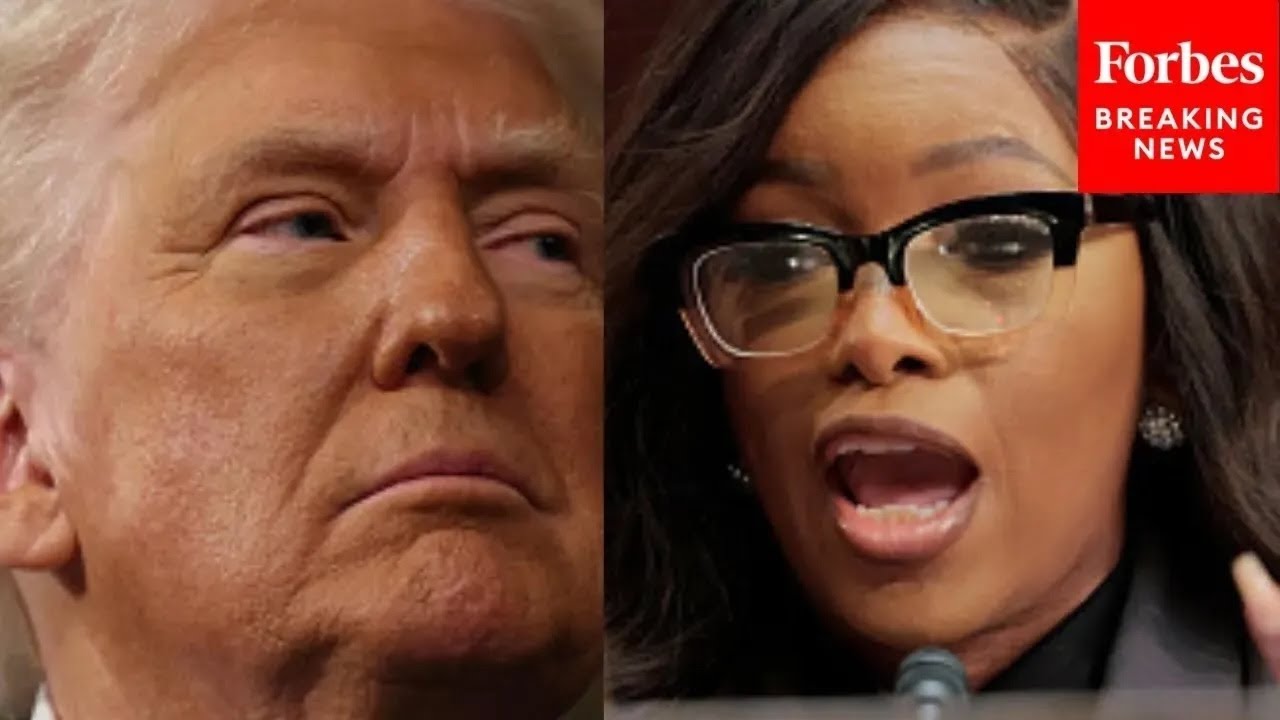
Donald Trump thought his usual bravado and deflection would shield him during the congressional oversight hearing. But when Representative Jasmine Crockett methodically placed three blue folders on the table before her and began asking pointed questions about his tax returns, the next 45 minutes would unravel financial discrepancies he had fought for years to keep hidden from the American public. As the former President's confident smirk transformed into an expression of stunned disbelief, even the most seasoned political observers in the room knew they were witnessing a historic moment of accountability that would reverberate through corridors of power for years to come.
The marble halls of the capital building had been buzzing with anticipation since dawn. News crews positioned themselves at strategic locations throughout the complex. Cameras trained on every entrance where the former president might appear.
Outside on the manicured lawns, competing groups of protesters formed a patchwork of political passion, their chants rising and falling like opposing tides. Capital police maintained a visible presence, their faces professionally neutral despite the charged atmosphere that had descended on Washington for this long awaited confrontation. Inside hearing room HC5, committee staffers made final preparations, checking microphones and adjusting the lighting for optimal television coverage.
The temperature was kept at a crisp 68°, though the growing number of bodies and the heat from television lighting would gradually warm the space as the morning progressed. Ornate chandeliers cast a golden glow across polished cherrywood panels lining the walls, their light reflecting off the brass Fixtures and lending an air of historical gravitas to the proceedings. The congressional seal prominently displayed behind the committee chairperson's seat gleamed under the lights, a silent reminder of the institutional power concentrated in this space.
The air carried a subtle blend of scents, furniture polish recently applied to the witness table, the leather of portfolio folders carried by attorneys, traces of coffee from cups Discreetly positioned beside committee members name plates, and the faint notes of various colog and perfumes worn by those in attendance. As the room filled, these scents mingled with the almost imperceptible anxiety that permeated highstakes political confrontations, creating an atmosphere thick with anticipation. Committee members settled into their highbacked leather chairs arranged in a shallow semicircle on an elevated platform.
Before them, a Solitary witness table stood centered on the lower level, positioned so that anyone seated there would need to look up slightly to address the committee. A subtle architectural reinforcement of the power dynamic at play. Three rows of press seating stretched behind the witness table, each position already claimed by journalists whose expressions betrayed the competitive tension of those anticipating a significant story.
AIDS hurried between positions, Distributing folders and whispering lastminute briefings to committee members. The soft rustle of papers mingled with the low hum of conversation and the occasional electronic chime of incoming messages in the gallery reserved for the public. Every seat was filled, the lucky few who had secured passes sitting with perfect posture, aware of their visibility in this moment of political theater.
At precisely 9:30, the committee chairman, a veteran Congressman with silver hair and reading glasses, perpetually perched at the end of his nose, tapped his gavvel three times. The sharp sound cut through the ambient noise, bringing an immediate hush to the room. "This hearing of the House Financial Services Committee will come to order," he announced, his voice amplified by the microphone system.
Today, we continue our legislative oversight regarding financial transparency requirements for federal Office holders and candidates. The chairman's opening statement reviewed the committee's mandate, examining potential reforms to financial disclosure laws in light of questions raised during previous administrations. Though his language remained procedurally neutral, the subtext was clear to everyone present.
This hearing had been called specifically to address the unprecedented opacity surrounding Donald Trump's financial affairs during and after his presidency. The American people deserve transparency from those who seek the highest offices in our government, the chairman continued, his voice carrying the measured cadence of someone who had spent decades in public service. Financial disclosure laws exist not merely as bureaucratic requirements but as essential safeguards for our democratic system.
They allow voters to assess potential conflicts of interest And ensure that those entrusted with public power are not compromised by private financial entanglements. As the chairman spoke, committee members arranged papers and tablets before them, some leaning to whisper to aids positioned behind their chairs. The partisan divide was visibly reflected in their body language.
Democrats sitting forward with expressions of intense focus. Republicans leaning back with folded arms and skeptical expressions. The chairman concluded his remarks with a reminder about decorum and the five-minute rule for questioning, then recognized the ranking minority member for an opening statement.
The Republican ranking member, a congressman from a rural district with 30 years of seniority, adjusted his microphone before launching into a passionate defense of privacy rights and a denunciation of what he termed the weaponization of congressional oversight For political vendettas. His voice rose as he described the proceedings as unprecedented harassment and a dangerous precedent that threatens every American's right to financial privacy. Several Republican members nodded in visible agreement while their Democratic counterparts maintained carefully neutral expressions.
20 minutes later, following opening statements from several senior committee members that adhered predictably to partisan Positions, the chamber doors opened to admit the day's primary witness. Donald Trump entered with the practiced confidence of a man accustomed to commanding attention. He wore a navy suit with his signature overlong red tie, his expression a mixture of defiance and performative indignation.
Flanking him were three attorneys in equally expensive suits, their faces carefully arranged in expressions of professional detachment. Trump Acknowledged his supporters on the committee with brief nods and a thumbs up gesture before taking his seat at the witness table. His legal team arranged themselves protectively around him, one on either side and one directly behind, creating a physical barrier between their client and the committee.
An aid placed a bottled water and a legal pad before him, then retreated to the staff seating area. The chairman instructed the witness to rise and raise his right Hand for the oath. Trump complied, his expression momentarily serious, as he swore to tell the truth, the whole truth, and nothing but the truth, a ritualistic prelude that carried the implicit reminder of the legal consequences of perjury before Congress.
As he settled back into his chair, Trump adjusted his microphone, leaning slightly forward in the posture of someone prepared to dominate the conversation. After a brief explanation Of the hearing procedures, the questioning began following standard committee protocol, alternating between majority and minority members, each allotted 5 minutes. The pattern quickly established itself.
Republican members used their time to decry the proceedings as politically motivated, offering Trump opportunities to expound on the witch hunt he claimed to have endured. While Democratic members attempted to extract specific answers about his tax returns And business practices, receiving only securitous responses and counter accusations. Mr Trump asked a senior Democratic representative from California, "You repeatedly promised during your campaign that you would release your tax returns after an audit was completed.
" That audit concluded in 2019, yet you continued to fight disclosure through multiple court challenges. "Why did you break your promise to the American people? " Trump Leaned into his microphone, his voice carrying the combative tone that had become his trademark.
First of all, I never broke any promises. I've kept more promises than any president in history. Probably the audit situation was very complex, extremely complex.
The IRS targeted me unfairly. Everyone knows that because I was fighting for the American people against the deep state. Rudy, the non-answer set the tone for the first two hours of questioning.
Trump alternated between lengthy digressions about his administration's accomplishments, attacks on the committee's legitimacy, and technical objections whispered by his attorneys. When pressed on specific financial questions, he repeatedly invoked the complexity of his business empire, the harassment he had faced from government agencies, and his superior knowledge of tax law compared to his questioners. Most observers were mentally cataloging The session as yet another example of congressional theater, passionate but ultimately inconsequential.
Journalists had already drafted the outlines of their articles, focusing on partisan divisions rather than substantive revelations. In the press section, several reporters had begun discreetly checking their phones, assuming the most newsworthy moments had already passed. It was at this moment, nearly 2 hours and 15 minutes into the Hearing, that the chairman announced the chair now recognizes the gentleoman from Texas, Representative Jasmine Crockett, for 5 minutes of questioning.
Those familiar with Crockett's work as a former public defender, straightened in their seats. Since joining Congress, she had established a reputation for methodical, evidence-based questioning that had repeatedly caught witnesses offguard. Unlike colleagues who used their allotted time for speech making, Crockett was known to prepare with prosecutorial thoroughess and question with laser precision.
Trump, however, showed no particular concern. As Crockett organized three color-coded folders on the desk before her, having weathered the previous two hours without significant damage, he leaned back slightly in his chair, projecting relaxed confidence. When his attorney whispered something in his ear, Trump nodded dismissively without fully Turning his head.
Representative Crockett wore a tailored navy blazer over a crisp white blouse, a single strand of pearls, her only jewelry. Her natural hair was styled in a professional manner that rejected corporate conformity while maintaining polished precision. She adjusted her microphone and opened the first blue folder with deliberate calm, taking an extra moment to arrange the documents inside, a pause that created a subtle Shift in the room's energy as all attention focused on her first question.
"Good morning, Mr Trump," she began, her voice measured and clear, carrying the practiced neutrality of someone who had questioned hundreds of witnesses in courtrooms. I'd like to start by establishing some basic facts about your previous statements regarding your tax returns. On April 15th, 2016, you stated, and I quote, "I cannot release my tax returns because they are under Audit by the IRS.
" "Is that an accurate recollection of your position at that time? " Trump leaned toward his microphone. "Yes, that's right.
I was under audit. A very serious, very complicated audit. probably the most complicated they'd ever seen.
Because my businesses are incredibly complex, spanning countries, different types of entities. Most people don't understand the complexity. Crockett nodded once, acknowledging the response without Commenting on its characterization.
And did your legal advisers inform you that being under audit creates a legal prohibition against releasing your tax returns? Trump shifted slightly in his seat. My lawyers advised me, and I have the best lawyers, they advise me it would be extremely unwise to release returns during an audit.
Extremely unwise. Only a fool would do that. I understand that was their advice, Crockett replied, maintaining eye Contact.
But my question specifically was whether they informed you of a legal prohibition. Was there a law preventing you from releasing your returns while under audit? The attorney to Trump's right subtly straightened, recognizing the precise nature of the question.
Trump glanced briefly to his legal counsel before answering. Look, when the best lawyers in the country tell you not to do something, you listen. Only a fool would ignore that kind of advice.
They Told me it would compromise my legal position. Crockett allowed 3 seconds of silence to emphasize the non-answer before continuing. For the record, Mr Trump.
There is no legal prohibition against releasing tax returns during an audit. In fact, she lifted a document from her folder. I have here a letter from IRS Commissioner Charles Retig dated February 7th, 2019 explicitly stating that nothing prevents individuals from sharing their Own tax information, including during an audit process.
The camera operators zoomed in on Trump's face as a flash of annoyance crossed his features. In the press section, reporters began typing more rapidly on their laptops, sensing that Crockett's questioning might yield more substance than the previous exchanges. The committee has obtained through proper legal channels partial information regarding your tax filings between 2015 and 2020, Crockett Continued.
I'd like to ask you about specific discrepancies that appear relevant to our legislative purpose of strengthening financial disclosure requirements. Trump's posture changed subtly, his shoulders squaring as he leaned forward. Before you continue, Congresswoman, I want to make something clear.
My tax situations are extremely complex. Probably the most complex the IRS has ever seen. people who aren't in real estate, who haven't built Successful businesses, they simply don't understand the sophisticated strategies involved.
I appreciate that perspective, Mr Trump," Crockett responded without breaking rhythm. "Let's focus on specifics. In your 2017 financial disclosure forms, you listed the Trump International Hotel in Washington, DC as generating over 40 million in revenue.
However, tax documents reviewed by this committee show reported income of approximately $24 million from the same Property for the same period. Can you explain this $16 million discrepancy? The room, which had settled into the familiar cadence of political theater, suddenly became noticeably quieter.
Journalists who had been half listening while drafting their stories stopped typing. Committee members who had been reviewing notes or checking messages on their phones looked up. Trump's attorney whispered urgently in his ear, but Trump waved him off with a flick of his hand.
Financial disclosure forms and tax returns serve different purposes and follow different rules. Totally different systems. One looks at revenue, one looks at income after expenses.
Every businessman knows this. Crockett nodded. You're suggesting the difference represents business expenses and operational costs.
Is that correct? Exactly, Trump replied, visibly relieved at the apparent understanding. Tremendous expenses in running a Worldclass hotel.
Tremendous. Crockett opened her second folder and removed a document with highlighted sections. Mr Trump.
I have here the detailed expense reports for the Trump International Hotel filed with your tax returns for 2017. The total operational expenses including staff salaries, maintenance, utilities, and marketing amount to 9. 3 million.
Even accounting for all documented expenses, there remains a discrepancy of approximately $6. 7 Million between your public disclosure and your tax filing. Can you explain where this difference originates?
" A congressional aid approached the chairman and whispered something in his ear. The chairman nodded and made a note, but did not interrupt the questioning. In the press section, a reporter for the Washington Post raised her eyebrows and exchanged glances with a colleague from the New York Times.
Trump's face flushed slightly as he Leaned back from the microphone to confer with his attorneys. The whispered conversation lasted 15 seconds during which Crockett waited patiently, her expression neutral. When Trump returned to the microphone, his tone had hardened.
Congresswoman, these selective leaks of private tax information are illegal. Completely illegal. I don't know how this committee obtained these documents, but I can tell you my legal team will be looking very closely at This violation of privacy.
Crockett remained unperturbed. Mr Trump. These documents were provided to the committee through proper legal channels following a Supreme Court decision upholding congressional oversight authority.
My question remains, what accounts for the $6 7 million discrepancy between your public financial disclosure and your tax filing for the same property in the same year. Trump's attorney placed a hand on his client's arm, a subtle signal to Exercise caution. Trump took a sip of water before responding.
Listen, different accounting methods can produce different results. My financial team uses sophisticated approaches to capture the true value of assets that simpler methods miss completely. D.
So, you're stating that the difference is attributable to different accounting methodologies? Crockett clarified, not to intentional misrepresentation on either document. Of course not, Trump Replied firmly.
I have always been very, very careful about financial reporting. The most careful probably, Crockett paused, allowing the room to absorb this statement. The silence stretched for five full seconds, creating a moment of tension that drew every eye in the room.
When she spoke again, her voice remained measured but carried a new note of precision. Mr Trump, are you aware that providing materially different financial information to financial institutions Versus tax authorities could potentially constitute bank fraud or tax fraud? The attorney to Trump's left started to object, but Crockett continued before he could speak.
I'm not accusing you of any crime, Mr Trump. I'm asking if you're aware of the legal distinction between strategic accounting and fraudulent reporting. Trump's jaw tightened visibly.
I'm aware that Democrats have tried to weaponize every aspect of government against me for years. Every Investigation comes up empty because everything I've done is perfectly legal. Perfectly legal.
In the gallery, spectators shifted in their seats, sensing the escalating tension. A photographer captured the moment Trump's attorney passed him a note, which he glanced at before pushing slightly aside on the table. Crockett closed her second folder and opened the third.
Let's move to a different property. In loan applications to Deutsche Bank between 2016 and 2018, you valued your Mara Lago resort at approximately $739 million. However, in Palm Beach County tax filings for the same period, the property was valued at approximately $75 million.
That's nearly a 10-fold difference in valuation of the same asset during the same time frame. Trump straightened his tie and leaned forward. Mara Lago is probably the most valuable piece of real estate in Florida, maybe on the entire East Coast.
Local tax Assessors use formulas that don't capture its true value or potential. Not even close. Every high-end property owner knows tax assessments are meaningless for truly exceptional properties.
Crockett removed another document from her folder. I have here the sworn deposition you provided in the case of Deutsche Bank versus Trump Organizations on September 12th, 2018. On page 47, when asked about the valuation methodology for Mara Lago, you Stated under oath that you relied on standard market valuations consistent with Palm Beach County luxury properties.
Yet the valuations you provided were approximately 10 times higher than other luxury properties in the area. Can you explain this contradiction? For the first time, a flicker of genuine concern crossed Trump's face.
He glanced at both attorneys flanking him before responding. There's no contradiction. Mara Lago is unique, completely unique.
It can't be compared to other properties. The history, the architecture, the prestige, these factors create exceptional value that standard metrics don't capture. So, you're saying, Crockett continued without changing her tone, that you used standard valuation metrics, but then applied a multiplier.
based on your personal assessment of the property's unique characteristics. Trump Began to respond, then stopped himself. His attorney whispered something in his ear, and Trump nodded before addressing the committee again.
Look, Congresswoman, with all due respect, how many luxury properties have you developed? How many international hotels have you built and managed? You're questioning business practices you don't understand.
People like me built this country's skylines while politicians just talk. A murmur ran through the Gallery at this personal attack. The committee chairman tapped his gavvel once, restoring order.
The witness will refrain from personal comments and answer the question posed. Crockett showed no reaction to the attempted provocation. Her expression remained professionally neutral as she waited for silence to return to the chamber.
Then, without raising her voice or changing her measured cadence, she continued her line of questioning. Mr Trump, I'd like To direct your attention to this internal email exchange between your chief financial officer, Alan Weiselberg, and your controller, Jeffrey McConey, from March 2017. She held up a document that had been entered into the official record.
In this communication, Mr Weiselberg instructs Mr McConey too, and I quote directly, adjust valuations upward for loan collateral submissions and downward for tax purposes. The email specifically References Mara Lago and Trump Tower Chicago. Were you aware of these instructions being given by your CFO?
The room fell completely silent. Trump stared at the document in Crockett's hand, then looked to his attorneys with an expression that combined surprise and alarm. One attorney immediately began writing on his legal pad, while the other whispered urgently in Trump's ear.
For a moment, the former president seemed genuinely caught off guard, his Customary confidence visibly shaken. "Those emails," Trump began, his voice uncharacteristically hesitant. I don't micromanage my executives.
I run a massive organization with thousands of employees. My executives have authority to handle day-to-day operations while I focus on the big picture, the vision. Crockett listened without interruption, then followed up with precision.
So, you're testifying under oath to this committee that you had no knowledge of These specific instructions regarding different valuations for the same properties? Trump shifted in his seat, tugging slightly at his collar as beads of perspiration became visible on his forehead despite the room's air conditioning. I review final numbers.
I don't get involved in the details of how those numbers are prepared. That's why I hire financial experts. The camera operators focused tightly on Trump's face as he spoke, capturing the slight Tremor in his hands as he reached for his water glass.
In the press gallery, reporters typed frantically, recognizing that the hearing had suddenly transformed from routine political theater into something potentially consequential. Crockett nodded, acknowledging his answer without accepting or challenging it. She consulted her notes briefly, then continued with the same measured tone.
Mr Trump, you just testified that you Review final numbers, but don't involve yourself in the methodology. I'd like to understand the extent of your review process. When presented with valuations of your properties for different purposes, banking, insurance, tax filings, did you personally review and approve these different valuations?
Trump conferred with his attorneys again, this time for nearly 30 seconds. The whispered consultation was just audible enough for the microphones to Pick up the urgency, but not the content. When he turned back to face the committee, Trump had regained some of his composure.
Of course, I review important documents. I'm known for my attention to detail, always have been. But in a complex organization, you trust your team to handle their areas of expertise.
That's just good management. So, to clarify, Crockett pressed, you did review and approve the different valuations submitted to banks Versus tax authorities. Trump's attorney placed a cautionary hand on his arm, but Trump shrugged it off.
Sensing a path to safe ground, he responded with renewed confidence. Yes, I review the final submissions. That's my job as the head of the organization.
I trust my team to prepare the documents correctly, and I give final approval. That's how leadership works. A slight smile touched the corners of Crockett's mouth, so subtle it was Almost imperceptible.
She reached into her folder and removed a final document, placing it carefully on the table before her. Mr Trump, I'm now entering into the record a memorandum dated March 15th, 2017, bearing your signature. She held up the document so cameras could capture it clearly.
This memorandum addressed to your financial team contains specific instructions regarding property valuations. I'll quote directly. Ensure that New York property Values are minimized for tax declarations and maximized for loan applications.
Pay particular attention to the Fifth Avenue and Columbus Circle locations. The document continues with specific percentage targets for these adjustments. The room erupted in murmurss as committee members leaned forward to get a better look at the projected document.
Trump stared at the memorandum, his face draining of color. His lead attorney quickly whispered in His ear, but Trump seemed momentarily frozen, unable to process a response. Crockett continued, her voice cutting through the growing noise in the chamber.
This document directly contradicts your testimony that you were not involved in valuation methodologies. It shows explicit direction from you personally to maintain different valuations of the same properties for different audiences. Would you like to revise your previous testimony to this Committee?
The chairman tapped his gavl, restoring order to the room. All eyes turned to Trump, waiting for his response. His attorney tried again to provide guidance, but Trump sat immobile, staring at the document projected on the screen.
When he finally attempted to speak, his voice cracked audibly. He cleared his throat and tried again. That I don't recall that specific memo.
It could be. There are many documents with my signature. Would need To review the context.
His voice trailed off as he looked to his legal team for assistance. The attorney to his right quickly leaned into the microphone. Mr Chairman, we request a brief recess to review this document, which we're seeing for the first time today.
Before the chairman could respond, Crockett spoke again, her calm voice in stark contrast to the tension filling the room. Mr Trump, you've testified under oath that you review and approve final numbers, But don't involve yourself in methodology. Yet this document in your own hand specifically directs methodology.
These cannot both be true. She paused, allowing the weight of the contradiction to settle over the room. Then looking directly at Trump, who sat uncharacteristically silent, she delivered the line that would be replayed on news channels for weeks to come.
The truth doesn't adjust itself for different audiences, Mr Trump. The Chamber fell into absolute silence. For perhaps the first time in his public life, Donald Trump appeared completely speechless, his mouth slightly open, eyes wide with genuine shock.
The confidence that had characterized his demeanor throughout his career seemed to collapse in on itself as the cameras captured his stunned expression. After 5 seconds of complete silence, the committee chairman found his voice. The committee will take a 15-minute recess.
He tapped his gavvel three times, the sharp sound breaking the spell that had fallen over the room. As soon as the gavel fell, the chamber erupted into chaos. Journalists rushed for the doors, eager to file their stories.
Committee members huddled in small groups, their expressions revealing the partisan divide in their reactions. Democrats exchanging looks of vindication, Republicans conferring urgently with aids. Trump's legal team immediately Formed a protective circle around him, blocking camera views as they engaged in intense discussion.
In the corridor outside, camera crews surrounded congressional correspondents delivering breathless updates. In an extraordinary moment just minutes ago, one veteran reporter narrated, her eyes wide with the realization she was covering a potentially historic exchange. Representative Jasmine Crockett presented evidence that appears to Directly contradict former President Trump's testimony about his involvement in property valuations.
Social media platforms immediately exploded with activity. Video clips of the exchange were uploaded and shared within minutes, rapidly accumulating hundreds of thousands of views even before the hearing reconvened. The phrase, "The truth doesn't adjust itself," began trending nationally, with commentators From across the political spectrum weighing in on its significance.
Inside a small preparation room adjacent to the committee chamber, Jasmine Crockett sat alone, reviewing her notes with the same methodical focus she had displayed during the questioning. Unlike some colleagues who might have been celebrating or giving impromptu interviews in the hallway, she remained in a space of concentrated preparation. A career built on courtroom discipline Had taught her that moments of apparent victory were precisely when additional scrutiny would come.
Her work wasn't complete until the record was clear and comprehensive. Her chief of staff entered with a tablet displaying realtime news coverage and social media reactions. It's everywhere already, he said, barely containing his excitement.
CNN, MSNBC, Fox, they're all running the clip on repeat. Twitter is going crazy. Crockett Glanced at the screen, then returned to her notes.
We need to prepare for the response. His team will come back with objections about the documents's providence or context. Have legal doublech check our authentication documentation and make sure the chain of custody is bulletproof.
Her aid nodded, impressed, but not surprised by her focus on substantive preparation rather than the viral moment. The chairman's office called. They want to know if you Need more time when we reconvene.
No, Crockett replied, closing her folder with finality. I've made the essential point. The documentary evidence speaks for itself.
No need to belabor it. Meanwhile, in a secure room reserved for witnesses, Trump's legal team was engaged in crisis management. The lead attorney, a seasoned Washington lawyer who had represented high-profile clients through numerous scandals, spoke in hushed but urgent tones.
We need to Challenge the authenticity of that document, he insisted, pacing the small space. Question the chain of custody. Demand forensic examination of the signature.
Trump, still visibly shaken, pounded his fist on the table. It's all fake news. They've been out to get me from day one.
Completely rigged system. The attorney stopped pacing and looked directly at his client. Mr President, with all due respect, we need to address the reality of what just happened in That room.
If that document is authenticated, and congressional committees don't generally enter evidence they can't verify, we have a serious problem with your testimony today. The second attorney reviewing statute books on his tablet looked up grimly. Making materially false statements to Congress is a federal offense.
We need to consider invoking Fifth Amendment protections for the remainder of this hearing. Trump's face Flushed with anger at the suggestion. I never take the fifth.
That makes you look guilty. Only guilty people take the fifth. De sir, the lead attorney replied firmly, the optics of invoking constitutional protections are far preferable to the legal consequences of contradictory testimony under oath.
As the legal team continued their urgent consultation, staff members outside the room could hear the former president's voice rising and falling in emotional Waves, occasionally punctuated by phrases like totally unfair and political witch hunt. When the committee reconvened 15 minutes later, the atmosphere in the chamber had transformed. The earlier routine of partisan questioning had given way to a shared sense across political divides that something consequential was unfolding.
Even members who had been scrolling through phones during earlier testimony sat attentive and engaged, Sensing a potential turning point, not just in the hearing, but perhaps in the broader narrative surrounding Trump's financial practices. Trump returned to the witness table with a visibly different demeanor. The confident, almost casual posture had been replaced with rigid formality.
His legal team had rearranged themselves with the lead attorney now positioned directly beside him, legal pad at the ready. As cameras focused on his face, viewers across America could see that the characteristic Trump bravado had given way to something rarely witnessed in his public persona, defensive caution. The chairman called the session back to order with three sharp taps of his gavvel.
The committee will come to order. Before we resume questioning, council for the witness has requested to make a statement. Trump's lead attorney leaned into the microphone.
Mr Chairman, in consultation with my Client, we are exercising Mr Trump's constitutional right under the Fifth Amendment to decline to answer further questions that might tend to incriminate him. A collective gasp rippled through the gallery, followed by an immediate buzz of whispered conversation. The chairman gave for order again.
The witness has the right to invoke this constitutional protection. The record will reflect this decision. He turned toward the democratic side of the deis.
Representative Crockett, you have 1 minute and 45 seconds remaining in your questioning period. All eyes turned to Crockett, who sat with the same composed demeanor she had maintained throughout the hearing. She adjusted her microphone slightly and addressed the chairman rather than Trump directly.
Mr Chairman, given the witness's decision to invoke his fifth amendment rights, I will reserve my remaining time. I would, however, request that the memorandum Presented earlier be formally entered into the committee record along with the full email exchange between Mr Weiselberg and Mr McConey regarding property valuation directives. Without objection, so ordered, the chairman replied.
As the questioning moved to the next committee member, cameras remained fixed on both Trump and Crockett. The former president sat stiffly, occasionally leaning to whisper to his attorney, but otherwise maintaining Uncharacteristic silence. Crockett calmly organized her documents, returning them to their color-coded folders with the same methodical precision with which she had extracted them.
Though they occupied the same physical space, the power dynamic had visibly shifted. Trump's commanding presence diminished, while Crockett's composed authority seemed to have expanded beyond her position on the committee dis. For the remainder of the Hearing, Trump maintained his fifth amendment stance, responding to all questions with a rehearsed statement.
On advice of councel, I respectfully declined to answer based on my rights under the fifth amendment to the United States Constitution. The proceedings, which had been expected to last until late afternoon, concluded shortly afternoon when it became clear no further substantive testimony would be forthcoming. As the hearing adjourned, The chairman thanked the committee members and announced follow-up proceedings to examine the implications of the evidence presented.
Trump stood immediately, surrounded by his legal team, and was quickly escorted from the chamber through a side door, avoiding the press gauntlet that awaited in the main corridor. For the first time in memory, he departed a public appearance without addressing the cameras or making impromptu statements to reporters, a Silence that spoke volumes to political observers. Jasmine Crockett, by contrast, moved unhurriedly, gathering her materials and conferring briefly with committee colleagues before exiting the chamber.
In the hallway, she was immediately surrounded by a swarm of reporters shouting questions about her explosive exchange with the former president. Representative Crockett, did you anticipate Trump invoking the fifth? Congresswoman, how long have you had That memorandum?
Can you explain the significance of the documentation you presented? Crockett paused, allowing the clamor to subside slightly before responding with characteristic precision. Today's hearing was part of this committee's constitutional oversight responsibility to examine financial disclosure requirements for public officials.
The documents entered into the record speak for themselves. Our work continues to ensure that our Democracy is protected by appropriate transparency measures. With that brief statement, she moved through the crowd, declining to elaborate further despite the continuing barrage of questions.
By early afternoon, the impact was reverberating through Washington and beyond. Cable news networks had transformed their programming into continuous coverage of what they were calling the Crockett confrontation. Political analysts from across the Spectrum acknowledged the significance of what had transpired, even as they differed in their interpretation of its implications.
"What we witnessed today," said a former federal prosecutor on CNN, was a textbook example of effective congressional questioning. Representative Crockett established a factual foundation built methodically toward her key evidence and allowed the witness to commit to a position before presenting contradictory documentation. It's the same approach that effective prosecutors use in court on Fox News.
Commentators took a different angle. This was clearly a coordinated ambush with selectively leaked documents designed to create a gotcha moment. The real question is how these internal business documents were obtained and whether proper legal procedures were followed.
Social media platforms exploded with activity. Nug truth doesn't adjust becoming the top trending Hashtag worldwide within hours. Video clips of the exchange were viewed over 60 million times in the first 24 hours with Crockett's final line being remixed into songs, printed on t-shirts, and incorporated into memes that crossed political boundaries.
Her measured delivery and documentation focused approach drew particular attention, with many observers contrasting her methodical style against the more theatrical questioning often seen in Congressional hearings. In downtown Washington, a bar near Capitol Hill spontaneously created a drink called The Crockett, described as smooth going down, but packs an unexpected punch. By evening, lines stretched around the block as political staffers and journalists gathered to dissect the day's events over the symbolic cocktail.
Beyond the immediate social media reaction, the institutional response was equally swift. By late afternoon, three Financial institutions announced internal reviews of their lending relationships with Trump Organization Properties. The Securities and Exchange Commission issued a statement indicating they were reviewing the testimony for potential regulatory implications.
State tax authorities in New York, Florida, and New Jersey announced examinations of Trump property valuations in their jurisdictions. Amid the media frenzy, Jasmine Crockett maintained her Composure, declining all interview requests with a simple statement. The documents speak for themselves.
My job was to ask questions that serve our legislative purpose of strengthening financial disclosure requirements. The American people deserve transparency from all who seek public office. The following morning, newspapers across the country featured front page coverage of the hearing.
The New York Times headline read, "Trump invokes Fifth Amendment After Crockett reveals valuation directive. " The Washington Post went with document contradicts Trump's testimony on property valuations. Even tabloids joined the coverage with the New York Post's characteristic directness trumped by Crockett.
In the week that followed, the political and legal implications continued to unfold. Trump's surrogates appeared on television defending their principle with familiar talking points about witch Hunts and persecution, but notably struggled when hosts played the video clip of the contradictory testimony followed by Crockett's devastating line. Several prominent Republicans declined interview requests altogether, creating an unusual void in the typically robust partisan defense.
A poll conducted 3 days after the hearing showed that 73% of Americans had seen at least clips of the exchange with 62% saying it raised serious concerns about financial Practices, including 38% of self-identified Republicans. Constitutional scholars noted that the hearing demonstrated why the founders had established congressional oversight as a cornerstone of democratic accountability. For Jasmine Crockett, the outcome transcended partisan politics.
As she explained to her staff in a private meeting that was later described by an attendee, this was never about embarrassing anyone. It was about Establishing that in a democracy, evidence matters more than authority. Truth matters more than power.
And no one, regardless of wealth or position, stands above accountability. The legislation that eventually emerged from the committee included strengthened verification requirements for financial disclosures, expanded powers for ethics offices to cross-check public filings against tax records, and increased penalties for material Misrepresentations. When it passed with bipartisan support 6 months later, many cited the dramatic hearing as the catalyst that had transformed abstract concerns about financial transparency into concrete reforms.
But beyond the policy implications, the exchange became a cultural touchstone, a rare moment when the often abstract workings of democratic accountability became viscerally clear to millions of ordinary citizens. Law schools incorporated the Video into their curriculum on evidence and questioning techniques. Journalism programs used it to illustrate the importance of document-based reporting over reliance on quotes and personalities.
Perhaps most significantly, the moment reverberated among everyday Americans who had grown cynical about the possibility of holding powerful figures accountable. In barbershops and diners, on factory floors, and in office breakrooms, the Exchange sparked conversations about the nature of truth in public life and the possibility that evidence could still triumph over power and celebrity. For Jasmine Crockett, the personal aftermath was both profound and understated.
She declined the flood of invitations to appear on Sunday morning political shows and late night talk programs, focusing instead on her continuing work on the committee and in her district. When asked by a local reporter whether the Hearing had changed her, she offered a characteristic response that combined humility with conviction. My approach hasn't changed since my days as a public defender.
Prepare thoroughly, focus on documentation, ask precise questions, and let the evidence speak. What changed isn't me, but perhaps the public's understanding that our democratic institutions can still function as intended when we focus on facts rather than personality. Three weeks after the Hearing, Crockett returned to her district for a previously scheduled town hall meeting.
The community center venue, which typically accommodated local attendants with room to spare, was filled beyond capacity with attendees spilling out into the parking lot. As she entered through a side door, planning to begin with her usual updates on constituent services and legislative priorities, the crowd rose in a spontaneous standing ovation that Continued for nearly 2 minutes. Visibly moved, but maintaining her characteristic composure, Crockett raised her hands to quiet the applause.
"Thank you for that warm welcome," she began. "But I'd like to clarify something important. What you witnessed in that hearing room wasn't about one representative or one witness.
It was about the foundational American principle that documentation and evidence matter more than power or Position. She paused, looking out at the diverse faces of her constituents, factory workers and teachers, nurses and small business owners, seniors and college students. In a healthy democracy, no single person's word should carry more weight simply because of their wealth or fame or office.
The truth doesn't change depending on who's asking or who's answering. It doesn't adjust itself for different audiences. The crowd erupted again, this time Chanting her now famous line back to her, "Truth doesn't adjust.
Truth doesn't adjust. " Crockett waited for the chanting to subside, then continued with a smile. Now, let's focus on what matters most, the issues affecting this district, and how I can better serve as your representative.
I'm here to listen. With that, she moved from the national spotlight back to the essential work of democratic representation, listening to concerns about health care access, Infrastructure needs, and educational opportunities. It was in many ways the perfect embodiment of the principle she had demonstrated in that hearing room that American democracy functions best when it focuses not on personality or performance but on substance evidence and the patient pursuit of truth.
In the years that followed, the phrase crockett moment entered the political lexicon, describing any instance when careful preparation and documentary evidence cut Through rhetorical deflection. Legal experts analyzed the questioning technique, noting how Crockett had built a foundation of factual predicates before introducing the key evidence, creating a situation where the witness had effectively trapped himself through prior statements. For millions of Americans who had watched the exchange, however, the enduring legacy wasn't the legal strategy or political consequences, but the indelible image of A public figure accustomed to creating his own reality, suddenly confronted with documented truth, and the quiet power of a prepared questioner who understood that in the face of deception, sometimes the most devastating weapon is simply the facts.
Presented with precision and without drama, the moment exemplified a principle that extended far beyond politics, that preparation triumphs over bluster, evidence over assertion, and Methodical precision over charismatic deflection. It offered a template not just for congressional oversight, but for confronting misinformation in all its forms. A reminder that while truth may sometimes be temporarily obscured by personality and power, it remains immovable at its core, waiting for those patient and prepared enough to bring it into the light.
In journalism schools and law programs across the country, the video became required viewing. a Masterclass in preparation, timing, and the art of asking the right question at the right moment. But perhaps the greatest testament to its impact came from everyday citizens who discovered in that moment a renewed faith that in a functioning democracy, truth can still prevail over power, facts over fiction, and evidence over evasion, provided there are those with the courage and capacity to pursue it methodically, present it clearly, and stand firmly in Its defense.
Jasmine Crockett herself remained characteristically modest about her role, deflecting personal acclaim to emphasize the institutional principles at stake. "What happened in that hearing room wasn't about me," she would say when asked. "It was about the system working as designed, one person asking questions, another answering, and documentary evidence serving as the ultimate arbiter of truth.
" But for the millions who had witnessed that Extraordinary moment when a former president was rendered speechless by the simple power of documented fact, Crockett had demonstrated something profound. That in a democracy worthy of the name, no voice, however wealthy, famous, or powerful, speaks louder than the evidence itself. The truth doesn't adjust itself for different audiences.
The words had resonated because they expressed a principle both simple and profound, that in matters of fact there Is no special exemption for the powerful, no alternative reality for the privileged, no sliding scale of truth based on wealth or status. It was a principle as old as the republic itself, suddenly made vivid through one precisely documented moment of accountability. In that sense, what the public had witnessed wasn't just a congressional hearing, but a reaffirmation of democratic first principles.
That evidence matters more Than assertion, documentation more than declaration, and that in the contest between power and truth, a well-prepared citizen armed with facts can still prevail. For those seeking to understand complex issues in an age of information overload, the exchange offered a template. Focus on documentation, build methodically toward understanding, and recognize that truth emerges not from charisma or volume, but from the patient assembly of verifiable fact.
It was in Its way a masterclass not just in congressional oversight but in critical thinking itself. A reminder that in evaluating any claim the essential question remains not who is making it but whether it can be substantiated with evidence. As one constitutional scholar noted in an analysis that would be widely cited in subsequent years.
What Representative Crockett demonstrated wasn't just effective questioning, but the bedrock principle of republican Government, that in a nation of laws rather than monarchs, no individual's word carries inherent authority based on their station, authority derives instead from evidence, documentation, and the verifiable patterns of fact that constitute truth in a democratic society. It was this larger significance that explained why the moment had resonated so deeply beyond partisan divisions. In an era often characterized by tribal loyalties and alternative Facts, the exchange had offered a glimpse of what remains possible when democratic institutions function as designed, when preparation meets opportunity, when evidence confronts assertion, and when the patient pursuit of factual clarity prevails over the fog of rhetorical deflection.
For Jasmine Crockett, who had built her career on these principles long before national attention found her, the extraordinary moment was simply the visible Manifestation of values she had always held. that justice requires evidence, democracy requires accountability, and both require citizens committed to the proposition that truth exists independent of power, immovable, unalterable, and waiting always to be revealed through the patient work of democratic oversight. I could end it here, but what's really going to stay with you is in the next video.
It's on your screen Now, and honestly, it's the best thing you'll watch this week.