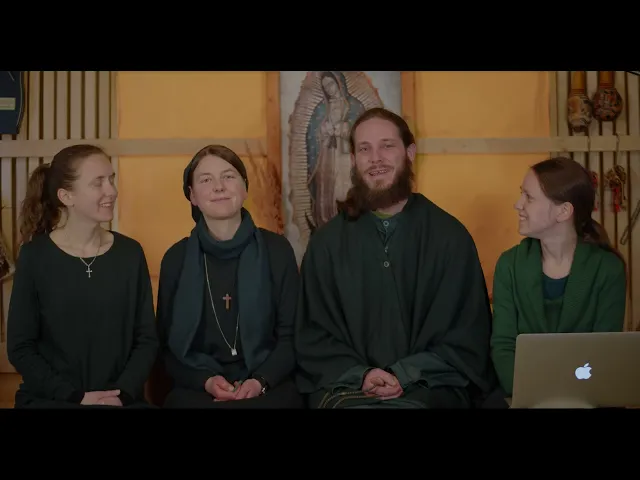
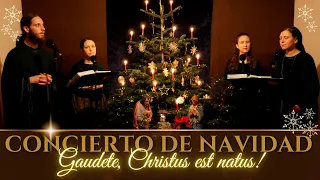
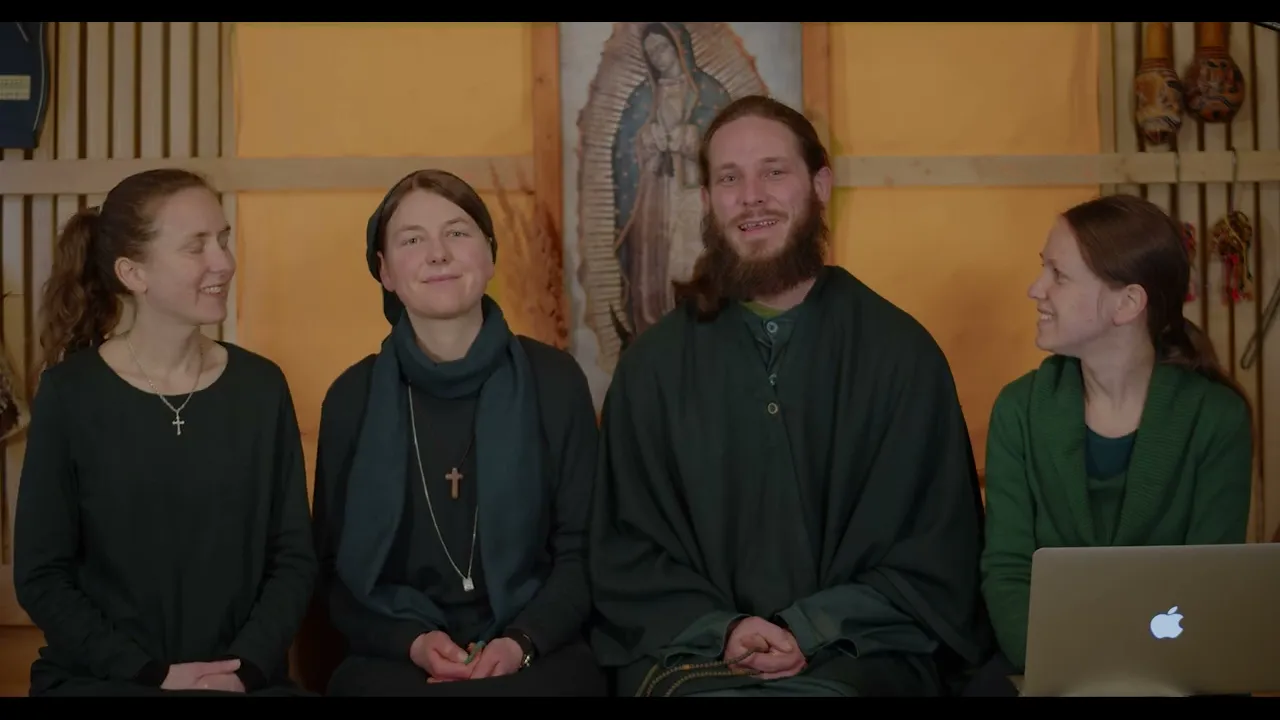
Thank you from the bottom of our hearts for the lovely invitation, it is truly our great intention to promote sacred chant, especially in the monastic life, among all those who want to follow Christ more intensely —since we ourselves know that sacred chant forms an elemental part of community life. So it is an honour and a joy for us to be able to help you in this regard, and so also to help you deepen your liturgical prayer life. Lucia suggests that perhaps we could say our names before we begin, for those who don’t know us yet.
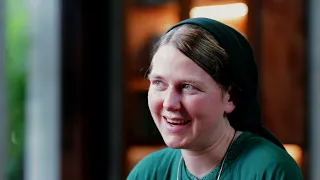
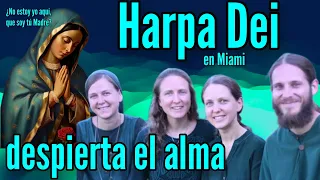
I’m Mirjana and I am the youngest of the four. I’m Nikolai. Lucia.
I’m Marie-Elisée. And with regards to the division of voices within the choir: Mirjana usually sings tenor in the lower octave. I usually sing bass or lead, depending on the character of the singing.
I am soprano. I sing alto. For us, it’s important to talk about the spirituality of sacred music on one hand, and on the other hand, as well, to move on to its practical application, both in terms of chant as sung prayer, and also its apostolic dimension—and the questions that can arise from that.
It’s worth clarifying that we are not experts: we are not musicologists, nor have we studied music; but rather it is our experience that we want to share with you, as well as some very beautiful thoughts from the saints or from our dear Pope Benedict XVI, who wrote beautiful things about sacred music and the liturgy. So Nikolai is going to start with a short introduction. Before going into the specifics, we could ask ourselves why human beings sing when praying —why, almost automatically, when turning to the transcendent, they often have recourse to song.
. . I speak of “the transcendent” in general, because in other religions we can also observe this phenomenon of singing in religious expression.
Here is a very beautiful explanation by St. Hildegard of Bingen, whom Pope Benedict named Doctor of the Church; she was a 12th century German abbess. She says that, in the paradisiacal state, man had a very resonant voice, that, in dialogue with God, he possibly sang rather than spoke.
But at the time of the fall into sin, man would have lost this resonance in his voice. Now, however, after the fall, when he wants to turn to his Creator, he immediately resorts to this memory he still has of the paradisiacal state, addressing his prayer to Him in the form of song. So this would be a very beautiful explanation of why chant is used in all religions to this day, because that memory of the original state is still within the human soul.
Now, in the Judeo-Christian context, already in the Old Testament, singing plays a fundamental role in Temple worship, in the synagogue service, in the singing of the Psalms. . .
There is a very beautiful detail: the first time the Scriptures tell of a song is when Moses and the people of Israel crossed the Red Sea, after the Lord rescued them from the oppression of Pharaoh. "I will sing to the Lord, for he has triumphed gloriously. .
. " (Ex 15,1) And then, at the end of the Scriptures, in the last Book (the Revelation of St. John), the cycle of salvation history is “closed,” so to speak, again with the “song of Moses and of the Lamb,” sung by the elect after they have been definitively liberated and have triumphed over the Beast and his image (Rev.
15: 2-4). Now they sing the eternal song, which will never end, because God has rescued them once and for all. Sacred Scripture places particular emphasis on singing: in the Old Testament it is mentioned… 309 times.
And also in the New Testament, we know the so-called “canticles” from the Pauline epistles. Jesus Himself also recited the Psalms. The term “singing” is mentioned a total of thirty-six times in the New Testament.
St. Paul exhorts us: “Address one another in psalms, and hymns, and spiritual canticles, singing and making melody to the Lord with all your hearts. ” (Eph.
5:19) So here again we see the importance of singing as we turn to God. Throughout the entire history of the Church—practically until the 13th century— the Holy Mass was always sung. There was no such thing as a “spoken” Mass.
Later there arose the so-called “low Mass”, in which the priest recites all the prayers in a spoken form and the people also respond by speaking. I believe that the reason for the establishment of these “low Masses” was practical, but until then singing had played a fundamental role in every liturgy. And also later it was natural that every solemn Mass should be sung.
It was clear that the “low Mass”—I do not mean “private,” because there are no private Masses— would not have the same solemnity and expression of beauty as the “cantata”. To this day, in the Byzantine Divine Liturgy we see the great role of singing: it is a whole sung conversation between the priest, the deacon, the choir. .
. The same is also true in the Traditional Roman Mass, in the so-called “cantata,” which is a constant conversation sung between the priest, the choir and the assembly. We have come to appreciate this very much, especially in recent years.
We could speak of an “indissoluble union” between liturgical action and singing. This is where we can really say: “We do not sing IN the Mass, but we sing the Mass,” because the same words that we are singing, for example, in the entrance verse (Introitus), the priest will then pronounce identically on the altar. While the celebrant pronounces the act of contrition, the choir sings the “Kyrie,” which he himself will then recite before the altar.
So we could say that it is really a “marriage” that cannot be divorced: the sacred chant (in the case of our Roman Catholic Church it is the Gregorian chant) and the liturgical action. Since the word “marriage” was mentioned, let us remember that in the Revelation of St. John, Sacred Scripture speaks of the “Marriage of the Lamb.
” We could not imagine a wedding without music, so we can already look forward to that heavenly music that awaits us in eternity, but already here, in our earthly life, we can sing and listen to it as we enter into the substance of the liturgy, which is a foretaste and a reflection of the heavenly liturgy. And speaking of “weddings,” there is one more point that is very beautiful and worth mentioning. St.
Augustine said: “cantare amantis est” (singing belongs to one who loves [or, more freely, “only the lover sings”]). We can already see this on a secular level, where the great majority of songs that people write or listen to are love songs, because singing allows the emotions to be expressed in a much more elevated and lively way, touching the soul more deeply… And if this applies to human love, how much more so to the relationship and dialogue of the soul with God. To the one we love, we want to give the best.
It is as if words are not enough to express love; it has to be set to music, which is much more elevated. As Nikolai mentioned earlier, the first song in the Old Testament —the song of Moses and the people freed from servitude—is a song of praise. When one wants to praise God, it is as if words alone would not suffice, and one intuitively seeks a more sublime expression, one that goes beyond the everyday.
And singing is the best way to do this. It is definitely the Holy Spirit Himself Who has inspired sacred chant throughout the history of the Church. He, Who is the love between the Father and the Son, “helpeth our infirmity.
For we know not what we should pray for as we ought; but the Spirit Himself asketh for us with unspeakable groanings. ” (Rom. 8:26) In a way, we can also apply this statement to chant: it is the Holy Spirit Who inspires the things that human words cannot express.
This is how sacred chant has developed from the earliest beginnings of the Church’s history, especially for the liturgy, perhaps initially based on the worship of the synagogue or the Temple, but acquiring more and more over time its own expression, and always distinguishing itself from the profane. Another particular characteristic that is worth mentioning in context with the Old Testament, although we will discuss it later, is that sacred music (in this case, primarily the singing of the Psalms) has always placed great emphasis on the Word, also in the Jewish context. In other words, it is not the artistic aspect that comes first, but the Word of God made song.
With regard to the psalms, Cardinal Ratzinger writes in his book “The Spirit of the Liturgy” that David, inspired by the Holy Spirit, speaks prophetically of Christ and, moreover, becomes His mouth. This is why we can say that the Psalms are a Trinitarian prayer: “In the psalms we speak through Christ, to the Father, in the Holy Spirit. ” (Card.
Ratzinger) So, this is an aspect that must always be emphasized when we speak of sacred music: that it is not only about the music as such, but about the Word that we sing. The melody clothes the divine words, so to speak, with the most beautiful garment. Gregorian chant mostly sets to music the Word of God itself, especially the Psalms, or other texts appropriate to the feast of the day—if a saint is being celebrated, for example.
In fact, Gregorian chant never ceases to amaze us by its vastness: it seems to embrace the whole of Sacred Scripture. There is almost no word, no biblical quotation that has not been turned into song over the centuries by so many monks and people consecrated to God, who set the Word to music. And we mention in a special way the Psalms because a great part of the Gregorian chants are verses from the Psalms, be it the introit, the gradual, the offertory, the communion verse, etc….
Of course, in the Breviary as well, the Psalms occupy a preeminent role. Now, in order to define more precisely what sacred music is, it is worth mentioning the three characteristics established by Pope Pius X, who was one of the Popes who paid more attention to the cultivation of Sacred Music. At the beginning of the 20th century, he promulgated a motu proprio entitled “Tra le sollicitudine,” in which he begins by pointing out that “among the cares of the pastoral office, not only of this Supreme Chair (.
. . ), but of every local church, a leading one is without question that of maintaining and promoting the decorum of the House of God.
” In this context, he mentions three characteristics that are indispensable for sacred and liturgical music. First: it must possess sanctity, that is, it must exclude the profane and not only in itself, but in the way it is interpreted by the singers. This means that, on the one hand, sacred music in itself must have a totally different character and genre from that which would be sung at a dance, for example, and it must also be distinguished in the way it is interpreted by the singer.
An important thought in this context is that if we want music to lead us to God, that is, to be holy, then it must also come from God, it must be music inspired by Him. And in our Church, thanks be to God, we have this inspired music in abundance. Both in the West and in the East, we know of statements where it is said that “our fathers heard these songs from the mouths of angels.
” We know, for example, the case of St. Hildegard of Bingen, who heard the angels sing in her mystical experiences and wrote down many of these songs in notes. So we can truly say that in the “musical patrimony” of the Church, we have songs that are inspired, holy, and therefore appropriate for worship.
A second characteristic mentioned by Pope Pius X is “goodness of form,” that is to say that it must be true art. Just as in everything related to the liturgy, it is a matter of setting apart the best for God, whether at the level of the vessels, the architecture, the clothing of the ministers —this also counts for music, that it should surpass what is merely mundane, that it should elevate the soul. And the third characteristic mentioned by Pius X is “universality.
” This does not mean that every expression proper to a particular region is automatically excluded, but rather that this proper expression must be subordinated to the general characteristics of sacred music. And this is truly an enormous treasure that we Catholics have (“Catholic” means “universal”! ).
We experience it a lot in Jerusalem: there are “national” Holy Masses, so to speak, where those who come from a certain country feel at home: the Filipinos at the “Filipino Mass”, the Poles at the “Polish Mass”, and so on. But when the Franciscans celebrate the solemn Mass at the Holy Sepulchre, which, thanks be to God, is all in Latin and Gregorian chant to this day, everyone can feel at home. No matter where they come from, whether they are from India or Africa: all are united in the Pater Noster, and differences of nationality are no longer relevant.
There, the great family of God becomes a reality: there is no longer any difference between Greek and Jew, as St. Paul says. Thus, universality must characterize sacred music.
In this context, Marie-Elisée can tell us a little about the concrete difference between sacred music and what we call “religious music”. One of the problems when talking about sacred music is that many people no longer have a clear and correct definition of what this means, but they think that anything that is sung in Church is automatically sacred and liturgical music. But unfortunately this is not so, because sacred music is almost in danger of extinction in the Church.
So, let’s define “religious music” as the music that is usually sung in religious services, but which does not exactly meet the characteristics we have learned above. “Religious music” has a strongly subjective and individual touch, expressing, for example, my personal encounter with God, which I have captured in words and music, and then sing in community. But that does not guarantee that it meets the requirement of the “universality” of sacred music, nor that it has the “goodness of form,” nor that it inspires holiness.
Not all religious music fulfills these three requirements. Perhaps some does; others do not. Some will have a greater artistic value than others.
. . Besides, it is worth mentioning that a great part of contemporary religious music has its origin in the Protestant world.
And we must take into account that Protestantism does not have a liturgy as such, they do not celebrate the sacrifice of the Holy Mass; they have services, community meetings, where the subjective experience plays a much more important role. And since they generally do not have a liturgy with such precise prescribed rules, many different forms of praise and song have developed over the centuries, which we cannot simply transport to our Catholic liturgy, which is a totally different spiritual reality. It is another context.
“Religious music” may has its time and place, but this due time and place must be observed. For example, many times in our liturgies we hear songs that sound exactly like a romantic ballad, because of their genre —with the only difference that, instead of saying: “I am dying of love for you, Pedro,” we sing: “I am dying of love for you, Jesus. ” This is to say that all the emotions these songs evoke in us are the same as those of a love song.
Thus, profane or human emotions of life are introduced into the context of worship, of liturgy, which should be entirely different. A romantic ballad does not fit in with the unbloody Sacrifice of Christ that is actualized in the Holy Mass, simply because it is a entirely different context. There would be no problem in expressing your love for Jesus in such a song at other times: in your personal prayer, at a meeting, etc.
It simply has to be the right spiritual context, different from the framework of the liturgy, because many times these songs do not meet the requirement of holiness either, in that their genre does not transcend the profane. And another aspect that must be observed is that of universality. This not only means that it must transcend the different cultures that may exist, but also the different eras.
It is easy to see that, throughout the various eras, musical taste has changed considerably. It is enough to compare the music of the 60’s, the 70’s, the 80’s, and the present day, to see how fast musical styles, and consequently, tastes, change. That is to say, what young people like today in terms of music, may cause strong dislike for older generations, and vice versa; young people may find to be unbearable the music that their grandparents listen to.
This means that our tastes are very much subject to the times in which we live, and therefore, they are highly subjective. Sacred music, on the other hand, especially Gregorian chant, has this universality especially with regard to eras and the passage of time. That is to say, the beauty of the Hymn “Veni Creator Spiritus” was perceived by generations of people from the 11th, 19th, 20th centuries, and we still consider it beautiful today.
This is an indication that this music comes from eternity. There, in eternity, tastes do not change according to the times, because God does not change. We can see this in a very concrete example in the story of Father Gereon Goldmann, a Franciscan whose life story is truly impressive.
He ended up as a missionary in Japan and started a school of sacred music there. He eventually succeeded in training Japanese choirs with incredible perfection and beauty, singing Gregorian chant. That is to say that no matter where, whether in Japan or in Africa (where we ourselves had the experience of singing the Missa de Angelis with our orphan children), Gregorian chant is considered beautiful.
These examples show us that this music is truly universal. There is a very enlightening parameter established by Pope Pius X in his writing on sacred music: “The more closely a composition for church approaches in its movement, inspiration and savor the Gregorian form, the more sacred and liturgical it becomes; and the more out of harmony it is with that supreme model, the less worthy it is of the temple. ” I think the rule is very clear, and I think that if we apply this parameter to many of the chants that we usually hear in our Masses, we can see that they are often quite far from it.
It is an excellent parameter, and also John Paul II in his “Chirograph on Sacred Music” quoted this same phrase of Pope Pius X and reaffirmed it. That is to say that to this day it has not lost its vigor. Therefore, it is not simply a “pre-Vatican-II” parameter, but it is still fully in force.
And we can pass this on to people. I think it is very easy to apply: the more Gregorian-like, the more appropriate; the more distant, the less it lends itself to liturgy. As for the last aspect of universality, I would like to add something else: one aspect that makes a piece of music universal is the fact that it is in Latin.
Latin, which is the mother tongue of the Catholic Church, was already sanctified by our Lord. That was a very beautiful explanation given by a priest: the three languages that were used in the inscription on the cross of Christ (“Jesus the Nazarene, King of the Jews”) were Hebrew, Greek and Latin (Jn 19:19-20). In this way, these three languages were sanctified and became sacred languages.
Today, Latin is no longer used in everyday and profane life, which has the advantage that the language does not change. Normally languages change a lot, even within a few years. Words acquire a certain connotation they did not have before, or they vary from country to country—as, for example, the Spanish of Mexico is slightly different from that of Ecuador or Spain.
So Latin, no longer being a living language, guarantees much better that the Faith which is transmitted, the word of God that is being sung, should be preserved intact. Moreover, today we still use the same Latin translation of the Bible that was used in the 6th or 7th century. It is the “Vulgata latina,” the translation made by St.
Jerome in Bethlehem. This also assures us that the words and the prayer are always the same, and it strongly demonstrates the mark of universality. Now let’s talk a little about the purposes of sacred singing.
The first purpose of sacred music is to glorify God. This explains why, in contemplative monasteries such as Benedictine monasteries, Gregorian chant is cultivated with great care, even if there is not necessarily a large audience at worship or at the Breviary: they simply sing for the greater glory of God. So, if it is three o’clock in the morning and there is no one else in the church but only the monks, it does not matter, because in itself, their singing has the great value of glorifying God.
That is what we were created for. We also experience this: we do not sing the Breviary so that people will listen to us; it is exclusively for God. It anticipates what we will do in eternity.
So we are already, so to speak, “practicing” for eternity and anticipating it here on earth. From this first purpose, many others are derived, because, as Mirjana said, we human beings have been created to praise God. That is why sacred music has the capacity to touch the deepest components of the human soul.
This can produce diverse effects and fruits in the soul. For those who are believers, sacred music can help to deepen the faith through the word of God, which is what most of the sacred songs contain. For non-believers, this music can be a bridge, because people are attracted by the beauty, and something awakens in their soul.
I would like to share with you in this context a quote from St. Hildegard of Bingen, who said that sacred music is the last memory we have left of Paradise lost. And we have had that experience with non-believers, or people belonging to other religions.
For example, there are Muslims who are deeply touched by singing. There are non-believers who burst into tears, without being able to explain why, and testify that they have never heard anything like it. We often hear such testimonies in Jerusalem, where, by the grace of God, we are blessed to live for several months of the year.
We sing Lauds and Vespers there daily. Pilgrims come from all over the world, as well as tourists, Jews, Muslims, etc. Not infrequently they come up to us afterwards and ask what it is that they have just experienced, something they have had never lived before.
Or they tell us: “I don't believe in God, but I can’t explain why I couldn’t help crying. ” It is as if sacred music awakens something in them that even they cannot explain. It is as if it suddenly touches the deep longing that every human being has for God.
I believe that it is a gift from God…. If we had previously said that it is the Holy Spirit Who inspires sacred music, then it is He Himself Who touches hearts through it and awakens love for God. It is like a tangible or perceptible experience of transcendence that people live out.
There may be people who are more visual, who experience something similar when contemplating a marvellous work of art, for example, by Michelangelo. But music is a medium that can deeply touch people, awakening within the soul those fibers that are sensitive to transcendence. Another very beautiful fruit of sacred music is the following: We, humans, have been created to praise our Creator.
But when we stray from the path and do not correspond to our destiny, we become deeply wounded. Then our soul—sometimes even unknowingly—suffers under it. But when we return to our raison d’être, which is to praise God, These songs unfold a great healing power in our souls.
It is the presence of the Holy Spirit, the Inspirer of this music, that acts in healing our hearts. It can even extend to the physical realm. That is to say that, on the one hand, sacred music helps in the healing of the soul, but we even receive testimonies from people who say that, for example, it has reduced their headaches or other ailments, anxieties, certain psychological illnesses, which have at least diminished, or even disappeared, thanks to the influence of the Holy Spirit that is present in sacred music.
Another fruit is the expulsion of the spirits of evil, because the devil himself is incapable of praising God, and when he hears these songs—which are, par excellence, praise to God —he cannot bear them and has to withdraw. That is another side effect of sacred music. It is the word of God sung, and the word of God drives the demons away.
nd, besides, as St. Augustine says: “to sing is to pray twice,” so the demons would also have to flee twice. This is confirmed by the story of David: he begins to play the harp, and the evil spirits tormenting King Saul had to yield.
So, those would be some of the purposes of sacred music, although surely others could be listed. But these are the ones we have been able to notice the most throughout our mission. Of course, it is also worth mentioning the great importance it has for prayer.
Above all in the consecrated life, prayer and singing are almost synonymous. Community prayer especially lives by chant, at least in those communities marked by Benedictine spirituality. Another very notable aspect is the apostolic character: communities that practice chant, and where it is well-sung, usually have many vocations (I am not talking about Harpa Dei!
). Monasteries that cultivate sacred chant also reflect this spirit of dedication to the Lord. That is to say, what they are going to do is exclusively for God, and they want to give Him the best.
This is a great sign of love for God, which outsiders can perceive. Speaking of the importance of singing in prayer life, it is worth mentioning, for example, that in our childhood we were very lazy to pray the Rosary, but when our mother sang it with us, we all did it gladly. That is to say: through singing, children and young people (as well as adults) can find a new approach, and delight, for prayer.
We could say that it is a sweeter and more pleasant way to pray. Now it is worth mentioning some of the possible objections and difficulties that may arise when one wants to implement sacred music, especially when encountering people who still have certain prejudices. One frequently heard objection is: “People don't understand it.
” In this regard, we find precisely in these days a very beautiful quote from St. Teresa of Avila, who, despite having been a very literate woman, reveals to us in these words that she was not able to understand Latin well. Would you like to read it to us?
“Thus, when in this state of Quiet, I, who understand hardly anything that I recite in Latin, particularly in the Psalter, have not only been able to understand the text as though it were in Spanish but have even found to my delight that I can penetrate the meaning of the Spanish. ” Certainly there are different levels of understanding. There is not only understanding through reason, but another fundamental element is the heart.
Perhaps today, there is a misconception that everything must be intelligible, and there is a desire to make the liturgy “accessible to reason” to such an extent that even official commentators at Holy Mass will say something like, “Now the priest is entering the house of God. ” And one wonders why they say that at all, as if we ourselves do not have eyes to see what is happening. It is the exaggerated tendency to want to explain everything.
Evidently this has not helped the faithful to come to a deeper understanding of the mystery that happens at Holy Mass. Now that everything is understandable, people are not understanding what is meant by the Sacrifice of Christ on the Cross, which is what is actualized in the Mass. The character of the mystery it should have is lost even more, because, in effect, the mystery goes beyond what we can grasp with reason.
In the past, the Mass used to be called “the Holy Mysteries”; a term that is no longer heard. But it is precisely the use of Latin and sacred music that emphasizes this character of mystery. It used to be said that, before a mystery as imposing as the sacrifice of the Holy Mass, the only appropriate thing is either the reverent silence of adoration, or the chant—but never speaking.
If this criterion is taken as a guideline, then the type of commentary described above will probably be the worst, since it completely trivializes the sanctity of the event. Almost nothing of it remains. On the other hand, what we have experienced is that often this prejudice does not even come from the simple-hearted people, but rather from others who pretend to speak on their behalf; but often they do not reflect what the simple-hearted people really think.
We have experienced this in Mexico, in Tanzania, in the most remote villages, where people definitely do not speak Latin. They would arrive with tears in their eyes, moved, to express their gratitude for that music which made them think of the songs of the angels. Or in Tanzania, we met a man who was almost 100 years old, almost without teeth, but he knew the Latin Credo from beginning to end and sang it with all his heart, happy to be able to sing again these songs that had accompanied him in his childhood.
So simple-hearted people, like children, can have a special receptivity for sacred chant and for Latin. Of course, sometimes it is necessary to convey to people what it is all about: to convey to them, for example, that it is not always necessary to understand everything with reason, but simply to have a receptive attitude. If you want, you can also translate the texts for them, or hand out leaflets.
In the circles where the Tridentine Mass is celebrated, the priests often become creative, so that, on the one hand, the faithful understand; but, at the same time, they have that contemplative attitude of simple receptivity. So that is what we wanted to respond to the objection of incomprehensibility. Another objection could be: “Where is the active participation of the community?
People have to participate in the Holy Mass. ” In that regard, one should first ask oneself what active participation is: is it about doing something, giving new ideas, designing new Masses? Or is it more about being united to Christ’s sacrifice?
Speaking this morning on this question, Nikolai mentioned the Virgin Mary, who is par excellence the image and model of the Church. And when Our Lady is beneath the Cross, we do not hear her utter a single word; yet she is actively participating in the sacrifice of her Son on the Cross, so much so that she is called the Co-Redemptrix. This shows us that the faithful can participate intensely in the Holy Mass; they can be attentively following everything that is happening, without this meaning that they have to make responses, or sing, or do something all the time.
The one does not take away from the other. This is what Cardinal Ratzinger wanted to explain in his book, “The Spirit of the Liturgy,” where he speaks of the false understanding about the active participation of the faithful. There he clarifies what the Second Vatican Council intended, to counter the lack of active participation in the liturgy: there was a danger that people were distant, in their attitude or spiritual disposition, from what was taking place at the altar.
In other words, for Christ’s sacrifice to bear the greatest possible fruit on a personal level as well, what is necessary is the active participation of the faithful, with the heart. Does this mean that I have to participate by taking over the reading so that the Holy Mass will bear greater fruit in my heart? No, not at all.
That has nothing to do with it, but it refers to the interior disposition of the soul to participate in Christ’s sacrifice. And in this Mary is, par excellence, our example. Of course, this does not mean that it is not appropriate to train the parishioners so that they can participate, for example, in the chants proper to the liturgy.
We had that experience in Ecuador, where our mother was in charge of forming a small diocesan choir, which was hard work because there was no musical training. But over the course of years, by singing the Missa de Angelis at every solemn celebration —such as priestly ordinations or the Chrism Mass—people learned it. his is also how active participation takes place.
We also see it here in Germany, where there are certain parishes in which the faithful are able to sing all the important Gregorian Masses (the Kyrie, the Gloria, the Sanctus, the Agnus Dei) without any problems. So, it is not something that is reserved for a “musical elite”; rather, the faithful are able to learn some of the basics of sacred music. Nor do you have to have the highest standards.
It is not going to sound beautiful from day one. However, you have to be clear about the goal, and at least aim for something concrete. For example, that the Ordinary of the Holy Mass be sung in Gregorian tones, or start at least with the Kyrie, and then add the Sanctus, and so grow like this, little by little.
One more objection that we might encounter: sometimes we hear it said that sacred music is not appropriate for young people, or that it will not attract people. But what we have been able to see personally, and which is even supported by statistics, is that it is precisely in the traditional Holy Masses, where Gregorian chant is sung, that there is the lowest average age. There you see many young people, men, families with children… We experience the same thing in our mission: age is irrelevant.
There are young people, children, adults… From what we have been able to observe from the statistics on our YouTube channel, it is certain Gregorian chants that have the youngest audience. For example, for Psalm 91 in the Gregorian tone, the majority of the audience is between 25– 35 years old, and most of them are men. So I think Gregorian chant is definitely appealing to young people.
There is a very nice story about when we were on a “musical mission” in Ecuador. In Quito, a bishop asked us if we could go to different schools to sing, and to give a message. At first we had some reservations about whether this was really appropriate for young people, nd we raised our objections with the bishop.
But he replied: “No, no…. Go, because this is the music that the souls of these young people long for, without even knowing it. ” And, in fact, this is what we experienced as a result, when we carried out this mission in the schools and in the colleges.
There was a lot of curiosity, a lot of openness. Of course they were surprised, because this kind of singing did not correspond at all to the musical style they used to listen to. But why not show them something new?
They can only take a liking to something that is presented to them. So, don’t be afraid to expose them to something that is new to them! I think that sometimes there is a tendency to believe that people are not capable of assimilating something more sublime, more transcendent.
People underestimate the capacity of other people, but our experience confirms the opposite. And even if there are a couple of people, three or five, who are somewhat displeased, on the other side there will be a hundred others who are at ease. So don’t be intimidated by those voices that may not yet be open to it, because there will be many others who are.
Above all, we must always keep in mind that the primary purpose for which the liturgy is celebrated and sung is for the greater glory of God. The first criterion is not whether or not people like it. So the question we must ask ourselves when choosing songs for Holy Mass is whether or not they correspond to the dignity of the liturgy.
Does this glorify God more? The criterion cannot be whether this song pleases this young person or not, nor whether it attracts people or not. .
. . All this is secondary.
We experience this with our children in Africa. Marie-Elisée, could you tell the story? The children had asked us if we could buy them instruments for their Masses: a drum set, a synthesizer, and so on.
And their argument was that, if they had all those instruments and had a party at the Masses, “we would see how people would come in great numbers and they would come from far away to listen to them. . .
. ” Then I asked the boy who made the request: “Let's see, what is the Holy Mass? It is the actualization of Christ's Sacrifice.
Can you imagine living that moment on Calvary, when Jesus is dying on the cross, giving his life for you, and the people at the same time having a party with dancing and noise? Do you think that harmonizes with the spiritual reality that is happening in a mysterious way on the altar? ” Then the boy started to hesitate, and then he said, “Well, if I imagine the Lord being crucified before my eyes, I don’t think that drums would be the right accompanying instrument.
” So you have to try to explain to people why certain musical styles are appropriate for the Sacrifice of the Mass, and others are not. And then you also have to get them out of the idea that you have to do everything to attract as many people as possible. The purpose of the Catholic Church is not to attract people just like that, to please them, but to save the greatest number of souls.
In the media it is easy to see that what people like does not necessarily have a high objective value, as can be seen for example on YouTube, in many of the videos that have a large number of views. And it must be kept in mind that the Church is first and foremost the Bride of Christ, who must please her divine Bridegroom in the first place and sing hymns and canticles to Him. And for people who are not yet in the Church and are searching for the truth, a solemnly and worthily celebrated liturgy will be attractive.
Holy Mass is the culmination of faith for the faithful. It is not primarily a missionary event to attract and evangelize people. This, too, must always be kept in mind.
The first recipient is God, and then the faithful who are already on the way with God. This is an important distinction, because for evangelization in the street, in schools, or in all kinds of missionary events, it would be legitimate to use various musical genres which would not be appropriate for the Holy Mass. These musical expressions are licit, but with the criterion of “each thing in its proper place,” as we said at the beginning.
So those would be some of the objections one might encounter. We have covered some of the most important aspects that we have noticed throughout our ministry with sacred music, both in our contemplative life and in the apostolate. What we have said is based more on our personal experience than on anything we have studied.
We would like to close with a very beautiful quote from a Benedictine monk: “Gregorian chant is the only chant that has made the four Benedictine vows: that of poverty, which does not mean misery, but sobriety; that of chastity, because it touches the sphere of the senses with respect; that of obedience, because it submits to the Word of God to give it a simple interpretation full of fidelity; and, finally, that of stability. Gregorian chant does not tire.