I've been training to jump higher for 14 years and I'm going to show you literally everything I know that you can use to jump higher in 2025 Step One play lots of sports here are all the sports I played growing up volleyball basketball baseball American football wrestling and on top of all that I was outside all day every single day playing games like tag hide-and seek going on playgrounds I even had a phase of my life where I was really into parkour now what on Earth does that have to do with jumping higher it's called
long term athletic development there are some motor patterns that are the foundation for every athletic movement pushing pulling throwing catching squatting hinging lunging skipping running jumping Landing even spinning these are all movement patterns that if you want to become an elite athlete one day or if you want to reach your genetic potential in terms of jumping higher that must be mastered when you are a child and if you're old and you're not a child bad news the ship has sailed and you kind of messed up your genetic potential however it's still possible to improve but
if you're young play lots of sports I can't State enough how important that is next you have to jump a lot especially if you are young when you're young you're not very fast or very strong compared to your adult self and because of that the risk of injury when you do stuff is lower so that's the perfect opportunity to be doing Max approach jumps every single day what does this accomplish it gives you better jump technique jump technique is what your arms and legs do that allows you to jump higher somebody with good jump technique
is going to jump higher than someone with bad jump technique all other things being equal literally spending 5 to 10 minutes improving your jump technique can make you jump higher instantly the day I hit my first windmill was the day that I figured out Rhythm and penultimate step and I literally improved my vertical by like 3 in in 15 minutes and I hit my first windmill what does good jump technique entail it's literally just two things acceleration and lowering the more speed you have going in to your penultimate step and the longer your penultimate step
is the higher your impulse is going to be impulse is a change in momentum and think of momentum as how badly you want to get hit by something right if something's really big and it's moving really fast it means it's carrying a lot of mass and has high velocity that means it has a lot of momentum now your mass doesn't change that's how much stuff is inside your body the thing that does change is velocity so the more velocity you have going into a jump the more impulse there's going to be the bigger the change
in momentum and the bigger the change in momentum the higher your exit velocity is going to be when you leave the ground thus the higher you will jump so there is a direct correlation between impulse and jump height and this is the equation for impulse as you can see it's how much force you were applying for how much time so the longer you're applying Force into the ground for the higher you could jump but you don't want to consciously get lower on your jump approach cuz it's going to mess up how much Force you can
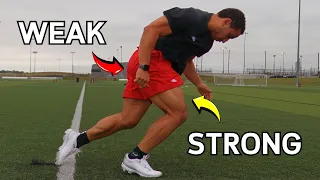
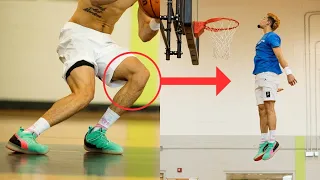
apply remember it's two parts of the equation force and time so how we maximize time is by lowering more through your approach cuz the lower you are the more time you can spend applying Force into the ground and what allows you to lower is your penultimate step penultimate stands for second to last it's a second to last step and in a twoot jump It's that really big step that jumpers take right before planting those last two steps like that looks like they hit a trampoline and they jump high into the air so my tip for
improving your jump technique is find a jumper that has similar body proportions to you that has the same jump style to you that could be left right right left left leg right leg and then compare your jumps frame by frame to their jumps and I suggest only starting with the last two steps that way you get your penultimate step dialed in practice this until it looks good and it feels natural it's part of your muscle memory this is going to take a few hundred to a few thousand reps now the second part of jump technique
is acceleration that's a change in velocity and one of the biggest mistakes athletes make when it comes to their jump technique is starting too fast so they start really fast at the beginning of the approach and then they decelerate they slow down as they go to take their penultimate step instead it should be the other way around you should start slower end up faster this is called your Rhythm and in order to improve your Rhythm start slow you can literally start by just walking into your Approach at this point your penultimate step should be mastered
so from there just take like two steps backwards and then practice walking into your approach and then when the support leg of the penultimate step hits the ground that's when you want to go as fast as you can so literally walk into it go as fast as you can on the penultimate then as you become comfortable with that practice starting with higher and higher speeds as long as there is an acceleration decelerating is the worst thing you can do avoid it at all costs so ideally you had a big background in sports that taught you
all the basic movement patterns you've jumped every day and you have perfect jump technique and now you're maximizing impulse on your jump however to maximize impulse you still need to improve how much force you can generate and the ability to generate force is called strength and the best way to improve your strength is by training with weights so let's get stronger now growing up I was actually very inspired to weight train because of my dad he was an Olympic weightlifter in college and I would go to his weightlifting meets and I was just always surrounded
by that then later on in high school when I started getting more obsessed with like bodybuilding and powerlifting and that type of thing I came across so YouTube channels like Clarence Kennedy all things Jim which Expos me to the most elite Olympic weightlifters on the planet and this influenced my training now strength is a specific adaptation and adaptation is just a change in an organism that allows them to survive whatever environment they're in the organism in our case is us our human bodies and the environment is the weight room and the adaptations that we're looking
for are hopefully ones that are going to help you to jump higher now strength is a specific adaptation that that has been shown to improve how high someone's vertical jump is for adaptation to occur there's a few things that must be present one is variety so think about your environment right if you're always in cold weather you're going to adapt to that cold weather then if you put an organism into a warm weather environment there's going to be some adaptations that take place in their body over time that's going to allow them to be able
to be in that warm weather another very important law of adaptation is the law of progressive overload which literally means that over time things to get more difficult and this is going to allow you to keep adapting then there is the law of specificity which is how similar an exercise is to the activity that you're trying to improve which in our case is jumping and then finally we have the law of individuality which means every organism responds differently to different types of stimulus in their environment so they're going to all adapt differently now let's look
at strength in terms of variety we can manipulate the exercise selection so doing a squat one month versus doing lunges in another month is an example of how we can Implement variety another way to implement variety is by manipulating volume and intensity think of volume is how much work you're doing sets times reps and then think of intensity as the percentage of your max that you're doing in terms of strength training they typically have an inverse relationship so if you're doing more volume you have to do lower intensity and vice versa and over the course
of a training plan you generally want to start at high volumes and move over to lower volumes and higher intensities and you will have implemented variety into your training how do you choose what exercise to do we want it to be specific remember the more specific the exercise the more adaptation there's going to be for the task that you're trying to improve and there's a few different ways to look at specificity in terms of strength exercises the first one is what muscles are being used when you do a two foot jump your quads and your
hips are the muscles that are most used so strength exercises that work on your quads and hips are going to have the most transfer over to Jumping joint angles also matter so when you do a twoot jump you're in a half squat so exercises that mimic that 90° angle at the knee are going to also have more transfer and finally we have speed of the movement the time elaps from when your plant foots the ground to when you tow off on your jump and a jumper that's jumping from like 30 to 40 in is around3
milliseconds now when you do exercises you have to accelerate the bar right that's part of the equation for force force is equal to mass time acceleration so the bigger the mass and the harder you're accelerating it the more force your muscles have to generate in order to move that weight how quickly you accelerate is called your time to Peak velocity so there's a point in a movement where the bar is moving the fastest how quickly you get to that is your time to Peak velocity and there is a correlation in terms of specificity when you
match up time to Peak velocities to ground contact times in a jump so if you measure your time PE velocity in a lift and it's. 3 milliseconds it probably means that it's very very specific now that we know about specificity let's choose a half squat as our exercise because it has joint angles that are very specific and it's going to give us the adaptation that we're looking for which is strength our ability to generate Force here's how you manipulate volume times intensity generally you want to choose a training cycle that's about 4 weeks long have
three weeks of loading one week of unloading during week one you want to have higher volumes lower intensities so as an example let's start off with five sets of six before you start doing your program you want to know how strong you are so I would suggest testing your Maxes make sure that this is done in a safe way and that you have proper technique which you have learned because you practice all your moving patterns from a young age and an easy formula to know what percentage to do your exercises at is this table right
here one rep you should generally work at about 100% of your max two reps 95 three reps 90 four reps 85 5 reps 75 6 reps 70% this is a general guideline for when you're mid training cycle you can actually do a higher percentage at those reps but when you're working out you're typically doing a lot of sets with a lot of reps and you're going to be fatiguing those muscles the actual number is you at like 100% effort right but you have to go up and try to hit that same sets and Reps again
which is not possible following these guidelines allows you to be able to complete the workout and provide a stimulus that's going to that's going to cause you to adapt and gain strength and then an easy formula that you can follow is week two add a set take away a rep move up the percent percentage by 5% and then week three is the highest intensity week do the same thing take away a rep add 5% to the intensity add another set so now as you can see your volume went down your intensity went up then during
week four you're going to cut your sets in half take away a rep add 5% again and now you're going to have high intensity very low volume so you're going to be able to maintain strength during that week but you're going to dissipate the effects of fatigue and then you're going to Super compensate which means you're going to jump higher which is the ultimate adaptation that we're looking for and now just follow the same principles for other exercises generally you want to have a knee extension exercise you want to have an exercise where you hinge
you want to hit your posterior chain you also want to hit knee flexion and then you want to hit your calves do this around three times a week and you're going to gain a lot of strength then the next month you're going to choose different exercises cuz we are still looking for variety right so instead of squatting you might do a lunge instead of an RDL you might do a hip thrust over time your strength is going to go up which is going to increase your ability to generate Force which means you're going to jump
higher however if this is true why aren't powerlifters the highest jumpers on the planet it's because as you become more Elite your ability to jump high and generate Force very quickly becomes less and less correlated with increasing your ability to generate force in a strength exercise this is because time is a big limiter in jumping remember the time to apply force in a jump jump is about 300 milliseconds how much force you can generate in that short period of time is called explosive strength or your rate of force development and in exercise science this is
typically known as your power your ability to generate Force very quickly power is force times velocity however we don't like to use that term very much because it's not a direct onetoone correlation between power and how high you can jump instead we like to think think about things in terms of impulse what we generally still use power as a term for rate of force development exercises that increase your explosive strength as you become more advanced you have to do things that increase your rate of force development and not necessarily your maximum ability to generate Force
so this is where power exercises come in my favorite Power exercise to do is a power clean now a power clean consists of three main parts there's the first pull off the ground then there is a double knee Bend so look at my knees here they go from straight after the first pull to bending again under the bar and then I jump that's called the double knee Bend and that leads to the second pull and then the final part which is the catch power clean is very specific to Jumping because it mimics the movement pattern
of a penultimate step on the first pull off the ground and then the time to Peak velocity in a power clean is actually very similar to the ground contact times in a twoot jump it's a very specific exercise that you can use to jump higher and there are variations that we can do to implement variety into the training so in our very basic plan we would start with clean pools in month one power cleans in month two and then hang cleans in month three there are different types of power exercises you can see by looking
at a force velocity curve this is a curve that shows the relationship between force and velocity generally the higher the resistance that is experienced the lower the velocity so resistance in our case is how much weight is on the bar for example in a squat it's going to move very slowly versus sprinting which is at the entire other end there's no resistance moving through very short ranges of motion so you're going to be able to generate a lot of velocity in that movement where exercises lie in this curve compared to where jumping lies on this
curve also is another way to see how much specificity an exercise has in a training plan you want to go from General to specific you want to be very general with high volumes because one it's going to decrease the risk of injury generally the more intense and specific an exercise is the higher the risk of injury two it'll increase your work capacity So you you're going to be able to do more without getting hurt later on three the higher volume leads to hypertrophy in specific muscle group group that you need to jump higher the bigger
a muscle is the more potential it has to produce Force when you're doing the high intensity stuff that more so improves your neuromuscular abilities right so think of your brain your brain has nerves that go out and inovate the rest of your body and the connection of a nerve to a specific muscle fiber is called a motor neuron also called a motor unit and there's different types of motor units there's fast twitch motor units and slow twitch motor units the ones that we like are the fast twitch motor units cuz they fire quicker they're bigger
they can produce more Force more quickly which means that they are very useful for jumping higher higher intensity exercises and exercises that are more specific in terms of jumping recruit more of these fast twitch motor units so we do the high volume stuff early on to increase the size of your muscle fibers and then we do the intense stuff later on to be a to improve your neuromuscular efficiency which is how quickly you can recruit those motor units how many of them can you recruit in what order you recruit them and how coordinated that recruitment
is so now we know what power exercises to do in terms of the Olympic list and their variations and we know what strength exercises to do to increase muscle hypertrophy later on in specific muscle groups and then increase the intensity later on to increase your neuromuscular efficiency in those strength exercises now let's learn about your tendons when you look at athletes like John Moran right they look pretty skinny but they jump higher than everybody else and they make it look really easy why is that so it's because they're able to tap into the power of
their tendons a tendon is a structure that attaches muscle to Bone and when you tug on that Tenon when you stretch it there is energy that is stored inside it that can be released into kinetic energy the higher the kinetic energy the higher the velocity of the movement which in terms of jumping as your exit velocity means that you will jump higher a tendon is literally like a rubber band right the more you stretch the rubber band The more energy is stored that is released into kinetic energy when you let go of it but how
exactly do we stretch the tendon remember a tendon is attached to a muscle so when the muscle generates tension right when it when you Flex it it tugs on the tendon so it's like this and then it tugs on the tendon so the more force and the more quickly your muscle can produce that Force the bigger the stretch on the tendon and the bigger the release of energy the best way to get the most stretch on a tendon is by loading that unit of the muscle and tendon very very quickly eccentrically an Ecentric action is
a lengthening of the muscle and tendon a concentric action is a shortening of the muscle in tendon and when performed in succession very very quickly it can load up that structure a lot and remember the bigger that load the bigger the release that is called the stretch shortening cycle and a very fast stretch running cycle is an elastic movement elasticity is a material's ability to return to its normal shape after being stretched elastic movements are things like jumping and sprinting think about it right the faster you squat down and up the higher you're going to
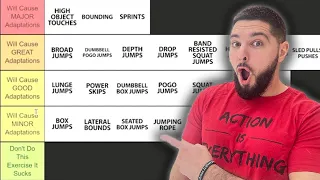
jump the more elastic your tendon is acting and the way that we train that stretch shortening cycle is by doing Plyometrics my favorite plyometric is Max approach twoot jumping because it is the most specific petric there is the same rules of ground contact times time to Peak velocities joint specific angles and muscles used apply to Plyometrics in terms of specificity so the activity you're trying to improve is the best plyometric and then things just get more General from there when you do other Plyometrics now true Plyometrics however overload that Ecentric portion of the stretch shortening
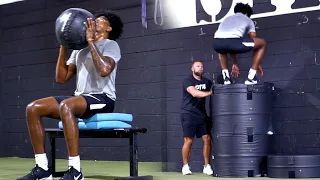
cycle and the way we do that is by using gravity to overload and the next size that does that very very well are depth jumps depth jumps is when you jump off a high box it overloads the Ecentric and then you want to shorten the ground contact time as much as possible to cause a very violent reaction force you're going to jump back up and by doing this your body your brain basically freaks out and it's like what is going on these forces are insane we need to cause some adaptations to occur in the muscle
and tendons and the neuromuscular system that will lead to this athlete to be able to handle those forces and in turn jump higher you're basically tricking your body to be able to launch up in the air as high as possible now there's a very easy way to implement these P metrics into your program it is by having a jump session at least once a week in conjunction to your strength training eventually there will be a point of diminishing returns this graph shows what diminishing returns are right you get a lot of gains later on and
then it levels off as you become a more advanced athlete you have to start using more advanced Plyometrics in order to implement variety into your training however if you're watching this this is most likely not you and jumping once a week is enough the order of the exercises is very very important you want to do the higher intensity more specific stuff later on so that you can do it with high quality without you being fatigued so that it becomes more intense something cool about petrics is that they self- intensifies So the faster you're running and
the higher you're going to be jumping the the higher the forces you're going to be experiencing which is going to cause a bigger adaptation and as you become better this becomes more and more magnified so you so they self- intensify right you don't have to just add weight to intensif fight they just become harder as you get better and because we want to do these with higher quality you want to do it in the beginning of the programs so do your exposive stuff early like sprinting and your cleans do that first in the workout then
do your more specific strength exercises next and then do your accessory work last in terms of the schedule this is a very simple schedule you can follow sprinting cleans in your strength training sessions three times per week doing on Monday Wednesday and Saturday do your jump session on Friday as far as your jump session literally go out and jump as hard as you can with a goal in mind so that can be trying to touch something that can be dunking do that for an hour or two cut the session as soon as you see a
big drop in performance and again repeat that for 3 weeks de lo on the fourth week and you're going to jump way higher at the end of that D Lo then rinse and repeat every single month however how do you do this without getting hurt specifically how do you do it without experiencing knee pain which is the most common injury you have to use load management principles and I'm going to give you guys just a simple way to do this choose a provocative pain test that hurts your knees every single morning do it once rate
that on a scale from 1 to 10 if the pain goes up from day to day that means whatever you did that first day was too much and you need to decrease the intensity the best way to do this is to remove the most specific stuff first if you're still feeling pain you have to switch your training plan to do slow squats essentially load up at least 70% of your max go 4 seconds down 4 seconds up do that every other day you also want to be doing isometrics every single day put a kettle bell
on your foot you can grab your your shin and push out against uh your hand against the force of your hands pulling in as long as you're at 70% effort do that 30 to 45 seconds 3 to 5 sets 2 to three times every single day and then you want to bleed the more specific stuff in later on however this is probably too advanced for the scope of this video and if you want me to coach you through that process of tending rehab or if you just want to get coached by me to just jump
higher even if you're healthy go to thp strength.com or click the link in the description we actually have a big discount going on so take advantage of it right now that's it for the video hopefully this helps you jump higher catch you guys next time peace out