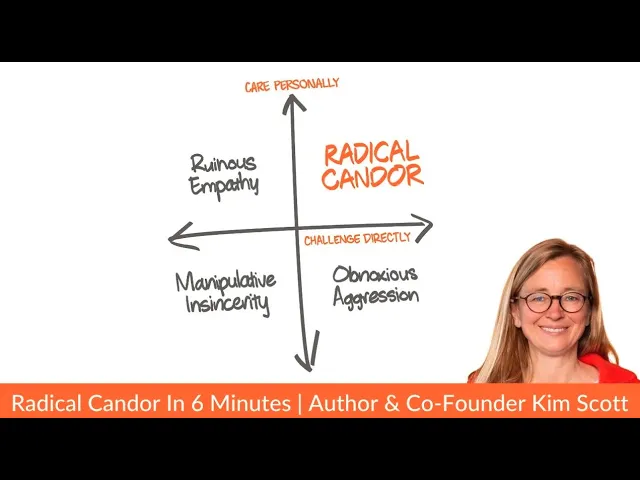
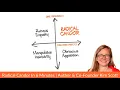
hi I'm Kim Scott and I'm the author of radical Candor it's a very simple idea and if you can put it into practice it will help you do the very best work of your life and build the best relationships of your career all I mean by radical Candor is care personally and challenged directly at the same time why is that so complicated to explain why I'm going to offer you a radical Candor framework a two by two framework all of life's hardest problems really can be boiled down to a good two by two framework care
personally challenged directly let's take each dimension in turn first of all care personally this is what I think of as the give a damn dimension of radical Candor and what happens here begins when we're about 18 19 20 years old the problem begins then we're right at that moment in our lives we get our first job but our egos are maximally fragile and our personas are beginning to solidify and right at that moment someone comes along and says be professional and for an awful lot of us we sort of translate that to mean to leave
your emotions leave your true identity leave your Humanity leave everything that's best about you at home and show up at work like some kind of robot and you can't possibly care personally if you're showing up at work like some kind of robot so what I encourage folks to do is is to really be more than just professional not be unprofessional but really create the kind of environments in your workplaces where you can you can bring real human relationships you can develop real human relationships at work however love is not all you need you also need
the other dimension of radical Candor that this is what I think of as the challenge directly Dimension or the willingness to piss people off and this is hard because from the moment we learn how to speak starting when we're 18 months old not 18 years old our parents come along and they say to us some version of if you don't have anything nice to say don't say anything at all and I would argue that now that you are working it's your job to say it so this is hard radical Candor is hard it's hard because
of this be professional training since we got our first job since we were 18 years old and it's hard because of this if you don't have anything nice to say don't say anything at all training that's been pounded into our head since we learned to speak at 18 months older however old we were one of the things that I've done to try to make it a little bit easier is to give a name to what happens when we fail on one dimension or another which we all do multiple times a day so sometimes we remember
to challenge directly but we forget to show that we care personally and this I call obnoxious aggression in an early draft of radical Candor I call this the quadrant because it seemed I don't know more radically candid but I stopped doing that for a very important reason as soon as I did that people would use this framework to start writing names and boxes and I beg of you don't use this framework that way think about radical Candor like a compass that is going to help guide specific conversations that you're having with specific people to a
better place now very often when we realize we've acted like a jerk and we've landed in the obnoxious aggression quadrant rather than moving up on the care personally Dimension it is our instinct to go the wrong way on challenge directly and the problem there is that then you wind up in the very worst place of all manipulative insincerity and this is where passive aggressive behavior political Behavior backstabbing Behavior Creeps in the kind of stuff that makes work intolerable and it's kind of fun to tell stories about obnoxious aggression and manipulative insincerity but the fact of
the matter is because that's where the drama is but the fact of the matter is the vast majority of us make the vast majority of our mistakes in this last quadrant where we do remember to show that we care personally it turns out most people are actually pretty nice but we're so concerned about not hurting someone's feelings that we fail to tell them something they'd be better off knowing and this is what I call ruinous empathy so one of the things that I want to do in the next couple of seconds is just offer you
an order of operations how can you begin to put these ideas into practice so start by soliciting radical Candor especially soliciting criticism don't dish it out until you prove that you can take it so you want to solicit first now you're in a better place to start giving radical Candor and remember radical Candor is just as much about praise even more about praise than it is about criticism you want to focus on the good stuff but you don't want to ignore problems either so that's giving radical Candor now in order to make sure that these
conversations are good the next thing you need to do is to gauge it if there were an objective measure of radical Candor I could just post on a blog post somewhere what the right words are but there aren't necessarily right words what you need to do is understand how what you are saying lands for the other person so radical Candor gets measured not the speaker's mouth but at the listener's ear so if the person is upset if they're angry if they're sad that's your cue to attend to the care personally dimension of radical Candor to
understand the human need behind the upset but if the person just isn't hearing you which actually even though you fear the strong emotions what usually happens is you work up your courage to say something and then the person doesn't even hear you when they don't hear you that's your cue to move out on the challenge directly Dimension a radical Candor and last but not least encourage it all too often one person who we know comes and starts talking to us badly about another person who's not in the room and it's tempting to listen it's tempting
to think that you're being an empathetic colleague an empathetic friend to listen this is the one time when listening is not your friend all you're doing is stirring the political pot when that happens the thing to do is to encourage that person to go talk to the person with whom they're having the problem the conflict so encourage radical candor thank you so much for your time go forth and be radically candid