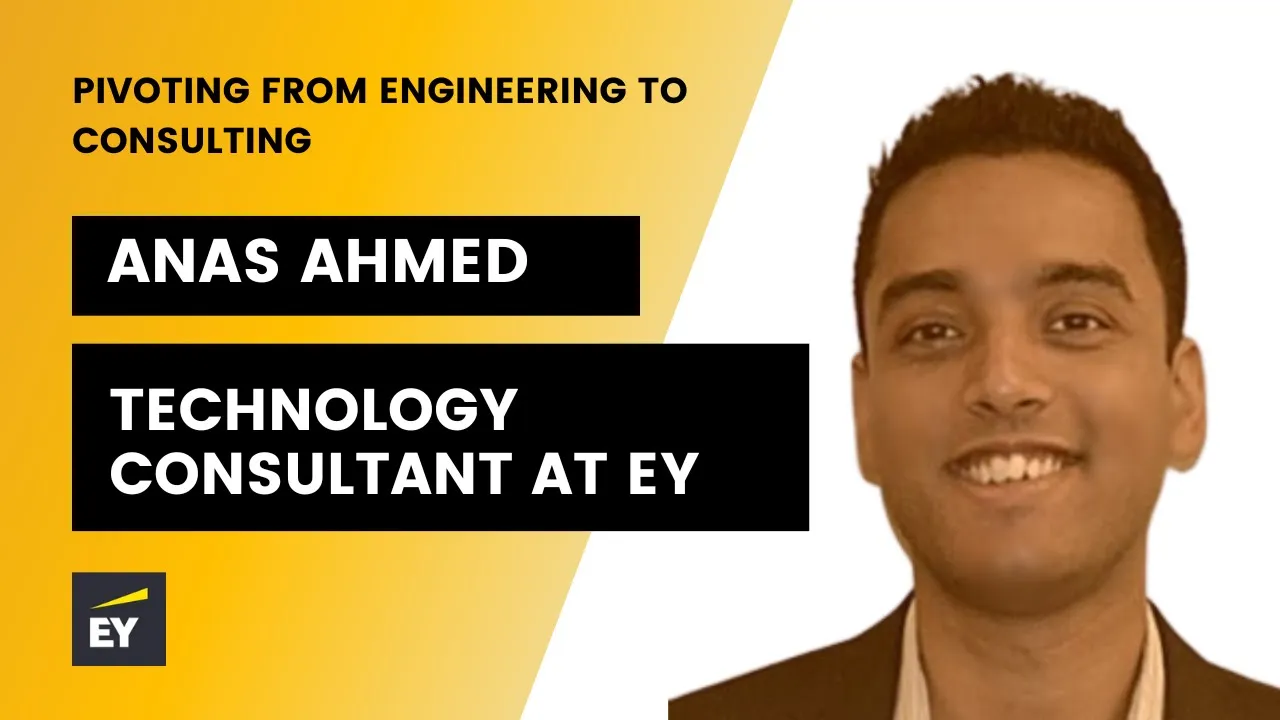
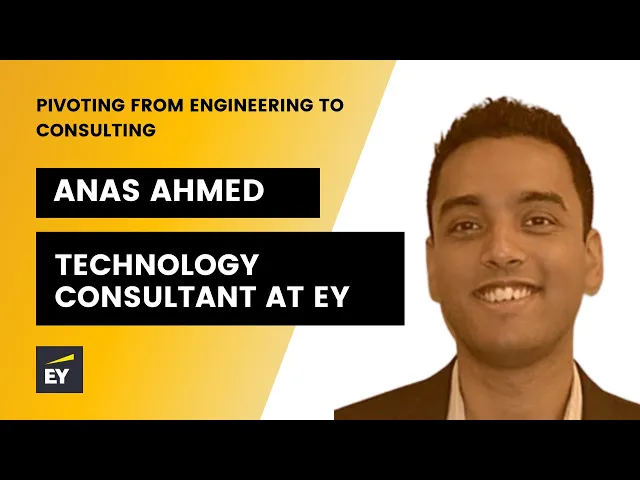
foreign [Music] welcome to the illuminate podcast the cast we're so excited to have you on today's episode so thank you so much for your time yeah pleasure to be on so could you please share your educational Journey leading you to your current role as a technology Consulting engineer at Ernst and Young what inspired you to pursue this field and how has your position evolved since your previous role yeah so I studied at the University of Waterloo I did chemical engineering there with management Sciences but that background I've worked in oil and gas field quite a
bit I've actually had an interesting Journey where I've done work for certain oil and gas companies I've done work for steel manufacturing I've worked for Honda as a as an engineer as well PTC if you guys have ever traveled TTC so I worked in all of these places when I was about to graduate I got a stint at Deloitte and they needed someone who understood oil and gas for an Erp project so that's how I got my shoe into Consulting and I wanted to try it after graduation and hansai was able to secure a job
at capgemini Consulting then eventually I moved on to Ernst young and that's what I do right now so that's a bit of my background and to move into Consulting when I was doing work at capgemini I was in oil and gas sort of Technology engineer so I used to work on projects where they would need input on how to design text solutions for oil and gas companies and I used to participate in that but the oil prices went down and the business went down with it so they told me either I could move to a
different industry and contribute to that or I could you know maybe try and look for something else so I want to try a different industry and I did so I've worked mostly in the insurance practice of my firm amazing yeah thank you for bringing us along with that journey and it's really interesting that the industry and its fluctuations had an effect on your career path and led you to your current role as a technology Consulting engineer so more on that specific role I would love it if you could provide an overview of your day-to-day responsibilities
as a technology Consulting engineer and what aspects of that job bring you fulfillment and satisfaction yeah so as a consultant do you wear quite a few different hats and Lead solution architect on one of the products that we sell on the workers compensation space but overall because we work in the insurance practice you tend to deal with customer clients that are in Property and Casualty so Standard Auto Insurance home insurance companies who people like you deal with on a daily on a or whenever hopefully you don't get into collisions daily but whenever you deal with
them you deal with them so we design solutions for them and I'm also the lead QA within my practice who we do a lot of work with designing testing strategies for them to test the solution that we're about to put in so for all of these companies the goal of our practice in Tech Consulting is to develop Solutions or Tech solutions that will help them enhance their business forward So within the insurance space this would be policy-based systems and claims based systems so we design those sorts of systems and I take part in the design
as well as the QA work on top of that I have some responsibilities with respect to our SAS operations so software as a service operations as well as the leading some of the training exercises for the members of my team that Internationals is what I do it sounds like it's quite a lot but when you work in Consulting this is the norm you have to contribute to different areas you have to make sure that you are successful in different areas and making sure everyone else is live within your organization and your clients at the same
time is made better if you want to move outside of your practice you can if you want to go into internal only role you don't want to be client facing you can do that as well UI provides you and most consulting firms provide you that level of flexibility yeah yeah exactly which can definitely make it easy to find satisfaction as well I'm going to pass it off to Crystal to ask the next few questions I thank you so much for joining us so my question to you next is as a solution architect and as you
mentioned a development and QA lead could you describe some of the notable projects and what are some kind of significant challenges you encounter and how do you ensure effective collaboration and successful project delivery a lot of insurance projects obviously that's the practice I work in my main focus and from a sort of a solution architect standpoint is workers compensation Solutions so I've done it for a couple of provinces and have a good amount of experience there I know a lot of those Solutions inside out that's what I typically do so leading teams in these areas
is what you will typically see my role so on the projects we engage in if it's for workers comp I typically lead the full team I will be leading the development work the QA work the solution design work and on top of that what I also do is to design the processes that you need in order to go about your software development life cycle so your software development life cycle is typically collection of requirements doing development work and then testing the development work and handling any post implementation exercises so all of this work involves a
lot of handoffs so you need to develop good structure within your team to allow you to do proper handoffs between individuals so I developed the processes and the tools that we have to use in order to achieve a good software development logical across our team members what sort of key challenges you would face well the handoffs are difficult when you're working with the number of folks if you're not having a method in the team is sort of regimented in to do on a day-to-day basis and do effective handoffs do quality work and have some methods
to do quality work they are empowered but almost empowered in a guided way where they are Guided by process when you are not there that's the kind of thing that becomes challenging and you have to be very good in your management principles too let your team work according to your methods rather than their own so that can be challenging also working with clients is difficult so within the tech space things change on a daily basis on a quite frequently today you have ai yesterday the big thing was web development and blockchain was there as well
you don't see a lot of people talking about blockchain anymore so because of the change in technology you need to work with books on the client side who are of the mindset of change so what does this really mean you can it's probably easy to have a speaking to a c-suite executive and or a CIO and if you want to change their mindset you can get them to change to yes I want to take on this new technology project and exercise but what you ideally want from them is to accept that change is inevitable on
an ongoing basis and very few c-suite executives are of the mindset that change is inevitable and they need to move with the time when it comes to technology so that becomes a very hard exercise to bring about that change in mindset within themselves as well as the organization that they're in so that can be quite the challenge sounds like there's a lot of cross-functional collaboration happening in this industry and you mentioned Ai and blockchain so that leads into my next question for you so apart from those challenges and adapting to change what are some other
emerging Trends you have encountered in the technology Consulting industry and maybe in regards to AI or whatnot how are you adapting to these changes and what strategy do you employ to stay ahead in the rapidly evolving technology landscape yeah so the way to put it would be um yes to Simply follow the money right where the money is is where you'll see a lot of change happening for example at the end of last year this was reported in the news that 300 000 accountants have quit their job across the US so why are accounting fitting
and why is that Gap being left behind so that Gap has to be fulfilled by something either by other individuals who are graduating or by technology Bridging the Gap between resources or individuals or professionals that need to join and the requirements of the company so when it comes to emerging technology you got to find out where the money is or where the requirement is and try and fit any emerging technology within that requirement when it comes to ai ai can with what's been done by open AI is quite interesting it can write code it can
read natural language quite well so these sorts of Technologies are quite useful and to stay ahead of the game you have to somehow incorporate these into your everyday life for example developers you should use them to write quick tests if they want to to test their code if you want to come up with a design for capturing requirements or dealing with a certain difficult problem AI can help you at least understand the basics so the more you incorporate this into your everyday life the better it would be then that's the kind of way you should
use emerging Technologies within your internal theme which is for us ey and also once you learn it there you need to take it to your clients and help them get better with it yeah it sounds like knowing how AI works is really important for people who wish to head into this field in the future so leading off of that question I just asked your answer that's your provided in your experience what are the essential skills both Technical and soft that you had to develop to thrive in this fast-paced Consulting environment yeah I'll talk about soft
skills in a lot of ways soft skills are more important than the technical skills itself I think individuals need to have confidence when speaking having a sense of confidence in building that confidence is very important your confidence should be backed by conviction in your work and good skills obviously a person can have great skills if they don't have the confidence in their delivery to exhibit their skills they will find it you know not that easy to be the one percent in their industry so that confidence is important and you can improve your confidence by and
what I do is I listen to a lot of debates right listening to a lot of debates especially on topics that may be difficult is very important because difficult topics will have difficult arguments and you need to understand how to challenge difficult arguments so the person who can make good Arguments for what they are presenting is likely to be more successful than the person who's not doing that and clients appreciate that when you stand in front of the client and you're able to give a good reason as to why they should go with you that's
when they are truly impressed and you need to deliver that with confidence having a good mindset to go about your everyday life is very important so value truth right how to find truth so truth would mean the best way to do certain thing in a given context from a professional's perspective so having that sort of mindset is important I think that really helps you in your everyday life not just professionally but also personally as well when it comes to technical skills it's like an asking an investor actually to tell you what stock would you have
invested in 10 years ago you know because hindsight is 2020. from the perspective of Technology yeah it's easy to say that oh we should invest our abilities into learning this type of language for example react is a good language to learn or learning how AI works but technology advances so fast that you know it will change very quickly I think the core skill you need to have is what in my industry at least is what system design is about how to go about designing systems and what each of those components are so studying something like
AWS is quite useful I think Azure systems and how they're designed so Cloud systems design is good to learn what are the different types of Technology Stacks that are needed for different Industries because knowing these would help you understand how different systems are designed for different purposes if you if you don't know the language itself any programming language that's probably okay but try and learn at least the simplest ones I think all of these together will make you quite successful in the tech Consulting industry thank you so much for sharing so for now for the
last few questions I'm going to pass the mic back to Sophie thank you Crystal and thank you and us for those amazing insights that illuminate we really value soft skills and and Advising youth on how they can acquire those so in addition to soft skills I would love to know if there's any particular resources or certifications that you would recommend to aspiring technology Consultants and which certifications hold high value in the field from your experience resources YouTube is a great resource if you can get access to udemy a lot of the courses on udemy are
also quite well structured but YouTube YouTube is great right you have some great teachers who put up their content on YouTube you can pretty much learn anything from there so utilize something that is free rather than spend money on anything else companies are trying to move to Cloud so understanding that is not too difficult and I think you can learn that I think so the language based certifications are also good learning react Ruby on Rails or python but also if you don't like that what you can also learn is some basic QA so istqb certifications
are quite good QA automation is quite good as well my favorite one that I do is something around solution design because I think learning is how to design Solutions and designing text systems is an interesting business to be in especially for those who like solving problems systems and software is very complex and the people on the top at the top of the tree are the ones that understand system design really well not necessarily the ones who understand developing code really well so any of those will be quite useful to you yeah definitely that's amazing thank
you for sharing that so we've covered soft skills that are required and certifications and resources for our listeners so hopefully they can take heat of those and lastly our last question is also something they might benefit from so and ask if you had the opportunity to travel back in time and offer one piece of advice to your younger self in terms of career goals what would it be yeah the kind of goes back to me talking about Afghan investor what they would have invested in 20 years ago right I did chemical engineering I moved into
technology Consulting so point the career shift but it's been a good decision I think being in the tech field is good it is cyclical at times meaning you could be one day working for Google the other day you're looking for a job right but it's quite rewarding and as long as you keep your skills up on a regular basis and essentially find the flow of money where the flow of money is you'd be quite successful if I had known in the past that you got to look at where the money is flowing and find gaps
that can be exploited by technology I would have done more of that now I'm starting to do it in my last few years but essentially look for gaps where something is needed there's a requirement for a solution requirement there's a problem there that exists that you need to solve and go ahead and try and find a solution for that problem that's the best advice I could give yeah definitely that's amazing and it's really nice that you're able to reflect on your history and provide insight to those that have yet to explore that career and take
heat of that and apply that to themselves so that concludes our last question for you today and ask I just want to thank you again so much for joining us and for your time and I really value your Insight and I'm sure our listeners will as well okay well thank you for having me on once again [Music]
![[WEBINAR] How to measure the commercial value of B2B content](https://img.youtube.com/vi/b2FivN9H09U/maxresdefault.jpg)