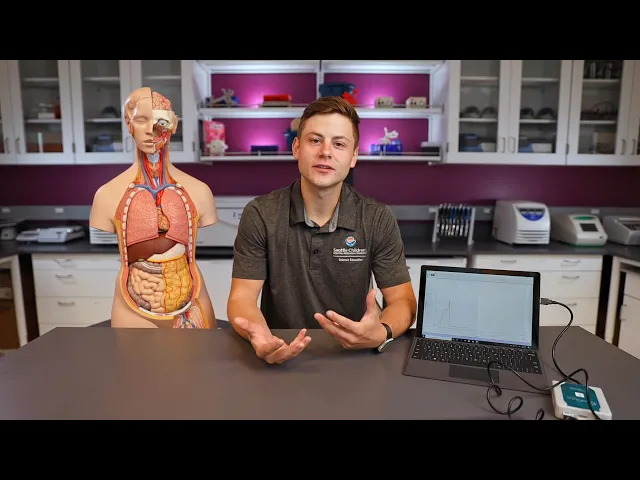
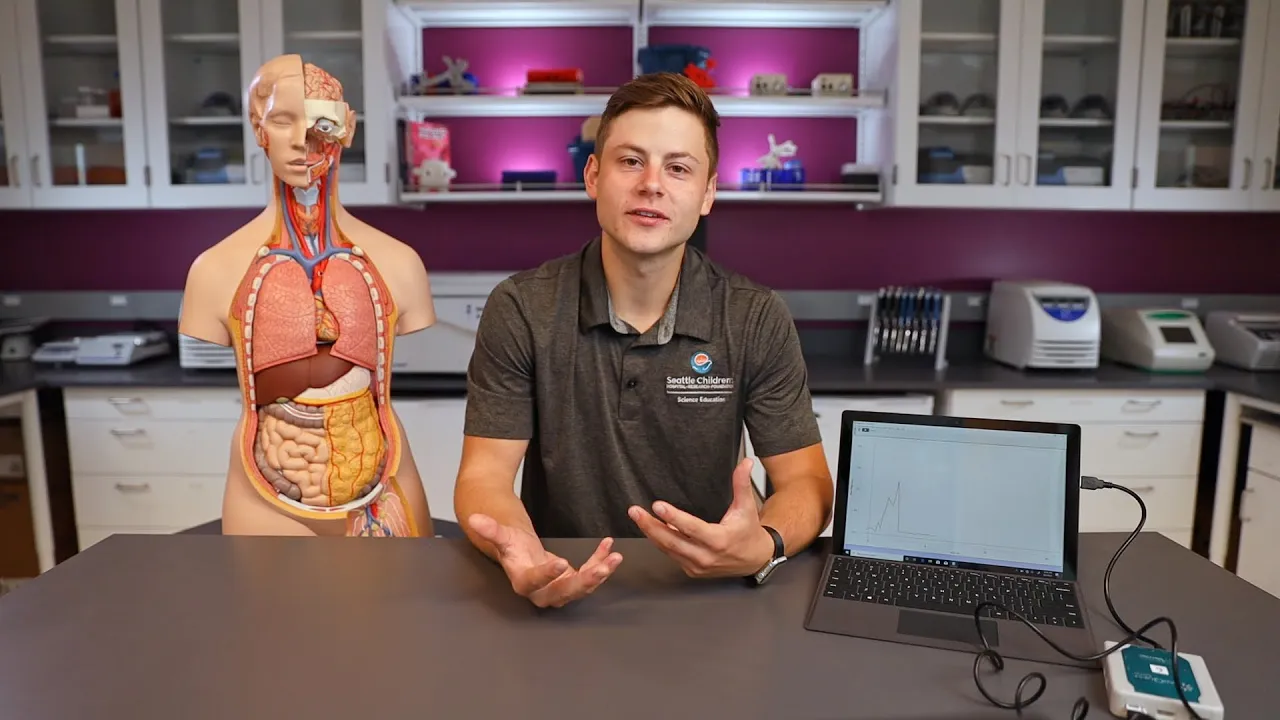
Hey everyone! My name is Corey and I'm a scientist at Seattle Children's Hospital. And, I'm actually inside my laboratory today to show you some really cool equipment, and we're going to be talking about vital signs.
[Music] Before we get into the lesson, I want to do a little bit of review. So, here I have my friend Torso Terry, and I just want to talk about the human body for just a moment. Inside our body we have organs, right?
And, they're not just floating around wherever they want to; they're organized. And, they're organized into what we call systems. A system is just a group of organs that work together.
And, a few quick examples: We have the brain, which is an organ that's in the nervous system. We have the lungs, which is part of the respiratory system. We'll talk about that today.
We also have the stomach, which is part of the digestive system. We have the heart; it's part of the circulatory system. You have all kinds of organs and different systems that work together, and it's really neat.
So, we're actually going to take some measurements today to monitor some of these, and they are called vital signs. Vital signs are something that a healthcare professional would take to monitor two really important things. One is to make sure that your body is working properly, that things are going as planned.
But also it helps, it's kind of like clues to kind of figure out why something is not working or what's going wrong. So, it's two things. One: to make sure the body is working properly.
Two: what might be going wrong. Healthcare professionals will use these vital signs to help determine what's going on. Now, just a disclaimer: We're not using vital signs today to diagnose anything.
We would need more sophisticated tests than what I'm going to do today, but they are an example of what a healthcare professional would do. Healthcare professionals are super cool. We work with all kinds of healthcare professionals.
There are many examples. There are nurses. There are physicians, doctors.
We have physical therapists. Dentists. We have all kinds of fantastic health care professionals, so we're actually going to see what it's like to be one today.
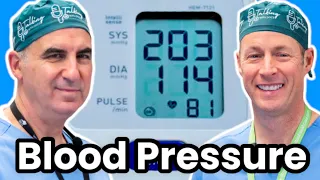
And, we're going to monitor four different vital signs today. The first one, we're going to start with our blood pressure or my blood pressure, and we'll go over what that means. But, it is related to the heart.
We're also going to monitor heart rate or pulse, so how many times my heart beats per minute. We're going to monitor my respiratory rate, so the amount of times I breathe in one minute. Now, keep in mind, one minute is 60 seconds.
That'll come in handy later, okay? And, we're also going to monitor my temperature. You might be a little bit familiar with your temperature.
Maybe you've taken your temperature to see how your body makes and gets rid of heat. It's really important. We're going to monitor all four of those, and we're going to go ahead and just get started!
The first one I'm going to monitor is my blood pressure, okay? Blood pressure, just to go over what that is, your heart is like a pump. And, it's pumping blood all throughout your body.
Your heart is, kind of, it's not in the middle, it's just off to the side. And, if you take your hand and make a fist, it's about the size of your heart. Your heart is pumping blood all throughout your body so all of your cells that make up your body can receive the oxygen and nutrients from the blood and it's really cool.
So, it's circulating blood, your heart, but what's really cool is blood pressure. If we take that into what it means, pressure is like force. We're kind of like pushing on something.
So, if I were to push on Terry right now, I'm applying force or pressure. So, blood pressure is just the force of blood that's pushing on your blood vessels. You have two numbers.
You might be familiar with this. You have one number when the heart squeezes or contracts, and that's when the blood is really pushing against the arteries or the blood vessels in your body. But, then you have another number, your low blood pressure, when your heart relaxes and the blood pressure is not pushing as much against your blood vessels.
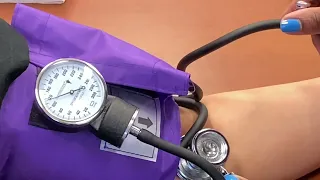
So, you have a high pressure when the heart squeezes or contracts and a low pressure when the heart relaxes, okay? That's your blood pressure. And, to monitor this, I'm going to use something called a blood pressure cuff.
It's this thing right here. You might be familiar with one that maybe you've had on your arm before. This one actually just goes on my wrist.
It has a little strap. And, what I'm going to do is I'm going to use this to monitor my blood pressure, but it's also going to monitor my heart rate or my pulse. So, it will monitor my high and low blood pressure, but also my pulse.
What I'll do, I'll take this strap; I'm going to place it on my wrist, and I'm going to make sure it's nice and snug, okay? I don't want to have too much loose room. I'm going to make it nice and snug.
I'm going to go ahead, rest my arm on the table. You don't want to monitor your blood pressure when you're running around too much or moving around. So, I want to be nice and relaxed, and I have here a little button that I can just simply press.
It'll start and this little cuff or strap will begin to fill with air. It will feel a little tight, but it's not going to hurt. You might be familiar with it on your arm.
It gets tight but then it starts to release the air and starts to relax. Now, numbers are on the screen. I'll actually show you in just a moment, but what it will do is it'll take just a moment, and it will monitor my high blood pressure, my low blood pressure, and my pulse, okay?
And, there'll be three numbers on the screen for you. And, I'll kind of explain what these numbers mean, but I'm going to be nice and relaxed, and there we go. We have our numbers.
So, here I'm going to go ahead and zoom in so you can see the numbers on the screen. On the screen you can see the top number, 146, is my high pressure, and the number below that, 99, is my low pressure. 146 was when my heart was squeezing or contracting and 99 was when my heart was relaxing.
So, my blood pressure is 146 over 99. The number down below that's next to the heart, 86, is my heart rate. That's how many times my heart beat per minute.
86 times in 60 seconds, my heart was beating. It's pretty cool. Those are my numbers.
I'm going to go ahead and take it away, and we can talk about what the numbers mean a little bit. My blood pressure, 146 over 99, okay that is in a normal healthy safe range, and typically adults blood pressure is higher than that of kids. And, the reason for that is your heart is pumping blood all throughout your body, and one really important place that your blood needs to get to is your brain.
Now, it supplies the oxygen and nutrients, so it's really important that your heart can pump blood against gravity all the way up to your brain, and adults, as they grow older they grow taller, and so they actually have to go a further distance. Think about the distance between your heart and your brain. Mine's probably a little further, so my blood pressure will be higher than yours, probably.
It's kind of cool. If we want to think about the animal kingdom, think about the animal with the furthest distance between their heart and their brain. Yeah, the highest blood pressure probably belongs to the giraffe.
It's pretty cool. Their heart and their brain, the blood has to go all the way up that neck. It's pretty cool.
So, that's blood pressure. My heart rate, 86. My heart rate, my heart beats 86 times in one minute as I was just sitting here relaxing.
But, it's pretty easy to change. If I wanted my heart rate to go up, I'd probably just go outside right now and run around. But, if I wanted it to go down, I would actually probably relax and just take a nap, lay down, relax, and my heart rate would go down.
So, your heart rate is pretty easy to change. And, it actually will probably lower as you get older because your heart's a muscle and it gets stronger and more efficient. As newborn babies, your heart rate was probably 180 beats per minute.
It's pretty fast. 180 times in one minute. That's three times every second.
As you grow older, your heart's becoming stronger. You're using your heart, your muscles, and it's becoming more efficient and it will actually probably get lower. The cool thing is if we were to take a professional athlete like say Russell Wilson, as an example.
He's a very fit individual, and his heart rate is very very efficient in pumping blood throughout his body, so it's probably more on the 40 or 50 range. It's pretty cool. That's blood pressure and that's heart rate.
Now, I'm going to go ahead and move on to my next vital sign, which is respiratory rate. Respiratory rate is the amount of times I breathe in one minute, which remember is 60 seconds. Your respiratory rate is how many times you breathe in a minute, and breathing is really important.
I mean, if we break it down, breathing is important because it keeps you alive. You're bringing in the oxygen when you inhale, and you're breathing out a waste gas called carbon dioxide, and that keeps you alive. If we want to look at our friend Torso Terry again, just as an example, what happens when we breathe in, air first enters your nose and your mouth.
Then, the air travels down this hard tube, kind of in the front of your throat, called the trachea or airway or windpipe, if you want to call it that. Then, it branches out into these bronchial tubes that enter the lungs. Here's just a lung, and inside the lungs it branches to even smaller and smaller tubes called the bronchioles, goes out to what's called alveoli.
It's kind of cool. There's a gas exchange, oxygen and carbon dioxide, and it keeps you alive. That way all your cells can have oxygen to do their job.
That's your respiratory system. So, it's important that you breathe enough times per minute, and we can monitor that with the vital sign called respiratory rate. To do that, I'm going to use a different piece of equipment called a spirometer.
That's actually what I have right here. If you follow the cord, you can see it's actually plugged into this computer here, and this spirometer will monitor my respiratory rate in a pretty cool way. If we want to break this up into root words real quick, often times in science you can take a really long, kind of intimidating word and break it into smaller words to help you understand what it means.
If we think spirometer, well, the first half "spiro" just means breath and "meter" means to measure. I'm actually just going to use this spiro-meter or spirometer to monitor or measure my breath. And, what happens is when I breathe into this white part right here, the air travels across this little, wire mesh screen.
The information goes down this cord, out to the computer, and it will graph my results. And, we'll actually interpret and read what it says. So, I'm going to go ahead and use the spirometer.
Before I start, my air, when I breathe out, there's another place it can exit other than just my mouth. It's my nose. So, what I'm going to do is I'm going to use this little nose clip.
But, I also don't want to put my lips directly on this white part right here. Other people may have used it before me, some might use it after me, so I'm also going to use another piece of equipment called a mouthpiece. This mouthpiece is sterile.
It's disposable. So, no one's used it before me; no one will use it after me. I'll throw this away.
But, it's also really handy to just go ahead and place right here, and that's where I will put my lips. That's where I'll breathe into. So, everything's clean, okay?
And, this nose clip, this is actually to prevent the air from exiting my nose so all of my breath is coming out of my mouth. And, I'll go ahead and place it on, and I might sound a little funny, okay? It's kind of fun.
What I'll do, once I have my nose clip on, my mouthpiece on, I will go ahead and I will look at my computer, and there's a little blue zero. That blue zero will zero out the results from the previous results, and I will go ahead and I will click the blue zero. When I'm ready, I'm going to go ahead and press that green play button.
I'm going to breathe nice and relaxed for 15 seconds. I'm going to breathe nice and relaxed. I'm not going to breathe really quick or really slow, just as if I'm just sitting here just kind of thinking about cool things to do with science.
So, go ahead, put my nose clip on, I'll click my play button, and I'll go ahead and breathe normal for 15 seconds. We'll go ahead and watch. So, I'll click play.
. . Okay.
I breathed normal for 15 seconds. And, I'll take my nose clip off so you can hear me. I'm going to go ahead and set this down, and what we can do is actually interpret these results.
I'm going to go ahead and allow this so that we can see. Looking at this graph, one breath is one inhale and one exhale. We need to think about the line going up when I breathed out, and the line goes down when I breathed in.
So, one breath is actually one mountain. If I count these on the graph, I have one, two, three, four breaths in 15 seconds. That's cool to know, but that's not my respiratory rate, yet.
This is 15 seconds. My respiratory rate is 60 seconds. So, we need to do some math.
This is only a quarter of a minute. What we need to do is take my four breaths and multiply it by four. So, if we think about what is four times four It's 16.
My respiratory rate is 16 breaths in one minute, okay? That's pretty cool to know. I breathe, I inhale and exhale, 16 times in one minute when I'm just sitting here relaxing.
There are many different, there's a normal range or a wide range of normal respiratory rates. It could be higher. It could be lower.
It's all dependent on you. As you grow older, you tend to get taller and your chest cavity gets larger and you can become more efficient at bringing more air in or out, so you maybe don't have to breathe as often. You might be supplying yourself with more oxygen per breath.
The muscle, the diaphragm underneath, becomes stronger because it's also a muscle, so your respiratory rate tends to go down as you get older because you become more efficient. It's pretty cool. So, that's my respiratory rate.
I'll go ahead and move this to the side. And, I'm going to move on to my last vital sign which is temperature. We all might be really familiar with temperature, nowadays.
We want to monitor our body's ability to both make and get rid of heat. So, we want to make sure we don't get too hot, but we also don't want to get too cold. Our bodies systems, all of these systems, work and do their job best at very specific temperature ranges, and we want to make sure that our body is keeping ourselves in that safe temperature range.
The way we're going to monitor temperature is we're going to use a thermometer. There are many different kinds, okay? We have oral thermometers, but I'm not going to put anything in my mouth in the lab.
We also have ear thermometers, but I don't really want to see what's in my ear. You don't either. So, what I'm going to use is a temporal scanning thermometer, which is this thing right here.
And, this simply measures or monitors the temperature of the blood in the blood vessels in my forehead. So, all I'd have to do is just scan my forehead, and it will read a temperature. I'm going to monitor my temperature in degrees Fahrenheit today.
That's what we'll use today. There's also degrees Celsius, but today we're going to use degrees Fahrenheit. What I'll do, if I just take this thermometer, place it on my forehead, and press this little blue button right here I'll slide it to the side, let go, and that will be my temperature, okay?
And, I'll try and hold it to the camera so maybe you'll be able to see it. Now, 98. 4 degrees Fahrenheit, that was my temperature.
If I want to double check that, I can actually take this back, and I can monitor it just one more time. It's always good to double check. Hold my button, slide it to the side, and let go.
There we go. 98. 3 degrees Fahrenheit.
It's monitoring my temperature in real time. There is a normal safe range for your temperature, which is pretty cool, and it's between 96 and 100 degrees Fahrenheit. Mine was 98.
4 and 98. 3 degrees Fahrenheit, so in that normal safe range. A lot of people may have heard that 98.
6 degrees Fahrenheit is that perfect normal temperature, but that's not true. As long as it's within that range, your body's systems can do their job properly. Your body actually has some really cool strategies to keep yourself within that normal safe range.
Let's think about it. If we get too hot, what does our body naturally do? It sweats, right?
The moisture accumulates on your skin, and, as it evaporates, it actually takes and pulls the heat with it and takes some of that heat away. But, if you get too cold, what does your body do? Yeah, you shiver.
Your muscles are trying to move and generate heat to warm you up. So, your body will naturally try to keep itself within that normal safe range. It's pretty cool.
In summary, today we learned about four different vital signs. We learned about blood pressure and heart rate, we learned about respiratory rate, and we learned about temperature. We also got to see what it's like to be a healthcare professional.
I hope you had fun today, thanks for joining me in the lab, and we'll see you next time!