hi guys welcome to part 2 on the law of contracts today we'll be discussing the essential elements of contracts so if you like my videos and you want to see more please hit the subscribe button please remember that this is only for educational purposes and it's not a substitute for proper legal advice or for studying and understanding the law okay now let's begin contracts have certain elements we have the natural elements which are presumed to exist even if the parties do not stipulate upon them no the only way that they will be avoided is if
the parties expressly stipulate that we are not including these natural elements one example is the warranty against eviction or the warranty against hidden defects in the case of a contract of sale these warranties are impliedly written into said contract of sale okay next we have the accidental elements now these are the terms the relations clauses which are established by the parties okay and finally we have the essential elements which can be broken down into two we have the common which we will be talking about today which consists of consent object and course and we have
the special which the law may require such as the law may require a certain form for a contract to be valid such as a public instrument or when the law requires of a certain object be part of the contract such as in the case of a real estate mortgage which must involve real or removable properties or when the law requires a certain cause for the condom okay now let's go to the first essential element no consent consent is defined by the law as the meeting between the offer which must be certain and the acceptance which
must be absolute upon the thing and the cause which will constitute okay now let's break it down the offer is a proposal by the offeror indicating his willingness to enter into the contract okay so the requisites for a valid offer is that first it must be definite okay there should be no doubt in the mind of anyone that the offer is offering a certain thing as the subject of the obligation for instance when an author says I am willing to think about entering into a contract with you that is not definite because no fair early
will still be contemplating if he will enter into the contract okay so that is not a valid offer so the offer must be definite next the offer must be complete if a certain contract requires the presence of certain elements then all those elements must be present okay in order for the offer to be complete such as in the case of a contract of sale which must necessarily have a price stipulated in the contract okay in other words a person who offers to sell a bottle of water without indicating in price is not giving a valid
offer okay and finally we have the last requisite that the offer must be intentional the offer must actually intend to from enter into the contract with the other person in other words if the offer is merely given as a joke no then it will not be binding as a valid offer okay now when the part of the offer or he me fixed the time the place and the manner of acceptance okay however the offer will become ineffective if of arrow dice okay suffers from civil interdiction because that affects his capacity or suffers from insanity or
one of the parties becomes insolvent okay if any of those occur before the offer is accepted then the offer becomes ineffective the contract will not be perfect okay this is image will be important later on when we talk about perfection of the contract but for now let's talk about business advertisements when you see business advertisements on the television or the newspapers you may think that this is an offer no these are not offers they are merely invitations to make proposals the same way with invitations to bid or advertisements for bidders no like in the cases
of auctions okay if you are being invited to bid there is definitely no offer yet they are actually asking you to bid or make an offer upon which if accepted will only then result in a perfect contract okay so in case of an auction the auctioneer is not bound to accept the highest or the lowest price unless of course they have already said that they will accept either the highest or the lowest price now finally the offer or may withdraw the offer as long as it is not accepted okay at any time before acceptance the
offer may be withdrawn and the contract will not be perfected it will not exist okay so Tong see every must give this acceptance right away or within the time period given now there is an exception here okay if the offer and the period is subject to a consideration different from the consideration of the principal obligation then the offeror may not withdraw his offer at any time okay why because this is what is known as an option contract an option contra is a preparatory contract okay it's a separate contract from the main contract under this option
contra the offeree is given the right now to purchase if he so decides and he has the right to prevent the offer from withdrawing the offer until the period has elapsed why because it is supported by an independent consideration from the consideration of the main obligation okay let's say the main obligation involves a sale of a car with 500,000 pesos the consideration is 500,000 for this obligation now this option contract to be valid must be supported by an independent consideration let's say 100 pesos then the offer will be bound to respect the period and cannot
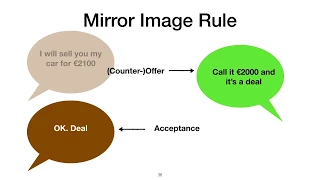
withdraw the offer until the period to choose who has expired okay so yeah let's go to acceptance what is acceptance acceptance is the assent of the ovary to the terms not all the terms of the offer by the overall okay from the definition itself acceptance must cover all the terms this is why I mentioned earlier that upset acceptance must be absolute okay why because if all fairness no accept a certain term or certain terms then that will constitute a counter offer which must be accepted now by the offeror who becomes an awfully now okay so
in that case if the offeree makes a counter offer then the affair is within his rights to revoke or withdraw his original offer he is not bound to respect the original offer given okay why because there has been no acceptance what was given by the offeree was a counter offer okay now acceptance of course must be clear it must the acceptance was be stated in unequivocal terms that you cannot interpret it in any other way acceptance must also be absolute I just mentioned this earlier acceptance must be unconditional and unqualified it's subject to no other
condition or qualification otherwise it will be a counteroffer no okay and how do we know that a contract has been perfected in the definition of consent no it is the meeting between the offer and acceptance okay so once acceptance has been given to the offer then we can say the contract has been perfected but take note this is only for consent soil contracts okay in case of real contracts they are perfected by merely delivery we're talking about consent so the contacts here okay so now how do we know the acceptance has been given to the
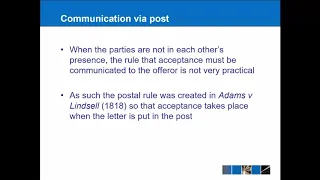
offer in order to perfect the contract here in the Philippines we follow the theory of cognition in other words the contract is perfect that once the acceptance comes to the knowledge okay comes to the knowledge of the offer or okay here's a better example I'll give an example rather know let's say X X writes an offer and sends it by registered mail why which Y receives on the same day let's say it's Monday the following day why writes his acceptance and sends it to eggs however since eggs before eggs received the letter milk by Wiley
X dice hey is the contract perfected no why because the letter of acceptance did not come into the knowledge of of eggs okay so the test here no there are other there are many other examples this will be asked usually in exams now the easiest way is just follow that is no the test is the theory of cognition did the offeror acquired knowledge of the offer okay okay let's move on now what are the forms of acceptance okay acceptance can be expressed know and it can be implied can there be acceptance through silence yes okay
but these are there must be strict compliance with the requisites first there must be a duty and an opportunity to respond okay there must be a duty on the part of the offeree and an opportunity for the offeree to respond then he did not give a response okay now comes the final requisite that that the acts of the offeree or the overt acts cannot be interpreted in any other way than to say that he had assented or agreed to be bound let's say a nod of the head is commonly accepted no in other words whatever
act the awfully performs so as to leave a clear idea in the mind of the author that it has been accepted is sufficient to constitute acceptance through silence okay finally on the part of an agent no we have to remember that knowledge of the agent is attributed to the principal of course provided if the agent acted in the scope of the powers and authority granted to him okay so in case an offer comes from the principal through the agent the contract will be perfected if the acceptance of the offering comes to the knowledge of the
agent or the principal the agent because the agent is merely the extension of the principal and whatever acts the agent does and whatever knowledge the agent possesses is automatically attributed to the principal okay now in order for consent itself to be valid it must be intelligently given okay there must be capacity the person giving consent must know exactly what he is consenting to likewise consent must be free or voluntary okay and finally unsent must be conscious or spontaneous the first one I mentioned on intelligence goes into capacity while the latter the latter two items on
freedom and voluntariness as well as consciousness or spontaneity goes into vices of consent okay now if the intelligence freedom or consciousness are absent or defective then what may result is avoidable contra we'll talk about voidable contract in a different video okay so now let's go into the intelligence first let's talk about capacity the law says that the following individuals cannot give consent first - why because it's presumed but they do not have well not presumed according to the law have legal capacity to act or to act with binding effect okay also insane or demented persons
cannot give consent likewise deaf mutes okay those who cannot hear at the end speak who do not know how to write okay they cannot give consent now this these individuals I mentioned are subject to modifications under the law such as in the case of minors when he receives necessaries know those things necessary to subsist and live no he must be a reasonable price therefore okay now in the case of insane or demented persons if they enter into a contract during a lucid interval during a period when they are not insane No then the contract is
valid okay however let's talk about drunk people and those under a hypnotic spell in those cases the contract may be avoidable because their ability to give consent is impaired okay as to the other two requisites of consent on freedom and consciousness please go into the basis of concern okay and I will be talking about the vices of consent more in detail when we talk about voidable contracts okay because it's more appropriate for that discussion but for now the vices of consent are mistake violence intimidation unjú influence and fraud okay steak violence intimidation and you influence
and fraud these are the vices of consent which if they vitiated the consent given render the contract voidable and avoidable contract is a contract that is valid until it is annulled meaning during the period it's valid it can produce effects but when it is annulled then it was no longer produced effects okay we'll go on now to the second essential element of contracts which is the object okay now object is simply the subject matter of the contract no it is the thing and how do we know if the object is a valid object of an
obligation first of course it must be within the Commerce of men second it must not be impossible whether legally or physically no one will speak of legal impossibility it's not permitted by law and physical impossibility it's not physically impossible of being an object okay next the object must be in existence or capable of existing so future goods may be the object of a contract such as pending crops no pal I like that no next the object must either be determinate or at least determine about it now what if we don't know the quantity of the
thing does that mean to say that the contract is already void because because the object is not the term in it now if the quantity is unknown okay but it will be determined later only then the contract will still be valid what's an example ex offered to sell all of his dogs no to why the word all is uncertain no because you don't know how many he has but if it's determinable by Counting the number of dogs that X actually has then the contract will not be void for absence of an object no it will
be void if let's say X offers to sell one piece of land one parcel of land and he has several parcels of land there is no way for you to know which one of those several parcels of land X will actually send Y so in that case the contract is void for lack of a determinant of giant okay so this requisite of the data object may determinate or determinable it should in case it is only determinable it must be determinable without the need of another contractor so within the four corners of the document you will
be able to determine that the object is precisely what the parties intend to be the subject matter okay now let's just talk about one more important thing on object contract having as object future inheritance will be void okay now what is inheritance I just want to clear this up though because some people incorrectly use the word inheritance by saying that oh I have received the bracelet from my Lola who passed away that is my inheritance no that's the other way around that was the inheritance of your Lola no why because the law defines inheritance as
the mass of Rights properties and obligations which a person will leave after his death and which will be transmitted by succession through the laws of succession to the heirs okay for a more thorough discussion on inheritance please refer to my videos on inheritance law or succession I have a three-part series I'll put the links in the description below okay now why you say contract for future inheritance void because as of the moment the person who is going to transmit the inheritance to you that's not yet died it is as if you are contracting upon the
death of a person okay now this prohibition on future inheritance being the object of a contract is subject to exceptions okay one ifs when the future spouses agree that their future properties shall be donated to each other no donations by addition of marriage which will take effect upon their death okay another example is a partition inter vivos not during the life of the partition ER but to take effect only upon his death okay now we can move on let's move on to the final essential element which is the cause of the Contra know what is
the cause it's the essential reason or purpose why a party entered into a contract No now the cause may be different between the parties okay for instance in the contract of sale over a bottle of water the pause for the seller is to obtain the price and the cost for the buyer is to obtain the bottle of water hey that that said no we have to say that the cost is different from motive okay and motives will not necessarily render in contract void now let's differentiate costs from mobile post approximately so why a party will
enter in the Kanta whereas motive it's the indirect or remote resort know in other words in costs that is really why the party wants to enter into the contract let's say in my example to get that bottle of water no in the motive no motive maybe because he wants to give the bottle of water to his girlfriend something like that okay next distinction now here in the course it is the objective always know the objective it's what we look at the objective is always the same for certain contracts okay the objective in a contract of
sale for the seller is to obtain the price and the objective for the buyer is to obtain the thing being sold okay whereas in motive it may vary from contract to contract and finally in case of a course the absence or legality of a course can affect the validity of the contract which I will be coming to shortly whereas motive it does not affect the validity no but there are exceptions generally motives do not the general rule the general rule is that motives will not invalidate or will not render void a contract however a motive
may render the contract void if it pre determines the cause of the poultra okay again just remember that the motive will render the contract void if it predetermines the purpose of the contract let's give I'll give you some examples so let's say there's a rich old man know and he offers to donate a certain house and lot to a miner in exchange for the miner to having sexual relations with him no their the course is predetermined by the motive of the old man to obtain his carnal desires okay another example let's say that his mother
who sells fish ponds to her daughter know and the daughter resents those fish ponds to her stepfather who of course is married to the mother now that in that case now the motive also predetermines the cause because the contract was entered into to circumvent the law prohibiting donations or sales between the spouses okay one final example in case you still do not get it let's say there is a person who owns a property and allows an alien no a foreigner who is not a citizen of this country the he offers for lease his property for
99 years with an option to buy the property in case the foreigner becomes a Filipino citizen well that is the motives predetermine the post as well in that case and the contract will be void why because it is obviously intended to circumvent the law prohibiting the transfer of Philippine lands to foreigners okay so now what I mentioned earlier let's go to what if there is no cause okay the absence of course or in case the cause is unlawful or in case there is a false course no in this there is a false cause there are
three instances okay there is no course absence of course or the course is unlawful or there is a false course these three instances they will render in the contract way okay of course if there is long pause why will you enter into a contract there is no conduct that exists so that that deals with the absence of course if the cause is unlawful of course the contract will be void because it's prohibited by law now in the pump and the cost will be unlawful if it's contrary to low morals public policy public order no okay
now what we really have to discuss is the statement of the finest scholars till the party is in entering into a contra me state their coastal in no and they may make a contract appear to be for a certain cost like a sale now when in reality it appears to be a different contract okay if the parties stipulated on a false course but it cannot be proven that there is an underlying true horse okay true and lawful cause then the contract will be void but but if there is a false cause and the parties are
able to prove that there is a true lawful underlying cause then the contract may be valid and the parties may be held to the intended obligation or contract no one example the parties stipulated that it's a conduct of sale okay - probably evade the loss on taxes no but in reality they intended it to be a donation okay who actually will talk about this is called simulated contracts but we'll talk about this more in boiled and voidable contracts okay so again the rule is absence of course renders the contract void unlawful costs renders the contract
void and statement of false cause will render the contract void only if it is not proven that there is an underlying true and lawful pause okay now now what if the contract does not state no it's not written there in that there is of course the law provides that causes always pursue even if it's not real and it is the burden of the party who is claiming that there is no cause to prove that there is in fact no horse okay so the requisites let's go to the requisites of course no of course the course
must exist at the time of perfection of the contract because if there is no pause then with no contract can be said to exist it's a void from the beginning the cause must likewise be lawful okay not contrary to law the cause must also be true or real okay so let's I want to differentiate absence of course which I discussed earlier half the total absence there is no cause from failure of course that's different okay if there is no no cause no the cause is observe as I said earlier the quadric will be void okay
but if there is simply failure of course then there is only breach okay and the contract exists why because failure of course goes into the performance it simply did not materialize what is an example in a contract of sale where the parties agreed that a certain thing was sold for a price certain take but the price was simply not paid the contract of sale is perfected because all elements are present it is in the failure ladder of the buyer to pay the price is merely the failure to perform this part of the obligation okay and
that is just a mere breach however if what is written in the contract is that this thing has been fully paid when in truth and in fact it has not yet been paid at all then that may serve to render the contract void for absence of course okay now let's talk about yes or no what is lesson it is damage caused to the person or a party to the contract due to analogous in the inadequacy of price another another will school on you - no it is unjustly moolah okay now the rule is the mere
fact that there is the shown in a contract no I will talk about this more in resistible contracts no but the mere fact that there is a showing no that's not serve as a ground to render the point oh boy okay that's the general rule why because well according to the Supreme Court they're not they're not bound to check every contract of every person in the Philippines to see if there has been economic damage no or relation so parties are free to enter into the contract or rejected okay so let's on by itself will not
serve to invalidate a contract however they've shown me invalidate the contract if it is attended by fraud mistake or undue influence okay again fraud mistake or undue influence if coupled with LeSean will render the point or maybe affect the validity of the contract finally finally let's just talk about moral obligations so if moral obligations can serve as a course for a contract okay first if a moral obligation that is sought to be used as the cause is simply an ethical obligation now with no underlying civil obligation then it cannot serve as a cost but a
moral obligation may serve as a cause if there was a previous or prior civil obligation which has prescribed I explain prescription in my other video but to reveal through prescription or the passage of time person may gain or lose rights okay so let's see a civil obligation prescribed and the party wants to perform it then it is a moral obligation only but it can serve as a cost to support a valid Kandra so that's it for the essential elements of condoms just remember not there are only three letters COC consent of Jack course pay those
are the three essential elements of condoms pay so stay tuned until I finish all the episodes of the law on contacts okay so I hope to see you soon and I hope you've picked up a thing or two okay bye guys