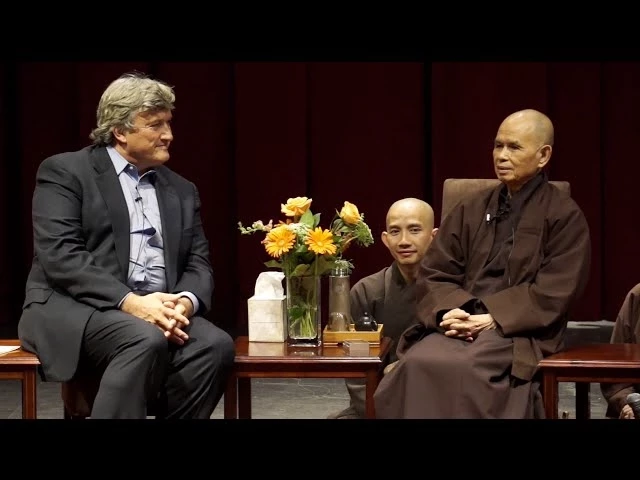
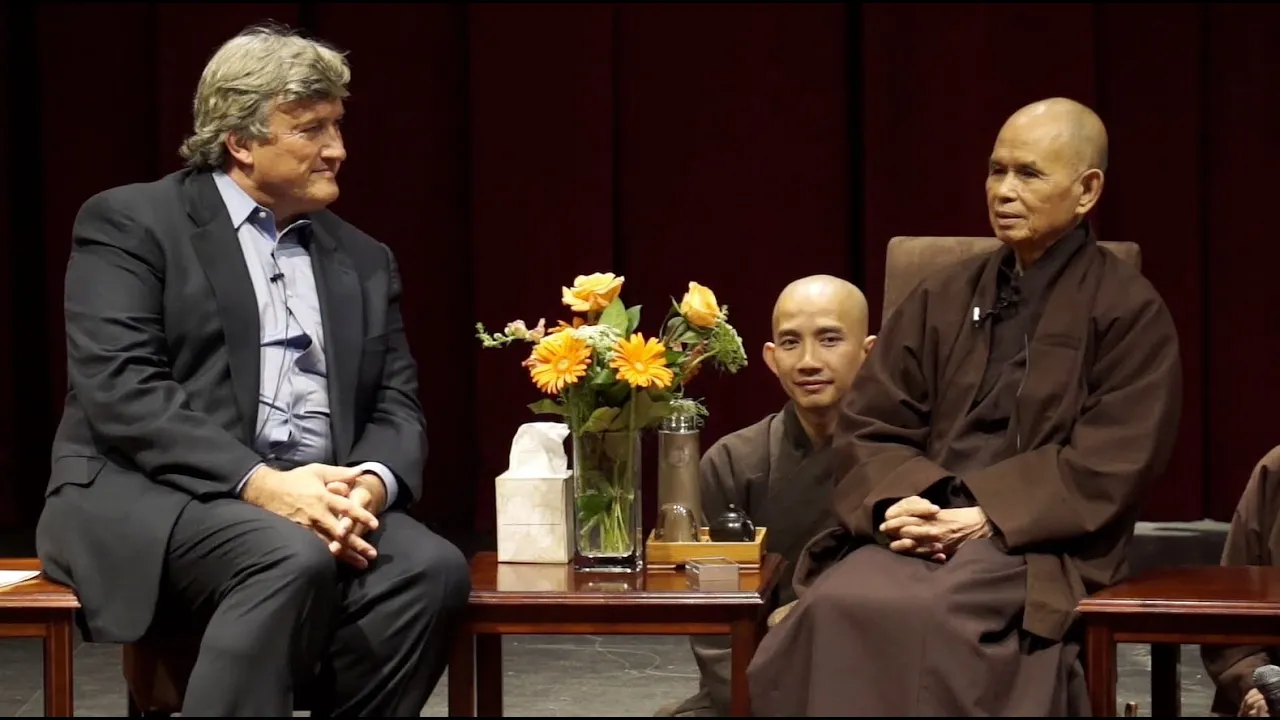
Welcome. Thank you all for coming this evening. Hopefully everyone has found a seat. There are some empty seats for anyone who may be outside who doesn't have a ticket. Let's make sure that everyone is seated who wishes to be here. It's really an extraordinary joy for me to be here with one of my personal heroes. Thich Nhat Hanh, or Thay as he is called by his students, who is one of the best-known and respected Zen masters. But in addition, he has spent his whole life promoting compassion, Kindness to others, and being a tireless advocate for
human rights, nonviolence, and peace. As many of you know, he's written a large number of books, he has spoken and taught around the world, he's been a role model to so many people in their lives, and he's led an extraordinary life. The reason we're chatting today is because of a program that I run here at Stanford called CCARE. I think many of you may be aware of it. But if you aren't, it's called the Center for Compassion and Altruism Research and Education. This is a program we have here at Stanford in which we work with
neuroscientists, psychologists, and people from a variety of disciplines, to really try to understand the neurological basis of compassionate behavior. And also the reality is that when individuals are compassionate, it's actually—as we've found through science— when our physiology works best. One thing that we have found through science is that we can actually change our brain through mind training. Now of course, the fascinating thing is that it's taken scientists hundreds and hundreds of years. If we had just looked back, which we are of course now doing, to the monastic traditions, they of course knew this all along.
Only now are we actually catching up. In fact many of these contemplative traditions, their entire basis is oriented around compassionate behavior. Because they have known, and we have now shown through science, that when we're compassionate not only does it improve the lives of others and serve others, but it is of great benefit to each of us. It makes us feel better, it lowers our blood pressure, and it makes us happy at a very, very deep level. In fact as we're now learning, it also increases our life span. And the amazing thing is that many of
the things that promote a happy life are actually things that are completely free and available to all of us every day. Now, I appreciate that few of you are here to really hear me talk this evening. [laughter] So what I would like to do is turn the evening over to Thay. Then we'll have a little bit of a conversation. I know that each of us will leave here today having learned something that will improve each of our lives and allow us to better serve our fellow man. So without further ado... Would you like to ask
a few questions? [laughter] Hmm. Um, yes. [laughter] It's always interesting, I think, to people— and I know of course some of your history— that, as I understand it, when you were quite a young age, you decided to become a monk and lead a monastic life. That is in many ways a life that the average person has a very difficult time even thinking about the possibility that they could do that. But for you, what was it about that tradition, or about becoming a Buddhist, that inspired you so much? I was sixteen when I was ordained as
a Buddhist novice. I had learned that during the Ly and the Tran dynasties, Buddhism had flourished. The kings and subjects and the population practiced Buddhism, and we had many hundreds of years of peace. So, that impressed me very much. And I believed as a young man that if you practice Buddhism well, you can serve your nation, your country, your people. That is one thing. When I was younger, about eleven or twelve, one day I saw a drawing of the Buddha on the cover of a Buddhist magazine. He was sitting on the grass, very calm, very
pleasant. I told myself I want to be someone like him. [laughing/laughter] Because people around me were not as calm or as happy. These things have pushed me to become a monk. One of the challenges, I think, is that you were in Vietnam during the Vietnam War. Of course many of the monks stayed in the monastery. And I know you have promoted, if you will, "engaged Buddhism" or engaged spirituality. What made you decide to actually engage and become an activist? And how did you overcome, what I would presume was, fear about what might happen? The practice
of Buddhism is mindfulness, concentration, and insight. Mindfulness is the kind of energy that helps you To know what is going on— going on in your body, your feelings, your perceptions, your mental formations, your consciousness, and what is going on around you in your family, in your community, in your country. So if you are aware of what is going on around you, you see the suffering. And you would like to do something in order to help people suffer less. I always, from the time of becoming a monk, wanted to have the kind of Buddhism that can
really help people— not Buddhist studies, but the kind of practice That can really help you to suffer less and help people to suffer less. That is why we created a current of thinking and action called "engaged Buddhism," "le Bouddhisme engagé." We study Buddhism and apply Buddhism in such a way that we can really solve the problems we are facing— in our families, in our communities, in our society. I think one of the challenges for many people is that there is so much suffering. For example, I'm a doctor and one of the things that happens to
doctors—and especially to people, if you will, in the caring professions—is they get overwhelmed with suffering, As does the average person. And they say, "There's so much suffering, what can I do?" People are afraid of being overwhelmed by suffering, and they lose their hope, their courage, and so on. There must be a way to live in order for you to be strong enough to handle the suffering inside of you. If you don't know how to handle the suffering inside of you, you cannot help another person to suffer less. That is why the practice of mindfulness is
first of all to help you yourself suffer less. First of all you have to learn how to release the tension in your body, how to reduce the pain in your body. The practice of mindful breathing, mindful walking, sitting meditation, and total relaxation can be very helpful in reducing the pain in your body. Then with the practice of mindfulness you can learn how to create, how to generate a feeling of joy, a feeling of happiness. This can be done by anyone if we want to learn how. For instance, when you breathe in, if you focus your
attention on your in-breath, you can bring your mind home to your body. There is the energy of mindfulness and concentration in your in-breath. And you realize that you are alive! Because someone who is already dead does not breathe in anymore. [laughter] So, one in-breath that may last three or four seconds can create mindfulness, concentration, and insight. When the body and the mind are together, you are established in the present moment, in the here and the now, and you can get in touch with the wonders of life that are available in the here and the now.
With that kind of mindfulness and concentration, you realize that you are lucky enough, luckier than many people. You have enough conditions to be happy right now, right here, and you don't have to run into the future to look for happiness. That happens after three or four seconds of the practice of mindful breathing. You get the insight that there are conditions of happiness that are available in the here and the now, that you are very lucky, that you are alive. Insight can happen just after a few seconds of practice. If you recognize that these conditions of
happiness are there, available, you can create a feeling of joy and of happiness right away. A good practitioner of mindfulness can create a feeling of joy, a feeling of happiness for himself, for herself, and for the other person. And that is easy enough. Then mindfulness practice can help you to go home to yourself in order to get in touch with the pain, the suffering, the despair, the anger, and the violence inside. With the energy of mindfulness and insight, you know how to handle the suffering within yourself. You have compassion toward yourself. Love for another person
depends on your capacity to love yourself. If you don't know how to love yourself And take care of yourself, how can you love and take care of another person? So, the practitioner learns how to suffer— how to handle the pain and suffering inside of himself or herself. And because he knows how to do that with compassion, with insight, with mindfulness, he can suffer much less than other people who do not know the practice. And he can go further. He can make good use of the suffering in order to create something more positive, like understanding and
compassion. It's like people who grow lotus flowers. They know how to make good use of the mud in order to grow lotus. No mud, no lotus. No suffering, no happiness, no compassion. So the practitioner, generating the energy of mindfulness and concentration, recognizes the pain in himself or in herself and embraces it tenderly. The fact that you can recognize and embrace your pain can bring you relief. Because the pain is a kind of energy and mindfulness is another kind of energy. This energy, mindfulness, embraces the other energy and produces a kind of change, like a mother
holding her baby. The baby suffers. The mother does not yet know what the cause is of the suffering of the baby. But the fact that she's holding the baby tenderly can make the baby suffer less right away, because there is the energy of tenderness of the mother penetrating into the body of the baby. That brings relief. If she continues with mindful holding, She will find out the cause of the baby's suffering, and then she can change the situation. For the practitioner, holding his pain or her anger is like holding our own baby. We have to
handle the suffering in us tenderly, with nonviolence. We should not try to suppress the pain. We should not suppress our own baby. And you get relief. If you know how to practice, you can gradually transform the pain, the anger, and the despair in you. So the practice of mindfulness helps people To suffer in such a way that they suffer much, much less than other people who do not know how to practice. To get relief and to make good use of the suffering in order to create understanding and compassion are the very foundation of happiness. There
is a deep connection between suffering and happiness; it's like the connection between the mud and the lotus. If you have the time to listen to your own suffering, to look deeply into the nature of your own suffering, understanding will arise. Understanding here means understanding of the suffering. And when understanding arises, compassion is born. That is the mechanics of compassion. When you look at another person, if you have the time to look at him or her mindfully and with concentration, you can recognize the suffering in that person. And if you are more concentrated, you can find
out that the person does not know how to handle the suffering in him and that is why he remains a victim of his own suffering. So far no one has helped him to handle the suffering in him. And since he suffers, he makes the other people around him suffer, even if he doesn't want to do so. So with mindfulness and concentration, you can realize, you can recognize, the suffering in him and understand that suffering. And if that understanding arises, you are not angry with him anymore, because compassion has been born in your heart. When compassion
is born in your heart, you don't suffer anymore. It's like a miracle. And instead of trying to punish him or her for having made you suffer, you want to say something or do something in order to help him suffer less. This can be done in our daily life with the practice of mindfulness and concentration. If we understand our own suffering, then it will be much easier for us to understand the suffering of another person and help him. That is why the meditation on compassion and on suffering, should begin—with yourself. Our suffering carries within itself the
suffering of our father, of our mother, of our ancestors. Maybe our father suffered so much and he didn't know how to transform and handle the suffering, so he has transmitted it to you and it is in your genes. You are a receiver of that transmission. You have to accept it. If you know the practice, you will transform the suffering of your father in you, which is also your own suffering. Your suffering also reflects the suffering of your society, of your nation. If you understand your own suffering, you will understand the suffering of your community, of
your nation, of your people. So, understanding suffering is very important for compassion to arise. And once compassion is there, you suffer much less. Suffering has a positive role to do. We can speak about the goodness, the usefulness, of suffering. It's like the goodness, the usefulness, of the mud in helping the lotus flowers. That's why my idea of the Kingdom of God is not a place where there is no suffering. If there is no suffering, there is no happiness either. That is the teaching of interbeing. Interbeing means you cannot be by yourself alone; you have to
inter-be with us. The left cannot be by itself alone; the left has to inter-be with the right. If you remove the right, the left disappears right away. If politically you are on the left, don't wish that the right would disappear. [laughter] If the right disappears, you disappear also. That is the teaching of interbeing. Interbeing means you cannot be, you can only inter-be. I think compassion is like everything else; compassion cannot be by itself. When you look into a flower, you see the flower is made of non-flower elements, like a cloud. I can see a cloud
and I can touch a cloud in the flower. All of us know that without the cloud there will be no rain and no flower can grow. So when I look into the flower, I see non-flower elements, including the element of cloud. I see the sunshine, I see the minerals, the earth, the gardener, and so on—non-flower elements coming together in order to help the flower to manifest as a wonder of life. Compassion is a flower. And compassion is made of non-compassion elements. I think we all acknowledge that some of our greatest poets, like yourself, some of
the greatest humanitarians, and some of those people who we consider enlightened beings have suffered an extraordinary amount. And I think it is in getting wisdom through that suffering And not running away from the suffering that allows them to do that. I think one of the challenges in modern society, and one of the burdens we have as humans, is one that you mentioned, which is that science has shown— and they've surveyed people— that over seventy-five percent of the time people are thinking of the past or the future, they're not thinking of the present. You talk about
mindfulness, which brings us into the present moment. But I think sometimes people look at the life of someone like you and say this is an individual who has spent literally decades of their life dedicated to meditation and mindfulness practice. There are people who, while they may look at your picture And want to be like you, may not be able to develop the capacity to become quite as enlightened. What can such individuals do in their daily lives? Does it really take hours and hours of deep contemplative practice? Or can you practice mindfulness every moment? Well, everyone
can practice generating the energy of compassion in order to suffer less. If we have the courage to go back to ourselves and listen to our own suffering, then we can begin to understand our suffering and begin to suffer less. Many of us do not want to do so. Most of us are trying to run away from ourselves, Because we believe that in going home to ourselves we may be overwhelmed by the pain, the suffering, and the despair inside. So most the people in our society try to cover up the suffering by the way of consumption.
We consume music, newspapers, food, the Internet, everything that helps us not to go home to ourselves. And many of the items we consume have toxins, like anger, fear, despair, craving, and that makes our suffering inside continue to grow. So the real practice is to try to go home without fear. If you know how to practice mindful breathing, mindful walking, You can generate the energy of mindfulness and concentration, with which you can go home to yourself without fear. You are protected by these energies. And if you are new in the practice, you can rely on the
collective energy of mindfulness of a community of practice. Going home to yourself, recognizing the pain in yourself, embracing the pain in yourself will bring you a relief. You can do that with the support of co-practitioners. Because when you are in a community of practice, when you live with a community of practice where there are many practitioners who know how to Generate the energy of compassion, energy of mindfulness, you can borrow that collective energy in order to recognize and embrace your pain and your sorrow. So compassion can be not only an individual energy, but also a
collective energy. Maybe scientists could measure [laughing] the degree, the intensity of the energy produced when we practice to generate the energy of compassion. We practice like a drop of water. A drop of water has to allow the whole river to embrace it and transport it. Sitting in the community of practice, you say to yourself, "Dear community, dear brothers and sisters in the practice, here is my pain, here is my sorrow, my despair. My mindfulness is not strong enough to hold them. Please help me to hold my pain, my sorrow, my despair." And that is very
much in the tradition. If you want to practice well, you should have a community of practice supporting you and guiding you. A few weeks later, you can be on your own, because now you can generate your own energy of mindfulness and concentration to handle the suffering in yourself. I think compassion has the power to heal. And compassion—there is never enough of it. In these days psychotherapists talk about compassion fatigue. I think if psychotherapists run out of compassion [laughter] it's because they don't know how to keep producing compassion. It's not because they have too much compassion,
but because they run out of compassion. Compassion is a kind of power, a kind of energy. And you should keep producing it if you need to help many people. If psychotherapists do not know how to nourish themselves, I think they should learn how to generate feelings of joy and happiness every day to nourish themselves, to be strong enough to continue. The second thing they have to do is to know How to handle the suffering within them. Without that, they will run out of compassion in a short time and cannot continue. And that applies to every
one of us who wants to serve society. We should be able to nourish ourselves by learning the art of happiness. There is an art called the art of happiness. And it's simple enough. We bring our mind home to our body by way of mindful breathing, mindful walking, and we establish ourselves in the here and the now, just by walking meditation or breathing meditation. In the here and the now we get in touch with the wonders of life that are available in the here and the now— the Kingdom of God that is in the here and
the now— in order to get the nourishment you need. And you can help nourish your beloved one in that way. The art of suffering should go together with the art of happiness. You should know how to handle a painful feeling, a painful emotion, with the energy of mindfulness and concentration. And with the practice of mindfulness and concentration embracing your pain, you suffer much less. You know how to bring relief. And you can go further by transforming these energies Into positive energies like understanding and love. I don't talk about the Kingdom of God as a place
where there is no suffering. It is my conviction that where there is no suffering there is no happiness either. That is the truth of interbeing. It's like the left and the right, the above and the below, the subject and the object. We don't want to send our children to a place where there is no suffering, because in such a place our children have no chance to learn to be understanding and compassionate. It is by touching suffering and understanding suffering, that you can generate love and compassion. That is why my vision of the Kingdom of God
is of a place where people know how to make good use of suffering in order to create understanding and compassion. In Plum Village, our practice center in France, we have invited groups of Palestinians and Israelis to come and practice with us. It is always difficult in the beginning. When the two groups would first come they couldn't look at each other, they couldn't talk to each other, because both groups would have a lot of anger, Fear, and suspicion—a lot of suffering. So during the first week we let them stay separately. First of all they practiced mindful
breathing, mindful walking, to help them to calm down their pain and embrace their pain. They're guided to get in touch with the wonders of life within themselves and around them to get the nourishment they needed. To learn how to calm the painful feeling, the painful emotion, and learn how to get the nourishment that you need is what we do in the first week. Then we continue with looking deeply into our own suffering and finding out where it has come from. Very often our sufferings have come from our wrong perceptions. Wrong perceptions give rise to fear,
anger, and discrimination. Mindfulness and concentration have the power to bring insight. And that insight can remove, can transform fear, anger, separation, and discrimination. At the beginning of the second week, we initiate them into the practice of deep compassionate listening and loving speech. One group is asked to tell the other group about their suffering. They are advised to speak out in such a way that can help people to understand— to try to avoid blaming, accusing, and so on. You are invited to tell us about your suffering. You can tell us everything— the suffering of your children,
the suffering of the adults, how your house has been bombed, and how your children have been maimed and so on. Please tell us everything. We are trying to listen to you, Israelis, or Palestinians, or any other people. And many of us sit there with them to lend our support. If you have one hundred people sitting and breathing and generating the energy of mindfulness and compassion, it supports them, because sometimes it's very difficult to speak out. The other side, the other group, will practice deep listening, compassionate listening. We have to train ourselves in how to listen.
Because what the other person or the other group says may trigger the anger and the irritation in us, and we lose our compassion; we cannot continue to listen. That's why in order to listen, you have to keep alive the insight, maintain the insight alive that, "I am listening to him with only one purpose, to help him to speak out and suffer less." You have to maintain that insight alive. That is called mindfulness of compassion. If you maintain that mindfulness of compassion alive, then what the other person says will not trigger the irritation and the anger
in you and you can continue to listen for an hour or more. You tell yourself, "Well, he is full of wrong perceptions. But I am not going to interrupt him right now, because if I do, then I will transform the session into a debate and that will ruin everything. In a few days, I may have the occasion to release some information to help him to correct his perceptions. But not now. Now is only listening." That is the art of compassionate listening That can help people suffer much less. With that practice, people suffer less right after
the first session. When you listen to them with mindfulness and concentration, you realize that on their side, on the other side, they have suffered exactly like the children and adults have on your side. For the first time, you see that they are victims of the conflict, victims of wrong perceptions, and you are not angry at them anymore because understanding and compassion are born in you and you do not suffer anymore when you look at them. Your compassion is reflected in your eyes. And when they see you looking at them like that, they suffer much less.
That is like a miracle. And we need only ten days to do it. You are able to see for the first time that the people in the other camp are just human beings like you, who have suffered very much the same way you have suffered. So, mutual understanding becomes possible, communication becomes possible with that kind of contemplation of suffering. And you know that you too will have a chance to speak about your suffering, your difficulties, your despair, and the other group can listen. The practice can remove a lot of anger, remove a lot of suspicion,
and remove a lot of fear. And the two groups begin to be able to sit together, share a meal together, and hold hands to do walking meditation together. The birth of compassion is like a miracle of healing. Listening to the suffering with mindfulness, you can help the energy of compassion to be born. Both groups experience transformation and healing, and all of us are so happy that they do. On the last day of the retreat they come up together as one group to report to the whole community about the fruit of their practice. And they always
promise that when they go back to the Middle East, they will organize that kind of practice so that other Israelis and Palestinians can come and practice and suffer less. That is what happens during the time we host these two groups. In our retreats of mindfulness that are offered A little bit everywhere in Europe, in Asia, in America, and so on, usually on the fifth day of the retreat we ask people to apply the teaching of deep listening and loving speech with the person with whom they have difficulty in order to restore communication. If the other
person is in the retreat, it's easier, because he or she has also been exposed to the teaching and the practice. If the other person is at home or somewhere else, you can use your telephone in order to practice deep compassionate listening, and loving speech. And you call him or her. If you call your father you can say, "Daddy, I know you have suffered Quite a lot in the past many years. I was not able to help you to suffer less. In fact I have made it more difficult for you by reacting in a way that
makes you suffer more. Daddy, it's not my intention to make you suffer. It's because I did not understand your suffering, I did not understand your difficulties, that's why I have reacted with that kind of stubbornness. I am sorry. I need your help. Daddy, you should tell me about your suffering, your difficulties, your despair. You should help me. Because I know that if I understand them, I will not react in the way I have in the past. Please help me, father. If you don't help me, who will help me?" That is the kind of speech that
we call loving speech. And that speech you can use naturally, if you have looked deeply into the suffering of that person. You know that person doesn't know how to handle his suffering. That is why he makes the people around him suffer, including you. So contemplating suffering helps compassion to be born in you. If you have the energy of compassion, you can very easily use the language we call loving speech, gentle speech. And that can really open the door to the heart of the other person. One German gentleman told me on the sixth day of a
retreat in northern Germany, "Dear Thay, I did not believe I could talk To him that way. I was so angry with him that I had vowed not to see him any more in my life. And yet last night, practicing according to your recommendation, I called him. And when I heard his voice, suddenly I found myself capable of talking to him with that kind of compassion. And he cried; my father cried like a baby. And we reconciled. And dear Thay, do you know something? The first thing I will do after this retreat is to go straight
to him and see him." So the miracle of reconciliation can happen very quickly With the practice of compassion. And compassion, we know, that is born from understanding suffering. We can practice that with ourselves before we can help another person to suffer less. (bell sounds) In the Buddhist tradition, we speak of love as true love in terms of loving kindness, compassion, joy, and equanimity or nondiscrimination or inclusiveness. In order to really understand compassion, you should understand also the three other elements of true love. The first element of true love is loving kindness, maitri. It has the
power to offer happiness. If love cannot offer happiness, it's not true love. Your true love offers you happiness and offers himself or herself happiness. It's not the willingness to offer happiness; that's not enough. Because if you don't understand the other person, the more you try to make him happy, the more you make him suffer. So you have to understanding his or her suffering and need before you can practice loving kindness, maitri. In Asia there is a fruit called Durian. [laughter] Many people crave for it. But for me, I cannot eat it. And if you say,
"Dear Thay, he works so hard, He should eat some durian," you will make me suffer by loving me. [laughter] So we should understand the other person in order to really make him happy. That is why understanding is the other word for love, for compassion. So we should ask our partner, "Darling, do you think I understand you enough?" [laughter] "If I don't understand you enough, please help me." My wife is right there. [Thay, audience, and Doty laugh] So maitri, loving kindness, is not just the willingness to make a person happy, but also the capacity to make
him or her happy. That requires understanding. And understanding requires having the time to look deeply. The second element of true love is compassion, karuna. Great compassion is called maha karuna. Compassion has the power to remove the pain, the suffering. If your love cannot make the other person suffer less, it's not true love. You have to understand his suffering, her despair, in order to help him or her to suffer less. That is why you need to have the time to look and to listen. And understanding will create love and happiness. And the practice is that you
have to apply that for yourself. You have to be able to offer yourself happiness and compassion. Do we have enough compassion toward our body, toward our feelings? Do we know how to handle our body to make it suffer less? Do we know how to handle a feeling so that we can help calm down that feeling or emotion? That is self-love. The capacity to love another person relies entirely on your capacity to love yourself and take care of yourself. And that is true with compassion. The third element is joy, mudita. If by loving you make the
other person cry every day; that is not true love. [laughter] So you create joy, for yourself and for the other person. And there are many practical ways to create joy Without having to go to the market and buy something to offer him or her. Suppose you breathe mindfully and you bring your mind home to your body, you become fresh and pleasant, and you go to her and say, "Darling, do you know something? I am here for you." [laughter] How can you love if you are not there? To love means to be there [laughter], to be
there for the person you love. If you are so busy in your work, if you are so busy making money, then you have no time for yourself and for your beloved one. You can practice mindful breathing and mindful walking to bring your mind home to your body, to be relaxed, fresh, and loving, And then you go to your loved one and pronounce the mantra, "Darling, I am here for you." That will bring joy to you and to the other person. When you are truly there and you offer your presence to him or to her, you
have a chance to acknowledge the presence of the other person as something very precious to you. Then you can pronounce the second mantra, "Darling, I know you are there and I am so happy." To be loved means to be recognized as existing. If you drive the car and you think of everything else except the person sitting next to you, she cannot be happy at all. So while driving you use your mindfulness to embrace her And you say, "Darling, do you know something? I know you are there, next to me; I am so happy." [laughter] So
there are very simple practices like that, practices of mindfulness that can bring joy. If he is at the office, you can practice the mantra by using your telephone, or send him an email with the contents "Darling, I know you are there and I am very happy." [laughter] Creating joy is true love. The fourth element is inclusiveness, upeksha. We cannot understand compassion deeply without understanding this fourth aspect of true love. In true love there is no discrimination anymore Between the lover and the beloved one. You cannot say, "Darling, that's your problem." [laughter] In true love, your
problem is my problem, your happiness is my happiness, my suffering is your suffering; there is no longer any frontier. This is inclusiveness. In true love, happiness and suffering are no longer individual matters. And if you continue to love like that, you will begin to embrace all of us into your love. These four elements of true love are called the four unlimited minds; there can never be enough. You begin with one person, and then if you follow the path of true love, Your heart will open, open, open, and you will embrace all of us inside. That
is true love, the kind of love that can enlarge your heart without stopping. One day the Buddha was holding a bowl of water in his left hand and he was holding a handful of salt in the right hand. He poured the salt into the water and stirred. He asked the monks, "My dear friends, do you think that you can drink that water? It's too salty! But if you were to throw that amount of salt into a big river, it wouldn't make the river salty at all, And thousands of people could continue to drink the water
in the river." So, someone who has a great heart, a big heart, a lot of compassion, doesn't suffer anymore. The things that make other people suffer don't make him or her suffer. It's like the one handful of salt that can make the bowl of water salty, but can't make the whole big river salty at all. So, the four brahmaviharas, the four elements of true love, are unlimited. Because by loving in that way, you embrace all of us in your heart. You love, not only humans but, also animals, plants, and minerals. Minerals are also alive. Minerals
can suffer. And that is the love recommended by the Buddha, the love without frontier, without discrimination. The fourth element of true love is inclusiveness, meaning there is no discrimination whatsoever, black or white, north or south, rich or poor, all are objects of your love. And when you have that kind of love, you don't suffer anymore and you are in a situation of being able to help many people. That is why all of us who want to serve our society should cultivate true love. With true love we are nourished, we are strong enough. If we know
how to build a community of love, a beloved community, a compassionate community, then we'll be powerful enough To make change in our society. I would like to make a few suggestions. Generating the collective energy of compassion is a practice that should be done in the family, in the hospital, in schools, even in the Parliament. [laughter] A guided meditation with one thousand people can generate a collective energy of compassion that can be felt. Maybe scientists have a way to measure the intensity, the degree of compassion, because we can feel it. One day I gave a talk
in Germany for one thousand people and I saw four young mothers nursing their babies. The babies were being fed by mother's milk. But also I saw that the atmosphere in the hall was so peaceful, so compassionate— because everyone was practicing mindful breathing, generating the energy of mindfulness, brotherhood, sisterhood, and compassion— that the four babies were having that kind of food also. They could feel it. They were very peaceful. When we come together as a group like this, if you know how to breathe, how to contemplate suffering, how to generate the energy of mindfulness, then the
collective energy can be very powerful. If you happen to be in that zone of that energy, you get healing. If you practice mindful breathing and focus your attention on your in-breath and out-breath, you can stop the thinking, stop the mental discourse. Thinking may take you away from the zone of compassion and then you can't profit from that collective energy of compassion. Creating such a collective energy of compassion is what we should learn how to do. Because it's the best thing we can offer to humankind, and to other species also. Please, as scientists, tell us how
we can organize ourselves to offer the world that wholesome collective energy of understanding and compassion, Because that's what we need. We cannot do the healing of the world unless we have enough of that energy of understanding and compassion. Usually in a public talk, we begin with chanting. We have one or two hundred monastics offering a chant. In a few days we have such a talk in the Paramount Theatre in Oakland. The audience may be four or five thousand people or more; in Hong Kong we had an audience of ten thousand people attending the talk. Everyone
is practicing mindful breathing together. And we create a very powerful energy of mindfulness and compassion. The monks and nuns have been instructed To chant the name of Avalokiteshvara, the great being of compassion. While chanting, they go home to themselves and touch the suffering inside of themelves. The purpose is to allow compassion to be born. When they chant the name for the second time, they reach out and recognize and touch the suffering in the people who are in front of them, on their left, on their right. And the aim is the same— to allow compassion to
be born and to grow. And when they chant the name of the compassionate bodhisattva for the third time they reach out and touch the suffering that exists a little bit everywhere in the world, in Asia, Africa, The Middle East, South Africa, everywhere that there is violence, war, death, despair, hunger, and so on. And the purpose is the same— to generate the energy of compassion. The audience is advised to practice mindful breathing in order to stop the thinking, to allow the collective energy of mindfulness and compassion to penetrate into their body and help release the tension
in their body, and open their heart and allow the collective energy of compassion to penetrate into their heart, helping to embrace so that we can suffer less after a few minutes of practice. So that is the way we cultivate the energy of compassion, not only individual energy, but the collective energy of compassion. Yesterday we spent a day of practice with the people who work at Google. We asked them whether with their technology they could help us organize a way to practice generating compassion together as a community, as the community of human beings. I think when
you give a guided meditation on compassion, with images and sound, and help people touch the suffering in themselves, in their family, and in society, you notice that the energy of compassion is born easily. You can feel it. Every time I sit as the monks and the nuns chant and the people listen while breathing, I see many people cry. That's because the energy of compassion can be felt, and it's very healing. We hope you can teach us how to do this on a greater scale, because, really, our society needs that kind of energy. We know that
compassion is made of non-compassion elements. We can make use of non-compassion elements like anger, fear, and suffering, in order to create compassion. If we have suffered, if we have fear, anger, despair, these non-compassion elements can be used to fabricate compassion. It's like the garbage. If you are an organic gardener, you can preserve the garbage and transform it into compost in order to nourish the flowers. So with the suffering that we have in the world, if we know how to handle the suffering, we can transform it back into compassion and love. And please, CCARE, with your
studies, help us to know how to do it more scientifically and on a greater scale. I think it's time for us to ask a few questions. If anyone from the audience has a question, there are microphones here and here. [bell] This is compassion; they're fighting for...[a place in line to ask questions?] Thay, I wanted to ask you, as a man in Western society, when I was raised I was told not to cry. In sports I was told to exploit the other team's weaknesses. In business I'm told not to show any weakness. I was wondering if
you've seen this difference between compassion in men and women. It seems harder for men to generate this compassion. Is there any way we can maybe make compassion more attractive to men [laughter], make it more of a strength than something....[weak?] You know, when I mention compassion to men that I talk to and they walk away. They don't want to know anything about it. And I was wondering if you've seen that difference between men and women and if you have any advice on how we can bring more men into the compassion movement? [applause] Dear Thay—I would just
like to repeat the question so that it is clear—our friend is asking about the difference in compassion for men and for women. Growing up in Western society, he was taught not to cry. In sport, he was taught to exploit the weaknesses of others, and in business also. So his question is how can we make compassion more attractive, More accessible for men, and if Thay might have any ideas how to make it more appealing. There must be some misunderstanding about the nature of compassion here, because compassion is very powerful. If you think that compassion makes you
weak, you are wrong. Compassion may cause a person to sacrifice his life to save other people. We have to really find out what compassion is. It's very powerful. And we have to embody that kind of energy in our daily life. We have to reeducate people about this. We have to show what compassion can achieve. When someone is angry, is being burned by the fire of anger, if he knows how to practice compassion, anger will die down very quickly and he will look much better, much more beautiful, much more attractive. That is why we have to
exemplify and embody that practice of compassion, in order to persuade other people to do the same. Compassion helps us to sleep well. Compassion protects us better than guns and bombs... and money; many of us think we are safer if we have more money. But you can lose your money very easily. But compassion is a kind of energy that can help protect you much much more effectively than money. And compassion helps you to relax, and your body has a greater capacity to heal itself. Compassion helps you to be pleasant, to be loving. And you can restore
communication with the other person easily if you have compassion in yourself. You understand the other person. Your compassion can help you do your business better, because you are in good relationship with other people, including your employees. So you can list a lot of qualities of compassion. We should have a community of men and women practicing compassion like that in order to show people that compassion is something very powerful. I hope in the department of neurology there will be a community practicing together, showing people, not only by lectures, but also by their way of life. With
compassion we are much happier; we suffer much less. And we should embody our teaching as faculty and students. Thank you. Thank you, thank you so much. I feel so blessed to be in your presence, And I think I can speak for everybody here. Thank you so much. I just had a clarification question. I'm practicing Buddhism--and practice is the operative word here. My understanding is that one of the basic tenets of the Buddhist Dharma is the Four Noble Truths. The first is that "there is suffering." And the third is "however, the good news is that there
is the cessation of suffering." I'm a little confused about two things you said. One was that in your Kingdom of God you hope there is still suffering. The second thing you said later on was if you develop a beautiful heart, a big heart, you'll be free from suffering. So I'm just a little confused. Dear Thay, our friend is a practicing Buddhist and she would like some clarification from Thay about the relationship of what Thay has said this evening to the Four Noble Truths. The Four Noble Truths are a core Buddhist teaching that speaks of the
truth of suffering and also the truth of the end of suffering. This evening Thay has mentioned that happiness, Or compassion, and suffering inter-are, and that in Thay's vision of the Kingdom of God, of heaven, there would also be suffering in that place. At the same time, Thay has said that if our heart is very big, then no matter how much suffering we throw into it we won't suffer. So our friend is really asking, is it ever possible to be free of suffering? Is that what the noble truths are sharing? Or will suffering always be there?
The truth is that suffering and happiness inter-are. There cannot be one without the other. And then there is the teaching of impermanence. Suffering is impermanent. If you know how to practice, then you can change the suffering into something else, like happiness. Happiness is also impermanent. And happiness can turn into something else, like suffering. The first noble truth is about suffering, and the third is about the cessation of suffering, which means the transformation of suffering into something else like happiness. In fact the third truth is happiness. And since both suffering and happiness are impermanent, Even if
you have happiness you have to continue to practice in order to maintain happiness for a long time, because happiness has the tendency to go back to suffering. [laughter] That is why you have to learn both the art of suffering and the art of happiness. The Buddha has a lot of compassion. But he has to suffer also. When his eldest disciple Shariputra died, don't you think that the Buddha suffered? The Buddha may have a headache, or rheumatism, and that is also why the Buddha suffered. But because he has a lot of wisdom and compassion, he was
able to suffer much less. And he knows how to make good use of suffering to generate more compassion for himself and for other people. That is why having become a Buddha, he continues to practice. So the practice is to make good use of suffering in order to create happiness. And since happiness is impermanent, it can become suffering. And you continue to practice in order to transform suffering into happiness like that. The fact is that we already have enough suffering. We don't have to make more. [laughter] Thank you. Thank you so much for coming. Jim, of
course, thanks for bringing this together. I'm taken by the economy and the economics of the principles that you're describing for compassion, and the balance of them, and the counter-party relations between them. And I wonder when you look at the compost creating a flower; do you see anything in Wall Street that could create an economy of compassion? That's a lot of compost! [laughter] They do it all the time. Thay has spoken this evening about The compost being able to make the lotus flower. And our friend is remarking on the economy and the compost that Wall Street
might be, and is wondering whether Thay feels there could be a positive flower growing from the compost of Wall Street and the way the economy functions. Yes. I think so, because compassion is born from understanding. And understanding is the kind of insight you get by having the time to look deeply. Every one of us has an idea about happiness. Some of us think that without a lot of money, we cannot be happy, That without fame, power, and sensual pleasure we cannot be happy— that is our idea of happiness. That is why many of us are
running after these objects of our craving. If we have the time to look, we see that many people who are running after these four things are destroying their body, their mind, and their family. Even those who have plenty of these four things continue to suffer. From that observation, you realize that true happiness is possible only with understanding, love, and compassion. Without compassion and love you are utterly lonely. And many rich people are very lonely, cut off from the whole world. Without compassion, you can't relate to any other human being. That is why even when they
have a lot of money, they suffer a lot. Those with a lot of power and fame may suffer very much, and many of them commit suicide. That is why our practice is to experience the happiness and health that are born from compassion. Our practice is also to help the others to wake up to the insight that happiness is not made of these elements they're running after. That's why compassion education is very important. Thank you. What you've said tonight resonates very deeply. I will try to become more compassionate. But I struggle with even the idea of
how I might be able to extend compassion to someone who might wish violence upon me or upon those that I love. I wonder if you might have suggestions for how those of us who have this struggle could extend compassion to those people. You know, during the Vietnam War, many young Americans came to Vietnam to kill and to be killed. Millions of Vietnamese were killed in the Vietnam War. And yet with the practice of compassion, we did not hate the Americans who came and kill us. Because by practicing compassion, We know that they are also victims
of a policy. Many policies of our governments are based on fear. This is why the root of the war is wrong perceptions and fear. If we realize that, we no longer blame the person who makes us suffer. A person who is happy, who is good, who is feeling good in himself, will never make you suffer. The person who has made you suffer has a lot of suffering in himself. You can recognize the suffering in him and see that he is the victim of his own suffering. He has been in a kind of environment that has
watered the seeds of violence And anger in him every day. That is why he has become such a cruel person. If he had been born in another place, had received another kind of education, had been surrounded by loving compassionate people he would not be like that. So he is a victim. And when you have seen that, your anger will be transformed and you will have compassion for him. That is something possible. And I mentioned the war in Vietnam as an example. We have compassion for those who have come and killed us Because we know that
they are victims of a wrong policy. Just like everyone mentioned before, I'd like to thank you for being here; it's a great honor. And I'd also like to thank Dr. Doty for letting me enjoy this wonderful event. My question is somewhat similar to that of the gentleman before me. It's about how to be compassionate toward certain people. As a young adult who's maturing, I've constantly tried to open my perspective and become a more compassionate person. And I have trouble finding compassion for those who are not necessarily a threat to me But whom I cannot understand.
What you said about compassionate listening and understanding really struck a chord with me. My question to you is: how do you understand those who might discriminate against others? For example, how can I understand those who sometimes I have difficulty fathoming, for example the Westborough Baptist Church or just anyone on the street who is a bigot or people who are out there to hurt others, but who are not necessarily a threat to myself. Dear Thay, our friend is asking a similar question, About how we can have compassion for those toward whom it's hard to have compassion,
for example those who discriminate, those who are bigoted or limited in their views. Our friend gave the example of people with extreme religious views, a particular Christian Baptist church that may be active here on the campus. So how can our friend cultivate the understanding that Thay spoke about this evening in order to grow compassion for these particular groups that are hard to understand? I myself have been a victim of a lot of discrimination. It's difficult, but it is possible, To love those who discriminate against you. My answer is somehow like the answer I just offered.
If you look deeply, you see that those who discriminate against us have been formed like that, they have been taught like that. If we are compassionate enough, and if we have a community that knows the way to help these people to abandon those kinds of dogmas, prejudices, and discrimination, that would be great compassion work. And again, we have to sit down together, to have the time to look deeply, and to find ways to help these people who continue to make people suffer. Thank you The person before already asked my question, but I have another one.
[laughter] I have a friend who's depressed, and he wanted me to ask this question about how he can improve his compassion fatigue when his mother, who has Alzheimer's, needs a lot of help, his two-year-old is creating a lot of energy pull, and his wife wants different things too. So it's like a mid-life crisis, I guess. He just wanted me to ask you what he can do to reduce his compassion fatigue. And, I guess this is a larger question, When someone has, for example, a chronic illness that fatigues them, how do they keep their compassion toward
other people and themselves? Dear Thay, our friend is asking a question on behalf of her friend, a man who is suffering compassion fatigue. He has many difficult drains on his energy at this time. His mother is suffering from Alzheimer's, he has a two-year-old child, and his wife wants different things from him. So he's fallen into a depression and has very low energy. Has Thay got any ideas for a way out, Either for her friend in this particular situation, or for other people with illnesses that drain their overall energy level? How can such people facing challenging
situations continue to cultivate and generate compassion? The answer is that such a person would need a community of practice that has the power to generate compassion, brotherhood, sisterhood, and to spend time with that community in order to recover. I think we all need nourishment. If we don't have nourishment then we run out of joy and love and everything. That is why he should be allowed a chance to rebuild himself by spending some time with a practicing community, Learning how to get in touch with the healing and nourishing elements in himself and around him, nourishing himself,
learning how to practice breathing and walking in order to recognize and embrace the suffering in himself, and learning how to look at the suffering of the people who have made him suffer. I think such a time of practice would be necessary for a person like him to restore himself and to live a normal life. The answer is that we need a Sangha, a Sangha means a community of practice that can offer you enough understanding and compassion. [Greets Thay in Vietnamese] Thay, you mention compassion, the way I understand what you say is that compassion is a
mirror of ourselves, our family, and our society. I recently have had an opportunity to find that love and compassion within myself, to understand my upbringing and what does Buddhism mean. My Dad passed away not too long ago. I tried to understand what was meant by the Buddhist ceremonies, which were part of his life celebration— for example, the Forty-nine Days of chanting. I know there are different kinds of lineages, different types of Buddhism. From what I've read online, there are so many different types out there. I'm struggling very hard to find my own truth and know
why we have to do that Forty-nine Day ritual as a way to honor my Dad. I find it conflicting because it's saying you have to suffer, you have to suffer for your father and become a vegetarian so he can cross over. I don't know all the Vietnamese scriptures we use when we pray, I just chant just to honor my Dad. So I'm really struggling with why we have to do that. When my Dad was passing peacefully at home, I held his hand and I told him, "Dad, you don't need to be forgiven. It's okay. You
are an angel. You don't have to feel guilty or feel that you are left empty-handed or short-changed, because it's okay." So I'm conflicted. I'm conflicted about honoring my Dad with his religion, yet I'm self-exploring my own compassion to understand how I feel about the Buddhist religion and how it conflicts with my true belief of what compassion means. Can you help me identify why that ritual happens, what does it mean and how does it tie in to self-transition of life after death And how the family honors a loved one that's passing? Dear Thay, our friend has
Vietnamese roots and a Buddhist tradition in her family. She has recently lost her father, and in order to honor his faith as a Buddhist, she wanted to practice the Forty-nine Days of mourning to honor her father's passing. She's been practicing chanting and also vegetarianism. In the research that she did online to understand this ritual more clearly, she felt that perhaps this is a type of penance, a suffering on her part in order to help her father's transition after his passing. And she would like some clarification from Thay On the roots of this Buddhist tradition of
the Forty-nine Days of practice to honor those who have passed away, and how truly to have compassion— not to suffer during that time of mourning, but really to have compassion for the one we have lost. There is popular Buddhism and deep Buddhism. I think you should learn something about deep Buddhism in order to have a good answer. According to the teaching of the Buddha, your father is not really outside of you. He is in every cell of your body. And if you know how to breathe in and relax your body, Your father suffers less. That
is what you can do right away and today. If you know how to handle your feelings, your emotions, get some joy and happiness every day, that will be for the profit of your father also. Birth and death happen every moment of our daily life. In this very moment, many cells in my body are dying, and I do not have time to organize their funerals. [laughter] And at this very time many cells in our body are being born, and I do not have the time to celebrate their birthday either. [laughter] So birth and death happen in
every moment. That day when your father was no longer in that form, That is not really the day of dying. According to this teaching, the death of something is the birth of something, right away. Suppose we contemplate the death of a cloud. A cloud can never die. The deeper teaching of the Buddha is that the nature of everything is the nature of no-birth and no-death. On the surface we see only birth and death. But going deeper there is no birth and no death. That is why the so-called death of a cloud means the birth of
the rain or the snow. So the cloud does not need forty-nine days In order to be reborn as the snow. And that is why if you have enough mindfulness and concentration you can see your father, the continuation of your father, right inside you and around you. You don't have to look for him elsewhere. You can talk to your father right now. You don't have to suffer in order to make him suffer less. In fact you have to be happy, to be peaceful and relaxed in order for your father to be in the same kind of
state. I'm afraid our time together is ending. While it may seem extraordinarily brief, we have had wonderful dialogue here. But we have to close. So I'm sorry for those who are waiting to ask a question. Thay, thank you so much. It's been amazing. It's a pleasure to be here with you, Dr. Doty. And thank you, all of you. And fill your life and every action with compassion. Thank you. [applause] Thank you.