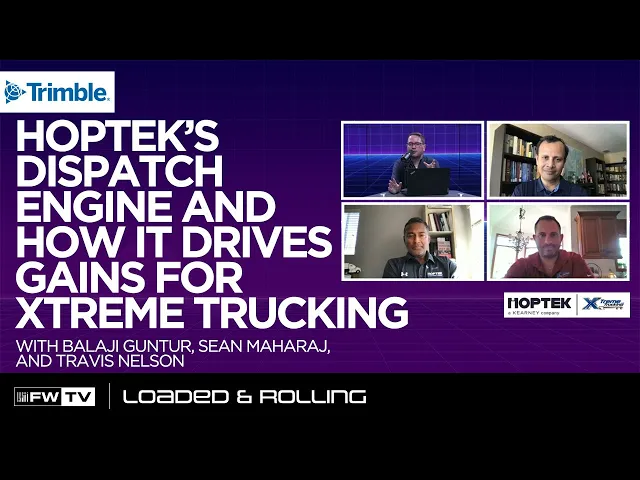
at Trimble we care about connection connecting technology connecting Solutions connecting you we're developing an ecosystem for transportation professionals that improves every facet of moving Freight whether you need to improve safety efficiency or compliance Trimble has you covered with telematics and Fleet Management route optimization asset maintenance and transportation management wherever you're headed your journey starts with Trimble [Music] welcome to loaded and rolling live I Thomas Watson the topic for today is going to be AI powered Fleet Solutions there's been a lot of talk with truck and Technologies truck Technologies but one of the big things for Fleet to especially in this challenging environment is going to be how to do more with less and how to make technology help you out and so one of the fun things we're going to be having on is some folks who are working on that uh the folks at hoptech and they're going to be talking about what they did for one company called Extreme Trucking and how this software solution was able to help out their operations talking about stuff like reducing your weight times uh talking about improving asset utilization and uh we're going to be having on three guests today so we get to bring on the four box that's right uh take that cable news we're going to be kicking it up a notch um before we bring them on we're going to be having on uh BAGI G is the co-founder and chief executive officer at hoptech it's a ky company we're gonna have Shan marage he's a chief commercial officer at hoptech and then Travis Nelson is going to be joining us president and founder of extreme Trucking Balaji gur uh co-founder and CEO of hoptech um hoptech is a technology Venture from Carney uh and and AD Carney has been driving a lot of technology in the um in the carrier in the shipper space for years now uh and and Tom I think you have worked with some very old version of the technology from many years ago maybe um in your past life uh and and this is really an iteration of that technology and we've grown a lot since then so what hoptech is bringing to the market is uh an in21 Fleet planning solution so we're basically helping trucking companies to uh get a handle on their dispatch operations all the way from tracking how their current network is moving looking at exceptions in the network planning all the loads that need to be planned so that you're maximizing the utilization of the fleet making the drivers are happy and the customers are satisfied and at the same time looking forward into the future and and determining what is the kind of Supply demand imbalance in your network and what sort of loads you need to um put into place so this this is really an end to- end solution um we also as part of this thing have a freight finder solution which is basically looking at plugging gaps in your uh network with uh loads from 3pls and shipper boards all put together so a lot of capability a lot of uh uh digitally enabled solutions that we think is helping uh companies get a handle on their on their operations and and really move to the uh next level of operations and scaler business and I think that kind of ties into the state of the industry the state of the trucking industry is one of the big things that's impacting this push for technology you know there's a very real reason since 2022 uh you're not getting more from the rate but your wages are going up let's see if we got Sean on here uh Sean uh talk about how let's put this in the context of the market here uh you know one of the challenges is ma maintaining this industry that still hasn't found an upswing uh tell us about some of the some of the data what's going on in the industry are there any signs for optimism yeah I think you probably can you hear me yeah you're coming through now we got you we'll make sure that we cut it in the front and then we'll extend it out a little bit so we get all this stuff and we'll be good fantastic fantastic well thanks for the opportunity here yeah I think this Market has been uh you know it's an understatement to say that it's been unforgiving I think what we're talking about here is probably 27 months of you know essentially turbulence in the marketplace which probably break the record compared to some of the other times we've seen you know some volatility you know if we look at rates you're looking at 0 2% relative year on-ear a little bit of nup tick I think we're we're still looking at you know some some volatility that continues forward but nobody's celebrating by any stretch of the imagination yet but there are some small signs of of some positivity and we just we just need to get through one full quarter of of positive signals and I think probably everybody really breathe a sigh of relief and follow on on that is there anything from conversations from uh positive signals as we're trying to read the tea leaves uh I've heard that you know a lot of folks are punting the ball 2025 depends on your Q3 earnings calls is there anything that folks should probably pay most attention to uh when we're looking for what these green shoots may be I think probably you know I think we're all unanimous in our our dis our perspective in terms of looking at the the election in terms of where that ends up in terms of generating some positivity in the marketplace I think you know we're going to wait to see how the rest of this busy season holds out from a retail perspective and how that looks and then obviously interest rates are are a big factor that that play a role in terms of where the market goes and how people you know lay down expenditures and especially on the trucking side and where they lay their Investments for us right now we're seeing a lot of a lot of interest and a lot of traction in terms of having conversations which really tells us people are having a a probably a different mindset and looking down the road and and what the future may hold and how talking about the impacts of that uh especially makes it harder for folks who are operating fleets let's kick it over to Travis as well uh tell us some of the challenges uh especially that you're dealing with in terms of improving your operational efficiency trying to do more with less uh you know for folks who are not as familiar what are some of these key metrics that you're trying to work on uh when you can't always get the wins on the spot or maybe an upcoming RFP I think he may be muted see if you can unmute yourself and we'll see if that works let's give it a go and see if that gives it a go I think it goes back to what you both have said early on as we've been in a downturn for 27 months now and Technology really has started to play a major role in this industry in the last three years in the past it was talked about I know some other Industries still make fun of us that were're on EDI or there may be a couple customers that fax or um still email and other other Industries you have seen that go by the wayside so since 20 20221 we're seeing a lot of Industry uh technology enter our Marketplace and I was on a panel a month or so ago and I think one of the hardest decisions now is what do you choose because you can have too much technology and half of it sits on the shelf and it's not as useful so what we're always looking for is we're measuring uh miles per truck miles per driver Revenue per Total Truck Revenue per active truck to see how how we're how efficient we're being in the marketplace and I want to do a follow on that because those are my those are some near and dear Parts Revenue per truck per week net rev Revenue miles looking at deadhead percentages uh I remember between 10 and 15 used to be kind of the old old remainder but as the market uh is getting a little bit rough is that one of the the challenges is trying to keep that I've heard some say upwards of 20% for some fleets is dead head one of the factors of reducing that wasting wasted miles you're trying to have technology solve for you yeah 100% we can see your rate per mile erode pretty quick when you factor in 15 16 you know a 20% dead head on a more localized or Regional Fleet but as far as over the road longer distance lanes that are going 600 plus miles uh per order typically you you want to be in that 10 to 12 per range but it's not always realistic you know we've pushed 15 16% over the past two years and in the in the past month month and a half we're seeing that Trend back down with utilizing some of the Technologies we're putting in place and just how do we how do we look at it at a different angle instead of always hopping to that next order that could be 16 17 18% and let's uh let's look into that the impacts as well because lower miles lower paychecks for drivers turnover becomes a big challenge uh I've seen it a few times we used to have a joker well when a joke we had a metric that had take like two or three bad weeks for either a carrier or even a driver in your Fleet before they're looking for something else uh and so let's go to BAGI real quick talking a little bit about that recent numbers from the American Trucking associations they said the driver shortage is down from a peak of 880,000 in 20121 uh to 60,000 but uh largely due to declining demand so we haven't solved it so much to his a poor economy welli tell us a little bit about that because driver turnover and retaining Talent seems to be one of these challenges that may bite you in the rear if you're not paying attention yeah absolutely right I think this is really a driver turnover issue in the industry where drivers are constantly switching companies to chase Revenue miles and Chase dollars and and you're absolutely right there are few few weeks of really bad loads and bad assignments that actually turns the driver off and wants to go look for something else now drivers have been somewhat patient and and some of these numbers that you're seeing going down is less a function of the driver mindset and more a function of the market there's will so much fight going around people are happy to have their jobs and and keep rolling and and keep loaded and moving uh but but the but the whole idea is that this industry really needs to actually start using technology to make sure that the the driver related issues are being taken care of like get the drivers the right miles get them the right assignments make sure that they are going home and and and being able to do so while every company wants to actually do this the right way that is not a problem that can be solved manually right I mean even with the best people working and doing the the very best it's a little bit like playing chess I mean you're only as good as you know your game is and and sometimes bringing in a chess engine that tells you what's the next best move to make actually goes a very long way in kind of helping the the drivers get the right miles and and start to take a real uh crack at this problem of driver turnover so we we we actually do think that you know as as as much as you know fleets want technology to impove F Fleet utilization it is the same uh Solution that's also going to make drivers happy and start to um improve on this driver turnover issue it reminds me of a recent fact uh atrie which is like the research arm of ATA they had their top 10 industry concerns for this year the first year and the combined top 10 including drivers and carriers where driver retention did not make the list and so I wanted to give a following on that BAGI before we get to Travis is that uh if you're not and it looks Illustrated larger fleets for this data set if you're not worrying about retention and you're not prepared for the uptick is that something as well because I I think that uh we should have recent numbers talking about driver availability and truckload conditions remains easy to find drivers is that one of the challenges where that you may buy technology to help in some aspects but then you're neglecting that human one I just want to get additional thoughts on what happens if you just don't pay attention well if you if you don't pay attention mean ultimately at the end of the day there is a there's a human sitting in the seat driving the truck and there is a chance that you know all the best technology in the world can still not get you the kind of Fleet utilization you're looking for so so part of this part of this calculus for us is to make sure that companies are using technology as an enabler it is not the only solution in the mix you actually need to it's a little bit like just to use analogies a new kitchen appliance in your kitchen so it actually starts to make your cooking easier but you still need to follow the recipe you still need to take care of the people there are still processes around booking the right Freight and and doing the right assignments and not letting the tribal knowledge and all those things interfere in the way you do your planning so so so the way we look at this thing is to to use the technology but use it as a force multiplier to take care of your drivers and kind of still retain that human element that's required to make sure that you're treating people all over the all over your operations the right way right that's a that change management is a big piece of adopting new technology while at the same time maintaining and improving your competitiveness in the industry right yeah I think that's a great concept you know I'd probably just add that you know I think this kind of multifaceted approach around driver retention you know using making sure you're leveraging the technology but there is a heavy human element we've seen organizations that have great cultural attitudes and philosophies around treating drivers and when you couple that with a solution like hopex I think you're you're in a pretty good position to kind of drive that down we'll never see it probably go to zero and there's no Silver Bullet but I think it's probably one of the set of tools that you need to have in the Arsenal to deal with this type of issue let's talk about application Travis you own a fleet uh extreme Trucking working on using this technology application this dispatch engine is cool because I remember I've had some where you have tms's and it helps out and then when I went to AI Fleet uh a trucking Tech startup there was no you had to use your cell phone when we first started and an Excel sheet now they had Technologies for load routing but your daytoday uh talk about how you guys has integrated that in because I think there's something really cool talking about matching the available Freight and the opportunities and then how to make sure your trucks aren't idle or just returning empty how did that kind of work out was there like a before and after or how did you all Implement that stuff yeah as far as implementing it's always tough when you first bring this technology on and to get your operations team to buy into it but once they started seeing the value in right now we have hoptech it it basically apis to McLoud and all of our orders and all of our hours of service driver availability plans home time is flowing into hoptech so what we've seen is we've been able to use the hoptech it's I know it's not a planning board I call it the planning board because I look at the hoptech board and it's telling me where trucks are dwelling where is there an issue on getting a driver home before our planners or driver managers might even see it because it's several pre-plans down the list and and the nice thing with using a dispatch engine like this is it is constantly pulling in the data we we all leave at 4 5 o'clock and then there's an after hours second shift and they don't always understand our operation or our customers needs like the the day shift and our customer service group and our leads so what hoptech is doing is it it is pulling in that hours of service and Drver information 247 and constantly optimizing it so a lot of times it's going to see an issue before we even see it um we've in the beginning the planners and the people always think there's no way that the technology can do it any better than they can because they've been working with the same customers and a lot of our routes are pretty static uh we do the same thing frequently but what we have found the more of the recommendations that we accept through hoptech the higher our Revenue per hour and our Revenue per truck go as we buy into the system and it's just showing them and hoptech really does a really nice job of we need to show them how and why with the data and once they see it they start believing in it and they actually start using it more I mean we still got a ways to go to continue to push our organization forward but we've seen the improvements uh day and night with just the projections that we have been doing so far and I think that's fun because uh especially the pre-plan component I used to be a load planner and uh we'd always and when I manage fleets as well you didn't always catch it so may have checked your Fleet in the morning you saw your pre-plans but then at 5:00 p. m. you may have given it a glance there's not really a good way and that reminds me of the variant program where we had uh uh it would be in the background adjusting pre-plans and so I think that for for the hoptech platform and I do have a question on this is uh do you usually show the drivers the first pre-plan or do they see all pre-plans on them I always wondered if there was a if there was an art in terms of how much should you show them because the smart play would be I want to be checking it all in the back end but also don't want to send them like reassignment notific a that's exactly you don't want to show them all the all the pre-plan right you want the planners to kind of give the drivers visibility to what they need to do next but ensure that as the network keeps changing and there a dynamic nature to the whole thing maybe the future pre-plans will change and that's the whole value of having a real-time dynamic system that's letting you make the most optimal plan within the planning window while letting the network evolve to whatever state it's going to get to so that you can continue to make the decisions in future optimally as well we think that planning out really far out into the future actually constrains the network and and and there is value in kind of trying to find that golden interval where it's not too far out in the future and it's not too close to now in a way that you sort of keep your network moving I mean and Travis you know how how do you do this in um in extreme yeah so this is one area where uh hoptech blagi Sean uh we have disagreed a little bit because as a former driver and dealing with drivers if I can out the whole week for that driver there is a retention piece to that because they can predict hey uh their kid their their wife I should be home on Friday at noon because I see all my plans on the flip side it seems like that is a never winning battle because Trucking happens someone gets delayed there's high winds in the midwest today and you know I took a call from a driver that's behind that does affect the pre-plans on that driver and we have to reoptimize it and it seems like whatever way you go um sometimes you can get in trouble and and someone's not happy with it but I prefer to plan out further uh hoptech does plan they they prefer to you know couple days out one to two days so the engine's always working we've just kind of taken a little more manual approach to that right now like Hey we're going to let it plan out and they have opened the windows for us uh one great thing with hoptech is they are very customizable it's not one one one size shoe fits they've really adapted to our needs because my 120 truck Fleet is different than a 500 truck Fleet or a 60 truck Fleet but there's applications for this technology and and all siiz fleets and having a provider that adapts to the different thought process on how dispatches should be planned or pre-planned and how to best optimize and we've kind of gone back and forth on that trying to find the best fit that focuses on retention but also focuses on the best efficiency and just trying to find a happy medium there is what we have been trying to do since integrating the technology and uh no that's the that's the trillion dollar question right there you can get five load planners together and ask them that same question you're GNA get different answers because I've been burned both ways I've planned a truck five deep and then something comes off and they get mad or I plan them one deep and I'm adjusting and then they're saying what am I going to do next boss I don't understand Sean let's dive in I'm going get your thoughts as well on this because I feel like art to science is there among folks the hoptech is working on uh is there kind of a specific way that uh they're utilizing this software is it kind of one thing where I want to plan them all out or let's get some of your uh your thoughts as well yeah I mean I think it's you know bolog is definitely the expert here on this but I think that it's a definitely a collaborative effort um I think that for you know companies like Travis and others out there I think there is probably um a difference of opinion in terms of their philosophy and how they run their business understanding the nuances I I probably couldn't pinpoint one in particular but you know I I'd probably say that there's no one size that fits all as Travis said and there's many different flavors and we're we're proud of the fact that we're able to configure many different ways to not be one one size fits all and I want to get Jar's thoughts as well let's see what the results are I think that's a really big thing day-to-day value since you've improved it some of the kpi that we're seeing uh changed uh let's talk about that and I like that you mentioned earlier I'm I'm I'm given a leading question Revenue per hour versus rate per mile in Revenue per truck cuz I I'm starting to hear that more and when I first started it was always rate per mile or Revenue per truck per week uh talk about some of the impacts of this what is what are some of the impacts of switching this in software yeah so um this was a new thought process as we moved on with when we integrated hoptech and I know blagi and I have talked about this because I always tell them when when people ask me what is it doing for you and if I got to talk in Revenue per hour it's not an industry Norm so we always look at Revenue per truck miles per truck utilization total revenue per mile that type of stuff but as he showed me how the dispatch engine is optimizing it started making sense because um you you can there's just so many facets you know someone some people compare Revenue per mile I got four bucks a mile but I went a 100 miles for the week well it sounds good from a revenue per mile but you really didn't make any Revenue so it's how do you look at all of them uh kpis together and what we have seen so far being on the program and utilizing the technology is we look every week what recommendations are our planners accepting and how does revenue per hour and revenue per truck and miles per truck follow that number and what we're seeing is it is it is indeed following when we can re uh dispatch a truck that hoptech may have found with very high dwell and we reoptimize that truck and put them on something else to get them moving faster or get a better Revenue per hour or maybe he's not sitting on it over the weekend or bringing it to the house there's all sorts of different angles you can look on look at on that um but we're seeing the revenue per hour leads the way to the revenue per truck miles per truck and pretty much all utilization metrics on that so right that's been a great thing with blasi is I'm I'm a I want to know numbers because so many people in in the tech space right now you go to whatever conference the McLoud conference I was just that and you walk into that room and you're just like a kid in a candy store like o if I had a little bit of all this everything would just be great and that's really not how it works I mean you got to understand the technology you got to use it but then what what are the kpis to show that it's actually improving because I you talk to a lot of other fleets and like yeah you know we put this in but I think it's doing a little better and one thing I've done with BL and Sean is like okay we we need a data set because I I like seeing the data is it actually improving does it I don't want it just to feel like it's improving and that's how we get our people to buy in when they see the numbers improving they're like oh guess I can't argue that I accepted 80% of all the recommendations Revenue per truck is here and this week soand so was out of the office so I was busy and I reverted back to the way I always plan we accepted 50% and everything fell to here so we've been able to really show that data and get the Buy in that we need that sometimes difficult when we're trying to put in this technology yeah I we get BAGI thoughts as well because I think that's such a radical thing here uh is that when you switch to a revenue per hour model it really does change the way that you look at a load a load fundamentally length of Hall characteristics rate per mile all in rate when you look at that Revenue per hour is that is that one of the challenges uh you know bology when you're looking at that uh changing the very fundamentals of of planning uh I wanted to get your thoughts as well yeah I mean fundamentally the one resource that fleets have is driver capacity driver time right so most of the full truck loads have 70 hours of a driver's time in a week how best are you using it so so what we are doing in hoptech is not just notionally planning based on proximity to a truck and so on but we're actually doing a Hos based movement calculation taking into account actual traffic on the road taking into account the the the truck routes taking to account the loading unloading times so it really is a fairly precise uh estimation of how a driver's time and capacity in a year in a week is being used and that's what we are optimizing right so fundamentally what you're doing is you're saying in the amount of time the driver is being productive how much time is spent on earning revenues how much is on dwelling repositioning and and hovers hours and so on so just optimizing that naturally leads to maximizing Revenue maximizing Revenue miles and minimizing non-prod hours but the challenge has always been it's hard to measure right so until there's a solution like hoptech that's actually tracking to how driver's time is being used and keeps updating it most most fleets don't exactly know when a driver is starting when a driver is ending how much time was spent on a load and so this Revenue per R while on paper seems like a great unit to solve for is not necessarily easy to measure and solve for until you actually have something like hoptic in the mix therefore when Travis is looking at this and saying ah this actually does make sense and solving for Revenue par does translate into all the conventional metrics that most of the fleets are always looking to solve for right so and we also think that you know because we are looking at driver's time all the time you know the driver has to go home on time you know as much as um you know is is if the driver has a home time coming making sure that they don't go too far away and they able to keep their home times keep their appointments at home uh all of that becomes a very very important piece of the puzzle so it actually uh takes away a lot of the decisioning from the planners in a way that they can actually rely on a system that's kind of doing a lot of this gruntwork thinking for them while at the same time keeping track of how to maximize the productive usage of a driver's time and uh yeah and Thomas i' add sorry just that you know this Revenue per hour discussion is one that comes up probably everywhere we go especially initial discussions with with Target clients and I think we we constantly land on this idea of you know it's not for us Revenue per hour doesn't work for us but the reality is the line is until you have a solution like ours you really can't consider Revenue per hour because you just have the you didn't have the data pipes or the data availability to kind of make that judgment and reach that metric and measure I I think that it does I have when I saw the transition to revenue per hour from my last startup that was the biggest conversation with uh Mark El Cory was that we'd look at loads and be like Mark this this load looks great and he'd show me the data he's like no look at the revenue per hour if you're looking at a software cuz I want to I got one more topic here then we'll start finishing things up I appreciate yall gentlemen for staying on a little bit longer we're moving it further out so we can chop off the front end where we had some issues make the recording look nice but let's talk about leveling the playing field and long-term Partnerships because I think that's something really important what your technology is doing is very radically different than what other offerings are at least from my personal experience um you know we'll start with Travis and uh when we're looking at leveling the playing field was this something that you know you've you have 120 plus truck Fleet uh was this stuff available from when you all first started what what's it like being able to have this opportunity because typically it it seems like this stuff was only available to the largest Mega carriers Nationwide carriers or publicly traded however you want to call it yeah it definitely wasn't uh available when I F started with my first truck 16 years ago I remember then we were we weren't in the foam booths yet but we were more Excel sheets or some sort of online SAS system but there's definitely not optimizers um I think even back then even the large fleets I know believe Schneider has their own in-house uh Optimizer tool I don't know when that was built but with Partners like hop Tech coming into the marketplace it really does help the midsize fleets be able to play the same game and when we've been in this downturn for 27 months give or take but I think one thing we have to do is we have to embrace the technology I know there's some fleets like you know this is just fly by the night it's a fat it's not going to stick but there are some really good Solutions out there and I think you need to look at what's the ROI in them and what's the future because hiring planners is primarily you know besides a driver or mechanic is one of the most difficult uh positions to hire because it takes that analytical fast-paced thinking that um some people just don't want that don't want to have to rebuild the puzzle every single day multiple times so it's given us the opportunity to how do we be more efficient for our customers because our our customers want things more efficient and that's what I try to explain to our people in the office all the time this techn technology is not to replace anybody it's how do we make your job easier and how are we able to do more with less because we can put more trucks on per non-driver employee when we utilize technology like this um so that's been kind of like what our focus is I I think in the next five years you're going to really see the technology now that there's machine learning and AI I know there's everybody calls it a different thing but I think you have to use it to be able to compete going forward um within this industry whether you're an asset based carrier or brokerage the technology is here and it's getting smarter and uh I know at the conference I saw just like big screen TVs it's it's coming into the market but it'll be more viable for you know 50 truck Fleet the 30 truck Fleet the 20 TR truck Fleet there's going to be different options that come out to make it available and I believe you just you have to be you have to adapt and uh start integrating some of this into your into your company now or get left behind on some of the technology that's coming out and final thoughtsi then we'll uh we'll go over towards uh Sean as well then we'll get uh you know where to reach out and learn more I mean just adding to what Tris is saying this technology is here to stay I think this is a new wave of Technology that's coming and that's going to make fleets all very very productive I mean to some extent the um the technology that exists in the trucking industry is also very Legacy right very old technology and one of the the best things that we heard a a customer tell us was when he saw our our demo and our solution he said I can finally tell my kids that they can become part of the trucking industry that's a big deal because everyone is using you know technology in their hands um but when they come to work that technology is stale and doesn't look like anything that they see anywhere else in the in the lives this is a need of the hour it's not only about Fleet utilization it is also about moving the the needle in the industry on adopting new technology so that you can attract the right Workforce you can attract the right drivers and kind of go through the cycle that the trucking industry sorely needs to get into because otherwise the workforce is aging pretty pretty quickly all said and done this doesn't have to be done as a cost it can be done as a productivity opportunity and and really improve the the value in the industry so it's here to stay yeah yeah I'd probably Thomas sorry I know you're going to hand it over to me now but I'd probably say that I'm going to be preemptive there and say that I like I like Travis's comment just around you know help helping people within your planning Division and the organization to be more efficient I think what it does also for a lot of people it keeps their job interesting because they're going to be elevated to a level of kind of dealing with exceptions rather than dealing with routine tasks and that also drives drives down you know waste inefficiency and and errors and a whole bunch of other things but I think if the the technology to B's point I think is here to stay I think it's going to become as as Travis said probably a more available mainstream as time goes on for everybody to take advantage of but I think it's really going to elevate a lot of our game and the data is already readily available but few can offer an h-based opportunity to kind of maximize the efficiency of your Fleet drive up utilization and and really improve your o and and profitability so we're happy about that and I think again I'm going to be preemptive and say that if you want to reach out and learn more about hop Tech we're at Hop tech.
uh we also have some people on our team that you're more than happy to reach out to Patrick Hardy is is on our team here and is more than happy to book you guys a demo if anybody's interested but thank you for the opportunity yeah know thank you all so much Travis folks want to learn about extreme Trucking as well or check out at a conference best way to find out yeah you can find us online extreme trucking. com um whether you're a customer or driver we we've continued to grow throughout the Midwest and we are a refrigerated Fleet so appreciate the time today yeah thank you gentlemen so much really appreciate y'all coming on and working with us this will be one of our longest episodes ever and one of our first episodes with the four box so really appreciate yall coming on we're going to have to wrap up this show though and if you are just joining us here we're going to be on demand on Apple Spotify and YouTube If you like what you're doing we have also the loaded and rolling newsletter which comes out on Thursdays at 2 p. m.