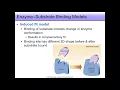
in addition to their influence on reaction rates another key feature of how enzymes work is the nature of their interactions with the substrates they bind we refer to the reactant and an enzyme catalyzed reaction as the substrate the portion of the enzyme to which the substrate binds is called the active site this is where the chemical reaction occurs recall that a catalyst speeds up a reaction without becoming permanently altered in the process this means that an enzyme must bind its substrate in a reversible fashion involving only non covalent forces such as hydrogen bonding electrostatic attractions
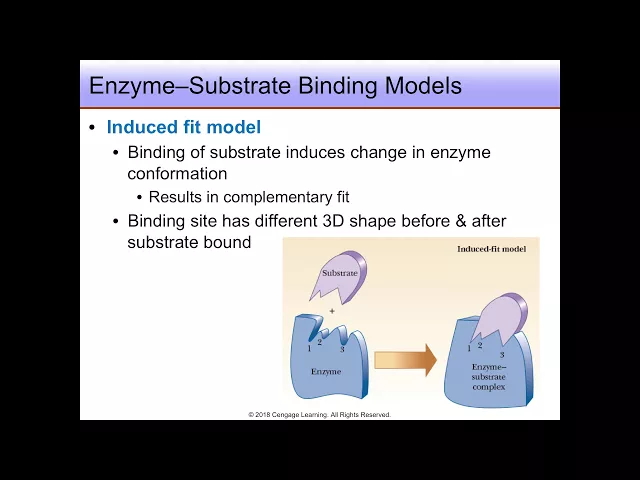
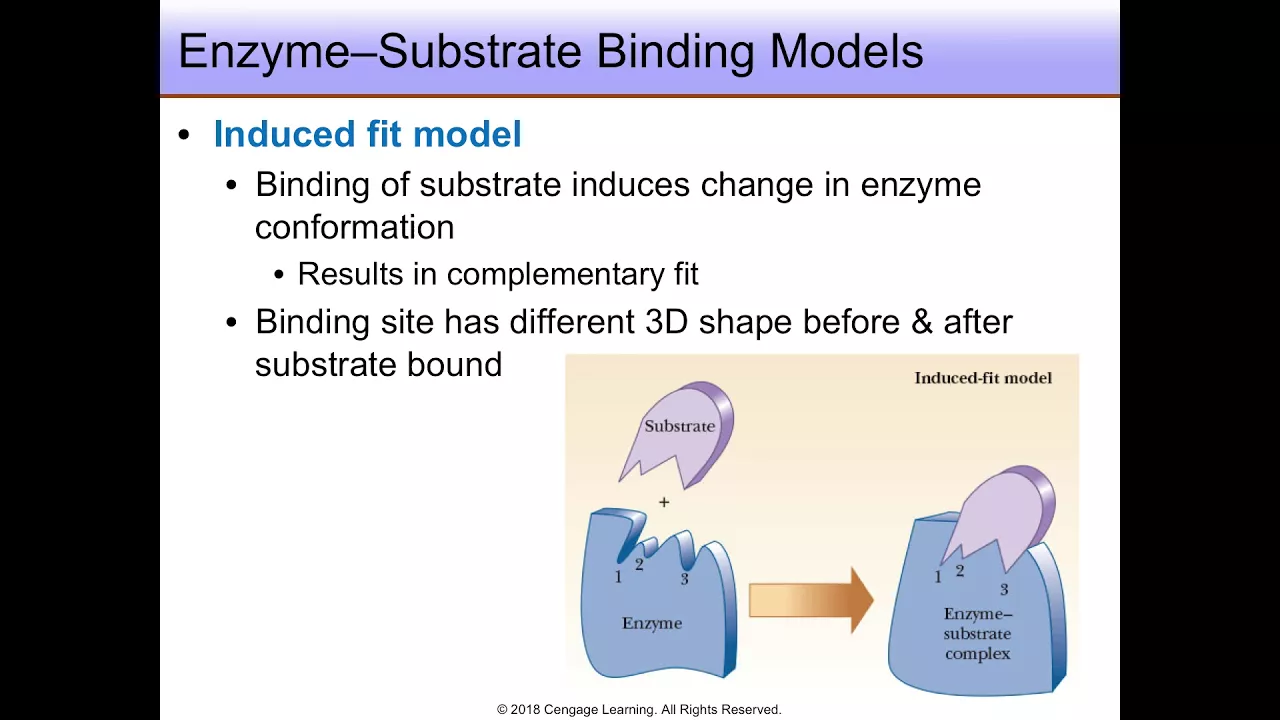
or Van der Waals forces clearly the enzyme must first bind the substrate before catalysis can occur there are two main models for substrate binding the first is called the lock and key model which predicts that the enzyme active site has the necessary shape to perfectly match the shape of the substrate notice that this is a very static type of interaction the second is the induced fit model and represents a more dynamic interaction between enzyme and substrate in this case the binding of the substrate induces a conformational change in the enzyme resulting in a good fit
in this model notice that the active site exhibits a different three-dimensional shape before the substrate binds then after it binds in nature there are examples of each of these two models if we look at the progress of a one substrate reaction pictured here we see the energy changes that occur during the course of the reaction on the far left the separate enzyme and substrate molecules occupy certain energy level and there is a slight energy held across before forming the enzyme substrate or es complex notice on the energy diagram that the es complex is more stable
at a lower energy level than that of the unbound species as a reaction proceeds there is a much larger energy hill the activation energy required to reach the catalytic transition state keep in mind that the higher the energy Hill the more unstable the species the ability of the enzyme to provide a platform for the substrate or substrates to achieve close proximity and proper orientation for the chemistry to occur also serves to speed up the reaction finally full product formation is achieved and the product is released returning our catalyst to its original form illustrated on the
far right remember to be a true catalyst the enzyme must return to its original form