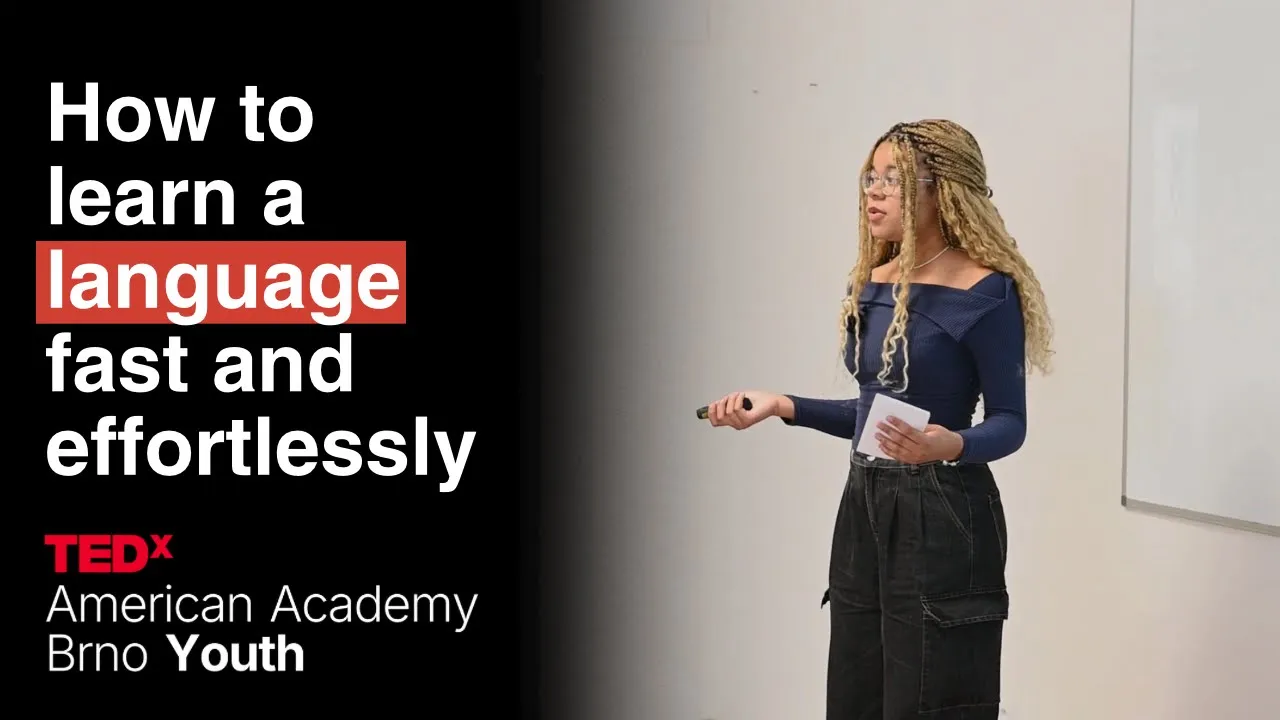
[Music] Have you ever struggled to learn 80 new words for a Spanish test? Have you ever been bored trying to memorize complex grammar for a German test? Have you ever had trouble connecting sounds to meanings in Chinese class?
Have you ever found language learning a long, tiring, and difficult process? If so, you're not alone. But today I am here to tell you how to change that.
When I was in fourth grade, my mom suggested that I should learn French. I didn't really have anything against the idea. So I started having private French lessons every week.
I studied from a textbook and memorized lots of vocabulary and grammar, but I wasn't making much progress. After three years of studying, I couldn't even hold a simple conversation in French or understand real spoken language. The same happened when I had to study German at school.
Despite having taken the subject for two years, my knowledge of German is very close to zero. I didn't have any real motivation to learn French or German, nor did I enjoy studying a language the same way I studied math, by memorization and completing tons of repetitive textbook exercises. Back then, I could have told myself that language learning is a long, exhausting, and boring process and that I should never try it again.
But instead, I decided to do it differently. When I was 12 years old, I decided to start learning Korean all on my own. I had started only because I enjoyed listening to Korean music.
At the time, I had no idea just how much it would change my life. Two and a half years later, I was studying in South Korea, speaking Korean all day to my host families and classmates, and I became fluent. Then, I decided to take up another challenge and start learning Mandarin Chinese all by myself.
A year and a half later, I can now hold full conversations in Chinese as well as read and write. The reason why I saw lots of improvement in my Korean and Chinese skills compared to when I was learning French and German was because I learned differently. And unlike when learning French and German, I didn't need a teacher.
I didn't need a textbook. And I didn't need to memorize vocabulary and grammar. Using the experience that I've gathered, I want to share with you how you can learn any leap foreign language effortlessly, for free, and completely on your own.
So, let's say you want to learn a new language. How do you actually start? There are many ways to do this, but from my experience, the best way to do this is to use a platform like YouTube and watch a few videos teaching basic words and phrases of the language you want to learn.
You should also try to figure out how to pronounce new sounds by repeating what you hear out loud. This is the only stage where you need to sit down and study for a bit. It can take you two months or it can take you a week.
This part can be as quick as you make it. Once you already know some basic greetings, nouns, verbs, and are familiar with the sentence structure, you don't need to worry about studying anymore. Most language learners make the mistake of sticking to traditional study methods throughout the whole language learning process.
Besides it being boring and exhausting, another reason why you should not rely on such methods is because you can often learn things that are incorrect or sound unnatural and carry those mistakes for a long time. Because once you learn something wrong, it is very difficult to erase. How should you improve after you've learned all the basics?
Uh, well, if I asked those of you who do not speak English as your native language, how you learned it, you probably wouldn't say, "I memorized all the grammar rules and studied every day for years," you'd probably say something more like, "I talked to people, watched movies and YouTube videos, and looked at social media in English. " You might even say that you don't even remember how you learned it, or that it feels like English just spawned in your head. If you relate to any of what I just said, that means you didn't learn English.
You acquired it. Acquiring a language is a mostly unconscious process by which humans gain the capacity to perceive and comprehend language without studying it. It is similar to how we learned our first language as toddlers.
The key to acquiring a language is comprehensible input, which is language that is a little above your current level of proficiency so that you can understand most of it, but you're still challenged by new words and patterns. Once you've become familiar with the basics of the language, comprehensible input is all you need. The goal is to get as much input as possible by listening to how native speakers express themselves and use the language in real life.
The easiest way to do this is to simply use the internet and listen to it. When listening to the language, you might not understand everything, but your brain is doing the work. It's recognizing sounds, picking up patterns, and little by little, you will notice yourself improving.
The more you listen to the language, the faster you will acquire it. If you want to speed up the learning process, you can look up the meanings of words that you've heard but don't know yet. However, you don't have to do this with every new word you hear.
You can easily learn what words mean and how they are used just by hearing them said enough times in context. And keep in mind that all languages are different. So some words might not have an accurate or direct translation into other languages.
So you should always trust what you hear instead of what a translator or dictionary tells you. Um right now you might think it sounds a little boring to just listen to somebody talk for hours, but the good thing about working towards acquiring a language instead of studying it is that it can actually be fun. The best way to learn is to listen to things you like in your target language.
For example, if you enjoy watching movies, TV shows, YouTube videos, or just scrolling on Tik Tok or Instagram, doing those things in your target language is a great and effective way to acquire it. Because in order to learn new words and phrases, you need to care about what the person you're listening to is saying. And if you already spend a lot of time on the internet, this can easily turn any unproductive habits you might have into productive ones.
Connecting the language with something you like will also help you become comfortable in it. This is important because becoming comfortable in the language will help you express yourself easily and communicate with people just as if you are speaking your mother tongue. Another crucial step in becoming comfortable in a language is using it to express yourself authentically.
You can do this by practicing speaking with people, preferably with natives. If you don't know anyone who speaks the language you are learning, you can try to talk to native speakers on the internet. And if you are still too scared to do that, it is also very helpful to practice thinking in the language.
By switching your thoughts into the language you are learning from time to time, you will become more comfortable in it and you will start to see it as a part of you instead of just as a skill or a school subject. Um, using the language when talking or thinking will also help you to um, remember words and phrases better because once you learn a new word or once you use a new word or phrase in a sentence that is your own, it will instantly become part of your vocabulary. Also, don't spend too much time trying to memorize how to read and write.
There's no need to spend hours studying different sound, different letters and symbols. If the language you are learning uses an alphabet or characters you're not familiar with, then of course you should put some time into learning it. However, if the language you are learning uses an alphabet you already know, instead of studying the sound each letter makes, it is easier to just focus on how each word is written and you'll be able to pick the writing system up naturally.
Uh it is best to look at written texts while listening to the language. So if you are looking at social media, you will naturally encounter the language's written form and needed to me and learn it without needing to memorize anything. If you enjoy watching YouTube videos, shows or movies, you can try to turn on subtitles in that language.
And uh like this, you won't have to memorize difficult spelling rules and you will start to remember how whole words are written. At some point in your language journey, you might feel like you're not making much progress, but remember that language acquisition is an unconscious process. As long as you continue to listen to the language, you will learn it without needing to memorize anything.
And the more you listen to your target language, the faster you will acquire it. To learn a new language, you do not need a teacher. You do not need a textbook.
You just need a little bit of motivation and an internet connection. Because the way you acquire a language matters way more than how hard you study it. Learning foreign languages has given me the opportunity to connect with new people, explore new places, cultures, and experience things I'd never even dreamt of.
Studying abroad and seeing the way people's eyes lit up when they found out I could speak their language. And their gratitude that they can express themselves comfortably when talking to me made me realize just how many new doors open for you when you learn a new language. Many people miss out on all these amazing experiences simply because they just don't know how to learn effectively.
But now that you do, I encourage you to open YouTube and learn a few new words and phrases in a new language. And if you already know the basics, watch movies, TV shows, YouTube videos, and look at social media in your target language. By working towards acquiring it instead of studying and memorizing, you too can learn any foreign language in a fast and um in a fun and effortless way.
Thank you.