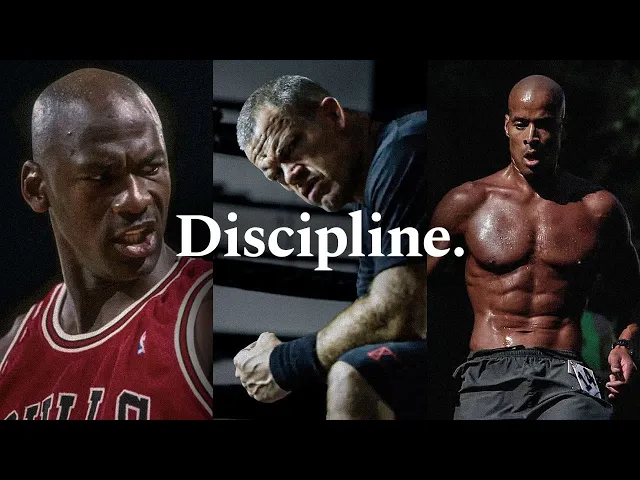
Discipline is when you take the battery of willpower and you squirt that extra juice to make up the difference. Your motivation's only getting you so far. Usually, it's far enough.
Sometimes it's not. How do you bridge this gap? You bridge it with something called discipline.
>> But what it takes is a a discipline that everybody has the ability to do it, but they just don't want to. Our mind may tell us it's easier to oversleep or not go to the gym, but at the end of the day, discipline can be practiced. It's not difficult.
>> But for some reason, I think when it comes to internal stuff, willpower, habits, discipline, because you can't see it because it feels like it's part of your sense of self. And I think that that limits maybe people's understanding of how much they can move that and lift the ceiling. >> We think that discipline sucks.
Like not getting to eat everything you want, not getting to do everything you want. We think discipline is a punishment, but actually nobody has a shittier life than a person who has no self-control, no boundaries, no rules. >> What are you going to get without discipline?
Are you going to be in good physical shape without discipline? Are you going to be financially successful without discipline? If you want to make progress in your life, you got to have discipline.
>> It's a discipline. It's a regimen. It was a choice I made.
And the choice I made was what are you willing to sacrifice? What are you willing to give up to find every bit of who you are as a human being? And I was willing to give up everything to do that.
>> There is a bridge from what you see in your head to what you hold in your hand. And that bridge is called discipline. We're talking about pressing and pushing towards something despite difficulty, despite delay, despite distractions, despite the doubters, despite the naysayers.
This is somebody who perseveres, who has an unwavering tenacity to achieve what it is that they see in their head. We do what we hate like we love it. That's what discipline looks like.
>> Okay. What you need to know about discipline is three things. If you do the three things from the next part of this video, you can accomplish anything you want to in life.
Okay? So, write this down. Three things.
The first one starts with the importance of getting enough sleep and planning your day the night before. You can't be disciplined if you're tired and if you don't have a clear plan for your day. So, the first thing I need you to hear is to get enough sleep and make a plan for your day.
Sleep is this tremendously important period of life because it resets our ability to be focused, alert, and emotionally stable in the wakeful period. So, we can't really talk about wakefulness, focus, motivation, mood, well-being without thinking about sleep. Optimizing what we're doing during the day is going to help us to actually sleep better at night.
And that's really the key. So, good night of sleep starts the moment that you wake up in the morning. When you sleep better, your entire day is better.
When you sleep better, your life is better. >> Until you are sleeping long enough and deeply enough, 80% of the nights of your life, you are functioning suboptimally. >> And what are what what's the biggest risk then if we're not getting enough sleep?
>> Deficits in learning, deficits in the immune system. We need to sleep enough. Now, what's enough sleep?
Enough sleep has been argued it's 6 hours. Other people it's 7 hours. Other people it's 8 hours.
It's basically waking up without an alarm clock and feeling rested. >> Okay. The second thing I need you to hear is the importance of time blocking your day and especially your morning.
Don't miss this one. It's not about making long to-do lists. It's about being very intentional with your day.
>> What does your morning routine look like at the moment? morning routine is wake up, try and get as much natural light as you can in the morning hours, whenever it is that that is for you. Especially the first 3 hours after waking.
I hydrate. I drink water and then I do everything I can to not do email, not do social media, and to take care of a few critical tasks. These days, I'm I have this obsession with trying to do one cognitively hard thing a day.
one and one physically hard thing a day. I try and get my brain into kind of a linear mode. I try and narrow that aperture.
So if I don't, the distraction that's created by social media and interactions with others can kind of wick out into the rest of the day. So I'm not necessarily trying to finish something in that time, but I try and do something challenging. I experience great pleasure from battling through something mentally challenging.
So, this is something I observed in myself, which is that from 6:00 a. m. until noon, my brain is very capable, my body is very capable of doing certain things far more easily than at other times of the 24-hour cycle.
So, I consider that sort of you the first phase of my day. Sometimes I'm up by 6:00, sometimes it's 7:00, sometimes it's 8. Usually, it's about 600 6:30.
So, I consider that one opportunity block. the second opportunity block because I eat lunch typically around noon between, you know, 1 and 6:00 p. m.
So our second opportunity block and then the third is between 6:00 p. m. and bedtime, which for me typically is 10:30, but sometimes late.
I mean, you have to live. I mean, come on. So, what I started to realize is that I can do really focused work in two, but not three of those blocks consistently.
I also notice that if I exercise early in the first block, like between 6:00 a. m. and before 9:00 a.
m. , I have more energy all day long. But if I exercise starting at 9:00 or starting at 10, sort of halfway through that block, the second opportunity block is diminished.
I'm kind of dragging. Maybe it's related to when I eat, but that wasn't changing when I eat or what I eat. So, I'm very aware of the fact that I get sort of two opportunities from these three blocks.
So, I do think that people could benefit tremendously, not necessarily by following the schedule that I follow, but by paying attention to their natural cognitive and physical rhythms. You don't have to wake up at 4:00 a. m.
, but you do need to block your day and understand when your most productive periods are. Okay, on to the last important piece of advice. Don't miss this one.
Okay, here it is. Strive to be an emotionally mature person. And one way of doing that is by forcing yourself to do hard things.
Practice discomfort every single day. You say, "The emotionally immature man seeks out motivation to do something hard one time. The emotionally mature man uses discipline to do something hard a thousand times.
" Why is emotional maturity related to motivation and discipline? Because when you have emotional maturity, you realize that some days you're not going to sleep well. Some days you're going to wake up and you've got your schedule and everything's planned out and whether things go well or not that day, the emotionally mature man will still do what he has to do to stack his wins to focus on his purpose.
Whereas the emotionally immature man will say, "Well, I didn't sleep well. I had nightmares, so I'll stay in bed. " Or, uh, it's raining outside, it's cold outside, I don't feel good.
You have to stay the course no matter what. And it takes a high level of emotional maturity because your emotions dictate your motion, like what you're going to do. And so if you have emotional maturity, you're more likely to lean into discipline when things are suboptimal.
If you lack emotional maturity, then how you feel determines what you do next, which is very damaging to outcome driven humans. You need to understand how your brain works. Doing hard things builds your brain and your ability to be disciplined.
Um, most people don't know this, but there's a brain structure called the anterior mids singulate cortex. But what's interesting about this brain area is there now a lot of data showing that when people do something they don't want to do, like add 3 hours of exercise per day or per week. This brain area gets bigger.
>> In many ways, scientists are starting to think of the anterior midsulate cortex not just as one of the seats of willpower, >> right? but perhaps actually the seat of the will to live. >> Now we're talking.
All the data point to the fact that we can build this area up. Y >> but that as quickly as we build it up, if we don't continue to invest in things that are hard for us that we don't want to do. That's the part that feels so gogganesque >> to me that we don't want to do.
>> Like if you love the ice bath, yeah, I love the ice bath. You go from 1 minute to 10 minutes. Guess what?
your anterior midsulate cortex did not grow. >> None. >> But if you hate the cold water, >> if you're afraid of drowning and you get into water and put your head under >> and survive, then the anterior mids singulate cortex gets bigger.
It's that I don't want to do something but do it anyway. That's >> right. >> That grows this area.
That's how I've lived my entire life. I don't know anything about that, but people go, "Man, you have such a strong will. It's something that you build.
[Music] And if you didn't have that will to carry on, you die. There's some internal drive that you either have or you don't have. And if you have it, you won't quit.
And if you don't have it, you're going to quit. Will you keep going? >> In the face of whatever.
I never thought about quitting. If they told me to get back in the water again, let's go. They told me to put that log on on my shoulder, let's go.
Put the boat on my head, let's go. I I didn't care. I wasn't the fastest.
I wasn't the strongest. I wasn't the smartest. But I did know that I could work hard.
I had to work hard. You're going to struggle. You're going to go through some hardship.
You're going to sweat. You're going to choke. You're going to get your arm broke.
And like these things are going to happen. Okay? I'm going to go forward.
There's no I can't get out of this. I'm going to go forward. I'm not going to quit.
So, I'm going to go forward. Bring it on. And I think if there's anything that you learn, it's to keep pushing through things that suck.
And I would love to say like, oh, keep pushing through adversity. But this isn't adversity. This is just things that suck.
It's one level below adversity. Adversity is when you're having a challenge. This is just something that's going to suck and you're going to have to push through it.
But it's like, oh, do do you want to do this or not? Which is what I think a lot of it boils down to. Do you actually want to do this or not?
But the vast majority of people, they quit. But they don't usually say that. And even in their mind, they probably don't believe it.
They probably believe, well, you know, it was my leg and once my leg was hurting, I knew I was going to have a hard time on the runs since I wasn't going to be able to make the runs. I just that's why I quit. But it wasn't really quitting.
It was cuz my leg. >> You're talking there about people making excuses. What have you come to learn about the nature of excuses?
>> Your excuses will destroy you and take everything that you ever wanted from you if you let them. When your excuses make you feel a little bit better about the fact that you didn't execute on what you needed to execute on, then they can make you feel better. But they're not helping you.
They're not helping you at all. When the excuses all go away and people can actually confront the fact that this is all because of me, it hurts. But is also unbelievably empowering because if these problems are because of me, then I'm capable of fixing these problems.
I was a little kid. I wanted to be some kind of soldier. I wanted to be some kind of commando.
So I collected little little plastic soldiers. I had different military units and one of the historical military units that I had was the British commandos. And so I had these tiny figurines and they had machine guns and they had kayaks and they had little inflatable boats.
And I thought to myself, that's what I want to do. And then when I was probably around 12 or 13, I realized you actually could do that. you could actually get the job of being a commando.
And the closest thing that I found was being in the being in the Navy and being in the SEAL teams. >> I have to ask a very dumb question here, which is what is a Navy Seal? >> Uh, so a Navy Seal is a part of the Navy, but you're the special operations component of the Navy.
The percentage of people that make it through SEAL training is about 20%. People that are under the age of 20, it goes down to about 5%. So yeah, I was one of those like small percentage of people that are very young but still make it through.
>> Well, they they call the uh one of the weeks hell week, don't they? >> Mhm. >> So they try and simulate hell.
>> Yeah. They try and simulate hell. It's it's it's about 5 and 1/2 days, no sleep, lots of physical activity, lots of stress, lots of pain, and lots of people quit.
I would say most of the people that quit. It's probably 80% of the quitters quit in that week. And it breaks people.
The other thing is you might be an exceptional swimmer and you might be exceptional upper body strength, but you're not that fast of runner. They're going to find that out. Or you might be a fast runner, but a bad swimmer.
They're going to find out what your weakness is. You might not like the cold. They're going to see it.
You might not like the boat on your head. They're going to see it. They might see that you have a bad temper.
They're going to find that and they're going to pick at that thing to either make you come out the other side or make you quit. [Music] One of the things they do is they'll they'll line you up and they say interlock arms and you get arm- arm with the guy next to you. They say forward march and you march in the water and they say take seats and you sit down and they leave you in there.
And it's called surf torture. And you just sit there and they'll after a while they'll pull you up out of the water. They'll line you up and the doctor will come down and see if anyone has hypothermia.
And if no one has hypothermia or signs of hypothermia yet, get back in the water. And they just keep doing that. Did Did you have some kind of innate advantage or can we all become Joo?
>> If I had to guess, I would say no. I I would say you can't teach it. I would say that you can grow it.
If you've got the seed of some sort of fire, you could probably grow and you can get better at it. But it's same thing you go back to like if you ever met anyone that was a prisoner of war, there's some people that had a will that they were not going to die. I'm not going to die.
I'm going to keep going. And if you didn't have that will to carry on, you die. And the people that died, they did not have the will to live.
And think about how bad things have to be before you say, you know what, I'm just going to lay here and die. That and that can get to that point. It was a guy who was Yeah.
going through hardship with his job with his marriage and the marriage was coming to an end. The job was not was going to come to an end as well and he's out there and doesn't know what to do. And the analogy that I set up for him is if I'm in the woods, which is where you are right now, you're in the woods and you don't know where to go cuz the wife's not there anymore.
The job's not there anymore. You don't know where to go right now. So if you're in the woods and you don't know where to go, start walking.
You got to start walking cuz the perspective is not going to change. You have to start moving forward. You have to start taking steps in order to improve your vision, improve your perspective, change your perspective, make some kind of progress, and worst case scenario, you figure out that you walked the wrong direction.
Okay, now you can go walk in the other direction, and that's that's going to be fine. But standing there lost and not doing anything is just waiting to die, waiting to starve to death. Don't let that happen.
If you frame things right in your life, if you frame a business challenge as an opportunity to build a stronger team, if you if you frame a personal challenge as an opportunity to overcome and improve yourself, these things that seem so horrible are actually very positive components of your existence and they're going to make you better and you're going to have to push through it. When the excuses all go away and people can actually confront the fact that this is all because of me, it's also liberating because now you have control over your fate and over your destiny. And that is a glorious thing.