hello everyone now we're going to talk about bertrand uh duopoly or bertrand competition and in this simplest case of this model there are two firms if you like you can call them firm one and two and each firm uh uh selects price p i which is in between zero and infinity all right i mean they can't choose negative price they can't choose price infinity so they're going to choose price for their good we assume that both firms produce exactly the same good but they're not able to i mean they're not choosing their quantity they're choosing
their price uh the the sort of the difference between cournot and bertrand may be in the bertrand case uh the quantity selection is easier easier than the price selection uh for example think of a software developer uh once you sort of uh made the uh invention once you develop the uh uh software uh the the the the producing for example uh i don't know word excel whatever so producing i don't know five or ten units of output is not a big deal it's it's just basically you're copying the same software same program on on on
a different cd and then sell the cd well but recently you don't even have to produce write the softwares or the programs on cd everything is downloadable from internet you see what i mean so producing is not a big deal but sort of changing the price is a big deal so therefore you you choose your price as your strategy and then depending on the market conditions meaning depending on the market demand you determine how much to produce okay obviously we are going to make bunch of other simplifications assumption and the assumptions we are going gonna
make is the following so let's suppose uh the inverse demand function is equal to uh uh well i mean let's make it even simpler i'm not gonna talk about inverse demand function but there's a group of consumers who buy from the lowest priced seller all right so don't forget there are two firms or two sellers in this market and the consumers are going to buy from the seller and remember both firms are producing exactly the same good and so the the consumers buy the good from the lowest priced seller uh again so there are a
lot of sort of simplification assumptions underneath this assumption one of them is that the consumers do not have any search cost which is in fact very important right but in i mean normally lately at least uh you know in the age of online shopping uh search cost is actually very very small for example when you go on amazon or ebay and search for an item what you see is exactly the same item right textbook or whatever sort of a brand new textbook or a brand new item but they're different sellers the different suppliers although they
all sell exactly the same thing sometimes you see that some of the sellers are charging slightly lower price than the others and so normally what you do you go and buy the good from the lowest uh priced seller obviously in amazon or ebay there's also the idea of reputation right maybe the seller is not going to send you the package or maybe the quality of the item is is not as good the uh you know they they advertise so for that reason actually the amazon or ebay sort of distinguish the sellers uh differentiate the sellers
by posting their sort of reputations uh sort of trustworthiness but let's ignore all that let's suppose the the trustworthiness or the reputation of the sellers are also the same so the firms are identical exactly the same in all respects and the only thing is that they can do is you know choosing their prices obviously this is a very simplistic environment um okay uh well that's it uh whoever charges the lowest price will get all the customers good what is the uh demand well let's suppose uh demand is equal to p i equals a minus b
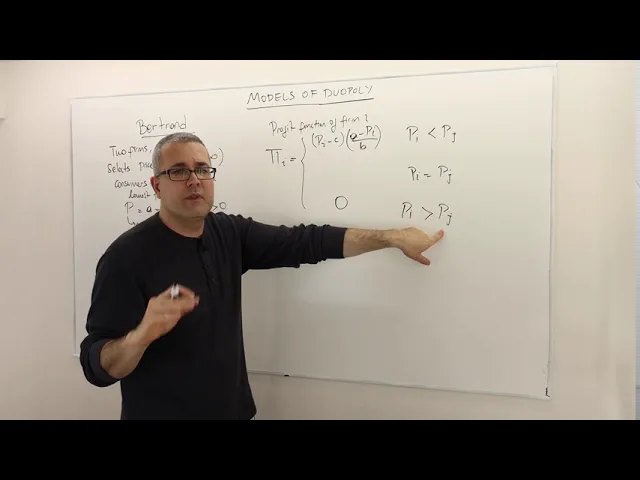
q all right so q is the total output a and b are some positive real numbers um so p i p is the market price so market price very good um well so here is how maybe we should be careful about this we should write down the profit function profit function of firm i there are two firms remember so i'm going to write it pi i so it's equal to it's a step function and you'll see why well here what matters is whether p i is less than or more than p j or maybe equal
to all right so if p i is less than p j what does that mean that means uh firm i is is the firm that is selling at a lower price so that means he's gonna get all the customers firm j is gonna get no customers in that case uh the profit is gonna be what revenue minus cost so what is revenue uh p i the price times quantity the quantity is given here right minus uh the marginal cost all right so let's assume assume marginal cost of producing this output is c for both firms
you may ask why we do not assume differences you'll see why because this is simpler difference c is a sort of a complicated example so here therefore the marginal cost times quantity so c times q all right so this is what the profit function will be all right uh by the way i can write this q as a function of p all right which i will so don't forget the q is equal to uh p i o oops sorry a minus p divided by b all right so therefore instead of writing this profit function as
a function of q what i can write it as uh p i times q which is a minus p i divided by b minus c times p i o i'm sorry q which is a minus p i divided by b all right so that means the profit function is going to be p i minus c times the quantity which is a minus p i divided by b all right well what if the price of firm i is higher than price of firm j well in this case the profit is zero but the profit of firm
i is zero because uh it's the high priced firm and so everybody is going to buy this product from the other firm from jay and so uh the thermi is going to sell only zero product and hence zero uh net profit remember there's no fixed uh cost and finally when the price of vermi and firm jr equal uh what's going to happen well without loss of generality we can assume that half of the customers are going to buy the good from firm i half of the customers are going to buy the good from firm j
so that means the profit is going to be this divided by two so basically p i minus c divided by two times a minus oops p i divided by b all right so this is the profit function of firm i it's a bit more complicated than the crew no case all right so the question is what is the nash equilibrium of this game all right well it is in fact simpler uh why is that so uh well you can sort of make it i mean finding the best response is is a fine job i mean
you can definitely do that how so you can just take the derivative of this guy set it equal to zero etc etc um i mean this approach is not wrong um but there's an easier way to find the nash equilibrium of this game and let me give you the solution uh in this game in the bertrand competition the unique nash equilibrium is such that firm one's price equals to firm two's price which is equal to the marginal cost c and hence the profit of firm one equals the profit of firm two which is equal to
zero okay um we did not calculate the profit of the crude oil firms in the nash equilibrium outcome but the chrono firms are going to make positive profit however the bertrand firms are going to make zero profits all right well the question is how do we show that well again this is a guess and verify approach and i think it teaches us more than uh the other approaches that you may follow so here is one way is p1 equals p2 equals c and nash equilibrium all right that's easier to verify well so p1 equals c
p2 equals c is this a nash equilibrium question is is this regret free i mean is firm 1 best responding firm 2 and vice versa is firm 2 best responding firm 1 the answer is yes let's look at firm 1 is firm 1 best responding firm 2 well the firm 2 is choosing the price equals marginal cost so we know from our intermediate micro that whenever a firm choosing its price to its marginal cost right price equals marginal cost so therefore the profit is zero all right so that part is obvious i think all right
uh the question is as firm one can i charge a price lower than c to get the customers of course you can so if i charge price lower than c what's going to happen my opponent is charging c but i'm going to charge a price lower than c so i'm going to get all customers but the problem is because pr is less than c it's going to be a negative profit meaning i am serving the entire market but i'm making loss so therefore p1 equals c is better strategy than charging price less than c so
p1 less than c is worse than p1 equals c very good but does that mean that p1 equals c is the best response no maybe p1 greater than c is better than p one equals c is it let's see when firm one charges price greater than c what's gonna happen so remember pj is equal to c and now i'm gonna charge price higher than c in this case i will basically serve to no customers and hence my profit will still be zero well what does that mean that means p1 greater than c is no better
than p1 equals c therefore p1 equals c is a best response is the best response in fact best response uh two p2 equals c all right so for one is best responding it's opponent and by exactly the symmetric arguments firm two is also best responding firm one hence this is a nash equilibrium all right so that part is easy the hard part is maybe is there any other is there any other nash equilibrium all right okay so think of this environment where uh obviously we know that charging a price lower than c uh can never
be part of nash equilibrium right because you know a firm who is charging less than c one of the firms will be serving the entire market or half of the market but it's going to make loss so therefore if i have a nash equilibrium other than marginal cost pricing it should be something like p1 p2 where p1 and p2 are greater than or equal to c and one of them p i is greater than c i mean one of them for i equal one two okay for sum for some i all right so the question
is can we have a nash equilibrium of this form uh well first maybe observations if p1 different than p2 then no nash equilibrium why is that so well i i think that's kind of obvious so let's suppose p1 is less than p2 all right symmetric arguments work if p1 is greater than p2 all right so for that reason i'm going to ignore these symmetric arguments so let's suppose price of firm 1 is less than price of firm 2. which is obviously i mean one of them is greater than or equal to c right so can
this be a nash equilibrium well look at firm 2 what's going to be the firm two's profit under p1 less than p2s scenario because firm one is the lowest priced firm all the customers are going to go to firm one and so firm two is gonna sell no product and hence its profit will be zero clear good however instead of charging p2 is this regret free no instead of charging p2 if firm 2 was charging p2 prime let's call it exactly equal to p1 so the same price with firm one what would be the case
well it would be then that the firm one is charging uh exactly the same problems or firm two is charging exactly the same price of firm one and hence they would split the profit which is positive as long as p1 is greater than zero all right once again if firm two charges decreases its price to the firm one's level well then firm one and firm two would share the market equally and firm two therefore would get positive profit if p1 is greater than zero but what if p1 is exactly equal to c uh because if
i reduce as a firm too if i reduce my price all the way to marginal cost my profit will be zero anyway right very good well in this case so let's say p1 is equal to c but p2 is greater than p1 can this be nash equilibrium no why not well this time firm 1 has incentive to deviate it's going to regret from p1 why is that well look by charging price p1 i'm already getting all the customers and i am getting zero profit because i'm charging p1 equals marginal cost but you know what there
is room between the marginal cost and p2 all right for example p2 is one dollar and the marginal cost is zero dollar so you know what why don't i charge for example 99 cents something higher than marginal cost but slightly less than p2 i will still get all the customers but because i am charging a price higher than marginal cost i'm going to get positive profit so therefore in this case firm 1 has incentive to deviate so in this case if p1 is strictly greater than c we just show that firm 2 will deviate and
hence firm 2 will deviate or it's going to regret it his choice and so no nash equilibrium because p2 will never be a best response in this case firm 1 will deviate and therefore p1 is not the best response to p2 so there's no nash equilibrium so that means we cannot have a nash equilibrium where one of the price of the one of the firm's price is lower than the price of the other firm so if there's a nash equilibrium price of firm one has to be equal to price of firm two and then the
final step um let's clean this part is there any nash equilibrium where p1 equals p2 uh but it's greater than c right because we already concluded p1 equals p2 which is equal to c is in nash equilibrium i'm i'm looking for another nash equilibrium different than this one so here is there any nash equilibrium where price of firm one equals to price of firm two which is strictly greater than c and the answer is gonna be no why is that so well here if this is the case firm one or firm two has incentive to
deviate why because they're sharing the markets because they're charging the same price if firm one highway so this is like they're charging one dollar but the marginal cost is zero dollar okay so the question is is there any nash equilibrium where p1 equals p2 which is greater than c well i don't want p1 equals p2 to be exactly equal to c because i already discussed that this is a nash equilibrium i'm looking for a nash equilibrium other than this one so but i just argued that if there's a nash equilibrium then the price of firm
1 and firm 2 must be equal so they're equal but strictly greater than c well can this be a nash equilibrium no why is not well because in this case firm 1 and firm 2 are charging the same price and so they're sharing the market demand all right that means this is the profit that they're getting however however instead of doing this if firm one for example charges slightly lower price slightly let's say one cent lower what's gonna happen well you're gonna get you're gonna serve the entire market all right and the pi the new
price is not going to be too different than the other price right so this is for example one dollar and the marginal cost is zero let's suppose so instead of charging a dollar why don't you charge 99 cents for example so one cent is not going to make huge difference uh in terms of revenue but you know serving the entire market rather than half of the market is going to make much bigger uh sort of a difference so you can actually formally show this for appropriate i mean for most demand curves this is actually the
case so there therefore uh whenever p1 and p2 are equal but they're uh higher than the marginal cost each firm has incentive to price undercut its opponent price undercut all right so basically this is a price war all right so you know that your opponent is charging a price higher than the marginal cost you're also charging a price higher than marginal cost instead of sharing the market i price undercut my opponent so i become the seller who serves the entire market but then once again that means p1 is going to be less than p2 obviously
firm 2 also has the similar incentives to deviate but well can this be equilibrium remember we said no because firm 2 also has the incentive to charge price instead of leaving it like this p2 i mean firm two has incentive to price undercut p1 meaning p1 minus epsilon all right so you know firm two will price undercut and then firm one will price undercut so you see the logic they will price undercut each other until they both hit the marginal cost and from their mo i mean from there on they cannot price undercut each other
because the marginal cost pricing is actually zero profit if you try to price undercut your opponent you're going to get negative profit so you're going to stop i mean the firms are going to stop there okay so therefore the conclusion is that in the bertrand model price of firm 1 equals price of firm two which is equal to the marginal cost of these firms is the only nash equilibrium unlike the crew know the firms are gonna get zero profits um and this is how we analyze the bertrand competition