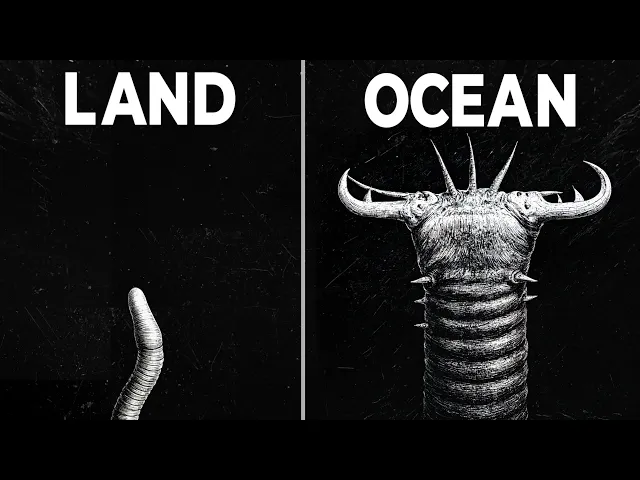
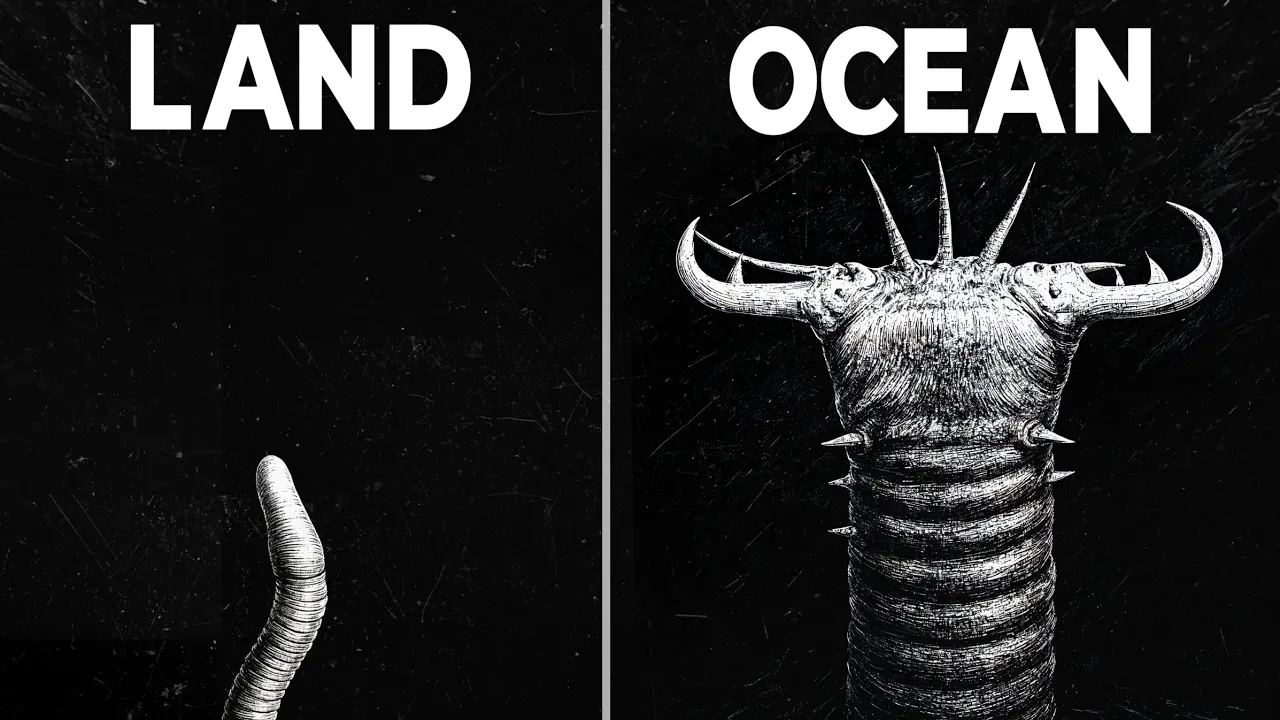
This is a worm. And this is also a worm. The only difference is one lives on land and one lives in the water.
On land, the scariest thing a worm can do is dry out on the sidewalk and then they sit and wait for predators like birds to snatch them up. But in the oceans, worms become the predators. They eat things.
They bite things. [music] They grow over 10 ft long and are even able to resist sidewalks. These worms are all classified as true worms.
But despite that, they fill completely different ecological niches. Why is it that only worms in the water are allowed to become monsters? And what could they possibly be defending themselves against in the ocean that land worms just haven't been dealing with?
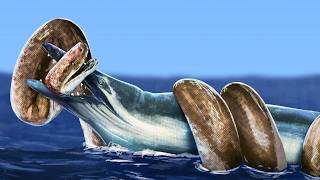
To find out why this is happening, let's take a look at the most obvious example of a worm affected by this phenomenon. This guy, this is Ununice aphrodito, also known as the bobbit worm. And if you couldn't tell, it can bite hard.
Bobbit worms have adapted to become literal living bear traps or well, fish traps. These guys can grow up to 10 ft long, but you almost never see their full body because they bury 95% of themselves underground. The only thing sticking out are five antenna that act like motion sensors.
And what happens if something triggers them? Yeah, that puffer fish is cooked. The puppet worm strikes almost instantly and snatches the prey down so it can't escape.
Oddly enough, the worm actually has basically no idea what it's eating. They don't really have eyes, just some light sensitive organs. If something swims near their burrow, they strike regardless.
After it strikes, the worm will try to drag whatever it snatches underground for its personal private feast. With large prey though, it doesn't always succeed. So, it usually tries to snatch a piece off.
Surprisingly, in this case, it actually managed to get this entire puffer fish down, even despite that puffer being a thick fella. But you're probably wondering, aren't puffer fish unbelievably poisonous? Shouldn't the worm be dead?
Well, that is actually a real danger, and that can be a real problem when you just go around biting anything and everything without looking. However, it's possible that the puffer doesn't get the chance to release enough of its toxins fast enough if it doesn't inflate quickly. And if it's only biting a chunk of the fish, it may not always eat the deadliest parts.
These worms could actually take a chunk out of your finger. But it's not super likely that they'd be able to bite your whole finger off. Although, I definitely wouldn't try it.
Fortunately, as well, we're definitely way too large to get pulled down into their burrow. But a bite from one will leave quite a nasty sting. But the creepiest part is that they actually are notoriously good at hiding.
There are stories of bobbit worms accidentally ending up in people's home aquariums, hiding inside coral rocks that people picked up and stuck in their tank. The owners would wake up every morning to find their expensive fish missing or chopped in half with no idea why until they saw a massive worm retreating into the gravel. These worms can be hiding for years without being discovered.
So, why did these worms have to evolve to become monsters instead of just being little wriggly worms like earthworms? Well, on land, earthworms are decomposers. Their job is to just chill, eat rotting leaves, [music] and occasionally get bullied by a robin.
It's a humble, quiet life. And while they don't really have the option to defend themselves, this is what works. On dirt, the most abundant resource is all the decaying organic matter.
And if earthworms can get in the soil, too, they can continuously extract nutrients. They follow the safety and numbers strategy. [music] It's kind of the opposite of what most people think of as survival of the fittest.
It's just survival of there's literally so many of them that you can't kill them all. Their competition for decaying matter is extremely low, and they definitely aren't competing with anything like lions or bears for a couple of dead leaves. But the bobbit worm lives in the coral reef.
And the reef is not [music] peaceful. It's crowded, competitive, and full of things with armor and claws. To survive down there, you can't just be a squishy tube.
You have to be a weapon. Dead organic matter is already extremely [music] nutrient poor. But one singular fish is worth a million times more than some soil nutrients.
As their prey grows bigger and actually fights back, the worms also need to grow bigger as [music] well. develop real jaws and set up life strategies a lot more violent than little earthworms. But the biggest reason these worms were [music] able to get so big comes down to simple physics.
Gravity. See, on land, gravity limits sizes immensely. If an earthworm tried to grow 10 ft long like a bobbit worm, it would be physically impossible.
It would be too heavy to move, and it would basically just be a floppy, sad noodle lying on the ground waiting to dry out. That body structure just doesn't work for worms. and it definitely wouldn't be able to move fast [music] and strike hard.
In water, though, their buoyancy supports their massive, grotesque [music] bodies and takes the weight off. This allows aquatic worms to bypass the limits of size, letting them grow massive muscles, thick armor, and heavy jaws without collapsing under their own weight. A lot more violence coming from just water.
And if you're a fan of extreme monsters, Drgon Anatomy is a speculative biology book that applies the same scientific lens we use to study deep sea life, evolution, and extreme adaptations to a creature we normally think of as mythic. Inside you'll find open water leviathons, reef dwelling species, nimble shoreline hunters, and even abyssal dragons shaped by darkness and crushing pressure. And they're not just fantasy cliches.
They're now treated like genuine marine organisms with real anatomy and evolution. But it doesn't stop at sea. Drgon Anatomy is a fully illustrated 220page field guide exploring dragons across mountains, forests, deserts, wetlands, tundra, and more.
Complete with anatomical cutaways, ecological behavior, and nutritionalist style field notes. If you play tabletop games, there's also an optional 5D compatible game guide, giving you [music] stat blocks, encounter ideas, and biomespecific behaviors so you can populate your world with scientifically believable dragon ecology. If you love ocean mysteries, speculative biology, or want a fantasy setting that actually feels like it's real, check out Drgon Anatomy using [music] the link in the description.
Limited supplies available, and huge thanks to Drgon Anatomy for sponsoring this video. But brute strength and size aren't the only ways the ocean turns worms into nightmares. Other aquatic worms took a different evolutionary path.
Instead of getting big, they got toxic. Enter the bearded fire worm. At first glance, this guy actually looks kind of fun.
It's colorful. It's not 10 ft long, and it has these fluffy white tuss running down its sides that make it look like a swimming pipe cleaner. You honestly might even feel a sudden urge to reach out and pet it.
Do not pet the worm. Those white bristles are thousands of hollow glass-like needles called Chaty, and they are filled to the brim [music] with a powerful neurotoxin. If you barely even brush against a fireworm, these bristles are designed to instantly snap off inside your skin, releasing the venom directly into your nerves.
The result, well, they don't name it the tickle worm. The pain [music] is instant and it's described as feeling like your hand has literally been set on fire. It causes burning, nausea, and dizziness that can last for days.
This is a strategy you almost never see in land worms. Fortunately, these worms aren't usually strong enough to cause any lasting serious complication for animals of our size, as well as they're not really trying to be hidden like bobbit worms. They have what's called opposematism, which is warning coloration.
It knows it's toxic and it knows that anything dumb enough to take a bite out of it is going to have a very, very [music] bad afternoon. So, it lets everyone else know, too. Oddly enough, fireworms are actually a lot like earthworms in a sense, too.
They're slow, they're soft, and they're extremely easy to eat. The only reason they didn't go extinct in the reef is because of the fire. Interestingly, despite the bobbit worm looking massive in size comparison to the fire worm, it's only about 5% of the length of the longest worm in the ocean.
This is the ribbon worm, and it's the longest animal on the entire Earth, longer than any dinosaur that existed, longer than blue whales, and definitely longer than earthworms. While a blue whale tops out around 100 ft, a bootlace worm was once found that measured an estimated 180 ft long. That is half the length of a football field made entirely of worm.
But unlike snakes, which are solid muscle, ribbon worms are fragile and gooey. So, how do they hunt? They possess a probuscus, a muscle structure they keep inside their body.
When they attack, they turn themselves inside out, shooting this sticky web-like structure out of their face to entangle [music] prey. It basically looks like the worm is vomiting a sentient root system onto you. And yes, it is acidic.
It can actually cause mild irritation in humans, but very unlikely to do any real damage. These are more monstrosities by length, not real threats. But what's even the advantage to getting this long?
Isn't this just a complete waste of space? Well, they're not actually trying to beat the Guinness World Record. It just gives them massive surface area.
Unlike us, or even fish, these worms don't have lungs or gills. They breathe entirely through their skin. By stretching their body out into an infinitely long, incredibly thin ribbon, they are maximizing the amount of skin that touches the water.
This allows them to absorb oxygen directly from the water around them much more efficiently. It's basically the biological equivalent of turning your entire body into one giant lung. But there's also the laziness factor.
If you are one of these bootle, you don't really have to go anywhere to hunt. You are everywhere. You can keep your vital organs tucked safely in a crevice while the rest of your body stretches out across the seafloor like a trip wire.
Now, you might think, "If I was 180 ft long, wouldn't I just be a massive, easy target for predators? " And you would be right. If these worms weren't still covering their entire body in that thick, foul smelling mucus.
They taste like death and probably worse than what we think normal worms taste [music] like. I will point out though that ribbon worms aren't actually true worms and are from the film neerti but were given the name because of their obvious wormlike shape. But if you saw our video on convergent evolution, body structures followed for somewhat similar reasons as well.
Ribbon worms are also insanely thin, so they're nowhere remotely close to the mass of a blue whale. And the longest ones are literally still only about 2 lb. Genetically, getting longer is a lot cheaper than getting bulkier.
and the longest ones [music] just kept evolving longer and longer. The same gravity effect that helped bobbit worms is at play here too, just on a 20 times factor scale. Despite this, there are actually worms that are not only long, but also thick.
This is the giant tube worm, which is shaped like a giant tube. To find them, though, you'll have to travel down to the hydrothermal vents. [music] Literal underwater volcanoes spewing out black superheated toxic chemicals.
You won't find fish. You won't find bobbit worms and [music] you definitely won't find earthworms, but you will find these guys clustered together like a forest of 8-ft tall alien lipstick [music] tubes. Strangely, they have no eyes.
They have no mouth. They have no stomach. And they have no exit.
They are a biological dead end, a closed loop. So, how do they stay alive? They have completely [music] outsourced the concept of eating.
Inside their bodies is a specialized organ called a trophosone, which is packed with billions of symbiotic bacteria. Since there's no sunlight down here for photosynthesis, these worms use a toxic hydrogen sulfide spewing out of the vents. Stuff that would instantly kill you and me and every other worm we've talked about and feed it to the bacteria.
The bacteria then turn that poison into sugar, which feeds inside the worm. They are essentially farming their own food inside their own bodies. Powered by toxic waste and volcanic heat.
And because they don't have to waste energy hunting or chewing or digesting, they grow fast. They are the fastest growing marine invertebrae known to science, shooting nearly 3 ft in a single year. Because of this, they're effectively completely harmless.
Even if you were able to get your hands on one, they can't do anything to you. They don't even know they exist. They don't have brains like most normal worms.
But interestingly, these are still true analids, which are the real worms, just like bobbit worms, fire worms, and earthworms. The ocean just removed their ability to be anything more functional than most plants. Even Venus fly traps are more conscious than this.
It's almost tragic in a weirdly poetic way because the ocean has stripped these creatures down to the absolute minimum version of animal and left them as hollow frameworks kept alive by something else entirely. Every function you'd expect a worm or honestly any animal to have been deleted. No mouth, no gut, no senses, no awareness, no decisions, no instincts beyond open plume, closed plume.
They can't move from their tube, can't flee, can't fight, can't forage, can't even recognize danger. They're basically living scaffolds for bacteria. A soft shell apartment complex built so microbes can harvest volcanic poison in peace, using their bodies as vessels.
Oh, get over it, though. They don't care. They're worms.
Interestingly, though, there are worms that have evolved a similar ecological niche to earthworms, being worms that go after decomposing material. But in the ocean, it's just a bit more gruesome. If you've watched our video on whale falls, you'd know that when a whale dies and eventually sinks, thousands of animals start to show up.
But these worms don't eat their meat. That's for normal scavengers. Only once a skeleton is left, the zombie worms called odax show up.
Like the tube worm, the odax has no mouth and no stomach. Instead, it grows massive green root-like structures that burrow deep into the solid whale bone. These roots secrete acid to dissolve the hard calcium, allowing symbolic bacteria to digest the fats and oils trapped inside the skeleton, literally dissolving the skeleton of a dead whale and drinking it through their feet.
Oddly enough, as well, their entire reproductive life cycle was morphed and made almost sickening because of this lifestyle. If you look at a patch [music] of zombie worms, you are only seeing the females. For the longest time, scientists couldn't find the males anywhere.
They looked everywhere until they looked inside the females. It turns out the male odex never actually grows up. They remain microscopic laravalized dwarfs and their only purpose in life is to live inside the tube of a female.
Sometimes 50 to 100 of them at a time just waiting. They don't eat, they don't leave, they just exist to fertilize eggs and then die. It is honestly one of the most bizarre lifestyles on the entire planet.
And it makes the Bobbit worms violence look almost normal by comparison. Fortunately, they're just worms. So, we don't really have to care.
And they're only about a few inches tall, including their root structures inside the bones. You're probably wondering how these worms even get there since rooting yourself in the bones wouldn't seem like a good way to find the next whale to devour. Strangely, their larae are constantly drifting through ocean currents just waiting to find a whale to suddenly start growing on.
99. 999% of these will drift, find nothing, run out of energy, and then die. And for the ones that do find something, it's eternal darkness in the void at the bottom of the ocean until they land.
This type of drifting simply wouldn't be possible without ocean currents and not something any terrestrial worm would ever be capable of. [music] You can't really catch wind currents with worm larae like this. Fortunately though, we live on land so we don't have to deal with these horrifying worms of the water.
And while earthworms may be a bit gross, they are sure a heck of a lot better than whatever's going on down there. Thank you for watching and I hope you enjoyed the video. Please let me know what you'd like to see a video on next.
I do actually read all the comments you guys are leaving. And if you want to see a video about the oldest vertebrae that also happens to be an apex predator, check it out here. It's a lot more dangerous than a worm.
I can tell you that.