Good evening, ladies and gentlemen. Welcome to the Nocturnes du Plan de Rome. This new season begins in a kind of special way; due to the COVID-19 health crisis, the amphitheatre is only occupied by members of the Nocturnes team.
We wanted to keep the spirit of live broadcasting, and I hope you are many in front of your screens. At the end of the presentation, it will be business as usual, i. e.
we'll answer questions live. You can ask your questions by typing during the session. They will be read to us by one of the members of the team at the end.
Trajan's Market, today's topic, has two astonishing features. The first feature is that today, by day or night, it is, like the Colosseum, one of the most visible and imposing features in Rome whereas in ancient times it was hidden; it remained practically invisible until very recently. The second peculiarity is that the name is fallacious, it is not a market.
First, we'll see what it was actually used for. It was a huge support structure to prop up the Quirinal Hill, which was notched to allow the construction of Trajan's Forum. We will then see how Trajan's engineers hit two birds with one stone.
Instead of a simple supporting wall, they created a structure with parts that could be used differently. These spaces are now part of the best preserved architectural structures in Ancient Rome, and we'll see the history of their preservation. Lastly, Sophie will take you on an interactive tour of the complex.
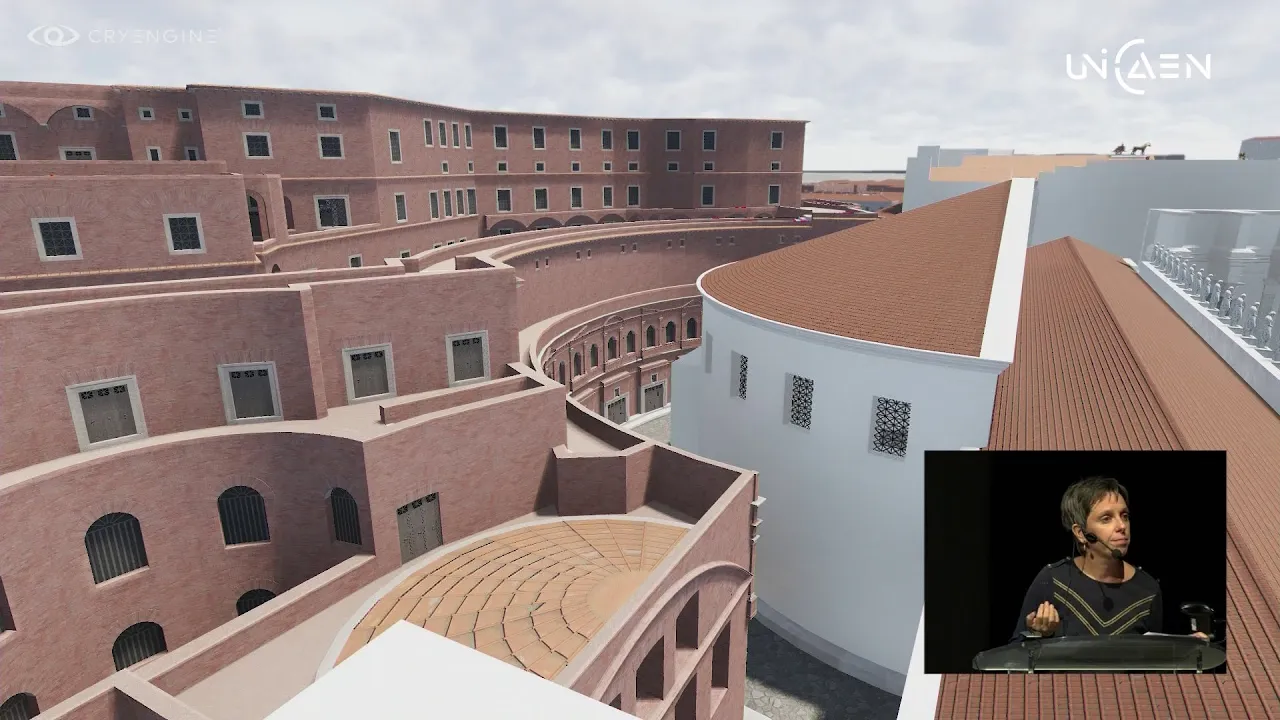
This 3D-modelling adapted to virtual tours, which is a first, is a real feat for the CIREVE engineers, because the structure of Trajan's Market is extremely complex. This is a version under development that you are the first to discover, so I apologise in advance for any imperfections. Before getting to the heart of the matter, I'd like to thank Lucrezia Ungaro, director of the museums of the Imperial Fora, which are precisely located inside Trajan's Market.
Lucrezia Ungaro opened the doors of her museum and provided us with all the documentation available. The history of Trajan's Market begins with the story of a square in every sense of the word. During the Roman Republic, Rome, like all Roman cities, like all ancient cities, had a main square called the Forum by Romans, called the Republican Forum in Rome, and which is located in a flat area among three hills: the Palatine, the founding hill, the Capitol which carries the citadel and the temple to Jupiter, very good, very grand, and the Quirinal.
At the end of the Roman Republic, Rome became the capital of a vast empire; the old forum became insufficient for the necessary representative and administrative purposes of the new capital. Caesar was the first to build a new forum. Then it was Augustus' turn, then Vespasian.
Then Domitian would build a forum in the empty space left between the forum of Vespasian and Augustus', but as his memory was condemned, that forum did not bear his name, it bore the name of his successor, Nerva. This is the situation at the end of the 1st century AD, all the flat space is now occupied. Domitian, who was planning to build a new forum, a monumental square with a nymphaeum, undertook the insane project of digging into the Quirinal Hill on its west side.
But it is his successor, one of his successors, Trajan, who actually did the work. Trajan's project was extraordinary because it meant notching a rocky ridge that connected the Capitolium to the Quirinal Hill. This rocky ridge simply had a low point at today's Victor Emmanuel Monument, on the left of the screen.
This low point formed a sort of small pass that led to the fora area and the Campus Martius area. The ancient walls of Rome are the Servian Wall, which was probably built in the 6th century BC, then rebuilt in the 4th century BC. It encompassed the seven hills of Rome, but over a much smaller surface than the Aurelian Walls built at the end of the 3rd century AD.
The Servian Wall ran on this rocky spur and it could be crossed using the Porta Fontinalis, located precisely on the little pass I mentioned earlier. Nowadays, it's difficult to grasp the depth of the dug slope because, based on the photo taken on the Via dei Fori Imperiali, we're five metres above the ancient level. The ancient Romans were five metres lower.
We have at least two landmarks. On the left of the picture, are the foundations of the Porta Fontinalis, at the foot of the Victor Emmanuel Monument. So we know that at this point, we're at the base of the old Servian wall.
The second landmark is to the right of the screen. You can see, in the top right-hand corner, the Torre delle Milizie built in the Middle Ages, the tower has its foundations laid on the original ground of the Quirinal Hill. How do we know that the slope was more or less even between these two reference points?
Because we know that Trajan's Column marks the height of the excavated ground. We know this because it's written on the base. This column is about 40 metres high from the base.
This is what is written, "ad declarandum quantae altitudinis mons et locus tant[is oper]ibus sit egestus" "to demonstrate of what great height the hill [was] and place [that] was removed for such great works. " An inscription by Dio Cassius, a Roman historian of the early 3rd century AD, who wrote in Greek, imparts to us much the same thing, "pantos gar tou chôriou ekeinou ore inou ontos katekapse tosouton oson o kiôn anischei", "indeed, this whole place being mountainous, he, [Trajan], excavated it to the height of the column. " It was an extraordinary work.
An estimated 316,000 cubic metres of debris was removed, excluding the demolished buildings, the Servian Wall and all the other buildings that were on the rocky ridge. We can't estimate the cubing here. Simply, for these 316,000 cubic metres of debris, we estimated that it took 52,600 working days.
The figure seems enormous, but with 200 workers, that's only a year's worth just for digging. Add to that those who transport the baskets full of debris, the chariot drivers transporting all this. We estimated that there were about 1,000 people on site for a year, just to make the notch.
You can see from the diagram on the right, that Trajan's Column is in the area that was not excavated; it's right on the edge of the rocky ridge. You will also notice, on the right, that the Forum of Augustus and the Forum of Caesar, or Forum Julium, have been slightly impacted by this excavation and they must have been partially rebuilt. The bricks that were found during the archaeological excavations in the area, the embossed bricks, tell us two interesting things.
The first is that construction work was started by Domitian. We already knew this from a text by Aurelius Victor which tells us that Trajan completed the fora begun by Domitian, but see, this brick bears the stamps of a factory of Domitilla. This was not Domitian's family, but it was a family adopted by his family, bearing the same name and contemporary to Domitian, so these bricks were produced between 60 and 93 AD.
The other interesting piece of information is that out of the 150 brickworks owners identified using the stamps, 50 were women. This means that there were female-owned brickworks. What's even more amazing for this one, for this brick, is that you can see that it was made in a factory, so to speak, in a brickworks that belonged to the wife of Emperor Trajan himself, Plotina.
The engineer in charge of all this work was Trajan's engineer, Apollodorus of Damascus, who is well known, who also wrote a book of poliorcetics, that is siege warfare with machines, and one of the subjects of our Nocturnes a few years ago. How did the engineers proceed? Instead of just building a simple wall, they built tiered structures, a bit like the tiers of a theatre.
To simplify things, we'll distinguish four main spaces. The great hall, the central body, the Via Biberatica and the great hemicycle. The great hall is today the entrance of the museum and the entrance of the archaeological site.
In antiquity, this was one of the entrances of this great complex, one of the upper entrances of the complex. The street in front was much smaller, much narrower than it is today, and the facade is very damaged. The interior, on the other hand, is well preserved, even though all the shop framework that you see was remade during a restoration in the 1930s, but the ceiling, all the vaults, are original.
The central body is the important part, the central part, as the name suggests, of this structure. In antiquity, one could enter either through the Via Biberatica, or from the upper street on the other side, on the north-east side. Today, access is gained through the hall, from the inside, to the central body, to each of the three levels, but these openings were made later.
Originally, there was no passage between the great hall and the central body. The central body probably led to a part that is today the arch that crosses the Via Biberatica. From there, one could go through a service area that ran above the shops on the right, which are now demolished.
The grandeur, the solemnity of the great shaft of light in the middle of this central body suggests that this was the heart of the administration. This was probably the seat of the procurator fori traiani, the chief administrator of Trajan's Forum. The Via Biberatica was a bit like the maenianum of a theatre, i.
e. the flat area that separates the high tiers from the lower tiers. On the left, you have the high tiers, the great hall where we were earlier.
The ground floor of the great hall, the one through which we enter today, is the second level here. Still in the upper part, on our left, there is the central body. On the right is the great hemicycle, the lower part of the complex.
The Via Biberatica connected the district of Subure with the Campus Martius district. Carts could not be used because, on the Subure side, it ends with stairs. By the way, today, as you can see on the flagstones which are still intact in the Via Biberatica, for a large part, on the original slabs, there are no signs of carriages.
We don't know the name of this street in antiquity. The name Biberatica is since the Middle Ages. The word biberatica derives from the Latin word bibere which means to drink.
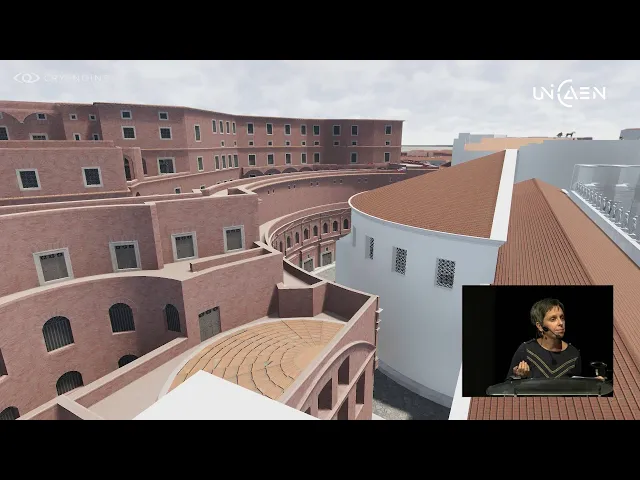
This doesn't necessarily mean that it was the street of drinking establishments. The name may also come from the fact that there are many springs in the area, but maybe there were also drinking establishments on this street. Fourth and last major part of Trajan's Market is the great hemicycle which is the lower part of the shoring structure.
On its upper part, it bordered the Via Biberatica. There were shops along the Via Biberatica. So, the Via Biberatica was much darker, surrounded by shops on both sides, it was much darker than it is today.
In front of the shops, on the Forum side, there was a terrace. The terrace still exists. When you walk on it today, there is a magnificent view of Trajan's Forum, but in antiquity, the view was completely blocked by a wall: the wall surrounding Trajan's Forum, of which you can see the remains of the exedra, on the left of the picture.
The base of the wall is still there. One went from the top of the great hemicycle to the ground floor by two staircases at each end of the hemicycle. The middle level had 12 shops that opened on an arched corridor lit by large windows that we see today.
This is what you see mainly when you look at Trajan's Market from the Via dei Fori Imperiali. As for the ground floor, there were 11 smaller shops decorated with black and white mosaics on the ground, and the walls were painted. We think that these were the treasurers' shops.
Sophie will tell you a bit more later on. All this space was seemingly used until the 10th century, with different functions. Little by little, the base got buried, partly by rubble, partly on purpose, because the Forum area - as the sewers of Rome were no longer working - had become insalubrious, so they redid levelling work.
The buildings continued to be partially used, but for other purposes. In the 16th century, Pope Pius V donated the area to a convent. In 1885, the convent was turned into barracks.
All this means that the area has been preserved. The radical change occurred between 1926 and 1933, when the entire fora area was cleared. It was a political will of the Duce, Benito Mussolini, who broke ground himself.
Today, the market is visible from the Via dei Fori Imperiali, previously, before 1930, like in antiquity, you couldn't see it. You couldn't see it because, firstly, it was hidden by Trajan's Forum itself and by houses, dwellings, which were built on the site of Trajan's Forum, the Alessandrino district. Today, when standing in front of Trajan's Market, the visitor is often fascinated.
They get the feeling of being in ancient Rome. It's partly true, partly exaggerated. It's true, it's one of the best preserved structures of ancient Rome, but you must realise what was discovered at the time of demolition and the current state to understand what is ancient and what has been restored.
I'll finish with just two examples: Via Biberatica and the great hall. Here is the Via Biberatica when it was cleared. You can see that the elevation was there, but that the façades have been heavily restored.
In this picture, you can also see that part of the paving was still in place; the rest was completed with basalt slabs from other Roman streets. This picture is important because you understand why the door frames were restored with travertine frames. This is because the two shops on the left, here, retained their original frames, so they reproduced these frames for the large opening and for the small opening above, on the entire structure.
To conclude, here's a picture of the great hall during construction. This great hall had been extensively modified, particularly during the installation of the monastery. A flooring had been made between the two levels, and in the vault, an oculus was drilled, which was filled in by the restorers, but other than that, the whole structure is original.
The vaults are the original ones. I will now let Sophie take you on a tour of the restored monument. Good evening.
Philippe showed you in the first part how much Trajan's Market was linked, from the point of view of the history of its construction, to Trajan's Forum in which we now find ourselves. In fact, these two structures are side by side. Trajan's Market is just behind the colonnade here, on the screen.
Surprisingly enough for us nowadays, in antiquity, Trajan's Market was not seen, or hardly, from here, except when looking through the exedra of these fora, and more precisely, through the windows of the exedra through which we can actually make out the brick structure. From the floor of Trajan's Forum, there's no other place from which you can see this market. The difference between antiquity and modern times is really impressive; this is what I'd like to show you now.
We'll take the same point of view in antiquity and modern times, and you will immediately see the difference. We'll stand here. This is what we saw in antiquity: on the right of the image, the square of Trajan's Forum.
There are three steps leading to a covered portico, and behind the portico, there is an exedra with the windows that I showed you. What about today? Look: perception, if you look at it from the same angle, it is not the same at all.
What do we see today? There's still the square, on the right of the picture, you can see the three steps that join the portico. Part of the paving of the portico and part of the paving of the exedra are still intact today.
If you pay attention, you can see that a column has been reassembled by archaeologists. This is one of the columns of the exedra. But above all, what catches the eye, the first thing you see in Rome when you stand here, is Trajan's Market, which we didn't see at all in antiquity.
I suggest we teleport ourselves to take a shortcut to see Trajan's Market, and we'll come back to the Forum, you'll see it at the very end of the tour. I'll take a shortcut, and we'll go just in front of the entrance to the great hall which is, roughly, at the highest level of Trajan's Market. What you must know about this market is that it constitutes a particularly interesting case study.
In fact, there is no mention of this market, neither in Greek literature nor in Latin literature. This absence of texts leads to two things: we don't know the name of this structure in antiquity, or even its use. This lack of knowledge means that Trajan's Market is typologically unclassifiable; we don't know how to classify it.
What I would like to show you through this tour tonight is that, nevertheless, it is a marvel of architecture, it constitutes an exceptional complex in many respects. So that those who have been to Rome won't have too much trouble getting their bearings, I'll enter Trajan's Market through the same entrance that we use today when entering the museum. What do we see as soon as we get through the door?
The first thing you see is that, despite the fact that we're here, in the virtual model, in the middle of summer, 21 June, despite the fact that we are in the middle of the afternoon, this area is relatively dark. We have therefore put forward the hypothesis that secondary lighting had to be added, perhaps with candelabra as seen here. What about today?
Today, the situation is partly different because the entrance to the museum is glazed, so there's light coming in naturally into the great hall. Look at something else: for the purposes of museography, statues have been placed in the hall; these statues are enhanced by spotlights to highlight them. In the end, we get something that is relatively close to what it was in antiquity.
What was the purpose of the shops or offices that opened here in this great hall? We don't know, it's uncertain. These may have been rooms for service providers related to Trajan's Forum.
Researchers have put forward various hypotheses. One of the hypotheses is that this office could have been used as the archives, hence the large number of scrolls and books stored here; perhaps official ceremonies were also organised here. We don't have enough information to definitively settle the issue.
What is certain, however, is that there were many offices in this great hall because there were desks on different levels. You'll see, if I go a bit further there is a staircase, which will take us to a mezzanine. This staircase has two flights, we'll take them and get to the top, in the mezzanine.
If I lean over the railing - let's try not to fall - if I lean over the railing, we realise that this view is reminiscent, quite astonishingly, of our modern shopping centres. It's like we're in a modern shopping centre. Perhaps this image from the collective imagination has, in part, encouraged the interpretation of this space being a market.
What is certain, and ultimately it doesn't matter what the use of this space was, is that this building was extremely functional. Once we're here, look, we forget that the available space for constructing this building was relatively small. We forget that the space is crooked, that there are major lighting difficulties because the building is leaning completely on a rocky spur.
The person who designed this building, who designed Trajan's Market, really did a remarkable job. We know the architect, it's Apollodorus of Damascus. You may have seen his bust earlier.
Before I go up those stairs, I'll go back and see him to tell you a bit about this man. I'm going back down to the ground floor of the great hall, and you'll be able to see the bust of Apollodorus of Damascus, which is right here. Who was this man?
Apollodorus was both an architect and an engineer. He made different things that are very well known today. One of his most famous feats, in inverted commas, is probably the construction of a large bridge over the Danube when Trajan was going to conquer Dacia.
Apollodorus had a roughly 1,000-metre-long bridge built across the Danube, 20 metres wide, which is quite colossal for the time. This is the same Apollodorus who built Trajan's Market between 109 and 113 AD. Once we have reached the end of the great hall, there is a flight of stairs that we can take today, which leads to a famous open-air area: the Via Biberatica of which we have already said a few words earlier.
Before we discuss the Via Biberatica, I'd like to draw your attention to the brick building here, right in front of us. This brick building was probably a surveillance area to monitor the comings and goings of the market. This was probably a control post set up within the imperial administration building.
What's left of it today? Look at this photograph, you can see the location of the staircase I've just taken; this is the staircase that takes you from the main hall to the Via Biberatica. You can also see the floor of the surveillance post, the walls have disappeared, and you can even see where the door was.
Look, close up, you can still see the groove used to slide the doors to close the surveillance post. This is the slight elevation that is still visible today, 459 00:32:24,720 --> 00:32:28,340 which probably looks like the image seen here on the screen. Let's walk up the Via Biberatica because I'd like to show you what is probably one of the best preserved streets from ancient Rome.
This street, as you saw in first part, has undergone heavy restorations, but nevertheless it is very interesting to look up close, and I'll tell you why. First of all, you can see that there are corbels along the street's façade. These corbels are perpendicular to the pavement below.
They were used to support a corbelled construction, which was used to provide shade for the passers-by underneath at certain times of the day. The shops that open onto this part of the street have probably similar functions to those in the great hall. These were also shops for civil servants of the imperial administration who seem to be having a somewhat heated discussion, but let's move on.
We'll go up the Biberatica because I'd like to try to see with you the view of Trajan's Forum from the highest terraces of this market. We're going up the Via Biberatica, which we already discussed. We're not at all sure that there were drinking establishments here.
It is likely that the main use of this area was administrative, which doesn't dismiss the possibility that certain open shops, for example, here on the right, were real shops in the true sense of the word. One of the characteristics of this street is that the pavement - you can still see it very clearly - was quite high, and this was for people to sit on it to chat in the middle of the day. Biberatica street is physically in the middle of the excavation of the Quirinal Hill, i.
e. we have, on the left, the high walls of the central building, the ones that have partially disappeared today; next, Biberatica street. Shops on the right, and on the right of these shops, the great hemicycle with a terraced roof.
You might say, "Yes, but it's not obvious to perceive the hemicycle with the ancient view. " That's why the modern view is useful. Look, we're back on Biberatica street, in the same direction as the photograph.
Here, you have traces on the ground of the shops that have lost their elevation, which is nicely rendered in the virtual model. The advantage of this photograph is that you can see, behind the shops, the terraced roof of the great hemicycle, which we'll discuss in a moment. I'd like to take you now to a third area, a third office, but this time to talk more about its architectural layout.
In fact, almost all the offices in this area have the same blueprint. Each time, there is a large opening overlooking the street, which provides an entrance to the office itself, like I just did in the virtual model. Above, there is a small window to light up the mezzanine, which is above the area we're visiting.
If you look at the bottom of the door's framework, you can see that there are grooves on the floor and grooves on the doorposts. These grooves were used to slide wooden panels, the doors that close the shop in the evening, before nightfall. All the shops in Trajan's Market were substantially built according to this same blueprint.
Let's now head towards the terraced roofs. To reach these terraced roofs, the highest points in Trajan's Market, you'll have to take a staircase which will be, in a few seconds, on the left of the image. We're going to go down these stairs.
Had I continued to the right, see there's a second street, that street would have taken us to the Subure district, just behind the Forum of Augustus, in the working-class district of Subure, which we visited together during a previous Nocturne. It was the Nocturne L'Amour à Rome, if you want to see it on our YouTube channel. I'll take these stairs, and we'll get to the terraced roofs.
There are two flights of stairs. The point of going up here, at the very top, is to see a really interesting view of ancient Rome. Why?
Because we're overhanging, and so we're in a spot that overlooks the rest of the city, and the view is panoramic. What do we see in this image? I've prepared a diagram to easily identify the places.
On the right of the image, you have the Basilica Ulpia, which closes Trajan's Forum. On the far left, the Curia Julia, the senate house in the Roman Forum. In the background, there are three temples.
These are the temples on the Capitolium. In the foreground, closest to us and the one that seems to be largest in the image, is the Temple of Juno Moneta. You can also see the Temple of Jupiter Capitolinus and the Temple of Venus Victrix above what used to be called the Tabularium.
Look, below the Capitolium, there is one more temple that is visible. It is the Temple of Venus Genetrix, the Venus Mother, in the Forum of Caesar. Forget about the trees we put on the right of the Capitolium.
We've put them there to liven up the image because our virtual model on the Capitolium isn't finished yet, but be patient, it's on the programme for the Nocturne in April 2021, and we are building you a Capitolium that matches the sources we have today. If I turn around, we can see a close-up of an exedra. It is the exedra of Trajan's Forum through which, earlier, we could see the market.
You can see the windows that gave us a glimpse earlier of the market's bricks. Just below, there's one last level we haven't seen yet. It is the level of the great hemicycle that we'll now visit.
What you must know, so there won't be any confusion, is that I'm currently on the highest terrace of Trajan's Market. This terrace today is interrupted; you can't walk on it in modern Rome. The only terrace you can walk on today is the one just behind, the one you see a little further down.
But from that second terrace, we wouldn't have a view of Rome as panoramic as the one I showed you just now. To avoid losing too much time in traffic, I'll take a shortcut that will take us directly to the great hemicycle. Let's go.
The great hemicycle, in antiquity, was probably much darker than we imagine today. I remind you that we are in the middle of the day. This area was obviously quite dark, because the left side of the street - you can see it on the image - was completely shaded by the high walls of Trajan's Forum.
If you look at a present-day photograph, the exedra is indeed still intact, but today we've lost the whole top wall of the exedra of Trajan's Forum, which was on the lawn here, at the bottom right of the picture. About ten rooms look out onto the great hemicycle. These rooms have a paradox.
On the one hand, they are richly decorated with plasterwork, painted plaster - you've seen photographs of it earlier, here are some more. We also have mosaics, a black and white geometric pattern on the ground. So, on the one hand, there are richly decorated rooms.
On the other hand - you'll see it right away in the image - these rooms are really very cramped. They are the smallest offices we've seen since the beginning of this tour. What did they do here?
According to sources, we can assume that imperial treasurers worked here, those in charge of collecting taxes related to various commercial transactions. The decoration you see here on the virtual model, like the one preserved today in Trajan's Market is not the original decoration. It is not the one during the construction of Trajan's Market.
This is a refurbishment from around the 3rd century in the time of the Severans. The question we must ask ourselves, now that we've gone through pretty much the entire market, is how do we get back to Trajan's Forum? There are different ways that I'd like to show you using this map.
There are three possible routes from Trajan's Market to Trajan's Forum. I suggest we take route number 2 on this map, which will take us to the side portico of Trajan's Forum, just along the Basilica Ulpia. Let's go.
We continue along this great hemicycle. Indeed, we are going to see a door on the left. As soon as I go through this door, we'll be back where we started, we'll be back on the side portico of the Forum of Trajan, so both areas are really connected.
As I said earlier at the beginning of the tour, from here, from the ground, it's impossible to see Trajan's Market. However, in antiquity, when we were in Trajan's Forum, there was a place one could embrace with the eyes the market, it was the terraced roof of the Basilica Ulpia, just in front of us. This is the last shortcut I suggest we take this evening.
We'll climb onto the roof of the Basilica Ulpia, and from here you will discover the only place in Trajan's Forum where one could have a complete and wide-ranging view of the market. I'd like to say a few concluding words here. This evening we visited together an urban area conventionally called Trajan's Market, and I explained to you that this was not a real market.
Though this scientific case is difficult to understand, it is nonetheless fascinating, because the architect who designed this really achieved his three goals. Firstly, his building effectively holds off the entire mass of earth and rock that was dug into, avoiding any landslide. Secondly, the construction map planned for an excellent use of the various available spaces, even though the floor levels distributed on different hights made the overall design relatively complex.
Finally, from a purely aesthetic point of view, the market is a success. Just think, about 18 centuries after its construction, it is still used as a market, and it still attracts crowds to Rome. Let me end this tour with a nod to the team of graphic designers at CIREVE.
I'd like to mention Nicolas, Charlie, Jérôme and Axel. In these difficult times in which we hust hold this conference online, where travel abroad is also difficult to organise, at least we still have the satisfaction of being able to travel virtually. Beyond the pleasure of travelling through time, I think this Nocturne on Trajan's Market is a real textbook case for measuring the utility of a virtual tour.
Interactive playback helps us better understand, better grasp the topography of ancient Rome. Let me explain. The last time I went to Rome, I knew that there were terraced roofs in Trajan's Market, and I tried to imagine what could be seen of the rest of the city from these terraced roofs.
I wondered if there was any area in the market where we could see the equestrian statue of Trajan. These were questions I had, and I didn't have any reference points to give a scientific answer to these questions. After tonight's tour, I think we all have a much better idea of the space occupied by this market, and hopefully a better understanding of its use.
I hope the upcoming season will bring us more surprises and that we'll soon have, before us, the audience who is so dear to us and who we are missing tonight. Thank you very much.
![Le Capitole : la colline sacrée de Rome [3D] - Les Nocturnes du Plan de Rome - 07 avr. 2021](https://img.youtube.com/vi/7CSjt8-0pSE/mqdefault.jpg)
![En voiture à Rome [3D] - Les Nocturnes du Plan de Rome - 10 nov. 2021](https://img.youtube.com/vi/Ov5-SJ9dVZw/mqdefault.jpg)




![Auguste : premier empereur de Rome [3D] - Les Nocturnes du Plan de Rome - 04 fév. 2026](https://img.youtube.com/vi/dK21SFhbsfY/mqdefault.jpg)

![L'installation d’un obélisque à Rome [3D] - Les Nocturnes du Plan de Rome - 5 févr. 2020](https://img.youtube.com/vi/A9bR7zI88Nc/mqdefault.jpg)
![La Domus Augustana [3D] - Les Nocturnes du Plan de Rome - 03 avr. 2024](https://img.youtube.com/vi/zPa6nM1cDKE/mqdefault.jpg)