by the turn of the 20th century it had seemed as though most essential issues in physics had been resolved despite some cracks as one would say most everyday occurrences could be explained either through classical mechanics thanks to Sir Isaac Newton and his laws of motion or through electromagnetism explained through the equations brought forth by James Clark Maxwell the Forefront of scientific progress at this point in time was more so in the field of chemistry in which scientists were trying to determine what the atom was made of so what were these cracks lying within the seemingly
straightforward world of physics well there were two distinct problems that stood out at the time one was the puzzling photoelectric effect which is a topic I will explain in another video the second crack arose from modeling radiation from what is known as a black body a black body is essentially any object that perfectly absorbs and perfectly emits energy there is no light reflection taking place if light is shot at it it will be completely absorbed and if light is seen coming from it its source is from that object a great example of a black body
is the sun the sun completely absorbs all light that hits it and all light that comes from the sun is emitted from it not reflected this is different from all other bodies in our solar system take the moon for example the moon doesn't create its own light rather it reflects light emitted from the Sun Sun some of which reaches us and we see that as Moonlight okay seems simple enough but what was the problem with modeling radiation from these black bodies let's start from the beginning with two scientists by the name of Otto lummer and
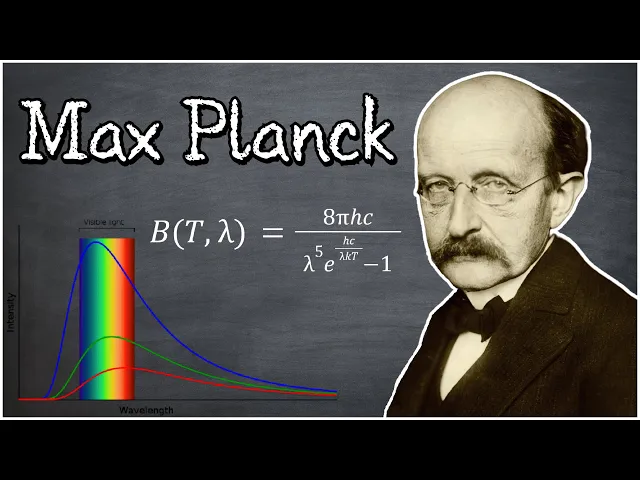
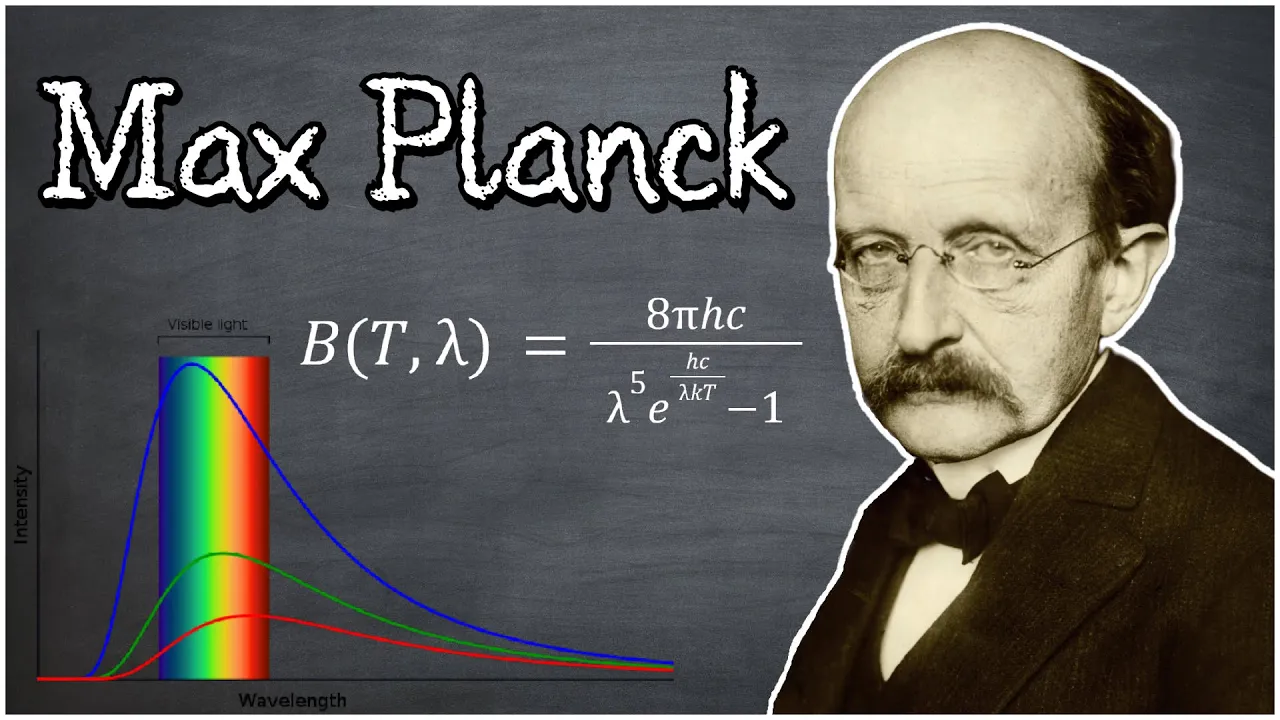
Ernst pring shim during the 19th century they set up man-made black bodies and collected data to model the relationship between the wavelength of light emitted and the specific intensity or energy density of that light they repeated this data collection at many different temperatures for the black bodies after the experiment was complete the data was organized into a graph that look something similar to this each curve on this graph represents a relationship between the wavelength of emitted light and the specific intensity of the emitted light at a certain temperature two distinct relationships were immediately recognized after
collecting this data the first was that as the temperature of the black body increased the overall intensity of light emitted from the black body also increased this came to be known as the Stefan boltzman law the second relationship discovered was that as the temperature of the black body increased the wavelength of light that was emitted at the highest specific intensity decreased this came to be known as ven's displacement law as revealing as these two relationships were there were still many more secrets lurking in this graph yet to be uncovered the next task was to write
a general function for these curves one that would be able to relate the wavelength and specific intensity of light emitted from black bodies a close attempt was made in 1900 by Lord John Ry and James jeans they use their current understanding of classical physics to derive their black body function now known as the reallyy genes law this derivation took a big step towards understanding thermal radiation but it had one significant flaw it didn't fit the data set for low wavelengths their equation implied that as the wavelength of emitted light gets extremely small the specific intensity
spirals out of control towards Infinity this obviously is Impractical in the real world and contradicts the experimental data so there was a giant hole in mathematical understanding here this came to be known as the ultraviolet catastrophe although this was a sizable Gap it was a gap that would only exist for a few short months the solution to the ultraviolet catastrophe would come from a German specialist in thermodynamics by the name of Max plunk Max plunk was born on April 23rd 1858 in Keel Germany his father Julius was a professor of constitutional law at the University
of Keel at the time when he was 9 years old he enrolled into the maximilan gymnasium in Munich here he developed three main passions music mathematics and physics he did happen to be a very talented pianist but decided to pursue physics instead and at the age of 16 he entered into the University of Munich he studied both there and at the University of Berlin where he studied under the notable physicist Gustav kirkov who coined the term black body radiation in the year 1860 plunk received his Doctorate with the thesis in the second law of Thermodynamics
at only 21 years old and started work as a lecturer at the University of Munich 5 years later in 1885 he would become an associate professor of theoretical physics at the University of Keel it was here while working in Keel that he married his childhood friend Marie MK in 1887 two years later he became a professor of theoretical physics at the University of Berlin succeeding his former Professor Gustav kirov it was here where he was working when he came up with his revolutionary approach to black body radiation in December of 1900 plunk proposed that rather
than energy being absorbed and emitted continuously it was only able to be absorbed and emitted in discret packets or quanta by using this assumption he was able to rewrite the boltzman distribution which is a for formula that represents the average energy in a system see taking a classical mechanical approach to thermal radiation meant using a ratio of integrals to represent a continuous stream of energy via the boltzman distribution which is exactly what Lord rley did when deriving his formula using the distribution this way would result in the average energy of a system being equal to
the boltzman constant multiplied by the temperature of the system but plunk using his idea of discrete package rewrote this distribution changing the integrals to sums of series in order to represent these discrete packets of energy in an energy distribution he also changed the energy variable e into n * Epsilon where n represents the amount of energy packets and Epsilon represents the energy of a packet as minor as these changes were they made Monumental changes to the derivation after plunk derived his formula in terms of N and Epsilon on he noticed something special the frequency or
the inverse of the wavelength of light emitted was proportional to his newly introduced value Epsilon so plunk replaced Epsilon with frequency or F in his equation to keep F an Epsilon equivalent he introduced a new constant H to multiply the frequency by this constant would go on to become known as plunk constant and would turn out to be one of the most important fun fundamental constants of our universe with this now complete derivation not only did this new formula match the experimental data for long wavelengths alongside the Ry jeans law but it also bypassed the
ultraviolet catastrophe and matched the experimental data for short wavelengths as well it was a near perfect match with the experimental data since plunk didn't have a fundamental explanation for this constant and by seemingly contradicting in the known laws of the universe to formulate the math to match the experimental data he was understandably dissatisfied with his formula at the time and called it an act of desperation he was unable to marry his formula with the current understanding of physics even though the formula was correct so although the problem of black body radiation had been solved it
seemingly left more unanswered questions than existed prior to tackling the problem to add to this there was still the unsolved problem of the photoelectric effect as well these gaps in understanding would still go unfulfilled for another 5 years when quantum theory would finally be verified at the hands of another upand cominging German Scientist by the name of Albert Einstein Max plunk won the Nobel Prize in physics for these discoveries in 1918 after a series of various experiments in the following years validated his foundations of quantum the theory he was elected to foreign membership of the
Royal Society in 1926 and later was awarded the cople medal in 1928 he retired from his position at the University of Berlin in 1927 from 1930 to 1937 he served as the president of the Kaiser vilhelm Society in his later years he worked on philosophical and religious topics rather than scientific ones but remained a prominent figure in the scientific community he was one of the first scientists to endorse the general theory of relativity proposed by Einstein in 1915 as incredible as plunk career was however his personal life was just as tragic his first wife Marie
died to illness in 1909 after 22 years of marriage together they had four children two daughters and two sons both daughters died at a very young age and his first son was killed in action during World War I plunk remarried 2 years after Marie's death to Marie's cousin marav Von hosin and together they had a son when World War II broke out plunk committed to staying in Germany to preserve German physics but renounced the Nazi regime this would prove to be a costly decision as his house was completely destroyed by bombings during the war and
worst of all his final remaining child with Marie with whom he had grown very close was executed for being a part of an assassination plot on Adolf Hitler in 1944 after the war plunk served as president of the Kaiser vilhelm Society a second time but for less than a year in 1947 he and his family moved to gingan where he would spend his remaining days plunk died on October 4th 1947 at the age of 89 shortly after his death the Kaiser vilhelm Society soy was renamed to the max plunk Society in his honor Max plunk
groundbreaking contributions to physics particularly his founding role in quantum theory have left an endearing mark on the scientific landscape by challenging established norms and introducing the Revolutionary concept of quantized energy plunk set the stage for a Quantum Revolution that transformed the course of physics his legacy is one of intellectual courage inspiring generation of scientists to question explore and push the boundaries of human knowledge Max plunk influence continues to resonate today reminding us that even in the realm of the smallest areas great minds can unlock the secrets of the cosmos