welcome to this press conference when we will present the Royal Swedish Academy of Sciences prize SAR SBS prize in economic Sciences in memory of Alfred Nobel we will keep to our tradition and start a presentation in Swedish and then continue in English and you're of course welcome to ask questions in either language later on my name is Hans Elin I'm the Secretary General of the royal Swedish Academy of Sciences and to my right is Professor jaob Sanson share of the prize committee for the S Banks prize in economic Sciences in memory of Alfred Nobel and
to my left Professor yon thel member of the prize committee and an expert in this field stun melan lender this year's prize is about understanding differences in prosperity between nations till Darren ashim MoGo MIT Cambridge USA Simon Johnson MIT Cambridge us James Robinson University of Chicago us the Royal Swedish Academy of Science has decided to award SAR Rick spanks prize in economic Sciences in memory of Alfred Nobel for 2024 to Daren Asim MoGo MIT Cambridge USR Simon Johnson MIT Cambridge USA and James Robinson University of Chicago USA for studies of how institutions are formed and
affect Prosperity Professor yob Sanson will now give us a short summary please yob thank you global inequality is largely driven by differences in average income across countries but why are some countries poor While others prosper and why are the gaps between poor and Rich na Nations so persistent these are not new questions but they are among the most urgent in the social sciences and and addressing them is extremely challenging this year's laurates have pioneered new approaches both empirical and theoretical that have significantly Advanced our understanding of global inequality on the empirical side their work has
greatly enhanced the study of the causal effects of institution on Prosperity in so doing they have identified the historical roots of the weak institutional environments that characterize many lowincome countries today on the theoretical side their research explains why extractive Economic Institutions and dictatorships often persist even though reforming them would benefit most it also outlines conditions under which institu s are likely to change reducing the huge differences in income between countries is one of our time's greatest challenges thanks to Daron asogo Simon Johnson and James Robinson's groundbreaking research we have a much deeper understanding of the
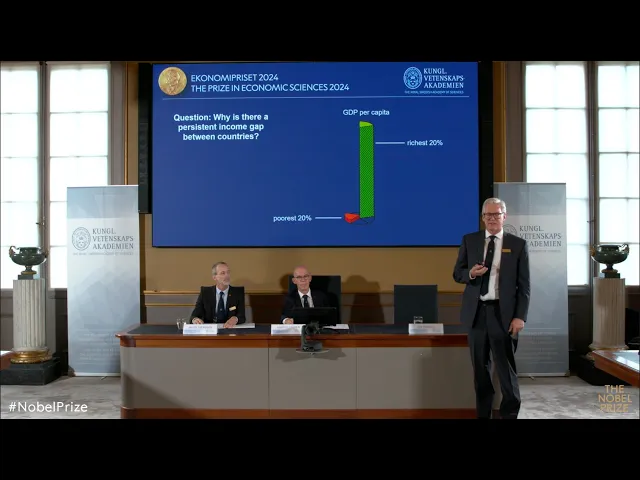
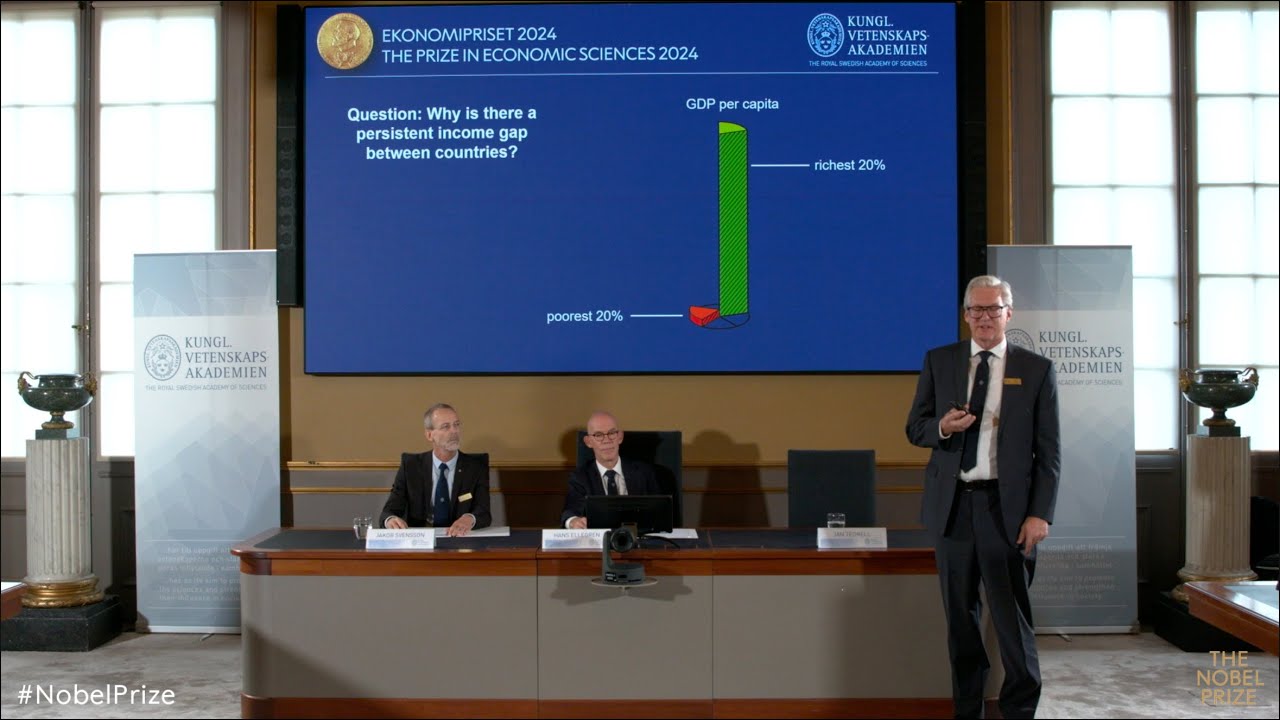
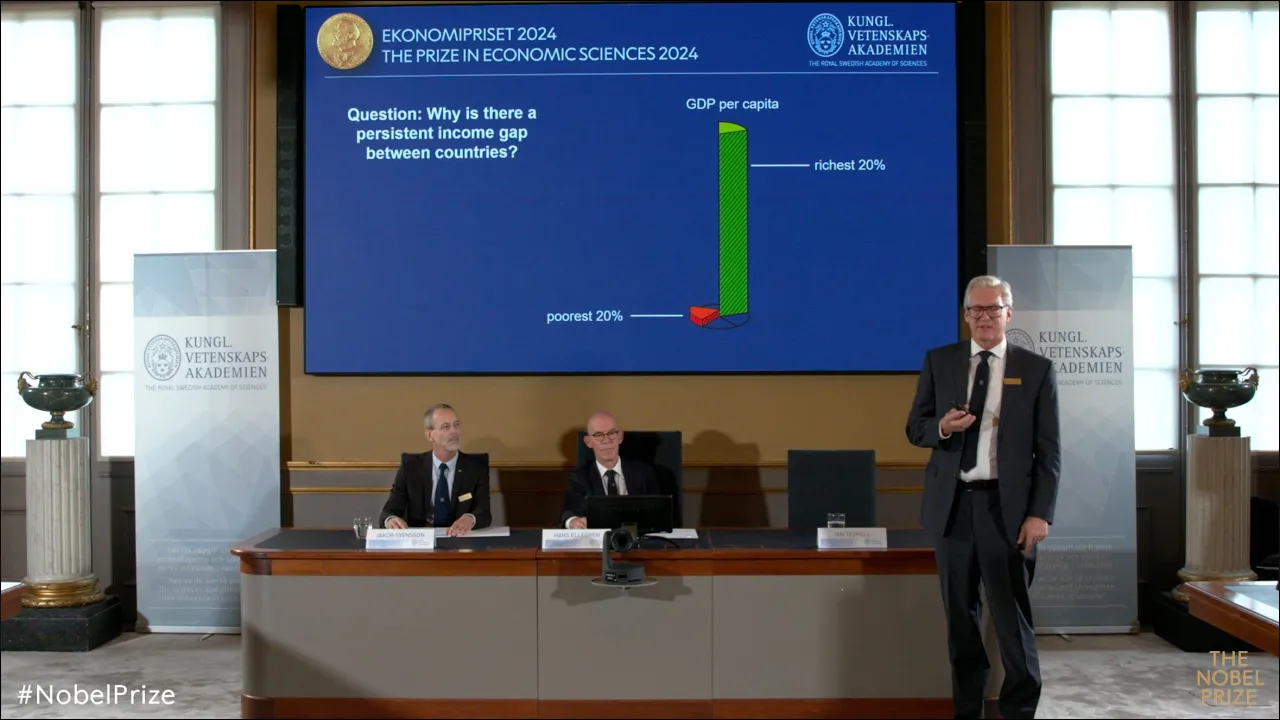
root causes of why countries fail or succeed thank you yob um Professor Terell are you ready give us more details about the price yes thank you very much today the 30% sorry the 20% richest countries in the world are about 30 times richer than the poorest 20% and this income gap is quite persistent so although the poorer countries are of course becoming richer they're not closing the Gap why is this the case backwards sorry ashim moglo Johnson and Robinson have shown that a large part of this income gap is due to differences in economic and
political institutions in a society and they depart from a very broad definition of Institutions uh as the rules of the game in society structuring the incentives in human exchange more precisely they make it a distinction between on the one hand inclusive institutions such as broadly protected property rights and democracy and on the other extractive institutions which more implies large risks of expropriation and autocracy and what they have demonstrated is that inclusive institutions are good for growth and long run Prosperity whereas extractive institutions lead to Poverty how do you provide evidence for that kind of claim
this is really really really difficult task to begin with a large many factors both affect what societal institutions you have and whether you get Prosperity or not and to control for all these in a single study is close to Impossible uh it's also the case that many things that you might think are a cause of prosperity could actually be a consequence making it even more difficult and these empirical challenges aside you also need a good really good theory to understand what institutions are how they persist and why they sometimes change empirically the laurates Met these
challenges by studying a huge intervention in human history the colonization uh of large parts of the world by the Europeans starting in the 16th century and onward what they showed was that as a result of colonization there were huge differences in economic and political institutions that arose in the colonized parts of the world World largely due to how many Europeans actually settled in the colonies so the more settlers you had the more you had to establish institutions that would good for uh investment by very creatively using data on mortality rates of soldiers Bishops Sailors stationed
in these colonies the lawy were able to show that one of the things that largely impacted on how many settlers actually settled was the disease environment in the colonies so the lower settler mortality the more Europeans actually settled and the more inclusive institutions they established for the benefit of the settlers but the more deadlier diseases there were in uh the colonies such as malaria or uh yellow fever the fewer Europeans actually settled and that meant that the Europeans either took over or established extractive institutions for the benefit of a narrow Elite at the expense of
The Wider population and this led then to this long run effect on Prosperity another thing the laurates showed was that as a result of colonization there was a reversal of Fortune and this graph illustrates this this reversal so what you have here on the x-axis is a measure of prosperity before colonization in the year of 1500 it's urbanization rate and on the y- axis you have a measure of the same around the time when they did this study that is the mid 1990s GDP per capita and what you can see here is that countries that
were richer before colonization to the right here have now become relatively poorer whereas countries that were poorer at the time on colonization have now become relatively richer and this again is a large part due to the uh inclusive institutions that the settlers established in these then formerly poorer countries but taking a step back you in order to understand this you the laurates not only had to make an empirical contribution but also a theoretical one because if you think about it and you if you rule over a poor country why don't you just take the institutions
that you know are good for growth growth would be best for everyone why don't you just introduce these inclusive institutions instead of the extractive ones to answer this question the laurates developed a serious game theoretical models and these models center around the conflict between a rich Elite ruling Elite and the poorer masses and a problem of creditability between those two groups so to simplify things the elite here represented by the king in his Tower could for example promise economic reforms they could promise more protected property rights uh for the people but this promise is not
credible as long as the king or the elite remains in power that is as long as they don't change the political institutions because as long as they don't do that the poor knows that the rich could just steal back from them whatever assets they have accumulated in the future so this promise or the economic reforms are not credible and this also means that with countries with extractive institutions get trapped in a situation with the rich Elite and poor m and this is called the commitment problem in this literature this commitment problem interestingly is also part
of explanation for why institutions sometimes do change one of the things that ordinary people have also in non-democratic settings although they lack formal political power uh is the power to mobilize so what the ordinary people can do is threaten with a revolution this could but does not have to be violent under such a threat the Elites in this countries face a difficult dilemma they would like to cling on to power so the king in his th Tower there he would again start promising economic reforms to make peace with the people but these promises are not
credible because again the people know that as long soon as the situation calms down the elites can just swiftly turn back to the old system so under this situation the only option for the elite could actually be to hand over power introduce democracy here represented by the king handing over the crown to the ordinary people so to sum up a mlo Johnson and Robinson have both made an empirical and theoretical contribution that has hugely impacted on later research in these fields on the theoretical side they have given us much better understanding for how institutions are
formed that is how they uh why they persist and under what circumstances they sometimes change and on the empirical side they have shown this huge impact of Institution tions on prosperity and although they don't provide any simple recipes or have any concrete policy proposals this of course also has huge societal impact to just mention one their insights show us that work on promoting democracy more inclusive institutions is an important Way Forward for promoting Economic Development and closing the world income gap thank you thank you Professor Tel uh I believe we might have Professor Daron asima
online here are you with us Professor ashamu yes yes I am I am thank you yeah good morning and please accept our warmest congratulations thank you I am delighted it's just a real shock and amazing news thank you yeah I so you feel okay right now I am completely fine yes yeah here at the press conference I believe we have many interested journalists both from Sweden and from the international press would you be ready to take some questions from them of course I would be I would be delighted okay who would like to start yes
please uh hello this is bki from the Polish television uh congratulations Professor uh what I thank you what I'm wondering and what I wanted to ask because uh uh you know at first first glance you could see the results of your work on your research as a simple recommendation that democracy means economic growth is it really that simple and uh how in that uh regard would you explain uh countries like China who do not uh who are not democracies yet they have experienced tremendous economic growth in the past decades thank you thank you very much
yes uh I think broadly speaking uh the work that we have done favors democracy and uh in follow-up work that I have done with uh uh uh pasal Restrepo s Naidu and James Robinson we uh specifically look at the Democracy problem as well and find that countries that democratize starting from a non-democratic regime do ultimately grow in about eight nine years faster than non-democratic regimes and uh it's a substantial gain but democracy is not a Panacea uh introducing democracy is very hard when you introduce elections uh that sometimes creates conflicts and uh and in particular
in already polarized societies elections can lead to short-lived outcomes uh that are uh sometimes not Democratic in nature in the sense that one party gains power and in an authoritarian way implements things and there are Pathways via which uh uh non-democratic countries can actually uh grow it's is something that James Robinson and I have emphasized ized a lot in our book why Nations fail what we called extractive growth countries can put resources rapidly mobilize resources for their existing sectors existing firms and that can lead to a uh uh a pickup in growth but our argument
has been that this sort of authoritarian growth is often more unstable and doesn't generally lead to uh very rapid and original Innovation and of course China is a bit of a challenge because it has recently started pouring a lot of uh uh uh investment and other resources into some sectors such as AI but I think my perspective is is generally that these authoritarian regimes for a variety of reasons are going to have a harder time for uh in achieving sort of long-term sustainable Innovation outcomes more questions maybe I can ask a question what was your
personal reaction when we reached you on phone oh well surprise and shock but uh you know this is a real good coincidence in the sense that uh I'm in Asing right now so it's not 5:00 in the morning for me it's a it's it's one one hour ahead of your time so it was easier to absorb than it might have been if I was in my usual place yeah so you are in ATA now yes and I in atam Greece correct yes please Professor rimu my name is uh Marcus Carson boru I'm I'm from the
Swedish broadcaster tv4 I was just wondering if you could explain to a lay person very very simply what your what your research is about and what you have achieved through your research well I think the Nobel committee gave a better summary than I can but I think uh the uh the most broad framing of some of the research that was cited there is we try to trace the roots of certain institutional trajectories to the Colonial past and rather than asking whether colonialism is good or bad we note that different Colonial strategies have led to different
institutional patterns that have persisted over time and then we Trace those institutional choices that Europeans have made to a variety of factors but quite importantly to the disease environments that determine whether Europeans settled what types of colonization resources they brought in and what kind of strategies they adopted and those persistent effects led to a real institutional Divergence uh throughout the last 500 years and then we are able to trace out some of the consequences of these institutional historical outcomes yeah thanks very much for that uh it's Marcus car are you again um I'm just wondering
your name has been in the mix quite a lot throughout recent years when it comes to the economics prize were you doubting that this price would come uh you never expect something like this you know I think it was it Napoleon said you know when you going into officer at school you dream of becoming a general but not a president or King so you know uh you dream of having a good career but this is over and on top of that so it's a great surprise and honor okay this seems to be the last question
from the press for you Professor Asam MoGo thank you or was it one more yeah sorry one more please of course I think was actually there in the in the back uh thank you congratulations Professor Paul ree from aler English um could you just sort of clarify again um in terms of a before and after State why Colonial colonialism is such a good test for this oh well I think it's uh uh it's not that there is anything in the nature of colonialism that makes it uh sort of a good test but what colonialism did
was it transformed the institutions the organization of many societies around the world starting sometime uh uh around 1500 and these were both different outcomes within the colonial world and because they were so deeply uh affecting the organization of these societies they had very persistent effects so in some sense to us colonialism is interesting and of itself it's one of the most significant things but it was also a natural experiment that divided the world into very different institutional trajectories was it some more there yeah please yes hello uh this is K fet from the Swedish daily
dogin new congratulations Professor Ros muglu thank you can you comment on how how you assess the the current quality and current trajectory of institutions in the world if you look at your your current home country the United States or other countries in your in the world right now well I mean I think this is actually another topic that I am researching and it's it's fascinating but worrying uh if you look at data uh that International organizations such as Freedom House them or others collect uh they see that institutions everywhere including in the United States uh
including some European countries and in many parts of the emerging world are getting weaker and weaker if you look at data from surveys that ask people their views about authoritarianism dictatorship democracy and so on you see that the that support for democracy uh among the population is at an alltime low so that suggests that despite the potential for democracy to spearhead rapid growth and consensus around difficult choices uh we are not probably achieving that full potential and in fact my evidence also suggests that the uh democracies particularly underperform when the population thinks that they underd
deliver they don't rise up to their promises in terms of uh providing good governance control corruption limit inequality create shared poverty Shar shared prosperity and so on so I think uh this is a time when democ democracies are are going through a rough patch and and it is in some sense quite crucial that they reclaim The High Ground of better governance cleaner governance and delivering sort of the promise of democracy to a broad range of people thank you no I don't see any more questions um uh again thank you very much Professor Shugo and again
our warmest congratulations uh we look forward to see you here in Stockholm in December for the Nobel Prize ceron thank you very much I am I am looking forward to that as well thank you yeah byebye byebye I see no questions so then we end here uh thank you for attending and look forward to see you then when we have press conferences in December with the law rights present here thank you