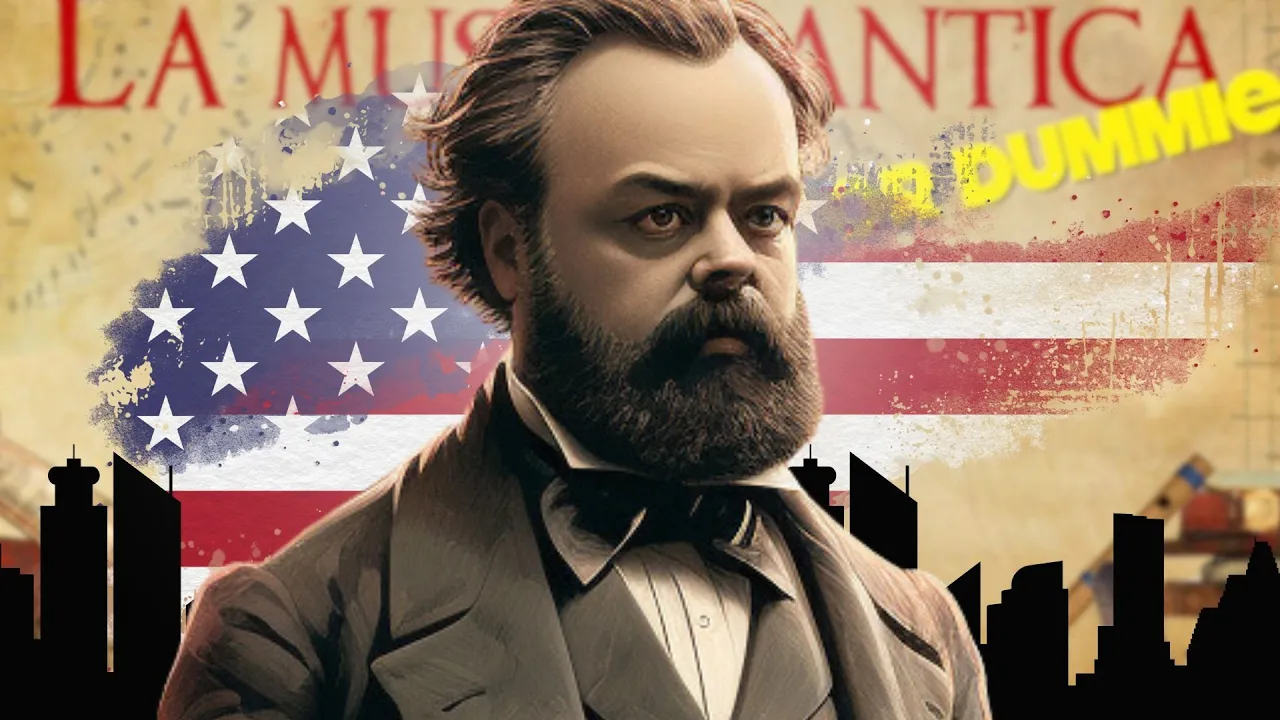
A man vomited leaning over the ship's rail. Wiping his mouth he mumbled a curse in Czech. He was born near Prague, he was traveling with his family aboard the SS Seal, a huge ocean liner, a hellish crossing, nine days of storms and rough seas, from Bremen to Hoboken, New Jersey.
The man never thought he'd see the new world, but he had received an offer he couldn't refuse, and above all a seemingly impossible mission. It was 1892, the composer Antonin Dvorak looked absently towards the west, and in the distance he bought, in the fog, the freedom that illuminates the world. Symphony n9, from the new world, begins with a long and stormy introduction, something is stirring in this gloomy atmosphere, it is the shadow of a theme, hinted at by horns and cellos.
after a labored crescendo, this dark shadow emerges into the light, it is the first theme of the symphony. the oboe repeats it, even more decisively this leap of the oboe gives courage to the entire orchestra, which slowly awakens, grows, until it explodes, reiterating the theme in all its power. sounds like the ringing of a military charge, it sounds like union soldiers, on horseback, routing the confederate army at the battle of Gettisburg.
Dvorak, had been invited to America by Janette Turber, a wealthy patron of Manhattan's upper class. To direct the national conservatory of music in New York, which she founded. Janette had offered him $15,000 a year, 25 times more than Dvorak earned at the Prague Conservatory, the composer had two children, and he couldn't refuse.
His mission was to establish an all-American musical idiom, to compose something genuinely, profoundly American. There was just one problem: the new world didn't have a cultured musical tradition to draw on. The first movement of the ninth is a sonata form, after the heroism of the first theme, we hear a mysterious modulating theme, it seems to observe the Indians, who move silently among the trees of North Carolina.
and finally the second theme appears, delicately hinted at by the flute in this theme we seem to hear the characteristics of an Afro American chant. Vaguely reminiscent of the spiritual swing low, sweet chariot, written many years before in Oklahoma by a freed slave wollas willis. Spirituals were the religious songs of African American slaves.
One day in the corridors of the New York Conservatory Dvorak heard a warm baritone resound, the composer followed its sound insistently, singing was a cleaner, Harry Burleigh, an African American singer of spirituals. Harry, he studied at the conservatory and paid for his studies by cleaning the corridors. Conductor Dvorak couldn't help but notice, the African American and the Bohemian became friends, and Harry introduced the composer to the black tradition of spirituals, from which dvorak drew inspiration for many of his themes.
ON May 21, 1893 in the New York Herald, the composer published a futuristic article: the real value of black melodies. “in the melodies of the blacks of America I was able to find everything a great and noble school of music needs. They know how to be tender, passionate, melancholy, vigorous.
There is nothing in all the variety of composing that cannot be said with these themes". At the beginning of the second movement of the new world symphony, a wonderful theme, entrusted to the English horn, unfolds on a soft carpet of strings that play with the mute. is a melody that evokes Native Americans, is based on the pentatonic scale, typical of many popular traditions.
In June Dvorak had made a trip to Iowa, passed the Mississipi he had settled in Spillville with some Czech friends. He had listened to the music of the Native Americans, the sound of the English horn represents well that of the Indian flutes. Dvorak was reading The Song of Hiawatha, an 1855 poem by Henry Longfellow.
This movement is inspired by a funeral rite described in the poem, in the finale we almost feel the spirit of the heroine Minnehaha, soaring in the air and reunited with nature. This wonderful theme of the second movement entered the American imagination and was immediately arranged in some famous spirituals. the same poem The Song of Hiawatha was also the inspiration for the scherzo, the third movement of the symphony, in which we witness a dance in the forest.
The incipit is a playful quote to another famous ninth symphony, if you recognize it, write it in the comments. this third movement will also leave a mark on american culture compare it with the soundtrack of the phantom menace written by john Williams, about a hundred years later. Are you disappointed?
Maybe it's just because you've never heard the soundtrack to the 1942 movie kings row. . .
the final movement of the new world symphony begins with a series of somber arcades that get more and more urgent. Strange I think I've heard them before the final theme of the symphony, Dvorak's trump card, is a heroic trumpet fanfare, the most American theme ever written. think of the blackfoot riding chasing bison in the endless prairies of montana.
Or the bandits of the old west who attack a stagecoach. At the premiere of the symphony on December 15, 1893, the audience in the New York Philharmonic began to applaud before the end. They all stood up, it was a triumph.
A Czech composer had done the impossible, he had invented the classical music of the new world. I'm Francesco on my channel I talk about music and art, I remind you to support me by subscribing to the channel or donating to the links in the description. And if you, like me, believe that these are definitively the best contents on youtube italy, and not only, subscribe and share.
We are almost 10,000. The spirit of this channel is to renew a cultural system that is now worn out, stale, the result of a university in decay, in the hands of sordid bureaucrats. Escape from a country where we can't find a place, and which basically doesn't deserve us.