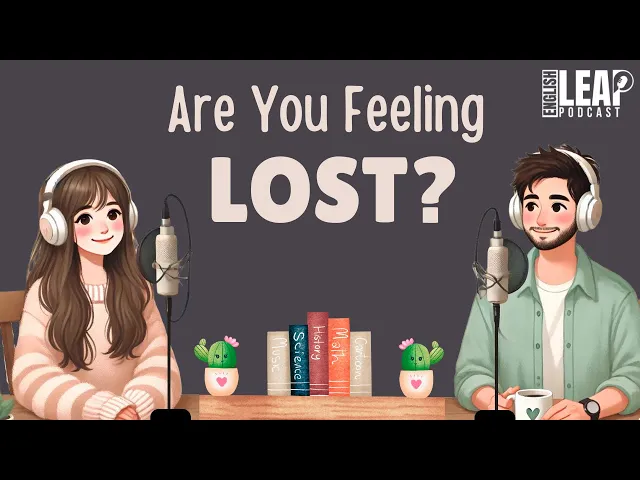
English Leap Podcast >> from [music] Speak English with Claus. Hey English learners, welcome back to the English Leap Podcast, your English podcast for daily life English, real conversations, and easy English listening practice. I'm Anna.
>> And I'm Jake. We're really glad you pressed play today. Maybe you're a bit tired.
Maybe you're walking somewhere. Maybe you're lying on your bed staring at the ceiling. But hey, you're not alone here.
>> Yeah. If you're going to stare at the ceiling and think about life, you might as well do it with some English in your ears. >> Exactly.
Your plans may feel a little messy right now, but your listening practice is on point. >> And you sound extra calm today, Jake. Normally, you're a bit more hyper.
What changed? >> Honestly, lately, I've been feeling a little lost myself. So today I told myself, okay, don't pretend everything is perfect.
Just show up and be real. >> I get that. I also have those days when I do my normal routine, but inside I'm thinking, where am I going?
What am I doing? >> Yeah. Like your feet are moving, but your heart doesn't know the direction.
>> And we know many of you feel this too. Life is moving. Time is passing.
but inside you feel stuck, confused, or unsure about your path. >> That's why today's episode is important for us. >> In this episode, we're talking about feeling lost in life and how that feeling might not be a failure, but the beginning of a new chapter.
>> We're going to share stories, talk about this feeling slowly, and give you small ideas you can try so you can see this lost moment in a kinder, softer way. But before we go deeper, we want to ask you for just one tiny favor. >> If you enjoy learning with us, please like this episode and subscribe to the channel.
It helps more learners find the English Leap podcast and join our little community. >> And we'd really love to hear from you in the comments. You can write one simple sentence, >> something like, I'm your name from your country.
And one time I felt lost in life was when >> we read your messages and they really help us understand what you're going through, not just in English, but in life. >> And when you write, your brain has to choose words and make a sentence. That's real practice, not just listening and forgetting.
>> Okay, let's also talk quickly about the English level for today so you feel safe. >> This episode is a B1 level episode. That means the language is clear and not too fast, but the ideas are a bit deep and emotional.
Perfect for intermediate learners. >> Yeah, it's not super simple and it's not super advanced. It's that comfortable middle place where you can understand a lot and still learn new things.
>> And if you're a strong beginner, you can still stay with us. You might not understand every single word, but your ears will get stronger. Yeah, this is a safe episode for you, too.
You can use it as a bridge from easy English to more natural real English. >> So, wherever you are on your English journey and your life journey, you're welcome here with us. >> And because we're vocabulary nerds, we will play with some bigger words today.
>> During the episode, we'll explain important words naturally inside the conversation, so you don't have to pause and look everything up. And at the end, we'll do a calm word tour. We'll slow down and go over some key vocabulary again with simple examples just for you.
>> All right, if you can take one deep breath. >> Yeah, breathe in and out. Let's start talking about that feeling of being lost and see what it might be trying to tell you.
Anna, have you ever had a moment like that? a moment when you suddenly thought, "Wait, is this really my life? " >> Yes, very clearly.
I can still see it like a little movie in my mind. It was a normal morning a few years ago. I was sitting in my car outside my workplace.
>> So, normal morning, normal job, normal day. >> Yeah. If you looked from the outside, everything looked perfect.
Stable job, regular hours, friendly co-workers. My parents were proud. My friends said, "Wow, that's nice.
" >> So on paper, everything looked good, safe, stable, successful. >> But that morning, I just sat there holding the steering wheel. I didn't want to open the door.
My body was still, but my mind was shouting, "I don't want to go in. " Inside my head, I thought, "Is this it? Is this how the next 10 years will feel?
Wake up. Drve here. Go home.
Repeat. " And that thought hit me like a wave. In that moment, I knew something was off.
I wasn't on my real path. I was a little off course. >> Wow.
Yeah, that really hits. I had a similar moment, but for me, it didn't happen in a car. It felt more like I was walking inside a giant maze.
>> A maze? >> Yeah. Imagine those tall green walls where you can't see over the top.
I kept turning left, right, forward, but every turn just made me more confused. In my head, I kept asking, "Am I doing the right thing? Is this really my path or just the path I fell into by accident?
>> That picture is so strong. Everyone walking confidently and you bumping into walls, turning in circles. >> And the hardest part was everyone around me looked like they had it together.
They looked like they had maps, directions, a plan. And I felt like the only one standing there with empty hands, no map, no idea. That's such a lonely feeling.
Everyone with maps and you with nothing. >> Yeah, it felt really uncomfortable. Like wearing shoes that are the wrong size.
Not terrible, but never quite right. >> And that uncomfortable feeling, that I'm stuck, I don't fit feeling is actually important. >> Important.
How? because it can be a signal, a quiet alarm from inside you, >> a little wakeup call from your heart saying, "Hey, something is wrong here. Something needs to change.
" >> It hurts. Yes, it can make you cry or feel empty. But it's also powerful >> because when you finally stop and ask, "Wait, what am I doing?
Is this really my life? " That's the moment when clarity can begin. Hm.
It's like standing at a crossroads two or three roads in front of you and for the first time you see that you have a choice. >> And often it's not because you made bad choices before. >> Right.
Many times it's simply because >> you listened to too many other voices and stopped listening to your own. >> Yeah. Let's stay with this and talk about those other voices for a moment.
M right voices like parents, teachers, friends, co-workers, even strangers on Tik Tok or YouTube. Everyone has an idea about what you should do with your life. >> It's like standing in the middle of a busy market and everyone is shouting advice at you.
>> Yeah. And after a while, it feels like your brain is that market. So many voices, so much noise.
>> And slowly, the noise gets so loud that your own voice becomes quiet. You stop asking what do I want and start thinking what will make them happy with me. >> I remember my family WhatsApp group when I finished school.
Every aunt, every uncle had a different plan for my life. >> Yeah. What did they say?
>> One said, "Be a doctor. It's safe. " Another said, "No, engineer.
That's the future. " Someone else said, "Business, you can earn a lot. " And there I was staring at my phone thinking, "Does anyone want to know what I like?
" >> That's so real. So many people talking about your life, but not really listening to your heart. >> That's when I started thinking about this idea of an inner compass.
We all have a small compass inside us, not made of metal, but made of feelings. Your heart, your gut, your instinct. >> Yeah.
And that compass quietly points to what feels honest for you. Maybe creativity, maybe freedom, maybe family, maybe service. >> But if that compass turns just a few degrees away from your true direction, not a big turn, just a little, >> then after a few years, you can end up miles away from the life you actually wanted.
>> You wake up and think, hold on, whose dream am I living? mine or someone else's. >> And often you end up on what people call the safe path.
The path that looks beautiful on Instagram, sounds good at family dinners, but feels heavy when you are alone with your thoughts. >> That was me in university. I didn't choose from my heart.
I chose a major that sounded impressive. In conversations, people smiled and said, "Wow, that's a strong choice. You'll have a great future.
" So outside it looked like you were winning, >> but inside I felt like a robot. I went to class, took notes, passed exams, but there was no spark, no joy. Years later, I had the paper, the degree, but not the passion, just confusion, and this quiet feeling of regret.
And that's why it's so important to stop sometimes and check your inner compass to stand still for a moment and ask where is it really pointing? >> You can ask yourself a very simple question. Am I doing this because I truly want to or because I think I'm supposed to?
>> It's a small sentence, but it can change the way you see your whole life. And when you slowly turn down the volume of those outside voices and your own voice becomes a little clearer again, something new comes in. >> M yes, the thing many of us try to avoid.
That strange open feeling called uncertainty. >> Yeah. Let's talk about this big thing, not knowing what comes next.
We humans really like plans, right? >> We do. We love calendars, to-do lists, and five-year plans.
It makes us feel safe when we think we know the next step. >> And when we don't know, our brain gets nervous. >> Yeah.
Like when your internet stops for a second and the video just keeps loading. That little circle turns and turns and you feel impatient. That loading feeling is a bit like uncertainty.
You're between two things, old and new, and nothing feels clear yet. >> But here's the gentle twist. Uncertainty is not always an enemy.
Sometimes it's like an empty room. At first, it feels strange and cold, but it's also a space where you can decide what to put inside. >> I really felt that when I left a job that didn't feel right anymore.
I didn't have a perfect plan B. I just had this heavy feeling. I can't stay here.
>> So, from the outside, it probably looked like a bad move. Leaving something safe with no clear next step. >> Yeah.
People around me said, "Are you sure? This is risky. " And I thought, "Maybe they're right.
Maybe I'm just being silly. " But then the next few months were surprisingly quiet and deep. I walked more.
I read books I always wanted to read. I tried small new things. And for the first time in a long time, I listened to my own thoughts.
So, it was like stepping out of a noisy party into a silent garden. At first, the silence feels uncomfortable. Then, you start to hear your own heartbeat again.
>> Yes. And little by little, a new direction started to appear. Not in one big moment, but like the sun slowly coming up.
First it's dark, then gray, then you see shapes, and then the colors come back. >> That's the strange gift of uncertainty. When things are not fixed, we become curious again.
We ask better questions. We try small experiments instead of running on autopilot. It's still scary for sure, but it's also the space between the old life and the new life.
Like a bridge you have to walk across. >> So if you feel unsure right now, maybe it's not proof that you failed. Maybe it's just proof that you're standing on a bridge.
>> You don't have to see the whole map of your future. You just need to stay open and curious and trust that something new might be growing quietly in this in between space. >> And to even guess what that something new could be, you have to look at what really matters to you.
>> Yeah, that's important. When you say what really matters, Anna, what are you talking about exactly? >> I'm talking about your values.
the simple things that are truly important in your life. Not your job title, not your exam score, not how many likes you get. >> Values like family, freedom, learning, kindness, health, the big things that make your heart feel right.
>> Yes, you can ask yourself, what three things do I deeply care about in my life? If everything disappears, what do I still want to protect? Often when we feel lost, it's because we quietly walked away from those values step by step without noticing.
>> I had a season like that. I was so busy trying to be productive. Ticking boxes, answering emails quickly, doing all the tasks that I stopped doing things that made me feel alive.
>> Things like what? like writing in my journal, taking long walks with close friends, having slow deep conversations. Those things always gave me energy, but I told myself, "No time.
No time. " >> So, you were doing a lot, but not doing the things that made you feel like you. >> Yes.
When I looked back, I realized I had drifted away from what made me me. My days were full, but my heart felt empty. [snorts] >> And when you slowly walk back to your values, even in small ways, things don't suddenly become perfect, but something feels more honest.
>> You might still feel unsure, but at least you're walking in a direction that matches your heart, not just your schedule. >> And once you have a sense of what matters most, the next step is not some big dramatic change. It usually starts with something very small.
>> Yeah. This is where micro goals come in. Very small goals that still count.
>> Micro goals, like baby steps for your life. >> On some days, I didn't feel like doing anything big. So, I made the goal tiny.
Just write one sentence today or just go for a 10-minute walk. Not a whole book, not a marathon, just one little action. >> I really connect with that.
I had days when my only goal was get out of bed and drink one glass of water. [laughter] That was my big win. >> And you know what?
That is a win. >> Yeah. Because that one small action gave me a tiny sense of progress.
And progress, even a few centimeters, builds momentum. Momentum is like the push that keeps the bicycle moving after you start pedaling. >> We often think change must look like an elevator going straight up.
But in real life, change is more like stairs. Small steps one by one. >> Even one simple English sentence spoken out loud every morning can slowly change your confidence.
It's like adding one brick each day to a strong house. So, if you're feeling stuck, don't wait for a huge movie moment where everything changes. Start with one tiny friendly win today.
Something so small that you can actually do it. >> And even when you start taking those small steps, some days still feel heavy. That's when people become really important.
>> Yeah. Support changes everything. When you felt lost, Jake, did someone help you?
>> Yes. One of the best things I did was send a real message to a friend. Not the I'm fine, all good message, the real one.
>> So, you told him the truth, not the polite version. >> Right. I wrote, "Hey, I feel really confused about my life right now.
Can we talk? " My finger was shaking before I pressed send. >> I understand that feeling.
your finger over the send button thinking, "Is this too much? Am I being dramatic? " >> Yeah, I thought all of that, but I sent it.
And when we talked, he didn't try to fix my life. He just listened. He said, "I get it.
I've felt like that, too. " And suddenly, I didn't feel crazy or alone anymore. Sometimes just knowing that one person understands you, that one person is quietly there on the other side of the phone makes your feelings feel less heavy.
>> That person can be a friend, a teacher, a mentor, a family member, or even an online community like this English leap family listening right now. >> And when you share your journey with someone, something else happens. You start to feel more accountable.
That means you feel responsible to show up because you know someone believes in you and is watching your progress with kindness. >> So if you're listening right now and feeling alone, maybe this is your sign. >> Yes, maybe tonight or tomorrow, you can send one honest message.
Something simple like, "Hey, I'm struggling a bit. Can we talk? " >> You're not weak for needing support.
You're brave for asking for it. It takes courage to say, "I can't do this all alone. " >> And when you ask for help and you take those tiny steps, something beautiful slowly appears.
Your own lost and found story. >> Yeah, that's your real story, not the perfect one on paper. And the funny thing is, we usually wait to feel proud only when something big happens.
passing a big exam, getting a new job, moving to a new country. >> But there are so many quiet moments that also deserve love and respect. >> Moments like the night you didn't give up, the morning you got out of bed when you felt empty, the day you pressed play on this episode instead of scrolling mindlessly.
Yes, we remember our mistakes so clearly. The things we did wrong, the chances we missed, but our brave moments, we forget them so quickly. Last year, I started something small.
I called it my lost and found journal. Nothing special, just a simple notebook. On one side of the page, I wrote down moments when I felt stuck, sad, or confused.
And on the other side, you wrote what you found in those moments, right? >> Yeah. On the other side, I wrote what I learned or discovered later.
Sometimes I found patience. Sometimes I found a new idea. Sometimes I realized, oh, I met an important person during that time.
When I looked back, I realized I wasn't just lost. I was changing, growing, becoming a different version of myself. >> I really love that picture.
Like your life is a little lost and found office. You lose something, but you also find something new. Strength, wisdom, courage.
>> Maybe today you can think of one time you felt lost and ask, "What did I find there? " >> Maybe you found a new friend. Maybe you found more courage.
Maybe you found the strength to start again after a hard time. Those moments are worth celebrating. Not with big fireworks, but with soft kindness.
>> A small smile, a deep breath, a gentle thought. I'm still on my way. And that's enough for today.
>> H even saying that gives me goosebumps. I think both of us needed that reminder, too. >> And we hope you felt something meaningful in this part of the episode.
Maybe a new idea, a softer perspective, or just the comfort of knowing you're not walking alone. >> Yeah. And while we were talking, we used some pretty big words and ideas, too.
>> Right. We did, Jake. We used some big emotional words today.
Maybe we should slow down and talk about them a little. >> Yeah. Let's do a tiny word tour before we finish.
A calm one. And I think we should start with the feeling of this episode. A heart-to-heart, >> right?
So, a heart-to-heart is a deep, honest conversation, not small talk. It's when you speak from your heart about real feelings. >> For example, I had a heart-to-heart with my friend about my future means we talked very honestly about my life.
>> Exactly. You can say, I want to have a heart-to-he heart with my sister about how I feel. >> And sometimes in those heart-to-heart talks, we talk about regret.
Yes, regret is a sad feeling about something you did or didn't do. >> For example, I regret not starting English earlier means I feel bad because I waited too long. >> Or she regrets shouting at her friend means she feels sorry about what she did.
Another big word we used was uncertainty. >> Uncertainty. That feeling when you don't know what will happen next.
>> Exactly. Uncertainty is when the future is not clear and you feel unsure. >> You can say there is a lot of uncertainty in my life right now.
When you don't know what will happen with your job, studies or relationships. >> But inside uncertainty, we also said a more positive word, curious. >> Yes, curious means you really want to know or learn more about something.
For example, she was curious about painting, so she joined a weekend class. >> Or, I'm curious about life in another country means you want to explore and understand it more. >> We also talked about how we sometimes drift away from our real values.
>> Yes, to drift means to move slowly without clear control or direction, like a boat with no driver. You can say he drifted away from his real goals. Meaning he slowly moved away from what was important to him.
>> Or I drifted into a job I didn't really like means you didn't choose it strongly. You just ended up there >> and then we said something more hopeful. Momentum.
>> Momentum is the energy that keeps you moving forward once you start. For example, when she studied a little every day, she built momentum and it became easier to continue. >> Or I lost my momentum with English, but I want to start again with 5 minutes a day.
>> Sometimes after momentum, you get a breakthrough. >> A breakthrough is big progress. after struggling for some time.
>> You can say after many tries he had a breakthrough in speaking English meaning suddenly he spoke much better >> or that conversation was a breakthrough in our relationship because it changed things in a good way. We also used the word accountable when we talked about friends and support. Yes, accountable means responsible for your actions.
You feel like you have to show what you did. >> For example, I feel more accountable when I study with a friend because you don't want to disappear or be lazy. >> Or my study group helps me stay accountable means they help you keep your promises.
And then there's the word mentor. I really love this one. >> A mentor is a person who guides you and helps you grow like a wise friend or teacher.
>> You can say my English teacher became my mentor and helped me in difficult times. >> Or I'm looking for a mentor in my career means you want someone more experienced to guide you. We also said milestone when we talked about celebrating small wins.
A milestone is an important step or event in your journey. It's like a special point on your road. >> For example, finishing my first English book was a big milestone for me.
>> Or listening to a full English podcast is a milestone in your listening journey. Then we use the word detour when we talked about your life path. A detour is a different or longer way you take when the normal road is blocked.
>> You can say his career had many detours, but each one taught him something new. >> Or I took a detour and studied something different for a few years. Meaning you didn't follow the direct path.
>> There was also a feeling word goosebumps. Goosebumps are small bumps on your skin when you feel a strong emotion like fear, excitement, or deep inspiration. >> For example, her story gave me goosebumps.
It was so powerful. >> Or I get goosebumps when I listen to this song because it touches your heart. >> Another important word was perspective.
Perspective is the way you see or understand something. Your view of a situation. >> You can say talking to my grandmother gave me a new perspective on life.
Meaning you saw things in a different way. >> Or when I travel, my perspective changes because you see new cultures and ideas. >> We also said autopilot when life feels automatic.
Autopilot is when you do things without thinking, just habit, no real feeling. >> For example, he was living on autopilot, just waking up, going to work, and sleeping again. >> Or I don't want to live on autopilot anymore means you want to be more awake and present in your life.
>> And the last word >> is crossroads. A crossroads is a point in life where you must make an important decision like when roads cross and you have to choose a direction. >> You can say she felt she was at a crossroads.
Should she stay at her job or start something new? >> Or I'm at a crossroads with my English. Should I give up or try again with a new plan?
>> If you didn't catch every word, it's okay. You can listen to this part again slowly like a mini lesson. >> And if you want a small challenge, choose one of these words and make your own sentence.
>> You can say it quietly in your head >> or be brave and write it in the comments. >> That's like sending your English brain to the gym, but a calm gym. >> Yeah, a small friendly gym where everyone is learning together step by step.
And if you're still here with us at the end of this episode, we just want to say we're proud of you. >> Really, we are. Whether you feel lost, are slowly finding your way, or already walking on a new path.
You showed up today, and that counts. >> Yes. And if this episode helped you, tap like, subscribe, and share it with someone who maybe feels a little lost right now.
Thank you for spending this time with us. >> This is Anna >> and this is Jake >> and you've been listening to the English Leap podcast. >> Stay kind to yourself >> and keep going one small gentle step at a time.
[music] Your progress doesn't end here. To continue advancing your English skills, click on the next video or explore [music] the additional videos we've thoughtfully selected for you.