Today's video is brought to you by our friends over at Displate. Ladies and gentlemen, there's somebody that's working on at least one project in regards to a game known as Cyberpunk 2077. This year and last year, I have basically been playing a couple of games that have sapped hundreds of hours from me, and this is where a Displate, our sponsor, comes in, helping me provide a way to actually spruce up my gaming environment with actual posters of games I like, like Cyberpunk 2077: Phantom Liberty.
And let's not stop there; we've got Elden Ring: Shadow of the Earth Tree, and these are just two games right here. Ladies and gentlemen, none of them are your favorite? Well, with over 2 million pieces of artwork all the way to pick through in Displate's catalog, from Call of Duty to Warhammer to The Witcher to various, various other games, you can pick numerous brands, dive in, and pick whatever you want.
It's a platform for artists too, with thousands of creators across the globe sharing unique designs, paintings, and illustrations on metal canvases. And of course, the best part about some of these is having the magnet mounting system, which means instead of drilling holes into your wall, you can literally get these things non-invasively put up in any part of your house. One of the things with these two posters that I showed specifically is the Textura feature, which again is where they have tactile textures, 3D contours, selective mattes, and gloss effects.
And of course, this is just the beginning of your fun with Displate, so feel free to go crazy. If something catches your eye, check out displate. com/someordinarygamers and unlock exclusive access to some of the best Displate deals before they're gone.
That said, let's get to the video. Hello guys and gals, me Mudahar. Over the last week and a half, I was watching something known as CitizenCon.
Now, if you remember a year ago, I made a video where I talked about Star Citizen and how I personally just didn't feel like it was really going to go anywhere. Now, before we go into these videos, I want to talk about a little bit of something called nuance when it comes to these topics. Look, I'm not going to come here and be the biggest hater on this project.
I ain't no Derek Smart, ladies and gentlemen, all right? I'm not a dedicated hater like some would imagine, but I'm also not somebody that just drinks the Kool-Aid when it comes to the cult. Now, to recap, people in the audience watching Star Citizen initially first showed up on Kickstarter.
com with an initial pledge of $500,000, where they ended up raising $2. 1 million, all because of an industry veteran known as Chris Roberts, who worked on a game known as Wing Commander. He also brought up the idea of Freelancer until Microsoft had to come take it over because of serious mismanagement— a story we'll get to later—and now runs Cloud Imperium Games, a massive crowdfunded gaming studio that has raised about $700 million plus without any single game release so far.
So, when you watch the first actual showcase of, you know, this Star Citizen Indiegogo or Kickstarter video, you can see Chris Roberts sitting in front of pretty tacky CG, pretty much being an endearing game developer who people looked at and said, "You know what? The guy behind Wing Commander? I can sign up for it.
" Now, space exploration games are nothing new. Okay, since the time of Star Citizen's announcements, there have been plenty of other games that have jumped into the mix—games like Elite Dangerous, more specifically No Man's Sky—that had an entire arc where it completely got lambasted by gaming media. Hello Games had to basically dig into a bunker, code an actual game, and several games on top of it, pretty much at this point in order to claw back a lot of goodwill— a part we'll get to in a bit.
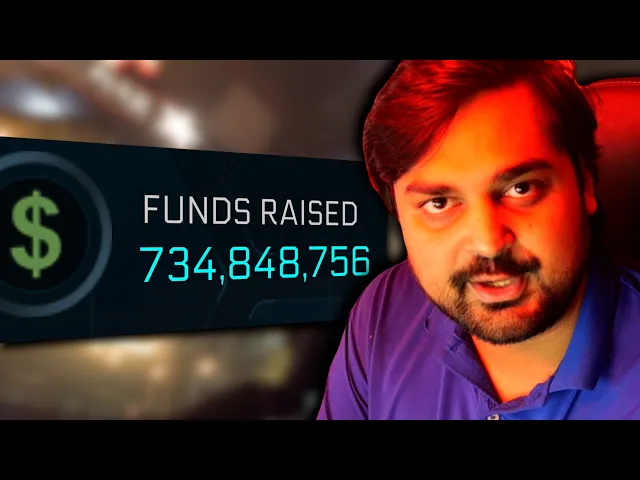
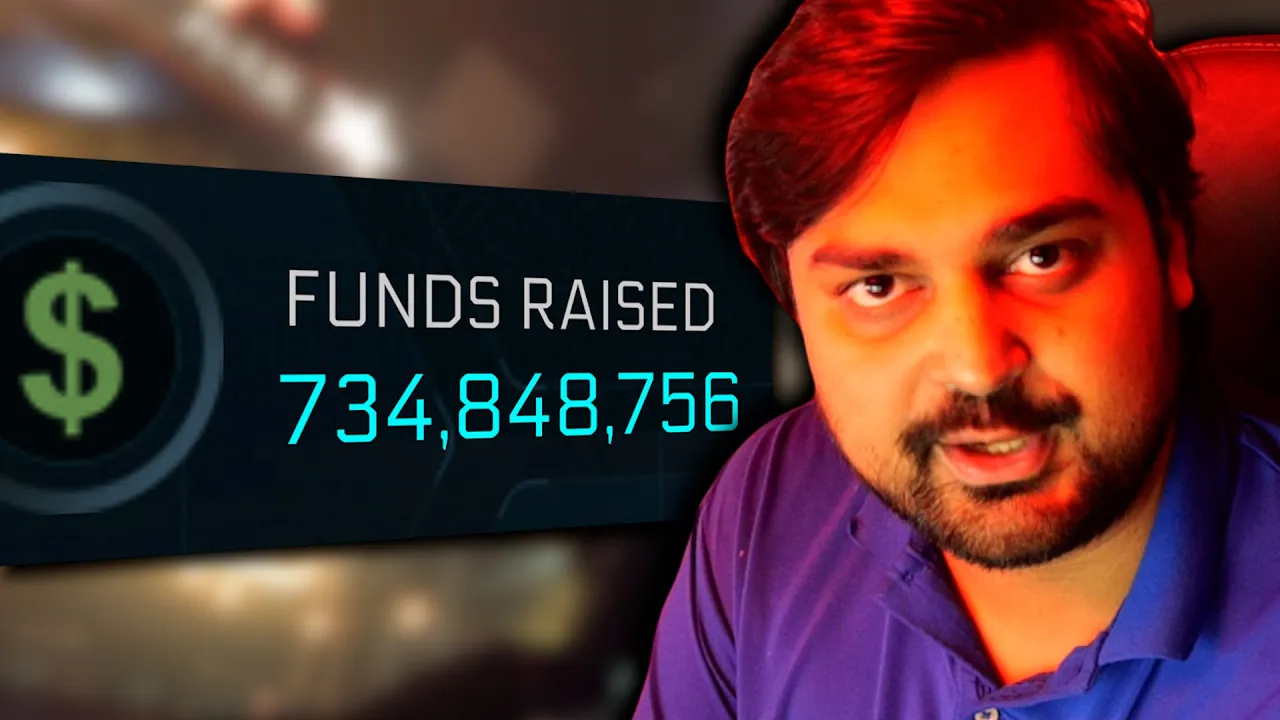
Now, obviously, that funding didn't just stop with $5. 3 million. Star Citizen is in the world with $734 million raised, and the level of stretch goals just kept being added until 2014, when we reached like $65 million.
What was Cloud Imperium offering for $65 million, you might ask? Enhanced ship modularity, so you can have the ship of your dreams. Now, of course, ladies and gentlemen, this game is in alpha.
If you go to the actual website for Cloud Imperium Games, you can see that their games are Star Citizen, which you can play in early access now, and one that I'm genuinely excited for that I have a package for, which I pre-ordered back in the day, called Squadron 42—the single-player cinematic adventure that's supposed to get you into the Star Citizen universe, kind of like the crack cocaine the dealer gives you as a sample. So, ladies and gentlemen, to give you a quick roundup of Squadron 42, if you actually look at one of the original release date trailers for this, I want to show you this just to give you a little laugh. This was Squadron 42: Bishop Senate Speech, uploaded October 10th, 2015.
So while this trailer looks pretty cool, you've got a big cast over here, you’ve got pretty good visuals for their time, and I would say still so much so toward the time you get to the end. You can see they’ve got the big set of names being offered, yada, yada, yada, and of course, "Answer the Call: 2016. " So, of course, 2016, as you all know, has passed.
We've been through, you know, a couple of presidential cycles at this point. You know, if we had another week, we've gone through basically two. And what has happened?
Since then, ladies and gentlemen, well, because of CitizenCon, we ended up getting a bit more of an update. Since the last time I talked about this, you know, a lot of the people at Cloud Imperium Games have been kind of updating their audience pretty well. I want to stress this: it's good.
It's good to have updates in a video game. Okay? It's good to talk about updates and keep your audience informed while ensuring everything is transparent and kosher.
At the end of the day, you know, if you're a crowdfunded company—even if you have shareholders, even if you have backers, however you want to differentiate it—it's always good to at least be upfront and transparent about what you're building. Now, about one year ago, just after I made the video that I had made about Star Citizen last time, they released a gameplay demonstration—about 20 minutes of footage—of the immersive single-player campaign. Right?
So, they had a modified user interface, and of course, it was kind of like this really immersive game where you weren't just flying a ship; you were literally doing every aspect in front. The animation was designed so that you could immerse yourself in every detail. Okay, you got to tap every single button; every ship has its different style to it, and again, they're trying to make it look as realistic and immersive as they can.
Remember, this isn't supposed to be just a space game; it's supposed to be a space simulation. Mind you, it wasn't supposed to be a game that was just a flight simulator—a space flight simulator. You also had situations where you were on the ground and engaging in actual combat.
So, they had a first-person module where you were fighting actual characters. You had some destructibility with debris, as you saw right there. It was a pretty interesting single-player campaign, and I guess the best way to kind of put it is if you ever played games around 2004 or 2005—games like Doom 3—you might have noticed that there were a lot of immersive elements they put into those video games at the time.
Beyond just shooting, when you're interacting with things, like computers, you're actually operating user interfaces within the game. It's something that you would see in titles like immersive first-person shooters. So it wasn't just a game that was supposed to be, again, the space dock fighting simulator; it was supposed to be you doing everything.
Now, to recap how Star Citizen plays in uniqueness to other actual space exploration games: it's a game where you have to wake up out of bed—in this case, I woke up out of a hospital bed because the game had me crashed out, and I lost every bit of progress. So I woke up in the hospital, took the elevator downstairs—which people don't really describe the real extent of how scary it is. People have said games like Silent Hill are scary, but, and I agree, there’s nothing scarier than taking the elevator in Star Citizen and hoping to God you actually make it to the ground floor.
Or, in case you don't, you might get sent to the Aether, lose your progress, and die in the middle of nowhere. Getting off the planet is its own actual task. Then, of course, it's going downstairs, getting yourself kitted out, making sure you're ready for space—maybe purchasing more ammunition, maybe purchasing some new tools just to help you in your quest.
Then, it's taking the actual tram all the way over to the spaceport near your area and then calling on your ship, getting inside, getting launch clearance, and leaving into the atmosphere. Then you take on a mission—whether it be delivery, research, salvage, you know, picking up trash, or maybe taking out some enemies. Really, the world is your oyster!
Okay, you can do whatever you want. At the end of the day, you are a Star Citizen, and it's this level of freedom and immersion that I think sets Star Citizen apart from literally every other space exploration game, if not every other game out there. If you're somebody that genuinely doesn't have the patience to deal with the jankiness right now, there are actual contained modules you can play that get you right into the action—whether it be the first-person shooter combat or the actual space combat itself.
One of the things that I talked about in my last Star Citizen video was that I kind of implied—I pretty much downright said—that the game is pay-to-win. So, for anybody that doesn't remember the fun parts about Star Citizen, I'm going to show you how much ships cost in pledges. Now, if you go to the Robert Space Industries pledge store, a lot of the whales in this community can choose to purchase some actual pledges.
You can purchase ships that cost an arm and a leg, quite literally. For instance, do you want the 100i, a multi-role starting touring ship? That's $50, and because it says "flight ready," that means you can apparently use this in actual flight, but $50?
Whatever—people could spend that kind of money. What about the most expensive ship? Well, if you go price high to low, you'll find crazy stuff like the Carrack for $600—that's a ship in the game, by the way—or the Caterpillar for $330.
Now, some ships that are unavailable for purchase, thank God, are ships like the Kraken Privateer at around $2,000. Now, you might be like, "Whoa, that’s a lot of money to put towards a ship. " Is it flight-ready?
No, that's a concept ship, ladies and gentlemen. Now thankfully, these aren't available, and of course, Star Citizen. .
. What I've heard and seen, it's kind of like Ferrari, where the more and more you purchase, I believe the more and more access you get to some of these things. So you might have seen those articles on the internet about these massive packages being worth like 40 grand.
In reality, I don't think most people can purchase them; you kind of have to be like a Pledger, like a pretty consistent Pledger in this universe, in order to get access to some of those higher tiers. Now, everything in Star Citizen can actually be earned by playing through, so it's about as pay-to-win as Grand Theft Auto Online. You know, you can either choose to purchase that goddamn Oppressor Mark I with Shark Cards, or you can be a douchebag and grind your way up the game just so you can buy that piece of [ __ ].
At the end of the day, you're both pieces of [ __ ]. One of you just uses Mom's credit card. Okay, and I guess the same logic can apply to Star Citizen.
So, to little on back to this whole story, why am I looking at Star Citizen this hard again? Ever since the last CitizenCon, which happened about 10 days ago, there was a bunch of stuff that ended up being revealed over the course of two days. Now, CitizenCon happened, I believe, in Manchester, where I think Cloud Imperium Games literally just launched another studio again.
And mind you, this is a game that, if we go back, literally has nothing released—complete access right now; only one game is early access, and the other one is in development. Now, in the last 10 days, the reason I'm looking at this again with fervor is again that this is a game, and CitizenCon happened about 10 days ago, and there's been a few more celebrities that have put into Squadron 42, a game that is still in development. So, 10 days ago, they posted this footage at CitizenCon 2954: a live gameplay reveal that lasted 1 hour, 16 minutes, and 12 seconds.
And again, if you actually watch this, one of the interesting parts about Star Citizen, and one that I absolutely defend to the ends of the Earth, is the fact that it is an incredibly immersive game. There's nothing that can be taken away from the fact that, like other games, they would put you through menu screens, but Star Citizen literally has your character getting up out of bed, putting their actual clothes on, talking to characters, immersing themselves in an environment before they end up getting into a ship and actually fighting in a massive galactic war. And it's not just space combat; like I said, it's also actual FPS combat inside these areas with genuinely good-looking environments.
It's one of the reasons why I think, like, people genuinely get excited because what Chris Roberts and his company are doing is actually developing a video game that people have kind of dreamed of. It's just a shame that this dream has taken so long to come that the people who are probably some of the most excited have ended up being the most jaded out of this entire story. So, yeah, by the time you get to the end of this entire situation, they put another release date in the story.
Okay, so Squadron 42 is now coming in 2026. Now, a little bit in the beginning of this video, I showed you — yeah, 2016, was it? Yeah.
So, we're now looking at a 2026 release date. And if you've been following Star Citizens' development for anything, you have to basically tack on an extra year and a half to anything this company promises if you even want to be [ __ ] close to realistic about any of the dates they provide. Now, one thing that Star CitizenCon had that I think made people laugh is the fact that even their demonstrations actually started crashing on stage.
This is one posted on Live Stream Fail, where actual users shared the fact that as they were showing the space dogfight, at one point it froze, and then boom, the game actually crashes. Now, I don't consider this a fail. I actually think, out of anything that any game developer has shown, I'd rather see when something crashes versus carefully produced bullshot footage that is running on a build that probably is something that we would never be able to touch.
Now, obviously, this is a build that I don't think anybody's going to be touching, too, but I'm glad they're showing actual gameplay and an actual crash from an alpha title. Remember, this game is still in development, even though that development has lasted quite some years now. Since the last time I looked at Cloud Imperium Games, there's been quite a few things that have come out that have made people a little bit shaky about the situation, right?
So, one of the things you started to see around Reddit about Star Citizen was "12 years and $700 million later, what's going on with Star Citizens' developments? " As of 2022, according to its financials, the company has spent $637 million on development, with 2020 and 2022 averaging over $100 million a year. Assuming that a company continues spending around $100 million a year, it doesn't take a mathematician to realize a $730-$790 million raise, so far at the time of writing, is on the verge of, or as likely, running out.
This would also imply that the company is not also bringing in crazy amounts of revenue, which Cloud Imperium Games actually is. Now, Cloud Imperium releases their financials, so one that I found in 2022 was released at the beginning of this year. So, of course, according to their financials in 2022, the amount of .
. . The money that this company makes is astronomical—literally.
When they first started out, this is again calculated in thousands of US dollars: around 7. 2 million for 2012. But that number ballooned up substantially the following year, and while it kind of stayed in the same place, it wasn't until 2019 and the next couple of years that Cloud Imperium Games, despite not having a game come out, has seen their entire amount of sales blow up.
If you look at the blue bar over here, blue is the amount of sales pledges that you'd find. Pledges being those ships I showed you earlier; people buy crazy ships, and there are plenty of Star Citizen whales that just love to spend crazy money on buying ships that they can show off to other players in this universe. It's like many games out there; if you go into the free-to-play space, you'll find tons of people buying [__] with their actual credit cards just to flex on other players—not that they get any intrinsic benefit out of it.
I've personally never understood buying a game and then spending money on top just to not play it. So, of course, then you've got subscriptions to the service because, of course, everyone has to have a subscription service, and of course, there's other income. But most of their money still apparently comes from all those sales and pledges of the game.
So, again, it raises an interesting question: why even bother finishing the [__] game when you're making hand over fist in cash on an unreleased product? I mean, quite literally, they could not finish this game by 2035, and I still feel that they would make crazy money because of the insane community that has kind of gathered around and believes in a project that still has yet to materialize. Another big issue that kind of kicked up was a problem around their actual employees.
One thing from GameDeveloper. com that was posted through Insider Gaming was that Cloud Imperium had actually enacted a 7-day work mandate for Star Citizen developers because of that CitizenCon I talked about earlier. According to the people over at Insider Gaming, the way that they discussed it was that apparently an internal email was sent to the staff that stated the company needs to double down over the next 18 days to make sure that, once again, we create an amazing experience for our community, and that includes finalizing this one big patch for Star Citizen.
So yes, while the game's not out, we're trying to get to patch 4. 0 of an alpha build of the game. I'm telling you, Star Citizen probably won't release—I'm being very charitable—until like 2030 or 2031, if I'm being nice.
But the company's mandate, apparently according to this email, said that this means the next two weekends will mandate extra time for all those working on deliverables for CitizenCon. The actual mandate allegedly said all staff are to be in the office on Friday, October 4th, and October 11th—typically a work-from-home day. All staff are to be in the office on Saturday, October 5th, and Saturday, October 12th; for these days, the company will provide breakfast and lunch, with staff receiving company toil, which is time off that can be stored and used for time off at a later date.
All staff are to work on Sunday, October 6th, and Sunday, October 13th. So yeah, the company is kind of putting in crazy crunch just to meet this annual convention for a game that hasn't [__] released yet. It's insanity.
Now, if you watch anything related to Star Citizen, one word comes to everyone's mind, and that is "scope creep. " Since the last time I covered Star Citizen, interestingly enough, there has been more gameplay added on top of it. Now, I didn't even touch upon base building last, but apparently there is actual crazy base building in the entire game as well, meaning that you can land on these planets and build a base, much to the similarity of something like Fallout or even Starfield.
God, I hate saying that! If you actually look at it, it feels pretty close to it. I don't know if they're ever going to expand on this to the point where they're going to try to create Factorio in an MMO—God forbid they go down that road trying to get things to work.
The game barely functions as it is in alpha. We're talking about a game where you're lucky to be hitting 30 to 60 frames in the towns and the cities, and then, God forbid, you go into space; that's probably where you'll see a playable frame rate. But this is a game that has a long way to go with optimizations.
Not to say that it's all bad or anything; the game is very good, but clearly there needs to be more focus put on delivering a proper game versus actually implementing more and more features that have yet to really materialize. For instance, there's a great website known as wwclclub. net, where literally for CitizenCon 2023—this is from last year—so they're like, "Listen guys, this was amazing.
The intention was to deliver everything presented within the coming 12 months. " This is how you read these lists: 29 out of 56 listed features in that entire point were released. Everything in green ended up coming out; red means, obviously, it didn't.
Do we have base building? No. Do we have engineering?
No. Do we have one of the star systems that'll come soon? Well, do we have the FPS HUD and user interface?
Thank God that's available. Static server meshing? Not so far.
What about the future of the actual game engine? Do we…? Have Quantum travel effects?
Do we have fire simulation? No, but do we have water simulation? Deformation?
Sure. I wonder how much of the stuff probably functions well in something like Unreal Engine, and how much time they would have gotten through that instead of the Star Engine. But speaking of the Star Engine, their technology is something that is probably the only thing drawing in pledges.
If you actually look at the Star Engine 4K, it isn't bad looking whatsoever. The amount of stuff they show in a real-time shot is pretty insane. You've got crazy foliage, and you've got the ability to actually go through these volumetric clouds, which look amazing by the way when you're taking off.
I mean, this is a very, very accurate and well-done way of looking at space. This is a game where literally it is jaw-dropping to actually fly from space into a planet, because I don't think visually any other game on the market is as impressive as Star Citizen in that regard. Now, since I made the last Star Citizen video, one of the things that I have been doing is kind of watching all the money go up—like I've been pocket watching, you know, Cloud Imperium a little bit—and just seeing how far and how developed this game has become.
And I'll be honest, since the last year I played the game, I don't really notice much different. Now, I wanted to wait a few days, a week after, so I could actually get my gameplay footage to represent Star Citizen in the best way possible. All the footage you've seen here is after the actual initial wave of their free weekend play, which is typically when the servers are so stress-tested that nobody is actually able to play the game at all.
If you play this game during a free weekend, it is effectively the most unplayable [__] game imaginable because of the way the servers work and how many people connect to it. Things like these server FPS end up being so erratic that trying to interact with anything in the game—which is obviously you interacting with a server—becomes nearly impossible. That elevator meme I talked about earlier is not a meme, and the worst-case scenario for this game's server operations—literally just getting out of the planet—is its own actual curse.
I spent more time wrestling with the fact of disconnects just trying to get out of my home world to go into space, just because of the server acting erratically. And that's effectively something the community said was pretty unavoidable until, of course, Cloud Imperium touches upon one of the Holy Grails of technology that they've been wanting. Since last year I covered it, just now they're finally starting to test it out.
What is it? It's server meshing. According to Star Citizen, server meshing is a technology that allows several servers to connect together and work seamlessly as if they were a single large server.
So, much like a lot of your favorite MMO games, you know, typically you'll hear about realms or servers where people play on different parts in Star Citizen. The way that the server is supposed to work is that if you have different cities and systems in the galaxy, they are all effectively different servers that you can interact with. But the moment you fly through portions of space, the game will dynamically move players from one server to another server.
Because of the server meshing system, no one should have any idea that this is happening dynamically. In theory, it's one of the coolest things out there. When we talk about dynamic server meshing, where servers can allocate and adjust load, if you have 2,000 people connecting to one city at any given moment, it can supposedly function.
This is technology that's so cool that if Cloud Imperium pulls it off, it's actually more impressive than the [__] game itself. It would actually revolutionize how many other MMOs are treated. Right now, imagine having Grand Theft Auto 6 dynamically modify itself by allowing thousands of players driving around Vice City together or flying to other parts of the map treated as different servers.
Instead of having a 32-player lobby, you could have hundreds of players realistically providing chaotic experiences in one location. Something that might be possible through third-party modifications, but this would literally change the game for any other MMO out there. In the last couple of days, two weeks ago, one video I found of this happening where servers were effectively dying was a situation where this account £142 talked about this and showed it happening, and it wasn't exactly all that great.
This is where, again, Star Citizen was testing its features by completely destroying the servers out there. And again, server meshing—if it can be achieved—would be some of the coolest tech out there, but it's not achieved, and it's something that's still [__] weary. Until today, or until one of the actual posts that I saw, the game still feels like pre-alpha.
It's amazing how the most funded project of our time still feels like a lobby game—janky as [__]. You know, if you actually look into the history of Chris Roberts and developing any video game, you'll find out that money mismanagement actually goes pretty much throughout most of this guy's career. So when you actually look at Chris Roberts's history, one of the interesting things about it too—and one of the things that I didn't know until I was researching this video—was the insistence of Chris Roberts on actually making movies out of this video game.
The reason why Squadron 42 just involves. . .
Pretty much all these big actors and these crazy cinematic experiences, this man is like Hideo Kojima. He just wants to be a filmmaker, except Hideo Kojima has a whole bunch of successful video games under his belt, while Chris Roberts does have successful video games under their belt. There's also a severe amount of mismanagement of money.
According to this one scenario, after Microsoft had basically given him the boot out of one of his companies, Digital Anvil, he ended up founding a company known as Point of No Returns, where they wanted to produce movies, various television shows, and various video games. But guess what? No actual project came out of Point of No Returns.
Then, of course, Roberts founded this Ascendant Pictures company in 2002 and actually became a real producer for big movies—okay, movies like "Lord of War," "Outlander," and "Lucky Number Slevin. " I'm not going to lie; when I saw "Who's Your Caddy," I immediately realized to myself that we are cooked as a society. Now, the funny thing about these movies, if you actually look into how they were filmed, is that they were apparently entirely financed by the government of Germany because of a tax loophole that effectively closed in 2006.
As one article touches upon, apparently the new Minister of Finance in Germany wanted to eliminate the part of the tax code that allows German investors in media funds to defer their taxes. The rationale for such government subsidies was that local filmmakers could not survive without them. Since the 70s, the American studios, with their enormous marketing muscle and their abilities to send stars to foreign openings, largely succeeded in overshadowing local European films with their own.
So, in order to combat the possibility of American movies completely overshadowing European stuff, Hollywood studios, lacking their own government tax relief, managed to join the party by having many of their films assume the identity of foreign co-productions. The studios definitely financed more film productions so they could legally qualify as German or English. The art of the deal comes in fully retaining both the control and the profits for themselves, which is why German tax shelter deals proved especially appealing.
Yeah, never leave it to any company to not know how to abuse a tax loophole. And, of course, once this absolute golden goose dried up, this pretty much marked the end for Chris Roberts's film endeavor. At that moment in time, 2011 came around, and that's where we're at now.
Ladies and gentlemen, "Star Citizen" is still being released at some point. Now, even looking into the history of Chris Roberts's game development, one of the games that I wanted to play for this video was something known as "Freelancer," and it's a game that I absolutely enjoy playing—probably one of the best space exploration games out there. Before I continue, I want to remind people that it's not just a beloved game for its time; it's still a game with a very active modding community to this day, an active roleplay community, and, of course, it's got several mods that completely expand and blow the scope of what the actual core game provides.
It's seriously an example of the modern community breathing so much life into a video game that people will still play it in the year 2024, despite this game being literally older than a whole chunk of you watching this video. So, when you look into the history of Chris Roberts developing a video game over at, uh, over "Freelancer," one of the things that, even back in the day in 2000, when discussed with IGN, they basically kind of chalked it up to the idea that this is just an ambitious title. And it was a very ambitious title—ambitious enough to the point where Chris had actually started running out of money to fund this project.
So, when asked in an interview with GameSpot, GameSpot asked, "Does this mean that Digital Anvil was ever at the risk of running out of money? Was this acquisition necessitated by the need for funding? " The acquisition they're talking about was the Microsoft acquisition.
Chris Roberts said partly, "Whenever something runs later, it needs more funding. Being part of Microsoft made that issue less of a problem because once you had one of the largest tech companies bankrolling you, you should be able to get your projects out. " Now, of course, Microsoft ended up acquiring Digital Anvil, and this press release from December 5th, 2000, pretty much talks about it.
And, of course, towards the tail end of it, Chris Roberts ended up getting out of this whole situation. In fact, one of the fan sites for "Wing Commander," one of Chris Roberts's games in their CIC, they kind of talk about the situation, and towards the tail end, they discuss how Microsoft has taken over Digital Anvil and that this is going to be the best thing that could happen—more money for "Freelancer," and so on and so forth. Excuse me while I discard the tattered remains of my faith.
We were duped; we wanted to believe, and we were duped. Of course, if you go down this one, it gets really cult-like, okay? Specifically, I wonder why the fans of "Freelancer" are taking this so well.
What exactly are you people fans of? The game does not exist. Oh yeah, I know a game that doesn't exist.
The reason I can see to declare it the greatest game in the history of mankind is the fact that Chris Roberts is helming it. Without him, what are you fans of? EA fired Richard Garriott, and no one seemed to care.
Now Microsoft has fired Chris Roberts, and one slick press release later, everything's just. . .
Fine, again, don't let it end this way. Thanks to Microsoft's press department, we now know that Chris Roberts is leaving due to creative differences. Yeah, it really came down to the fact that the game Freelancer was pretty much sitting in the same place Star Citizen is right now, which is what we call scope creep: you know, the idea of the game never ending.
Chris is a perfectionist; he wants [__] to come out in this entire simulation of Earth. And if you're a business person, if you're running projects, you just want the game to come out. You want there to be a solid goal, a solid release, and ultimately Microsoft says, "Look, we're not just going to burn money, okay?
We're not going to be [__] making this into Concord. We're not going to spend hundreds of millions of dollars on this IP. It's got to ship at some point.
" And, of course, that ended up being one of the best space games, to the point that people, to this day, still play it. And, of course, it kind of hurts when I look at Star, you know, Freelancer 2 gameplay at some point down the road that never ended up coming out. But, uh, yeah, you know, to this day, that Nebula tech demo for Freelancer 2 still blows me away, even though I'll never end up getting to play it.
You know what's also really funny about scope creep when we talk about it in the realm of Star Citizen? One of their stretch goals, literally back in the day, was kind of hinting towards VR. So the hangar module will feature Oculus Rift support, and this was back when $12 million was achieved.
Now, according to the actual people at Star Citizen, that hangar module did in fact add support for the Oculus Rift. So if you decided to slap on one of these—this is a Quest—but if you slapped on one of these headsets, you too could see your ship in glorious virtual reality. But what about the rest of the game?
So at some point in 2016, Star Citizen was focusing on virtual reality, and of course, the story then ended up becoming, uh, later on, where Star Citizen, down the road in 2018, said it would still get VR support. It didn't end up getting virtual reality support whatsoever for that. I mean, you know, I know people always ask about VR—that's an ongoing question—but, uh, you know, on the VR front, um, you know, the game is very much built to be VR friendly because, you know, like almost all the UI is diegetic, and the stuff that isn't, we're putting more into being diegetic, and we want to prove the whole diegetic feel.
So, you know, our biggest holdback on the VR is really just we're still doing so much base-level refactoring on the engine and the renderer, and we'll, you know, be starting on sort of the DX Vulkan, DX12 kind of refactor as well. We're doing so much optimization that we sort of feel like, you know, when you talk about optimization, I have yet to [__] see it playing this game in multiple different graphic APIs, whether it be Vulkan or DirectX 12, does not provide a better experience. My experience with Vulkan is just facing a big giant crash.
Now again, to note, no disrespect over here; obviously, adding virtual reality is something that if you were to be any form of honest with yourself, you probably wouldn't be seeing it. And I mean, at least for, like, a while you wouldn't be seeing it. Even in 2020, when a junior engineer came up and told people, "Listen, implementing VR into the rendering itself isn't a big deal," but as others have pointed out, it's having support from the game itself in terms of gameplay.
So look, at the end of the day, if you're expecting virtual reality in this project, it's probably not going to come until the game actually releases. This is a prime example that I picked out to show you when scope creep becomes a problem. We haven't gotten the game out yet; we're already thinking about how do we have a VR gaming experience added on?
It's not that you can have VR; it's that you should have a final project before you even consider adding in all of this extra functionality. And again, this is a game that still is going through several re-optimizations and changes to graphic APIs. It is an insane level of development for this one title.
I mean, this is an indie game that has made so much money that it might just end up being the same as any triple-A development you've ever seen. The budget for Star Citizen alone is facing that of serious AAA titles out there; it's probably surpassed even other Grand Theft Auto games. And honestly, at the amount of money they keep generating, it might be a game that costs as much to develop as games like Red Dead Redemption 2 or even Grand Theft Auto 6.
And you might be like, "Well, Muda, you know, those games have those franchises," like Grand Theft Auto, which also have taken a long time to release a game. But the point is Rockstar, Bethesda, and plenty of these developers have actually released full functional games, and Cloud Imperium still hasn't released anything worth actually backing them over, at least in my personal opinion. So look, at the end of the day, I'm not going to sit here and be the biggest hater in the world, but one of the things—and one of the reasons I brought up that VR stuff—is so important into this is if we go back to other space games.
The other title, and this is No Man's Sky, by the way. And before we go into it, obviously. .
. Star Citizen is meant to be this space, uh, exploration, very realistic game where physics are represented in the most realistic fashion, and No Man's Sky is a more stylized, a much more casual way to do space exploration. But ultimately, this is a game that is actually completed.
Now, obviously, we all remember when No Man's Sky dropped; the actual game was not supposed to be, uh, the actual game wasn't, you know, anywhere close to what people had hyped up and what was even kind of discussed in the promotional material. Even if you look at some of the statements that Shawn Murray had given before the game's release, he kind of gave vague answers that let people's imaginations go wild. So obviously, the company had two options: they could have literally ignored the game and moved on with their lives, or they could have bunkered down and actually clawed back that goodwill, and they did.
If you look at No Man's Sky, it's one of the most difficult games to actually review right now, and that's just because, if you look at their patch history, the game has had several updates: the Foundation update, the Pathfinder update, the Atlas Rises update, No Man's Sky Next. You've got things like the Abyss update; the game constantly provides new gameplay features and updates and actual advanced features that have changed the game from what it initially came out like, literally years ago, to something that is completely unrecognizable right now. Buying this game on a physical disc means that you purchased a game that has already been outdated by at least two expansions when it actually ships to your house.
This is a game that gets updated that much entirely for free. As we speak, the game, I believe, is actually on sale, and it comes with its own actual expeditions, which are actual experiences where you can go on and play with new gameplay features and get new rewards. But here's an interesting part about No Man's Sky: it's not a game that had all these features day one.
Even if you go to Virtual Reality, No Man's Sky, well after its release date, has a fully functional virtual reality mode completely built in for free that you can play right now. So, scope creep is one of those things that I think a lot of games can fall into that rabbit hole for, but because they actually released a fully functioning product that is locally running on people's devices, by the way, meaning that you can play this on your Steam Deck, your PC, even all the way down offline on your Nintendo Switch, and get a pretty comparable experience to everyone, the game actually released. A lot of these features ended up being added as part of a development roadmap that Hello Games has been hitting.
Now, am I going to pre-order their next big game? No, but I am excited to see what they're going to do because they've proven that their technology, their rendering, and their engine actually is completed, and these people have released a game. It's interesting that an indie title came out of nowhere, an indie company, and actually released a fully functional, beloved game before Cloud Imperium could even actually finish their one initial hype title—a title that was announced long before No Man's Sky.
And it's not even just No Man's Sky that becomes that game. Like I said, Freelancer is an absolutely brilliant game you can play right now. There are other games like Star Sector that literally have been developed by like three or four people that, while it visually may not look great, the amount of actual interactivity in this game rivals that of many AAA titles.
I mean, seriously, that game puts AAA developers to shame with how in-depth you can go. And I can bring up a whole bunch of other space games that go into empire building and whatnot, but I'm just going to keep this relegated to space exploration. Stuff like Star Citizen, you know, if it's one thing to top this video off with, the amount of money that Star Citizen has made in the last year has really shown that there is a serious market, ladies and gentlemen, for space exploration games.
One of the first videos that I kind of showed on stream when I started my channel was this one video called “Infinity Pre-Alpha Tech Demo,” uploaded 14 years ago. And what's insane about this video is, to this day, still visually, it blows me away. Now, I love space exploration, and one of the things that I keep kind of telling myself is I was born too late to explore the oceans but born too early to explore the stars.
And that's one of the reasons why I play these space exploration games. At some point, humanity will be spacefaring, but for now, for at least us sitting here in our plebeian worlds, we can only experience that level of science fiction through our computers and video games and simulations. A game like Star Citizen is something that is the dream, the final singualrity for gamers like me who love space exploration stuff.
Which is why I think, to some extent, that people are willing to drink the Kool-Aid in this cult, because this game probably would have been called a scam had people not been able to play some alpha version of it. But the thing is, we can. We have alpha versions, and some of the stuff is there, and it's promising.
But honestly, with the development and mismanagement over at Cloud Imperium Games, it's becoming harder and harder not to be a jaded person following this project. I really do wish that by 2026 I will be playing something like Star Citizen, but there was one comment left on. .
. My last video that I want to end the note on—I want to end this video on—and I think it's a comment that pretty much hits me right at the point of this whole video. One user by the name of Aiden Nansu said, "I'm going to leave my Star Citizen account in my will and hope my grandkids will finally see the game released.
" Honestly, I agree. I really think that's where it's going to end up. I don't know if I'll ever be able to play Star Citizen in my lifetime, but I hope to God that my grandchildren, probably at one point, will get to explore Star Citizen and play it while they're taking off on their actual shuttles to space.
But ladies and gentlemen, this has been another episode of "Holy [ __ ], I am coping. " If you like what you saw, please like, comment, and subscribe; dislike if you dislike it. I am out.