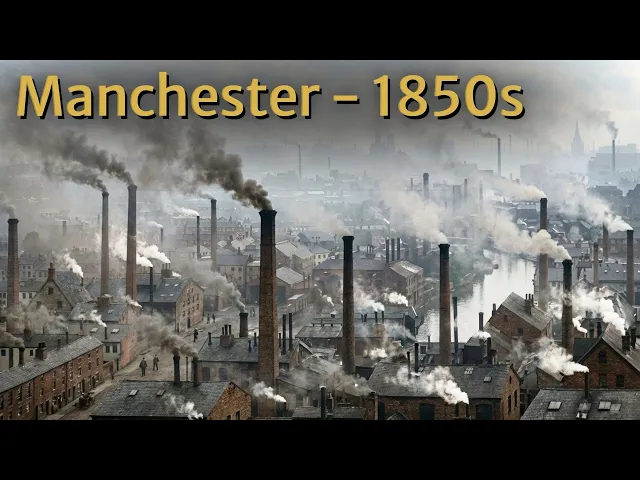
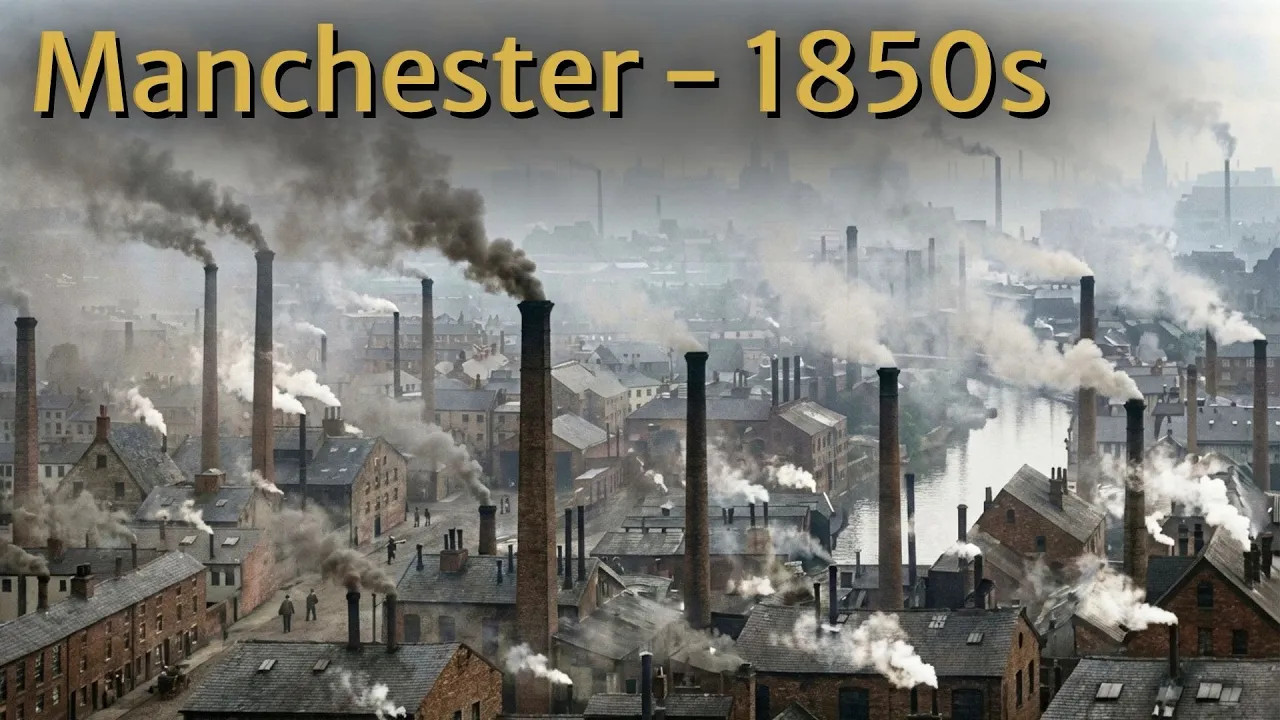
By the middle of the 19th century, Manchester had become something new in human history. A city built entirely around production. The skyline was dominated by mill chimneys.
Hundreds of them, releasing smoke that hung in the air and darkened the sky, even at midday. The sound was constant. Machinery, steam engines, the movement of carts and workers through narrow streets.
This was not a city that had grown organically over centuries. It had exploded into existence within a single lifetime, driven by cotton, coal, and steam power. In this video, I use modern AI tools to bring historic engravings and early photographs to life, allowing us to move through Manchester as it appeared in the 1850s.
What you're about to see is a city that invented the modern world, not through intention, but through relentless acceleration. This is Manchester before the transformation. Still recognizable as a market town serving the surrounding countryside.
In 1750, the population was around 20,000. There were churches, ins, a marketplace, and modest workshops. The riverwell flowed through, providing water and transport.
But the city itself was unremarkable. One of many provincial towns scattered across northern England. Then came cotton.
The first water powered cotton mill opened in the 1780s. Within decades, mills multiplied across the city and its surroundings. Steam engines replaced water wheels, allowing factories to be built anywhere coal could be delivered.
The population surged, 50,000 by 1800, over 300,000 by 1850. This was not organic growth. It was acceleration.
Streets were laid out quickly, often without planning. Housing was built to meet immediate demand, not long-term need. The city expanded faster than its infrastructure could support, creating density, congestion, and pressure at every level.
By the 1850s, Manchester bore almost no resemblance to what it had been 70 years earlier. The market town had been consumed by the machine. This is the interior of a cotton mill in the 1850s, and it was overwhelming in every sense.
The noise was constant and deafening. Power looms clattering, spinning frames worring, steam engines driving belts, and gears that connected hundreds of machines across multiple floors. Conversation was impossible.
Workers communicated through gestures and learned to read the rhythm of the machinery by sound alone. The air was thick with cotton dust. It coated everything.
Floors, walls, clothing, lungs. Ventilation was poor. Windows were kept closed to maintain humidity, which prevented thread from breaking but made the air stifling.
Machines dictated the pace of work. Operatives tended multiple looms or spinning frames simultaneously, moving quickly to repair broken threads, replace bobbins, and keep production flowing. The work required constant attention.
A moment's distraction could result in injury. Fingers caught in gears, hands crushed by moving parts. Shifts ran 12 to 14 hours, 6 days a week.
Brakes were short and regulated. The factory bell controlled when you arrived, when you ate, when you left. Human labor had been subordinated to the machine's rhythm.
And the machine did not stop. This was the engine room of the industrial revolution. Everything else in Manchester, the housing, the pollution, the wealth, the global trade networks radiated outward from these mills.
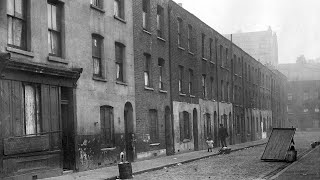
This shows the streets where Manchester's mill workers lived, and the density was extreme. Housing was built quickly and cheaply. Rows of backto-back terraces with minimal space between them.
Families lived in single rooms. Multiple households shared courtyards, privies, and water pumps. Privacy was impossible.
Disease spread easily. The population included large numbers of Irish immigrants, many of whom had fled the famine of the 1840s. By 1851, over 13% of Manchester's population was Irishborn.
They lived in the worst districts, Little Ireland, Angel Meadow, where rents were lowest and conditions most severe. Ethnic tensions existed, particularly over jobs and wages, but necessity forced proximity. Children worked alongside adults in the mills.
Some started as young as five or six, employed as scavengers, crawling beneath moving machinery to collect loose cotton. Accidents were common, fingers lost to gears, limbs crushed, lungs damaged by years of inhaling cotton dust. In the poorest districts, average life expectancy was 26 years.
This was not hidden. Reformers documented it. Physicians reported it.
Government inquiries investigated it. The conditions were known, debated, and for decades largely tolerated as the cost of production. Life in industrial Manchester was organized around the factory bell.
You woke to it, worked to it, and returned home when it released you. Daylight was irrelevant. The rhythm of machines replaced the rhythm of seasons.
This was the first time in history that millions of people lived this way. This is Manchester's atmosphere in the 1850s, and it was inescapable. Smoke poured from hundreds of mill chimneys, mixing with coal fires from homes and workshops.
The air was thick, gray, and often difficult to breathe. Buildings were coated in soot within months of cayenne destruction. The riverwell ran black with dye and chemical waste from textile processing.
Pollution was not a side effect. It was evidence of output. A smoking chimney meant a mill was operating.
A blackened sky meant production was high. Sootcovered buildings signaled industrial success. The city's ugliness was inseparable from its function.
Visitors remarked on it constantly. The darkness, the smell, the grime. Some were horrified, others were aed, but no one denied what they were seeing.
A city that had sacrificed beauty, health, and comfort in pursuit of production. Standing on a bridge over the Iwell, looking at the mills stretching into the distance, you would have seen the future. It was not clean and it was not quiet, but it was undeniably powerful.
This shows the Rodale Canal and the railway lines converging on Manchester, and they reveal how the city functioned as a node in a global system. Raw cotton arrived from across the world, but primarily from the American South. By 1860, 90% of Manchester's cotton was picked by enslaved people on plantations thousands of miles away.
The city's industrial revolution was built on their labor. This was not hidden. It was how the system functioned.
Cotton bales were shipped to Liverpool, then transported to Manchester via canal or increasingly by railway. The Liverpool and Manchester Railway, opened in 1830, had revolutionized transport. What once took days by canal now took hours by train.
Speed mattered. Faster transport meant faster production cycles. Faster delivery, faster profit.
Finished goods, cloth, thread, garments left Manchester just as quickly shipped to markets across Europe, Asia, and the Americas. The city did not consume what it produced. It exported almost everything, feeding a global demand for cheap textiles.
Canals, which had built Manchester's early industrial infrastructure, were already in decline by the 1850s. Railways were faster, more reliable, and capable of moving far greater volumes. The Bridgewater Canal, once the symbol of industrial innovation, was being overtaken by the very forces it had helped unleash.
Manchester was not self-contained. It was a processing center. Raw materials flowed in, finished goods flowed out, and the city's wealth depended on maintaining that flow.
This is how observers saw Manchester in the 1850s, and their reactions were mixed. Friedrich Engles arrived in the 1840s and documented what he saw in the condition of the working class in England. He described strict class segregation.
Wealthy merchants living in suburbs, workers confined to slums, the two groups rarely intersecting. His observations were largely accurate, though recent research suggests the reality was more complex. Some professionals, doctors, engineers, lived in the same buildings as workers, though their lives rarely overlapped.
Social reformers visited and were horrified. Physicians reported on disease rates, child mortality, and industrial injuries. Government inquiries gathered testimony from workers, factory owners, and civic leaders.
The evidence was overwhelming, and it led to gradual reforms. factory acts limiting child labor, public health measures addressing sanitation, housing regulations attempting to improve conditions. But others saw Manchester differently.
They saw innovation, wealth, and progress. They saw a city that had solved the problem of mass production, that had harnessed steam power and organized labor on an unprecedented scale. They saw the future, and they wanted to replicate it.
Manchester was not universally condemned. It was studied, debated, and copied. The fear and awe it inspired were two sides of the same response.
Recognition that something fundamental had changed and uncertainty about what that change meant. Standing in the free trade hall built in the 1850s on the site of the Peterloo massacre, you would have felt that tension. The hall celebrated free trade and industrial capitalism.
The ground beneath it remembered state violence against workers demanding political reform. Both were part of Manchester's story. This is Manchester's influence spreading outward and it was rapid.
Other cities studied Manchester's model. How to organize factories, how to house workers, how to connect production to global markets. Industrial centers emerged across Britain, Europe, and North America.
each following patterns established here. The cotton mill became a template. The factory town became a template.
The separation of work and home, the subordination of labor to machinery, the reliance on global supply chains, all of it originated or was perfected in Manchester. This city did not stay unique. It became a blueprint.
The problems Manchester faced, overcrowding, pollution, inequality, labor exploitation, also spread. Other cities inherited not just the industrial model, but its consequences. Reformers in those cities looked back at Manchester both as a warning and as proof that such conditions could be endured, managed, and even justified in the name of progress.
By the 1850s, Manchester was no longer an experiment. It was a system and that system was replicating itself across the industrializing world. This is Manchester in the 1850s.
Smoke drifting across the skyline. Workers leaving the mills at the end of a shift. The city continuing as it always did.
The modern world did not arrive quietly. It announced itself here in the noise of machinery, the density of housing, the blackened air, and the relentless rhythm of production. If there's another city, another moment, or another place in history you'd like to see brought back to life, let me know in the comments.
I'd love to continue exploring the past with you. Thank you for watching.