foreign today we're learning about ancient Greece today we'll first talk about the pre-history of Greece from about 3 000 to 1400 BCE and this will include the cycladic culture the minoan culture and the hood culture and then from there we'll talk about the Archaic Period leading into the Classical period or the classic period from 5 20 to 323 BCE now the textbook for this course doesn't really cover ancient Greece as well as that I would like it to um so the references and images for this lecture for the most part are from the art and
Archeology of ancient Greece by Judith Barringer so if you're interested in ancient Greece and you want to learn more about what you've read here or heard here I recommend taking a look at that textbook it's a prehistoric Grease the Bronze Age dates from 3 200 to 1100 BCE in Cree it's well known for its palatial civilization the civilization during this time period was primarily agrarian which means that most of the people were farmers but there were some trade including the trade of obsidian and metals these palaces probably belong to Chiefs or overlords who collected and
redistributed goods from Central Storage centers the seletic culture settled on the solidic Islands during the Bronze Age the islands were rich in marble and well located for trade across the Aegean Sea this is a picture of the location of challandrayani kastri which is a solidic village the village is well situated on the island with views of the Seas to watch for trading and potential attacks the site consists of a 70 meter long Stone Fortress with five Towers protecting Stone houses with thatched roofs the site also had a very large burial ground with 600 to 1
000 burials the grades include vast arrays of artifacts including marble statues like the one pictured here these marble statues are some of the first known Greek marble statues that have been found it's likely that they were carved with obsidian and copper tools and that they would have been painted in Antiquity so here you can see an example of one of those marble statues and the site plan of chalandriana kestry so you can see the five Towers at the top a big large wall and then buildings inside of the wall minoan culture was centered on the
island of Crete which is the largest island in the Aegean Sea their settlements have large buildings which archaeologists have called palaces like the one shown here however there are no signs of fortification this has led archaeologists to believe that they were primarily a peaceful civilization the Minoans were great Traders they traded across the Mediterranean and Scholars have found texts from ancient Egypt that mentioned the island of Crete Minoans had two systems of writing but neither have been deciphered however it appears that the texts were used to record economic and administrative things associated with the palace
because we have not deciphered the text what we know about minoan life comes from the archeology and images left behind on ceramic vessels and wall frescoes one of the most well-known palaces on Crete is called gnosis these buildings were multi-storied in later time periods all palaces have domestic quarters as well as large areas that seem to be used for storage workshops and public meetings because these non-residential zones exist in the Palaces archaeologists have argued that these were important administrative buildings for society and were used to redistribute Goods we know that these buildings were very important
to the Minoans because we have evidence that gnosis was burned down and was quickly rebuilt we've talked a lot about social hierarchies in this class we can tell that the Minoans likely had social hierarchies but we don't know what much about what those power structures looked like it's likely that gnosis had an Associated town of a population of around 17 000 people Crete had a highly developed bull worshiping cult there are many of frescoes and statues depicting Bowl leaping the later Greek myth of King Minos and the Minotaur likely evolved from the minoan bull worshiping
cult according to the myth of the Minotaur there was a king named minnows who ruled from gnosis his wife longed to have sex with a bull she eventually succeeded and gave birth to a half bull half-human child called The Minotaur the Minotaur monster wreaked havoc on the island so King minnows built a labyrinth to house the monster every year Athens had to pay gnosis a tithe of seven young men and seven young women in reparation for an earlier war that they lost stenosis the 14 Youth were taken to Crete where they were locked in The
Labyrinth as food for the Minotaur one year the son of the king of Athens volunteered to be sacrificed to the Minotaur when he arrived in Crete he met the daughter of minnows and they quickly fell in love she gave them a ball of wool to take into the maze he unwounds the wool behind him so that he could find his way out of the maze he then killed the Minotaur found his way back out of the Maze and married minosa's daughter some have argued that this story arose later in time after gnosis had been abandoned
the origin of the story were likely inspired by all of the bull imagery and the complexity of the palace remains with all of their passageways and different rooms foreign we have several surviving representations of what we have termed the snake goddess because she is holding two snakes on the left is a statue of the goddess and on the right is a gold ring with what appears to be four goddesses or one goddess on the right being greeted by three women we don't really know exactly what um the snake goddess may have been or what she
represented because we don't we are not able to read the texts of the Minoans but there's a lot of representations of this woman so we know that she would have been a really important Mythic character the minoan Palaces were destroyed by 1450 BCE despite the destruction of the Palaces there is evidence that people were still living on the island but there were many cultural shifts like a new writing system and new forms of burials we don't know what happened but it seems that a new group of people with a different writing script and cultural practices
arrived at Crete and took over from the Minoans we call these people hellatic they're also sometimes called mycien after the archaeological site of mycenaea this culture flourished from 1600 to 11 000 BCE mycnia the site was excavated by Heinrich schliman in 1876. the helledic culture had a script called Linear B this script has been deciphered and we've been able to use it to learn a lot about halotic culture economy and politics the text also describes the gods that the Hellenic worshiped this is interesting because in many cases the gods are the same as much later
Greek gods like Zeus Athena and Poseidon many of the stories that would be incorporated in later Greek mythology were developed during this time period and represented on vessels that have been found all across Mainland Greece there are many lavish Graves that date to this time period the mycian built shaft tombs and buried individuals with luxurious great Goods like the gold mask of agamemon the nesters cup and gold relief pictured above these items are all in the national museum of Athens the Archaic Period after the Mycenaean period Greece went into the Dark Ages before the rise
of the classical Greek civilization classical Greek The Classical period of Greece is represented by democracy which was well established by 500 CE the Olympic Games originated in ancient Greece to honor the god Zeus there were other athletic competitions held to honor other gods but the Olympics are the most well known the Olympics were held every four years at Olympia and consisted of a number of athletic competitions including Wrestling Boxing and the pentathlon which is five invents including a running race wrestling discus long jump and Javelin so all of those are still events today there's also
horse racing and Chariot racing there were three other major competitions that took place in each of the three intervening years but of course the Olympics are the most famous women rarely participated in athletics however there was a foot race for girls at Olympia in addition to being athletic events these games also had religious importance and here's a picture of one of the temples at Olympia nudity and Sport went hand in hand for the ancient Greeks and homosexuality was a cultural norm this homosexuality included physical intimacy but was also used for social networking education and creating
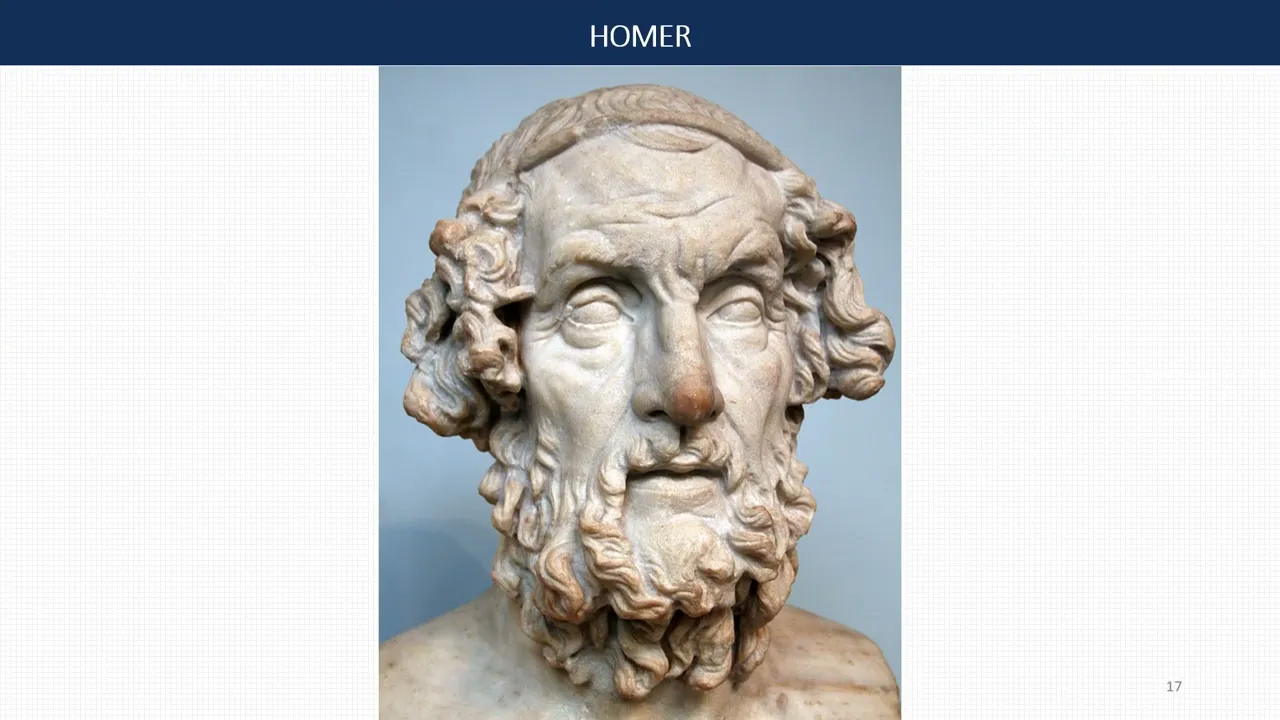
strong bonds within the military athletes exercises exercised and competed in the nude so they were naked there are many depictions of this on Greek basis including romanticized images of ideal male form which was youthful beautiful and athletic Homer is a famous author and poet and to this day is known for his most famous works including the Iliad and the Odyssey he wrote both of these epics around 750 BCE ancient Greece had city-states city-states are sovereign states that are kind of like small independent countries based around a single City and its peripheries two predominant city-states include
Sparta and Athens and here you can see the other ones on this map including Ephesus Thebes Delphi Corinth so there were quite a few of them Athens was a powerful city-state democracy arose here in 508 BCE and it was a Center for the Arts philosophy and learning the Acropolis or upper city was located on a cliff in the middle of the city this is a picture of the Acropolis which was built destroyed and rebuilt many times this version the temple that you see here dates to the classical Greek period according to Legend Athens divided her
territories into 10 different tribes that represented many different aspects of the territory people who lived on the coast versus in cities versus Inland each tribe was given 50 Representatives who would meet and debate and vote on legislation this is the first example of an entire population being able to participate in government however the definition of citizen was very restrictive only Freeborn males that were 18 years or older could be citizens so this excluded women slaves and individuals who moved to Athens from elsewhere the Acropolis had many temples including the Parthenon which was dedicated to the
goddess Athena the namesake of the city according to Legend the population of Athens asked Athena and the sea god Poseidon to each present a gift to the city whichever God provided the best gift would have the city named after them Athena presented the city and the Olive Tree and Poseidon presented the city with the Fountain of Life according to Legend the Athenians chose the Olive Tree the Parthenon is adorned with beautiful marble statues called the algen marbles that are now housed in the British museum in London the Parthenon also had a massive statue of Athena
inside of it this is a reconstruction of what that statue may have looked like in the replica of the Parthenon in Nashville so you can go visit that if you're ever in Nashville if you'd seen the movie 300 you'll know that Sparta was known for their Warriors by 650 BC Sparta was the dominant military power in the region and led the Greeks in the greco-persian wars Spartan society was a mix of citizens free people who were not citizens and hellots which were state-owned surfs or slaves all Spartan men were warriors so the hellots were needed
to tend to the field and participate in other trades the movie 300 depicts the Battle of Thermopylae when the Persians tried to invade Greece the Persians were a large empire that was controlling much of the region around this time they invaded Greece in 490 BCE and repelled by the Athenians in 490 BC at the Battle Battle of Marathon written sources suggest that the Persian army attacked with as many as 200 000 soldiers although Scholars have questioned this number and have suggested that it's probably more around 25 000 soldiers the Athenians chose a very strategic location
for the battle in mountainous terrain that blocked the only two exits from the plane of Marathon this prevented a full-on assault from the Persians the Athenian sent a runner to Sparta to ask for help with the Invasion the runner asked for help but the Spartans were celebrating a holiday and could not join the Athenians for 10 days according to the writing of Herodotus the Athenians won the battle regardless and they only lost 192 soldiers while thousands of Persians died the run from Marathon to Athens was over 140 miles and completed in one day after the
Battle of Marathon the forces were worried that the Persians would try to attack Athens so the Greek warriors marched from Marathon to Athens which is 25 miles and arrived by the late afternoon this is quite remarkable seeing as they just won a battle and would have been wearing all of their armor we now use the word Marathon to represent a long race it seems that over time these two stories of the runner to Sparta and the march of the Athenian Warriors have been conflated into this one idea of the marathon thank you Classical Greece Scholars
generally consider the end of the Persian Wards in 480 to 479 BCE at the beginning of the Classical period of Greece Athens banded many of the Greek city-states together to form a coalition and created a large defensive Alliance in the event that the Persians would try to attack again in doing so they formed a large Maritime Empire which was primarily ruled from Athens classical Greek intellectualism is best represented by Athens and the Acropolis Athens had a silver mine nearby which not only helped to finance the military defense but was also invested in building projects like
the Acropolis and statues the python was built on top of the Acropolis as can be seen in the middle of the plan of the Acropolis above construction was begun in 447 BCE and finished in 432 BCE made some of the world's earliest coinage archaeologists can now use these coins to date archaeological sites and materials because the coins were so widely used in trade and often showed up in archaeological context yeah Herodotus is known as the world's first historian he lived from 484 to 425 BC and wrote a book called The histories which recorded the origins
of greco-persian wars Plato is one of the most famous philosophers from ancient Greece he lived from 428 to 348 BCE he founded the academy in Athens which is often regarded as the first University in the world his work contributed to Western philosophy and science including influencing early Christianity by setting the intellectual stage for Christianity by proposing that there was a divide between the body and the soul according to Greek mythology the first woman was made as a punishment for mankind for trying to deceive Zeus Zeus made woman from a mixture of earth and water Athena
and Aphrodite two female goddesses gave women Beauty and desirability the first woman was named Pandora which means beautiful evil Pandora was given a box and was told by the gods not to open it but she couldn't resist and when she opened the box she released evil into the world Zeus then declared that man could not live without woman because she can have children but that she would bring nothing but misery this is reflected in leader writings which value women because they can provide more citizens and warriors that are necessary for civilization but there's also this
fear that their irrational emotions and sexuality needs to be controlled
![Visual Calculations in Power BI - DAX Made Easy! [Full Course]](https://img.youtube.com/vi/JITM2iW2uLQ/maxresdefault.jpg)