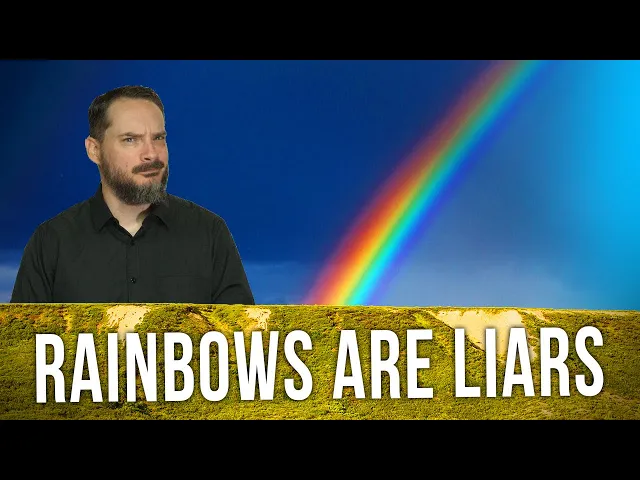
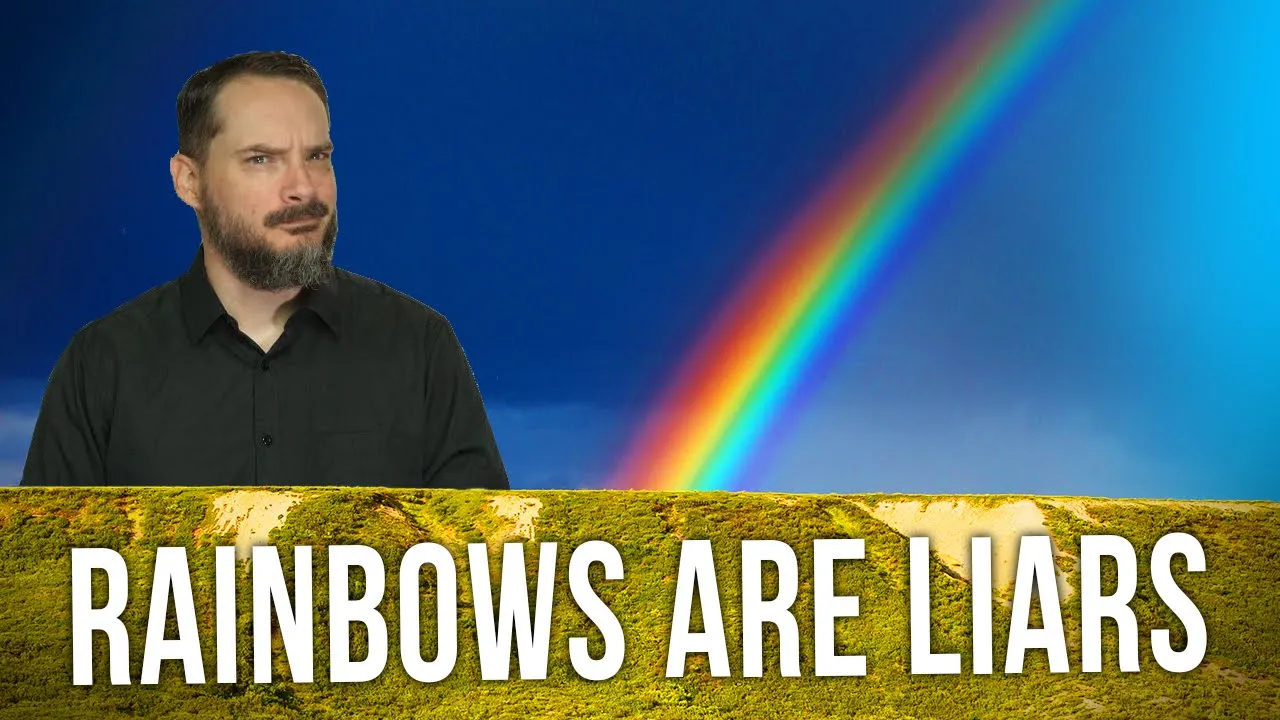
quick what are the colors of the rainbow easy pneumonic if you're unsure just remember the name Roy G Biv representing the seven colors red orange yellow green blue indigo and violet but have you ever wondered why the rainbow has seven colors after all the visible color spectrum is just that a spectrum encompassing a continuous range of wavelengths from 380 nanometers at the red end to 700 nanm at the Violet even stranger one of the standard seven colors isn't quite like the others we are of course talking about indigo sandwich in between blue and violet indigo
is neither fish nor foul being variously reported as either a deeper blue a lighter purple or some mixture of the two and when presented with an actual rainbow many people can't even perceive Indigo as a distinct color unsurprisingly then that many popular depictions of rainbows including the original Apple computer logo the pride flag and the iconic prism artwork from Pink Floyd's 1973 album The Dark Side of the Moon have opted to ditch the Hue alt together opting for a simpler and more intuitive slate of six colors because the individuals Behind These monstrosity so-called Rainbows are
clearly colorist for shame so why was Indigo ever included in the first place as with so many standardized facts taught to us in school the answer lies in the arbitrary and idiosyncratic choices of a single person in this case legendary 17th century scientists and apple hater Sir Isaac Newton this is the strange and mystical story of how Indigo ended up on the rainbow prior to the work of Newton the most widely accepted theory of color was that developed by ancient Greek philosopher Aristotle in his trees on sense and what is sensed written around 330 BC
Aristotle posited that all colors are composed of varying mixtures of lightness and darkness and arranged the five known chromatic colors red yellow blue green and purple on a linear scale extending from yellow on the light end to Blue on the dark end he also linked the colors to the four fundamental elements arguing that earth air and water were naturally white and fire yellow and that the former acquir color through interactions with varying levels of light and darkness this model remained largely unchanged for more than 2,000 years because humans were stupid however consistent with this Aristotle
theories offered no concrete Logic for which colors corresponded to which proportions of white and black the precise ice number and Order of colors in his linear scale was open to interpretation indeed while Aristotle's original scale went yellow red purple green blue a version recorded in 325 ad by Roman philosopher chalk kidus included only three primary colors yellow red and blue in that order in the 14th century fren Franciscan monk barus anglicus proposed a color scale of yellow orange red purple green while in the early 1500s Renaissance Man extraordinaire Leonardo de eventually used the order yellow
green blue red moving red from its traditional Central position to the dark end of the spectrum where all naughty colors belong given this ambiguity it was clear that a more rigorous and comprehensive theory of color was needed enter Sir Isaac Newton in 1665 London was struck by the Great Plague the last major outbreak of the Bubonic plague in the British Isles the epidemic killed nearly 100,000 people forcing many institutions including universities to shut their doors Newton then a 23-year-old student at Trinity College at the University of Cambridge was sent home and spent the following year
at his family's estate in woor Lincolnshire while Newton had been an unexceptional student at Cambridge the following 18 months proved extraordinarily productive seeing Newton develop the rudiments of calculus and make major breakthroughs in theories of Optics and gravitation which fun story is remarkably similar to my achievements during covid lockdown which among other advancements with regards to biology included an extensive many months long sample siiz study on how much squeezy cheese one human can intake in a 24-hour period without dying going back to Newton perhaps the most famous experiments Newton conducted during this period involved using
glass prisms to investigate the nature of light and color at the time there was a considerable debate regarding the source of colors produced by prisms did the prism somehow add these colors to the beam and light as it passed through or were the colors an intrinsic property of the light itself which the prism separated out in his experiments Newton cut a small hole in a window shutter allowing a beam of light to enter a darkened room then placed a prism into the beam projecting the resulting light spectrum onto a screen by changing the shape of
the hole and the angle of the prism Newton discovered that no matter the shape of the light beam the color spectrum produced by the prism was always dispersive or fan-shaped furthermore he found that no matter how many times any of the colored bands in the Spectrum was passed through set of prisms it could not be broken down further it remained the same color finally by passing the Spectrum through a lens and another prism Newton was able to recombine the colors into a single beam of white light based on these results Newton concluded that white light
was not a pure entity as previously believed but rather a mixture of every other color and that the prisms separated out these Colors by bending or refracting each one at a different angle furthermore these experiments suggested that there was a physical basis for the specific order of the colors within the Spectrum obliterating the ambiguity inherent in the old aristotlean model proving yet again Aristotle was wrong about everything in his 1704 Masterwork Optics Newton Illustrated this inherent order by Rolling the linear color spectrum into a circle creating the first modern color wheel according to this model
there are three primary colors red blue and yellow which can be combined to produce three secondary colors green orange and purple today of course we know that this is not actually the case and that each color on the Spectrum corresponds to a different wavelength of light nonetheless Newton's TR chromatic model remained highly influential for hundreds of years Newton's color wheel allowed the results of mixing different colors to be predicted by placing a mark at any point within the circle and calculating the relative number of rays contributed by each segment of the wheel a process similar
to determining the center of gravity of an array of masses in physics this model effectively pioneered the modern concept of hue and saturation for characterizing different colors though it should be noted Newton did not use this exact language the wheel also Illustrated that colors opposite one another the so-called complimentary colors cancel each other out to produce white light they are also the colors which when placed side by side produce the greatest contrast however it's important to note that Newton's wheel only predicts the colors produced when mixing beams of light and is thus governed by itive
color theory by contrast the mixing of paint ink and other substances which absorb reflect or filter light rather than transmit it follows different rules and is governed by the subtractive color theory but while Newton's color wheel was very similar to those used today there were two notable differences first while most modern color wheels are divided into equal segments Newton used segments of unequal size and second while Newton's TR chromatic Theory theoretically dictates six primary and secondary color colors red orange yellow green blue violet and purple Newton added a seventh Indigo between blue and violet but
why why did Newton break the elegant Simplicity of his model by adding a seventh color well you might think it was just that he got hopped up on barley wine and began wondering if the same color blue to you was the same color blue to him in fact the answer actually isn't that much better Newton thought the number seven was more cosmically meaningful well this may seem seem like a strangely arbitrary and unscientific decision for such a great mind it's important to understand the very different state of Science in Newton's day while today we think
of Science and religion as having nothing to do with one another inherently this was not the case in the 17th century religious and spiritual thought permeated every facet of life and intellectual thought and the scientists or natural philosophers of the era saw their task as one of uncovering and underlying order and Beauty in God's creation as German astronomer yannes kept discover of the laws of planetary motion explained God manifests himself not only in the words of scriptures but also in the wonderful arrangement of the universe and in its Conformity with the human intellect as a
result discussions with Theology and natural philosophy often overlapped with many of the greatest intellects of the era including godfred lianet Renee deart blae Pascal and Francis Bacon performed extensive work in both the spiritual and scientific realm indeed while remembered today as a rigorous mathematician and experimental scientist Sir Isaac Newton was also an avid Alchemist spending a significant amount of his life searching for the fabled philosopher stone which would Grant eternal life and Convert base medals into gold because sure why not he also wrote many works on theology including a detailed analysis of biblical prophecies and
tracks denying the Anglican doctrine of the Holy Trinity such views were Radical for their time and could easily have gotten Newton branded a heretic indeed when Newton was appointed Luc Ian professor of mathematics at Cambridge in 1669 his colleagues fearing that his controversial beliefs would derail his academic career hastily secured him an exemption from the traditional requirement that he be ordained into the church of England Newton's alchemical experiments were also conducted in secret as the practice was banned by the government who feared that the ability to create gold would undermine the economy ironically in 1699
Newton was appointed Master of the Royal Mint a position he would hold until his death in 1727 looks like someone managed to use science to create gold for himself after all as a result of his more spiritual and occult Pursuits Newton believed in the Harmony and interconnectedness of all creation and it is for this reason that he divided the visible spectrum into seven rather than six colors the number seven is seen as important and sacred in many cultures and appears again and again in Christian theology God rested on the seventh day or sometimes called the
seventh event after creating the universe there are seven archangels In Heaven There are seven churches Seven Seals and seven trumpets in the Book of Revelation and Seven Christian virtues faith hope charity Prudence Temperance Justice and Fortitude by contrast the number six was strongly associated with Satan in addition seven also showed up frequently in the natural world for example in Newton's day there were seven known classical planets Mercury Venus Earth the Moon Mars Jupiter and Saturn as well as seven notes in the musical scale indeed newon division of the color wheel into unequal segments was based
on the notes of the western major scale with the smallest segments orange and indigo standing in for semitones all right so Newton chose seven colors because it fit better into his mystical holistic view of the universe but why Indigo specifically as previously mentioned many people can't even distinguish Indigo as a distinct color between blue and violet while there are two other intermediate or tertiary colors Newton could just as easily have chosen blue green or turquoise and orange yellow while Newton never wrote down his reason for choosing this particular Hue it may well have been a
mere accident of history and 17th century global trade the color indigo takes its name from Indigo Farah A genus of plant which for centuries was the traditional source of the dark blue dye while Indigo Fara comprises more than 750 species found around the world the most commonly cultivated variety is indigo Fara tintoria or true Indigo thought to have originated in the indis valley Valley in what is now India indeed the word Indigo comes from the Greek indicon meaning die from India traditionally Indigo D was manufactured by crushing the plants leaves and leaving them to ferment
in water for a period of time the resulting deep blue liquid was then drain mixed with sodium hydroxide or lie then packed into cakes and left to dry in the Sun the resulting powder varies in color often appearing dark green but reverts to a deep vibrant blue when mixed down with water for dying cloth the earliest evidence of indigo production comes from the indis valley civilization in the 2 millennium BC and by the 4th Century BC the die had spread west across the Mediterranean becoming a highly prized luxury good in both ancient Rome and Greece
nonetheless it was far cheaper than Tyrion or imperial purple extracted from thousands of murex sea snails and so expensive it was reserved for the exclusive use of Emperors and other high officials being an important product from the East the source of indigo remained a mystery to Europeans until the 13th century when Venetian Merchant Marco Polo annoyed at people constantly calling out his name returned from his travels across Asia with a description of the manufacturing process at the end of the Middle Ages the opening of trade routes with the East brought a flood of indigo and
by the time of Newton in the late 17th century a flourishing trade had emerged in Britain and across its growing Empire the more colorfast Eastern pigment supplanting the traditional blue dye industry based on the plant is sasis Toria better known as wode in 1744 American colonist Eliza Pinkney established the first North American Indigo Plantation in South Carolina founding an industry whose profits quickly outstrip those of both cotton and sugar in the region indeed by the time of the American Revolution in the 1770s Indigo Cakes as a currency had greater purchasing power than the dollar and
were used directly to purchase slaves from Africa because the past was the worst and arms and other supplies for the rebels because Rebels need to Rebel it's literally in the name used in all kinds of products including artist paints and blue jeans first introduced in the 1870s by Levi Strauss natural Indigo remained a value commodity until 1901 when German chemist Johannes Fleer discovered a method for inexpensively synthesizing the die the introduction of cheap synthetic Indigo caused the traditional Indigo Market to collapse especially in India where manufacturers and ders having suddenly lost their only source of
income face Mass poverty and starvation all because Johannes fleer's parents encouraged him to study chemistry I hope they're happy with what their pigment loving son became so when choosing a seventh color to fill out his color wheel Newton likely chose Indigo simply because it was familiar to him especially living in Lincolnshire where blue W Dy was traditionally cultivated yet despite Newton's enormous standing in the world of natural philosophy not everyone agreed with his more scientific take on color theory among Newton's greatest critics were his contemporary and bitter enemy Robert Hook and 19th century German polymath
Johannes V goth who in his 1810 book theory of colors argued that the perception of colors varied subjectively from viewer to viewer and could not be accurately modeled mathematically though mostly remembered today largely as a poet and novelist goth considered theory of colors to be among his greatest accomplishments but while Newton was largely proven correct in his mathematical interpretation of the color spectrum goth may have had a point for numerous factors including lighting conditions the presence of other colors and the subjectivity of the viewer can indeed greatly affect the perception of a given color one
example of this is in the so-called abne effect discovered in 1910 by English chemist and physicist Sir William abne this describes a phenomenon whereby adding increasing amounts of white light to a particular color causes a shift in its perceived Hue such that blue seems to shift towards Violet red towards magenta and green towards cyan another is the infamous dress viral phenomenon from 2015 where the ambiguity produced by differing light conditions caused people to variously perceive a photograph of a dress as being either blue and black or white and gold and to think that was the
most heated and divisive thing people on the internet had to argue about humans the extreme subjectivity of color perception has led some Modern experts to speculate that the colors in Newton's original Spectrum may actually have been slightly different than the ones normally depicted today as color theorists which apparently is a thing Gary Waldman explains a careful reading of Newton's work indicates that the color he called Indigo we would normally call Blue his blue is then what we would name blue green or cyan you're not fooling anyone Gary walin we all know you simply got baked
and are now trying to say in a more smart sounding way with your fancy color theorist title no less how do I know the same color blue to Newton is the same color blue to me but going back to waldman's totally not drug induced supposition this makes sense given that the color of both natural and synthetic Indigo are far closer to Blue than the purplish shoe typically depicted in the visible light Spectra with what is now commonly referred to as Indigo being closer to the color of another traditional deep blue pigment lapis lazuli or ultramarine
this means that the seventh color that Newton added to fit his semi mystical model of the universe may not have been Indigo at all but rather cyan as for today the colors of the visible light spectrum are defined by their wavelengths though where each color begins and ends is still a matter of subjective interpretation and no doubt keeps color theorists up at night indeed the Spectrum encompasses a near infinite continuous range of wavelengths with the entire idea of there being six or seven main colors deriving from our brain's tendency to break up information into smaller
or manageable units a process elegantly known as chunking for the sake of convenience however agencies like the US National Bureau of Standards Define the Red Band of the spectrum as extending from 700 to 600 nanom Orange from 600 to 580 NM yellow from 580 to 550 NM Green from 550 to 500 NM Blue from 550 to 450 NM and Violet from 450 to 400 NM meanwhile what is commonly described as Indigo extends from 420 to 450 NM this translates to a wavelength range of 20 NM meaning that while the Indigo band is often criticized as
an arbitrary addition too small to count as its own separate color it is in fact equal in size to the universally recognized yellow band take that yellow truthers today the jury remains firmly out on the Indigo question while many current depictions of the color spectrum retain the controversial Hues others replace it with the more easily discernable cyan while still others as well as most artistic Renditions of the rainbow eliminate the seventh color all together suddenly demonstrating their colorist biases and returning to a more manageable red orange yellow green blue and violet as God intended but
whatever version of the rainbow you prefer the story of indigo's controversial inclusion like the Persistence of the misleading tongue taste map which never made any sense and anyone with a tongue could tell was a whole lot of crap but everyone bought into it anyway because humans vividly demonstrates how small seemingly arbitrary decisions can have surprisingly long lasting impacts because and we cannot stress this enough humans man grabar can't get here sooner these sugar caves aren't going to mine themselves [Music]