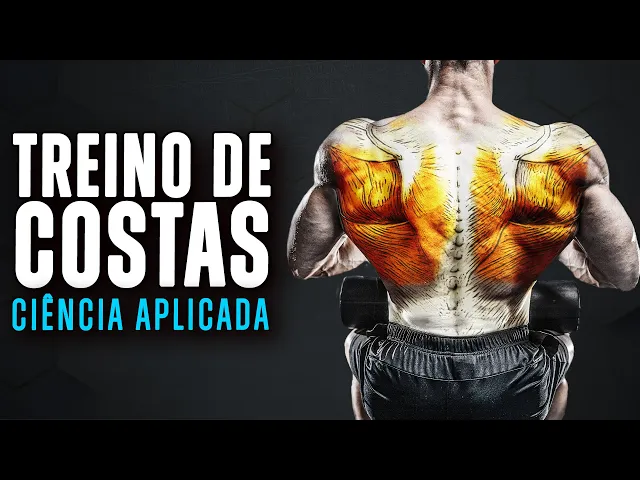
V back with a scientifically designed workout. We already need to understand that our head works like this: first, it activates the arm, and then it activates the back. If you've ever been training your back and ended up with gigantic arms, and didn't feel anything in your back, you're in the right video.
What are we going to do? To begin with, your training, before even doing any specific training session, you will now understand a first phase that will revolutionize your back training called the "connection phase". You will do an exercise that is just to turn on the muscle you want to activate in your brain, which in this case is the dorsal muscle.
You will do a high pull. Pay attention to this thing here. You don't need to do this exercise with a lot of weight.
The purpose of this exercise, the idea of it, is not to fatigue this muscle, it's just to connect your brain to exert force with it. So, you will do two sets and leave a load of around 20, up to 50% of your normal load. of work.
In other words, it is very light. When you're doing it, you'll pay attention to the dorsal and tighten it a lot. This way, you will be educating your brain to connect with it and tell it to push during the exercises to come.
Keep doing it there, pressing hard, when you feel it starting to burn, that's enough. Rest for about 40 seconds or 1 minute. Are you ready to start back training at this point?
No. I want you to still do chest stretching work. The first exercise you will do for your back, I 'll tell you, you alternate it, do you know how to rest from the exercise?
You do a series and stretch your chest. The warm-up series you will do - stretching. - Just like I didn't understand?
Your back work will flow better simply because you have this joint more prepared. The 1st exercise on our list is the front pulley. And we go to the front pulley as the first because it is an exercise that works very well on the back as a whole, from the point of shortening and stretching.
This exercise is considered one of the best for back work. In the 1st series, you will place more or less 50% of the load. So, you're going to do this series, right next to the machine, stretch your chest on one side, 20 seconds, stretch your chest on the other, 20 seconds.
Then you go to the next warm-up series. Adjust the load a little to around 70%. He started to feel a burning sensation behind, okay, he stopped.
Then you go to the side of the machine again, stretch your chest on one side, stretch your chest on the other, stretching is over and warming up is over. Now we're going to start training. Charge 80% or so, and you will get very close to failure.
When you pull the bar, your chest rises and your elbow drops down. Okay, first series, you'll do 3. You'll progress with the load.
The last series is rock n roll, it goes to failure. Roll up. Unilateral bent over row, but here you do the Lalá row.
You will understand this business. When you're going to work a muscle and want a really nice job from it, what I do: I optimize the whole process. There will be exercises that will allow you to shorten this muscle a lot, there will be exercises that will allow you to lengthen this muscle a lot, and there will be exercises that will get you halfway there.
What are we going to do at this moment? We will shorten this muscle a lot, and the saw is wonderful for this. In this exercise, as it is unilateral, it makes the arm weaker, the arm will then be stronger, and you only rest for an average of 30 seconds.
There is another thing that the saw delivers to us that is very good to always have in your training, which is the fact that it is unilateral. Your muscle, the more different the stimuli are, the better for it, and the proposal is for you to intensify the shortening of this fiber. When you throw your elbow up, you will squeeze as much as you can.
What's the big difference between Lalá's saw and a normal saw? Besides being Lalá's? You can work your arm less and work your back more.
If you observe, you will notice that in a normal saw, the forearm goes up kind of straight, like this. The elbow goes into a flexion of 90° or more, and in Lalá's saw, this is what happens here. Your forearm will rise diagonally.
You will bring the weight towards your hips, and you will throw your elbow up in the same way. This way, you will activate your back much more, and your arms much less. Bro, if you've never done it, it will change your life.
In this exercise, the fact that you tighten a lot and shorten a lot, we are going through the 2nd way of stimulating hypertrophy, which is muscle hypoxia. Out of 3, we have already gone through 2. One to go.
Do you realize that there are several things? It's like putting together a puzzle. That's what putting together a training session is, it's drinking from the physiology of exercise, kinesiology, biomechanics and putting together this training in a way that gives you the best stimulus possible.
That's what I do on the Muscle 60D, right, young man? In fact, he has delivered 1 year of results in 2 months to our students. The link is below so you can learn more and see not just a workout, like you see in this video, but an entire periodization, and there are also professionals such as personal trainers, nutritionists and physiotherapists on your WhatsApp at your disposal.
Click below to find out. The 3rd exercise that we are going to do at this moment, look what a beautiful thing, wonderful thing: high pull up. Then you'll turn around and say "Lalá, I already did that today!
" Will do it again! You did it there at the beginning because it isolates the work from the dorsal. The arm does very little work, and you focused on activating the muscles.
Now, you will use it because it stretches the lats very well. We are talking about an exercise that will stimulate more tissue damage to this muscle, the 3rd way to work on hypertrophy. And as it also stretches a lot, it is the 3rd way to stimulate this muscle.
I understand everything now! And there is another point that this exercise is very interesting to be in at this moment. He doesn't work his arm flexors.
In the front pulley, you work your arm flexors. There on the saw, no matter how much you did that strategy, you have to do a little flexor work. Here it's zero, the dorsal will turn itself, and the triceps will help a little there, but the work will be very directed towards it.
And when you stretch your lats, feel it stretching completely, and when you pull it, you will shorten it a lot, but the priority is to stretch it a lot. My concern about tissue damage is so great at this point that I want you to do the following: you've finished the set, you're going to get very close to failure in the first one, and as soon as you let go of the machine, I want you to stretch your lats for 20 seconds . You rest for another 1 minute until you start the next series.
Here, you will also do 3 sets, that will be enough. And to build your V-shaped back, these 3 exercises in this sequence are perfect. But the back training itself lacks a little back work, so we're going to do it now: it's the open pronated row on the machine.
When you pull, I want your elbow to be in line with your shoulder or a little lower. If you leave the bench too high, this will happen. You will aim it exactly in the middle of your back.
It will also work the posterior deltoid and all of that, in addition to creating a more beautiful, more toned back, this exercise is important at the end of the training. Here, you will keep a small series just to warm you up, thinking that you were focusing a lot on the side and then you will do 3 rock n roll series following that idea: first series, close to failure, 70%, second series, 80%, and third series, bro. .
. Now you're going to click on this video here, which is a science-based chest workout . This video was amazing, and the physicist will compose it, right?
Now you will have a V-shaped back, heavy, gigantic chest, looking like two traffic signs. Go ahead, click on this video.