When we use the term payroll we mean salaries and wages. Salaries are usually reported in terms of a monthly rate or an annual rate. Wages tends to refer to an hourly rate.
Gross pay is an employee’s regular pay, plus any overtime, or bonus, or commission, etc… Most employees’ take home pay isn’t the same as the gross pay because of payroll deductions. Some deductions are mandatory, like social security, federal, and state tax withholdings. Others are optional like employees’ portion of health insurance premiums, pension and retirement plans, and charitable deductions.
Social Security withholdings are classified on most paychecks as F-I-C-A, or FICA. FICA really has two parts: OASDI, which stands for Old Age, Survivors’, and Disability Insurance, is paid at 12. 4% of an employee’s first $118,500 of earnings.
Now that's as of 2015. That threshold changes every year. Half of the 12.
4% is contributed by the employee. So 6. 2% is withheld from employee paychecks.
The other half is paid by the employer. HI, which stands for Health Insurance, is 2. 90% with no cap.
Again, half is contributed by the employee and half is contributed by the employer. Employees can impact how much is withheld from paychecks for federal and state income tax withholding. This amount is determined, in part, by how employees complete a W-4 form.
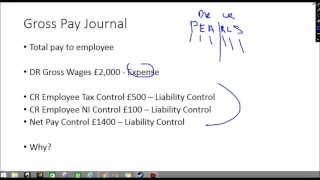
The more dependents claimed on a W4 form, the less is withheld. So gross pay minus deductions equals net pay or take-home pay. We would journalize the recording of salary expense as follows: We debit Salary Expense for the amount of gross pay.
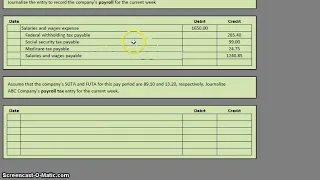
In this example, $552. Then we credit all of the related payroll liabilities from the amounts calculated earlier. Note that “FIT Payable” means “Federal Income Tax Payable” and “SIT Payable” means “State Income Tax Payable”.
Finally Salaries Payable is credited for the net amount. Then, on pay day, Salaries Payable is debited and Cash is credited for the net amount. In addition to recording salaries expense, companies also have to pay payroll taxes.
Payroll taxes are paid by employers, and not withheld from employee paychecks. The payroll taxes include the employers’ portion of FICA, FUTA, which stands for Federal Unemployment Tax, and SUTA, which stands for State Unemployment Tax. FUTA is an administrative fund that oversees state unemployment benefits.
FUTA is paid at a rate of . 8% of an employee’s first $7,000 of earnings. of employees first $7000 of earnings.
Once an employee has earned more than that in a year, the employer no longer pays this tax. SUTA is the fund that actually pays unemployment benefits. If any of you have ever received unemployment benefits or know someone who has, it was paid out of your State’s SUTA fund.
SUTA is paid at a rate of 5. 4% of an employee's first $7,000 of earnings. Once an employee has earned more than that in a year, the employer no longer pays this tax.
Using the same example as earlier, and assuming this employee hasn’t earned more than $7,000, The journal entry and calculations are shown here. Finally, employers might offer benefits to employees. if so, this would also create payroll liabilities.
In this example, assume the employer pays for health insurance premiums ($250), life insurance premiums ($25), and pension ($75) for the employee. The journal entry would be to debit the Related Expenses as shown here, and credit benefits payable.