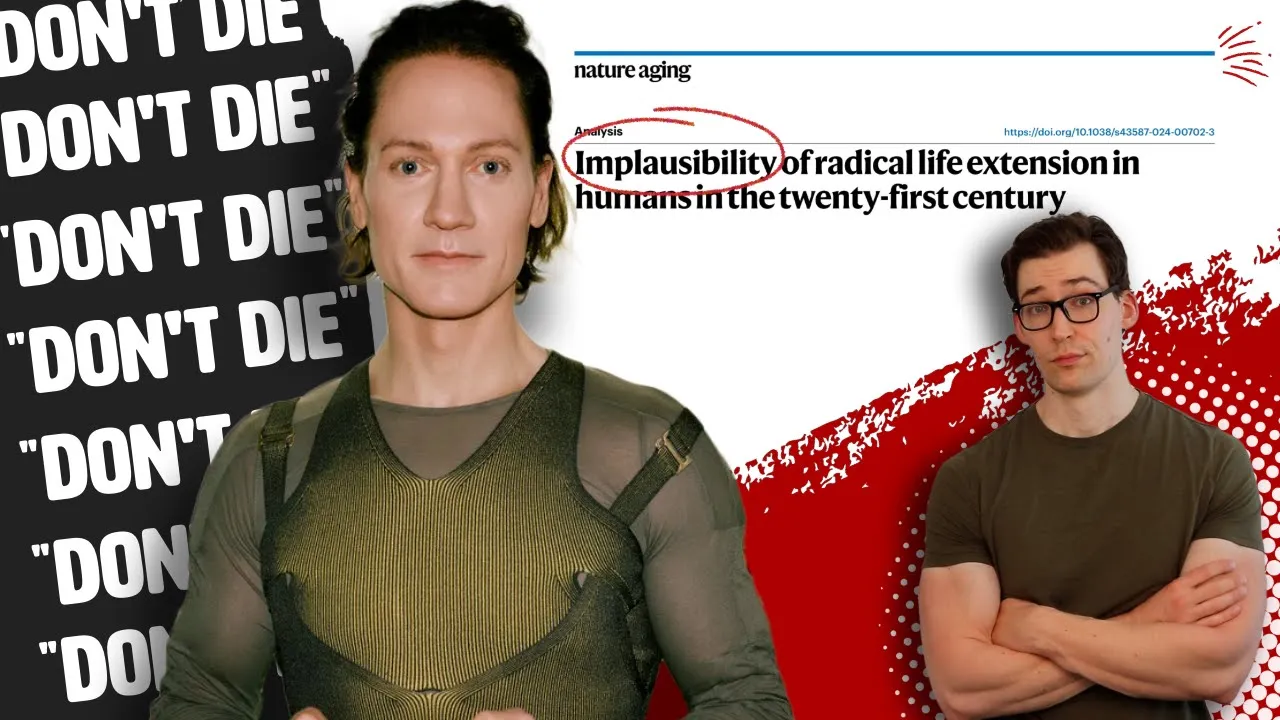
if you're someone like longevity vampire Brian Johnson I say that with kindness you might be in trouble because a new study published in nature attempts to quantify the sheer difficulty of extending life expectancy Beyond where we are today since one of Brian Johnson's missions is not only don't die for himself but for the rest of the population as well this might be sobering news these researchers are not optimistic about our odds of increasing our population lifespan and they have good reason to think that even so there's some light at the end of the tunnel is
it a burning pile of trash tune in to Nic public radio at 8:00 Eastern to find out the study that we'll discuss is this one here the researchers work with several large sets of data to detail Humanity's past performance in terms of extending life expectancy then they compared the parameters that allowed humans to be successful in the past to the current trajectory as well as what might need to change to push life expectancy into advancing more quickly or at all they looked at the data across nine countries to determine if the rate of life expectancy
increase meets the previous threshold that we've experienced for many decades the threshold is 0.3% Improvement in life expectancy at Birth and here is that data the 0.3% line is indicated by the dotted black line there the decades are on the bottom and then there's the list of countries each designated with their own color across all of these countries chosen due to their highest life expectancy almost all fell below the threshold indicating that we are decelerating in our ability to extend life EXP expectancy there were two countries that hit above or near the threshold South Korea
here and Hong Kong the United States was this line by the way so not so great on pushing overall life expectancy forward and the researchers also looked into more extremes of lifespan the percentage of people who live to be at least 100 here's that data the vertical access is the percent of the population hitting 100 or Beyond and the horizontal AIS is the decades the graph stops at 2019 because the researchers didn't want to confound the data with the covid pandemic which makes sense as we can see some countries are doing pretty well on this
front so with France and Japan really leading the way yet I'd also note that all the countries are trending upward so that's a pretty good sign okay great it's not all bad news but here's a heavy hitter that really gut punches you and knocks the wind out of us the researchers calculate that if we were to achieve similar radical life expectancy improvements like we've seen in the past 6% of women would need to survive to be 150 years old or by another metric if we wanted to reach a life expectancy of years old death rates
would have to be 88% lower than at a life expectancy of 109 so not 88% less than now but 88% lower than an already incredibly ambitious level in less numerical terms the researchers say that we would need to cure every major disease cancer cardiovascular disease diabetes Etc but that's not all 70% of women would need to live to 100 years of age too if these numbers seem impossible that's because they basically are at least based on the current state of affairs still this isn't all doom and gloom because there are a number of positive caveats
first keep in mind that this is based on what's known as a disease model of life and as time passes this model has less and less impact on life expectancy the researchers acknowledge that the frontier is wide open when we include the potential of J therapeutic research it's possible that as cuttingedge research becomes more and more prominent this could overtake the disease model of life as the dominant key to extending lifespan second life expectancy is still going to increase in many other countries especially lower inome countries we've been focused on the highest life expectancy countries
so while they struggle to push the numbers forward significantly it doesn't reflect other countries and third and how this applies to you and Brian Johnson's style of longevity This research tells us about the population expected result but it doesn't mean that you can't be in the extremes as in the average is say 80 years old but you live to 105 years old in addition this paper argues that if we're going to make radical improvements to the average science is going to be the way to achieve that so as experimental techniques become more mainstream they may
have a significant effect even if they may be undiscovered as of yet I know I have my eye on several research areas that I think are incredibly powerful I also don't want this to seem like uh taking care of yourself through good nutrition and physically active and so on aren't critical they are I don't think that there's uh much that science can do on a Broken Foundation at least not now so so improving in every foundational respect nutrition exercise Etc is the first step and then from there researchers will need to find solutions to Breaking
the light speed barrier of Aging anyway let me know your thoughts and unlike a lot of other creators I see encouraging people to comment their opinion and then never engaging I promise I'll actually respond to the first few days after this video publishes and if you want more longevity research there's plenty more to be had right here thanks for watching and I'll see you in the comments [Music] [Music]





![GlyNAC Supplement: Reversing Aging. [Study 117 - 119 Analysis]](https://img.youtube.com/vi/6Lmc-mmqxyQ/maxresdefault.jpg)



![These Molecules Reversed Aging by... YEARS! [TRIIM Study Explained - Study 216]](https://img.youtube.com/vi/rVoxfABoHh4/maxresdefault.jpg)