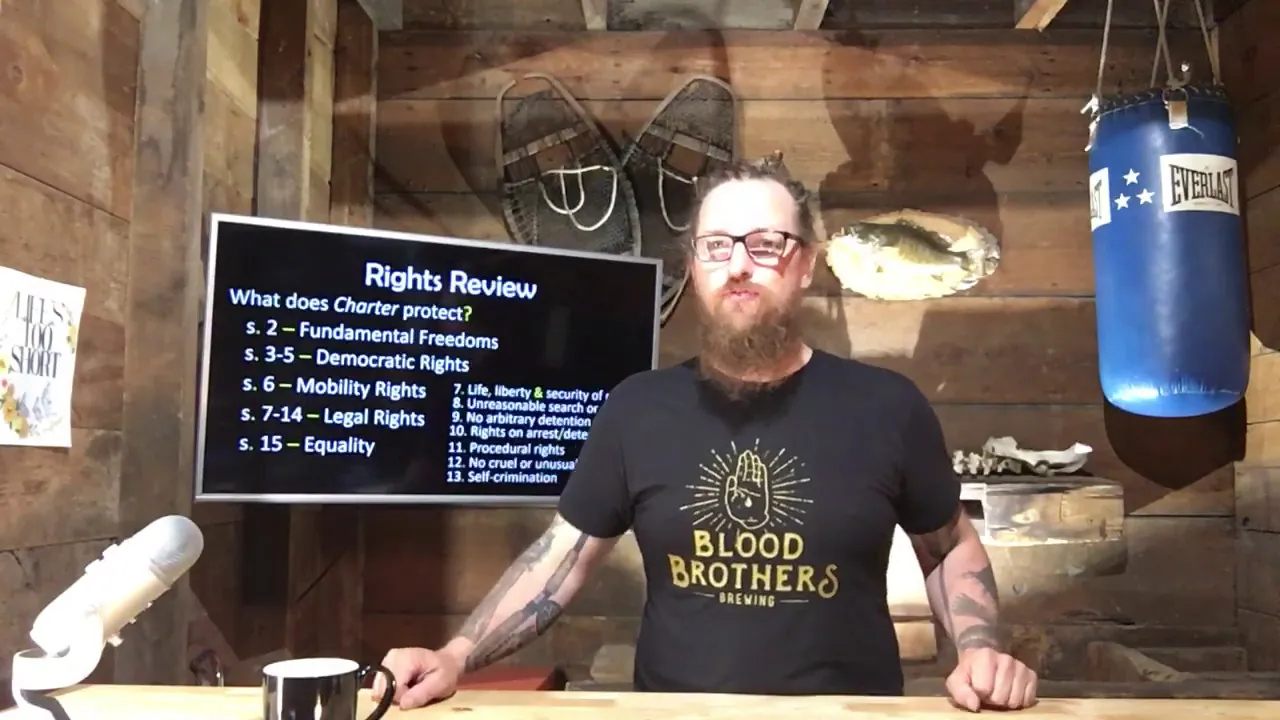
today in law 101 from the barn i want to talk about one of my most favorite uh parts of the charter and that's the freedom of expression now i love this topic because i've worked a lot in it and it has such profound implications for very simple parts of our lives from everything to how we dress how we treat ourselves the things that we we value like perhaps art permanently etched on our skin to fish on walls to whatever else we might imagine to to also very important parts of our social environment things like advertisements
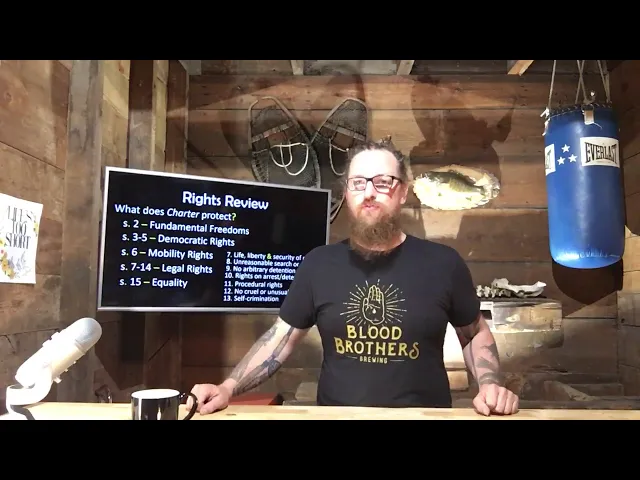
promotions political pamphlets and flyers there's so much that's captured by expression media all sorts of things so this is a fantastic lesson and we'll have lots of fun maybe i'm going to try but who knows um all right so today what we're going to do we're going to start by actually just really quickly looking at the various parts of the charter and just a very basic review of the charter rights just to situate where freedom of expression is again we will then talk about uh section 2b more specifically and what it actually says and then
we'll look at what expression means and then we're going to talk about some examples now i've already given you uh indication as a bonus lesson coming it's about freedom of expression tobacco litigation so we will talk about expression in more detail in that bonus lecture that hopefully you indulge me with okay so first off a review of rights what are we actually talking about so don't forget that the charter of rights and freedoms which is limited to the state protects a whole bunch of things right we have talked about these in passing you will talk
about many of these in other contexts during this year but here we're talking about what are known as fundamental freedoms section 2b which is expression is part of a bundle that are deemed to be fundamental of all the freedoms and why are they fundamental what makes them fundamental there's something very profound about the rights that are in section 2 because they're the rights that allow us to be and express ourselves and believe what we want there's also maybe a more cynical way to look at what's fundamental is that the rights of expression the rights of
political beliefs the rights of religious beliefs these things they don't cost anything so to allow people to have them might not be that important at the same time they're hugely important right if we didn't have the ability to express ourselves freely how would we have debates how we have political discussions and we we see examples of this around the world when when the ability of people to express themselves is is squashed or limited the people rise up we want to express ourselves as part of our being social animals that's how we interact it's how we
talk and there are so many things that we do to express ourselves just think about what you see on this video how am i expressing myself what am i telling you about me well number one uh i'm telling you that i haven't shaved since kovitz started right now that's true that is true so that is a hundred percent what i'm telling you but also it's just i don't grow facial hair really really well this takes me about seven to eight years to grow and so when i started growing i'm just gonna go with it and
i'm just gonna roll with it and i'm gonna let the hair go which is currently up as well my hair is down to about here now she's the longest it's ever been now it's curly so it bounces back up what am i trying to tell you through through my my hair now that may seem like a simple idea and i'm privileged that i'm able to do what i want with my physique my hair my look for my job i've considered potentially volunteer firefighting and applying to be involved my neighbor just over here who sometimes you
hear fixing engines is the captain but to do it i have to shave my beard my kids they're not into that and i'm not sure that i am it's a privilege to be able to say hey i can do whatever i want but i'm also expressing myself i'm telling you something about myself whether i mean to or not right sometimes we don't realize that how we dress and how we act and how we carry ourselves the shirts that we wear from breweries or from whatever it might be but they're all aiming to tell you something
same with my tattoos my tattoos tell you things about me that if you were to inquire what they mean and why i have them i would give you an indication about about things that are important to me and sometimes just stupid things so i have a tattoo here this is a guy from a famous painting by salvador dali and it's the temptation of saint anthony i've always just loved this painting and i've always thought this guy is wretched i thought he looks wretched i like the look of him i like how ragged and bony and
just almost grotesque and i thought if i ever get a tattoo i want that this is also a dolly painting it turns out actually i have several paintings currently tattooed in various spots and i probably will get more at some point i like the idea of expressing myself through my skin why is this important though what is important about it and what does it actually mean now this is again not all that important maybe at the end of the day but there is something that's being expressed whether i deliberately do it or not now i
know for myself i've just always liked tattoos and i wanted tattoos but i also liked the idea that if you met me in the street you probably wouldn't guess what i do and i kind of like that i'm not gonna lie i like that if you showed pictures of me in a lineup i might get picked out and then i might be able to blow the assumptions people have about people that have long hair long beards and tattoos now maybe you don't have those prejudices i don't know this is one of the things i do
what about my set what does the set tell you about me well hopefully it tells you that i like fishing you can't always see them but there's two fishing rods on the wall over here there's a paddle on the wall over here right now i have leaning up here a paddle my parents just got me for my recent birthday as a gift um i'm really really happy i didn't smash my tv when i did that i have a saying here that was really important to my partner abby's dad that they've all had made into pictures
i have that on the side of the wall but also i have other things that maybe are just decor like i like the snowshoes i've mentioned that i'm trying to tell you something about myself and it's simple this is not all that important but what if i was told that i had to present these videos in a particular way that i had to wear a suit for example or stand in front of a green screen so that the administrators could put whatever they wanted behind me i'm not sure that i'd be as interested in doing
these videos because i like that i get to express myself through them that i get to talk about the things that i want to highlight things that are important to me and expression is really important for that reason so let's talk a little bit about section 2b so first off what does section 2b actually say so it starts off by saying in section 2 that everyone has the following fundamental freedoms now remember that everyone here means everyone it's not just individuals it's also legal persons which includes corporations and as we'll see that actually plays a
very important role in how this area of law has evolved it then continues in section b to say everyone has the following fundamental freedoms freedom of thought belief opinion and expression including freedom of the press and other media of communication now these first three thought belief and opinion really you always have those unless there's some sort of mind control or some sort of device pharmaceutical that is preventing someone from thinking freely you always have the ability to think and have your opinions and your beliefs to yourself you may not be able to exercise them or
share them and that's where expression becomes really really important that's how we communicate our beliefs to one another that's we communicate our thoughts is how i'm getting you my opinions through this this course through this this video and so expression is really really really important but freedom of expression includes freedom of the press and other media of communication freedom of the press is an important fundamental freedom in democracy to ensure that our our leaders are held to account for for the things that they're doing it's it's good to be able to have a free press
and we see what happens when when we don't in other dictorial dictatorships and autocratic type of governments where they don't allow for for for the press to actually communicate what is true we still have largely freedom of the press in in the west although we're seeing that be desecrated and diminished through various uh political leaderships beyond trump but trump certainly included so expression is all wrapped up in all of these so we're going to talk mostly about this idea of expression but it includes more of an expression now i've given you some trivial examples of
tattoos t-shirts beards and and bass but it can be fundamentally important consider now the ability for my clothing or my facial hair or my my skin art or the things that i do recreationally or perhaps eat all our part potentially of a religious dogma or belief and suddenly now expression might be way more important so sikhs that don't cut their hair have something else they're expressing through their long hair than simply what i am which is i like my hair long or people that that may actually have uh particular images on their body to express
belonging to a particular group whether we agree with that group or not or whether we think it has good purposes or not it's really irrelevant it's their ability to express themselves so we can see how even things that are trivial might mean more religious dress right we can think of lots of different religious sex and belief systems that require certain attire certain religious garb and that is an important part of the religious belief so all these trivial examples can be much more important for me i'm fortunate that they're not as important at this point in
time that being said if i was told i had to cut my hair to keep my job i probably wouldn't be super thrilled i haven't been told that yet so section 2b protects expression what do we mean by expression i've given you all sorts of examples what else could count this would be a great time to have some sort of interactive you know hundreds of people breaking out to break our room's discussion but because we can't i'm just going to keep telling you what it is expression was articulated in a case called irwin toy we've
already talked about urban toy a little bit irmantoy if you don't recall already is the case of urban toy challenging quebec's consumer protection act the consumer protection act prohibited advertising of a commercial nature to those that are under the age of 13. and as we talked about when we discussed the oaks test the supreme court of canada upheld this infringement on an expression suggesting that it was a valid infringement because the aim was to protect children from the pernicious uh effects of advertising i feel like i'm speaking fast today so i'm sorry i know some
people speed up videos perhaps you'll need to speed this one down so i apologize if that's that's the case i just i really do like this topic so irwin toy was one of the first cases that actually i also have uh just you can't see but just off screen there's a seven-year-old boy sticking his head under the door and watching the lectures this is the first lecture i haven't done i love hi nolan i'm sure all the kids watching would say hi if they could but they can't anyhow back to expression irwin toy was one
of the first cases that really articulated what expression meant it's one of the first cases that had to deal with this it was done in conjunction with another case called forward but we're not going to talk about that right now an irwin toy really just discussed expression it said expression is anything that attempts or conveys a meaning so if it conveys a meaning or attempts to convey a meaning it's expression this gets to be kind of a difficult concept to bookend because you can always argue that almost anything is an attempt to express oneself i've
had many a conversations in smaller groups when we talk about freedom of expression about whether or not acts of civil disobedience count as expression in particular i had a question once about whether or not it was okay to punch right-wing nazi uh sympathizers because at the time they're having this incident where a guy who was a right-wing neo-nazi was giving a speech and someone came up and just hauled off and decked him someone said what isn't that expression well of course it could be now we know that through the oaks test that form of expression
is currently limited that's an assault under the criminal law and it's a tort of uh potentially an assault as well um but it is definitely a battery because the intentional interference with another person's body so it may convey meaning but it's not protected expression but this is a big big big ten now erwin toy did identify three reasons why we want to keep that a big ten and the first is that expression is necessary for truth seeking in that truth seeking is an inherent good in order to get to the truth we need to be
able to express both with our our cohorts our friends our family but beyond we need to be able to express our ideas express our concerns and so forth so the idea of expression as being truth-seeking activity makes it inherent good it's worth it protecting on those grounds just because of the inherent good involved in it the second reason why we want to protect expression is that expression is necessary to participate in social and political decision making both by being expressed too by other parties but also by being able to express when we engage in social
or political decision making it's just that one activity of another of expression in some shape or form think about the upcoming debates that are going to occur in the american presidential election this is a form of expression the expressing of platforms and ideas that will then be taken and listened to by constituents who then vote now sometimes people just vote on their party but many people vote on issues they vote based on the information shared to them in fact we all be in better position if people voted on issues rather than just political adherence to
a party and so because then we're getting at what we are actually concerned with which is what democracy is actually about so irrespective of where you are on on the spectrum politically you need to express your ideas and be able to be expressed too to be able to participate politically and socially obviously think about all the things that we enjoy because of expression whether it be art music film dance poetry whatever you want to include in this particular category there's all sorts of things that can bring us together socially or the abilities to sit down
and have a conversation which one day postcode will return to hopefully something more normal where we can just meet friends at a bar or at a coffee shop not yet let's hold off on those for now but soon if we're smart and we're careful soon so participation is important but even in the context of covid my my children have been complaining about the protests particularly in berlin because they've been larger there but they're like how could this be happening during coving but it's an important part of our political rights is to be able to express
ourselves marches like the black lives matter lives matter marches or marches for equality or whatever social political issue even those that we may fundamentally disagree with those that stand at the corner with an anti-abortion pro-life sign or someone who's preaching their religion it doesn't really matter the reality is the opportunity to share their views is important for social interaction the third reason why we protect expression is because it allows for diversity and human flourishing we couldn't express ourselves and we weren't allowed to have differences then we would start to look more and more similar or
more likely start to look like what the powers that be wished us to look like i think even of the the argument around clothing as a form of expression could you imagine if we all had to wear the same outfit like in a one of these sci-fi movies like i i actually don't know that i'd care that much if the outfit was a hoodie but if it wasn't a hoodie i'd be very disappointed like that's primarily what i wear on a day in and day out basis t-shirt a hoodie sometimes a shirt and a hoodie
but usually a hoodie now if i had to wear a suit every day right i'm i could probably do it but isn't it great there's diversity that some of your profs wear suits and some of us wear hoodies right i think that's a good thing the reality is our human interactions are dependent on us being unique in and having the ability to share our uniqueness to grow and to learn from one another one of the greatest opportunities you may have in your lifetime is to travel and see other cultures how they live how they express
themselves and how they engage with one another and how lucky we are that we have that diversity even within canada where we have people that have moved to canada from elsewhere that have brought the richness of their life with them they've brought the diversity and the cultural artifacts and stories and all of that makes for a much better life just think about what you've eaten in the last couple of days i had a mixture of leftover thai and indian food for dinner or for lunch today i had a fajita for dinner last night i had
tacos thank you nolan nolan's still watching this lecture so this is a free education for him we all have the ability to benefit from even the expression that we have through our food through our diversity i don't think i need to convince you of this but the court said it's anything that expresses or attempts to convey some sort of meaning and so that is a big big basket which means there's all sorts of potential for laws or for the state to interfere with our rights of expression in all sorts of ways just recently in the
in the town that i live in there was a rally schedule there's during cobit so never kind of got off the ground for for people that drive those little cars with the giant exhaust i don't i don't know what you'd call them cherry bombs or something annoying most of us would call them but they're right to have these loud mufflers people gather to say look we should be allowed to have our really loud obnoxious cars it's our right to express ourselves think about all the cars that drive by with the base so loud that your
fillings fall out of your teeth this is not my form of expression it's not something that i think is really that important and also societally we might not think it's that important either so we say look you want to express yourself that way go ahead but there are limits there's bylaws there's rules around how loud you can be at night because we live in a community so we we have all sorts of things that count as expression that nevertheless get get limited because of our are working and living in in one space together and so
expression actually does get a lot of restrictions placed on on it now we're to talk about tobacco advertising but let's just think for a second the rules around advertising and broadcasting and the kinds of things that are allowed to be advertised and to whom and the kinds of warnings that have to be given there's all sorts of ways that we limit commercial expression so let's talk about expression in the types of expressions that can exist because expression actually exists on a spectrum of speech and at the highest end of it the top of it is
political speech political speech has the most importance we will work harder to protect political speech in the courts of the courts will work than they will other things because political speech is deemed to be fundamental to participating in democracy so there are a lot of protections in place for political speech but as we move down the spectrum things aren't maybe as important so we have things like commercial speech like an and toy and then very far and we have things like hate speech where it's a form of expression it's no no question that this is
expression but we have said we are not going to protect all forms of speech now this is actually controversial there are individuals that think that all forms of speech should be allowed there's nothing the state should do to interfere with people's speech because that's their thoughts and opinions they should be allowed to express them but this is actually potentially problematic for a lot of reasons but also there are lots of ways that people might be injured but there have been cases about whether or not child pornography is speech that is worthy of protection particularly when
it's child pornography that is done in an artistic or literature you know it's something that's not taking advantage of an actual child but nevertheless perpetuates potential disadvantage or exploitation so we have to always be looking at speech and think where does it fit on this spectrum our personal beliefs our personal speech might fall in a variety of things depending on what we're doing and the court doesn't treat all speech the same there is a hierarchy so political speech being at the top of this hierarchy so let's talk a little bit about black cod let's give
you an example of a case where there was speech that was on the far end of the spectrum and so in this case we have watkah distributing anti-homosexuality fires in his community and he is um distributing these essentially saying some pretty terrible things about the gay community now this is contrary to section 14 of the human rights code in saskatchewan at the time this was against the human rights law so remember that provincial laws are government so they're subject to the charter so one of the things that was challenged here was the provision within section
14 because of what it actually said and so in what we have a discussion about how hate speech ultimately can be used to marginalize individuals based on their group membership so hate speech is not simply i don't like that person or i don't like susan or i don't like jimmy or i don't like whomever hate speech is about targeting particular individuals and marginalizing them based on their involvement in a group so hate speech would be more like i don't like them because of their ethnicity or i don't like them because of their of their ethnic
uh or their religious police or i don't like them because of their their sexual orientation or a variety of other possible ways that hate speech could arise and so hate speech is more than simply being mean now being mean is not nice people shouldn't be mean i think the world will be much better if people weren't me i tell my kids over and over again the most important thing to me is that you're kind everything else jobs grades future success all the other stuff it's important but i think it will follow from kindness kindness is
critical in my mind it's hard sometimes to be kind and it's certainly hard to be kind to everyone but being mean to someone being a jerk even having really terrible ideas even being nasty about someone doesn't necessarily amount to hate speech hate speech is the inclusion of someone simply by their membership in a group and calling out them based on that and it's more than simply being upset by something it's inciting violence it is something that is bringing about violence and and then whack hot they said that this does not advance the values that erwin
toy talked about hate speech doesn't get at those three values it doesn't actually advance things like human flourishing or social and political engagement or truth seeking that hate speech has no other purpose other than to to push people down to actually further marginalize and to to cause harm and so it doesn't get at the underlying values that freemium speech is intended to to protect but section 14 of the human rights code went a little further than simply saying prohibiting hate speech it actually said that hatred ridicules belittles or otherwise affronts the dignity of any person
or class of persons now if i was to ask you about this there might be some that kind of stand out as being a little softer than marginalization based on group membership or inciting some form of violence against against people like to ridicule someone to belittle someone isn't nice but freedom of expression is important enough that we're not going to curtail or limit expression because something isn't nice there's been lots of things said to me in my lifetime that are not nice and i'm sure i've shared uh far i've said my own fair share of
things that aren't nice and returned to people that may be ridiculed or belittled and maybe even sometimes affronts their dignity i grew up very religious and i'm not now and sometimes i realize that i i accidentally affront someone's sense of their of their own sense of self and and sometimes i think it might even get to dig it's not on purpose by any means um and often if that occurs i'm like oh i'm so sorry i didn't i didn't mean to because i you forget that some people this is core to their identity perhaps it
is for you but that's different than hatred i don't hate these people i'm not speaking about them in a bad way because they're religious i just may say something that may hurt their feelings they may feel belittled by or perhaps may actually confront them in a way they're not happy so court said these categories this is not something we can protect these categories ridicule belittling and affront their human dignity they don't have the same impact as hate speech they're not going to the degree that hatred is going to to just belittle someone to simply make
fun of them it's not kind again but it is protected you're allowed to walk out in the street tomorrow and ridicule someone or belittle them you are not allowed you're not permitted under the law to participate in hate speech now the line sometimes can be difficult to identify and particularly for some that hold very deep entrenched beliefs there's a tension if you recall early on we talked about tension between rights what if your religious beliefs cause you to do things that come across as hatred it's possible having studied religion i have a and a master's
degree in theology i know enough about religious beliefs i know that there are some that do and so what do you do then but the court said here hatred we won't protect we won't protect hate speech but we will protect other types of speech even though it might be harmful because there's still something important in that and you know what the truth seeking of that might be the person that's belittling you and ridiculing you it's not worth being around it still has value it's also we don't know where to draw the line there because you
might feel like you're ridiculed if someone makes fun of you but i get to see myself make these videos i've watched clips of them as i try to edit out the beginnings and ends as far as i've gotten technologically so far i think i sometimes look ridiculous in these videos i make some very strange facial features sometimes my beard is like way over here i've had frizzy hair a couple times and you could be like making fun of me all you want and i'm okay with that that's on you it's not hate speech it's not
something that we won't have protection for so what about other things there are some other areas where what about advertising to kids or tobacco warnings we're to talk about tobacco warnings there's all sorts of other areas of speech where you know hate speech on one spectrum one side of the spectrum you say no but as we move towards things like advertising the kids irwin toy said no that's a legitimate limit that under the age of 13 children don't understand the nuances of of advertising they're particularly vulnerable so we're going to uphold that limit on speech
but i've worked tirelessly well maybe not tirelessly i've worked a lot though in the last couple years on a campaign to help stop advertising the kids of food and beverage companies and the reality is one of the concerns is this is a violation of expression but that expression is harmful kids normalize certain food products certain types of food products certain companies they get developed brand loyalty i'm a pepsi family right you're probably a coke or a pepsi family or maybe none but you may have other brands that your family only eats or only uses and
and that's because of advertising it's partly because we like those products but we get it ingrained in our head when i was a kid there was pepsi points you could collect points and on the cartons of pepsi boxes or under lids of bottles and you got to collect them and send them in and get swag so i got a pepsi watch i think i got a pepsi backpack i don't remember all but i was younger but like it ingrained in my head i was walking around i'm walking around right now with an advertisement for a
toronto bird i like this brewery they make fantastic sours lots of great beer but this is an ad somehow we've just been like yes staple your ad onto my body let's do this so what about advertising the kids where do you think that that should end up how do you think you would justify an limitation on advertising to children now or do you think that's going too far or what about tobacco warnings we're going to talk with this one in more detail soon i'd like you to think about how would you justify limiting advertising to
kids or would you think that this is an invalid intrusion on the freedom of expression for companies today in canada something to think about i'll be back to talk about equality