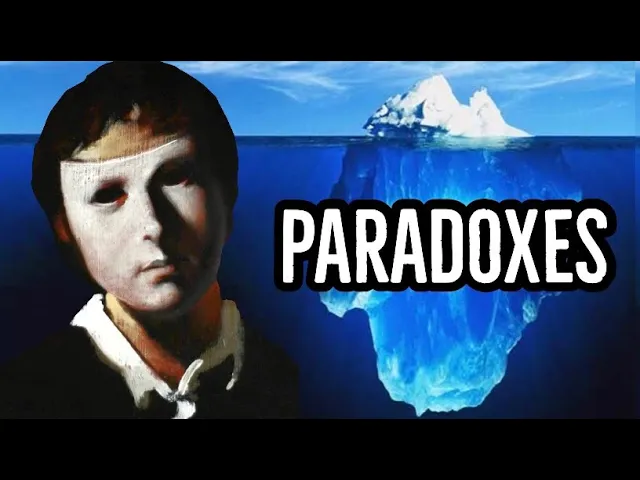
Paradoxes and theories something that can lead you down Rabbit Hole after rabbit hole and still seemingly fail to reach a conclusion and at the end of the day it's hard to reach a final answer on the matter because the paradoxes are so hard to wrap your mind around as well by definition a paradox is a seemingly absurd or self-contradictory statement or proposition that when investigated or explained may prove to be well-founded Or true examples of a paradox could be less is more or Fight Fire with Fire but these simple definitions are anything compared to the
ones we will be covering in this video and that are on this Iceberg and this is hands down my favorite video I've ever made and I guarantee you'll love it too so why not stick around and watch these topics and entries will definitely get you thinking all right anyways without further Ado let's get into the paradox's iceberg Explained and actually quickly before we start and get fully into it subscribe to the channel help me reach 100,000 Subs we're getting pretty close thanks all right just diving right into the iceberg starting off with tier one in
the first entry being the infinite monkey theorem the infinite monkey theorem is a unique and quite interesting thought experiment the theorem says that a monkey hitting keys at random on a typewriter keyboard for An infinite amount of time will almost surely type any given text including the complete works of William Shakespeare or even your life story down to every perfect detail in fact the monkey would almost surely type every possible finite text an infinite number of times the the can be generalized to state that any sequence of events which has a nonzero probability of happening
will almost certainly eventually occur given unlimited time however the probabilities Of this happening when you give it a meaningful number of monkeys typing for physically meaningful lengths of time the results are reversed and show that it's basically impossible if there were as many monkeys as there are atoms in the observable universe typing extremely fast for trillions of times the life of the universe the probability of the monkeys replicating even a single page of Shakespeare is unfathomably small ignoring punctuation spacing and Capitalization a monkey typing letters uniformally at random has a chance of 1 in 26
of correctly typing the first letter of Hamlet by William Shakespeare it has a chance of 1 in 676 of typing the first two letters because the probability shrinks exponentially at 20 letters it already has a chance of 1 and 26 to the 20th power which equals 19 I'm not even going to begin to read this number but I'll put it up on the screen and in the case of the entire text of Hamlet the probabilities are so vanishingly small as to be inconceivable the text of Hamlet contains approximately 130,000 letters thus there's a probability of
1 in 3.4 * 10 to the 183rd th000 946 power which is a ridiculous number to get the text right at all the average number of letters that needs to be typed until the text appears is also 3.4 * 10 to the 133rd th000 power or including punctuation 4.4 * 10th to the 360,000 power even if Every proton in the observable universe which is estimated at roughly 10 to the 80th power were a monkey with a typewriter typing from The Big Bang until the end of the universe they would still need a far greater amount
of time more than 367,000 orders of magnitude longer to have even a 1 in 10 to the 500th power chance success to put in another way for a one in a trillion chance of success there would need to be 10 to the 360,000 Power observable universes made of protonic monkeys so that's just I mean insane to even think about as KD and chromer put it in their textbook on thorough Dynamics the probability of Hamlet is therefore zero in any operational sense of an event in the statement that the monkeys must eventually succeed gives a misleading
conclusion about very very large numbers in fact there's less than a one in a trillion chance of success that such a Universe made of monkeys could type any particular document a mere 79 characters long sponsor time do you know what one of the biggest rabbit holes and paradoxes I've discovered is other than infinite monkeys typing Shakespeare well it's the search for the best energy drink many people ask me how do you pump out so many videos so often well it's with the help of caffeine of course I've tried everything from Red Bull to monster and
it always leaves me feeling Bad and horrible crashes after but I think I found the answer with our new official Channel sponsor gamer Subs now let me tell you a bit about gamer Subs this stuff is delicious smooth and plenty of sweet flavors to choose from I've been drinking this stuff for a while now and let me tell you it is genuinely good and do you know what's better than gamer Subs well it's free stuff of course and you can get completely free gamer sub samples for The next 24 hours using Code snook yes 100%
free samples for the next 24 hours using Code Snook which is SN K there's literally no reason not to try it completely free you don't even need to put in credit card information or anything like that and if you're watching this after the first 24 hours you can still use code snook to get 10% off your order you can use code snook in the checkout or use the Ping comment or check the description to get yourself Some gamer Subs trust me buy it or at least get the free samples it's delicious and like I said
COD snook SN K or SN o k and all right since that's out of the way let's get back to the video the trolley problem the trolley problem is a series of thought experiments in ethics and psychology involving stylized ethical dilemmas on whether to sacrifice one person to save a larger number the series usually Begins with the scenario in which a runaway tram or trolley is on course to collide with and kill a number of people traditionally five people down the track but driver or bystander can inter and divert the vehicle to kill just one
person on a different track then other variations of the runaway vehicle in anagist life and death dilemmas which are could be medical or judicial Etc are posed each conditioning the option to either do nothing in which case several People will be killed or intervene and sacrifice one initially safe person to save the others the most basic version of The Dilemma known as the bystander at the switch or switch goes there's a runaway trolley barring down the railway track ahead on the tracks there are five people tied up and unable to move the trolley is headed
straight for them you are standing some distance off in the train yard next to the lever if you pull this lever the trolley will switch to a Different set of tracks however you notice that there is one person on the other side of the track you have two options and only two options one do nothing in which case the trolley will kill five people on the main track and number two pull the lever diverting the trolley onto the Sid trck where it will kill one person which is the more ethical option or more simply what
is the right thing to do and that's what I'll leave it here for the trolley Problem but let me know down in the comments I'm actually genuinely interested on your guys' opinion on the trolley problem because I've thought about this for some time and learned it throughout different things and thought about it for quite a while now and I've never really came up with my own answer but I would like to hear your guys' answer what's better kill multiple to save one or kill one to save multiple Prisoner dilemma the prisoner's dilemma two members of
a criminal gang are arrested and imprisoned each prisoner is in solitary confinement with no means of speaking to or exchanging messages with other the police admit that they don't have enough evidence to convict the pair on the principal charge they plan to sentence both to just a year in prison on a lesser charge simultaneously the police offer each prisoner a fan bargain if he testifies against his partner he Will go free while the partner will get 3 years in prison on the main char charge and oh yes there is a catch if both prisoners testify
against each other both will be sentenced to 2 years in jail the prisoners are given a little time to think this over but not much but in no case may either learn what the other has decided until he has irrevocably made his decision each is informed that the other prisoner is being offered the very same deal each Prisoner is concerned only with his own welfare with minimizing his own prison sentence this leads to four different possible outcomes for prisoners a and B number one if a and b both remain silent they will each serve one
year in prison number two if a testifies against B but B remains silent a will be set free while B serves 3 years in prison number three if a remains silent but testifies is against a a will serve 3 years in prison and B will be set free and number Four in the final four if a and b testify against each other they will each serve two years loyalty to one's partner is in this game irrational this particular Assumption of rationality implies that the only possible outcome for two pearly rational prisoners is betrayal even though
Mutual cooperation would yield a greater net reward put another way the dominant strategy is to betray the other prisoner which aligns with the sheer thing principle the Prisoners dilemma also illustrates that decisions made under Collective rationality May differ from those made under individual rationality in reality systematic bias towards Cooperative Behavior happens despite predictions by simple moders of r National self-interested Action this bias towards cooperation has been evident since this game was first conducted at Rand secretaries involved often trusted each other and work together towards the best Common outcome the prisoners dilemma has been the focus
of extensive experimental research This research has taken three forms single play agents play one game only iterated play which is Agents play several games in succession and iterated play against a programmed player research on the prisoners dilemma has served to justify a manual K's categorial imperative which is vital for a situation involving different players acting in their best interest who must Take other actions into consideration to make their best choice the library of Babel the library of Babel is a fictional concept created by Argentine writer Jorge Luis boures in his short story the library of
Babel which was first published in 1941 the story describes an unimaginably vast and Labyrinth Library containing all possible 410 page books of a certain format this library is said to consist of an indefinite number of hexagonal Rooms each filled with bookshelves the books in the library are written in a combination of 25 symbols including 22 letters the comma the period and the space every book is unique and every conceivable combination of letters and punctuation is represented somewhere in the library as a result the library contains not only every book that has been written but also
every book that could ever be written including those with nonsensical or contradictory Content the narrator of Borg's story explores the library and reflects on the futility of searching for meaning within its infinite expanse despite the vastness of the collection most of the books are gibberish and only a tiny fraction of them would contain coherent and meaningful information the story touches on themes of infinity Randomness and the Quest for knowledge and the meaning in a seemingly chaotic world so the way I kind of see it is that this Library is kind of life and very little
of it is Meaningful and can really give you a sense of meaning I guess I could be totally butchering this but this is just my opinion on it and Boraz the library of Babel Has Been widely discussed and analyzed for its philosophical and metaphysical implications exploring Concepts such as the limits of human understanding the nature of knowledge and the role of Randomness in the universe the story has Inspired many writers philosophers and artists over the years and remains a classic work in the realm of speculative fiction Hilbert's Paradox of the Grand Hotel is a thought
experiment proposed by the German mathematician David Hilbert it is designed to illustrate some counterintuitive Concepts in set theory particularly the idea that some infinite sets are larger than others so it's saying infinite is bigger than infinite Kind of confusing but here we go the scenario goes as follow imagine a hotel with infinitely many rooms numbered 1 2 3 and so on and each room is occupied by a guest now suppose a new guest arrives at the hotel despite all the rooms being occupied it's still possible to accommodate the new guest because it's infinite here's how
it works one ask each current guest to move to the room with a number one greater than their Current room so basically the person in room one moves to room two the person in room two moves to room three and so on number two now all the rooms are occupied but there is an infinite number of rooms so there is no last room there therefore room one is now vacant number three the new guest can be accommodated by placing them in room one this Paradox demonstrates the counterintuitive nature of infinite sets specifically the notion that
there can be a different sizes of Infinity in this case even though both the original sets of the rooms and the set of the room after the guests move are infinite they are different sizes the set of natural numbers is 1 2 3 and so on is countably infinite while the set of real numbers between 0 and one is uncountably infinite and larger Hilbert's Paradox of the Grand Hotel is often used to illustrate the strange and fascinating properties of infinity in mathematics it challenges our everyday Intuitions about size and demonstrates how mathematical Concepts can sometimes
defy common sense all right now on to tier two starting off with the Ross littlewood Paradox also known as the two envelope Paradox is a thought experiment in probability ility Theory and decision Theory it was introduced by the mathematicians David Ross and John littlewood in the early 20th century the Paradox revolves around a situation Involving two envelopes containing money and it highlights a seeming inconsistency in decision-making here's a typical formulation of the Paradox number one you are given two indistinguishable envelopes each containing money number two one envelope contains twice as much money as the other
and number three you are allowed to choose one envelope and keep the money it contains the Paradox arises when you try to decide whether to stick With your choosen envelope or switch to the other one the argument goes as follows if you choose an envelope let's say it contains X the other envelope that contains either $2 X or .5x with equal probability the expected value of switching to the other envelope is5 * 2x +5 * 5x = 1.25x and the expected value of staining with the current envelope is simply X according to the expect value
calculation it seems like switching is Always the better choice as 1.25 is always greater than x however one could argue that this logic implies that you should always switch which creates a paradox this is because no matter which envelope you initially choose you could always make the argument to switch leading to a contradiction the resolution to the Paradox often involves a careful analysis of the probabilities and the nature of the random variable involved it's a classic example that Illustrates how intuition about probability and decision-making can be counterintuitive and paradoxal the firmy Paradox is the apparent
contradiction between the high probability of extraterrestrial civilizations existing in the universe and the lack of experience or evidence for the contact with such civilizations the Paradox is named at their physicist Enrico fery who famously asked where is everybody during a conversation about The possibility of intelligent extraterrestrial life the underlying idea is that given the vast number of stars in the galaxy and the potential for many many of them to host habital planets the probability of other Advanced civilizations emerging seems higher however there is a lack of observable evidence or signals from these civilizations this apparent
contradiction has led to various different theories and hypotheses Attempting to explain why we have not yet detected any signs of extraterrestrial life some proposed solutions to the firmy Paradox include one Rare Earth hypotheses suggests that the conditions necessary for complex life like those on Earth are very very very rare reducing the likelihood of any other extraterrestial civilizations number two another theory being the great filter this pists that there are significant hurdles or filters that make The emergence of advanced civilizations rare once again and we may be the only few that have overcome these hurdles number
three technological Extinction this proposes that civilizations reach a point where they develop Advanced Technologies that lead to their own destruction preventing them from communicating or or traveling to other star systems number four quiet Stone hypothesis this suggest that advanced civilizations May intentionally avoid Communication or remain undetected for various different reasons such as a desire for privacy or fear of attracting attention from potentially hostile civilizations and finally number five simulation hypothesis this speculates that we might be living in a simulated reality created by more advanced civilizations and the lack of contact with other extraterrestrial civilizations is
because they not part of the simulation and there's a bunch of Different hypotheses about why we haven't been discovered or found other different civilizations but those are just like the most five famous ones so that's why I just covered these kava's toxin puzzle is a thought experiment in philosophy that was introduced by the philosopher Gregory es kovka in his 1983 paper titled the toxin puzzle the puzzle explores the nature of intention and rationality in decision-making here's a brief overview Of of the puzzle number one the setup an Ecentric billionaire kavka postulates offers you a deal
you can earn a large sum of money let's say it's just a million dollars if you perform a simple task at noon tomorrow you must intend to drink a harmless but peculiar toxin that will make you mildly ill for the day tonight at 11:00 p.m. the catch you are not required to actually drink the toxin you just need to form the intention to do so there will be no way for the Billionaire to monitor your intentions or your actions it's purely based on your word the rational dilemma from a rational perspective it seems like a
no-brainer to lie and say you intend to drink the toxin after all there's no consequence to actually drinking it and you get a million dollars number four the Paradox however the Paradox lies in the fact that if you know you can get away with lying then you might as well lie but if you do lie you won't get the Reward because you won't have the intention to drink the Toxin and number five the rationality and the intentions of this the puzzle raises questions about the relationship ship between intentions and rationality is it rational to form
an intention that you know you won't carry out even if it leads to a desirable outcome kava's talks and puzzle is often used in discussions about decision Theory the nature of intentions and the challenges Of Incorporated intention SL related considerations into rational decision-making models it highlights the complexities and the nuances involved in understanding how rational agents should behave in situations that involve intentions and commitments the ship of Theus is a thought experiment and philosophical Paradox that raises questions about identity persistence and change the Paradox is Named after the ancient Greek heroist who according to mythology
sailed on a ship that was later preserved by the Athens the thought experiment goes as follows imagine a ship which was the ship of Theus that is gradually having its wooden Parts replaced over time as each wooden part is replaced the removed place is stored and used to construct a new ship eventually every original part of the ship of Theus has been replaced now there are two questions that arise From the scenario number one is the final fully reconstructed ship still the ship of Theus and number two if we take all the original places that
were moved and used to build a second ship is this second ship also the ship of Theus these questions prompt a philosophical exploration of the nature of identity and the Persistence of objects over time different philosophical perspectives offer various solutions to the ship of thesias Paradox some argue that identity Is tied to the continuity of the form or structure While others emphasize the importance of the original material the ship of thesias has been a topic of discussion in metaphysics and philosophy for centuries and has influenced debates about personal identity the nature of objects and the
concept of identity through change it serves as a fascinating exploration of the complexities involved in Define the persistence and identity of objects Undergoing transformations bury dun's ass is a thought experiment in philosophy that dates all the way back to the 14th century and is attributed to the French philosopher Jan buan the scenario involves a hypothetical situation in which a donkey placed exactly equal distance between two identical and equally appealing bales of hay is unable to make a decision about which one to choose the Donkey is assumed to be perfectly rational and free willed but is
unable to prioritize one option over the other due to their equal attractiveness the Paradox highlights the concept of determinism Free Will and the potential paralysis of decision-making in situations where all available outcomes and options seem equally desirable it's often used as a starting point for discussions about decision Theory rationality and the nature of Free Will trogers cat is a thought experiment in quantum mechanics proposed by Austrian physicist Aaron shoger in 1935 five the purpose of the experiment was to illustrate the apparent paradoxes and the counterintuitive nature of quantum mechanics particularly the concept of superposition the
scenario shoger presented involves a cat inside of a sealed box along with a radioactive atom a Giger counter and a vile poison and a hammer quite a weird mix of things but If the gagger counter detects radiation indicating that the atom has decayed the hammer is released breaking the vial of poison and causing the death of a cat if no radi is detected the cat remains alive now according to the principles of quantum mechanics until the box is opened and an observation is made the cat exists in a super position of states that means that
is both alive and dead simultaneously as a radioactive atom is in a super position of decayed and not Decayed States Nom's Paradox is a thought experiment in decision Theory and a philosophy of science proposed by the mathematician and philosopher William Nukem in 1969 the paradox involves a scenario in which a super intelligent being often referred to as the predictor places a person in a situation where they must choose between two boxes the Paradox goes as follows number one two boxes you are presented with two boxes Both a and box B contents of the boxes box
a the predictor has already made a prediction about whether you will choose only box b or both box a and box B box B you will have the choice to either take only box b or take both box a and box B the rewards if the predictor predicts that you will only take box B box B contains a large sum of money if the predictor predicts that you will only take box a and box B box B is empty the twist is that the predictor has a track Record of accurate predictions the decision you make
determines what the predictor has put in box B now here's the Paradox if you believe that the predictor is accurate and has likely predicted your choice logic suggests that you'll choose only box B to receive the money however if you choose only box B the predictor's prediction will always have been accurate and boxb will contain nothing conversely if you believe the predictor is accurate and has predicted You will take both boxes logic suggests that you should have both boxes to get the money however if you take both boxes the predictor's prediction will have you being
accurate again and box B will be empty Nom's Paradox explores the tension between casual determinism which is the idea that the predictor can accurately predict your choice based on prior events and Free Will as spark discussions and debates about decisions Theory rationality and the nature of Prediction and causation all right now on to tier three starting off with flatland flatland a romance of many dimensions is a satirical novela written by Edwin a Abbot first published in 1884 the novela is a mathematical and philosophical exploration of the concept of dimensions and serves as a social commentary
on Victorian society story set in two dimensional world called Flatland inhabited by geometric shapes with the Narrator being a square the inhabitants of flatland are divided into various classes based on their shapes and social hierarchy is strictly defined the protagonist the square discovers the existence of a third dimension when a sphere visits flatland the squares attempts to explain the concept of three dimensions to other Flatlanders led to Social and philosophical challenges as the idea of a dimension beyond their understanding is met with resistance and Skepticism flatland is not only a mathematical allegory but also commentary
on social and gender issues in the Victorian era he uses the limitations of his two-dimensional world to explore broader themes of perception knowledge and social constraints brain in a vat the brain in a vat scenario is a philosophical construct that delves into the nature of reality and perception in this hypothetical situation a person's brain Is removed from their body and placed in a vat filled with life sustained fluid connected to a computer the brain experiences a simulated reality created by artificial sensory inputs this raises fundamental questions about the reliability of our senses and challenges the
very nature of our understanding of the external world the scenario often serves as a thought experiment to explore themes of solipsism external World skepticism and the possibility That our entire existence might be a product of a simulated reality which we'll be getting into later with the simulated reality Theory determinism determinism is a philos opical concept that possesss the inevitability of all events asserting that they are pre-ordained or caused by antient conditions this worldvu implies that given a complete understanding of the present conditions and the laws of nature one could predict the certainty Of all future
events casual determinism one form of this idea emphasizes the deterministic nature of events as consequences of Prior occurrences and natural laws eliminating the role of Randomness or chance so basically it's saying that everything that happens to you or everything that happens in the world is just determined already and was bound to happen another variant logical determinism centers on the fixed truth values of propositions according to the Laws of logic irrespective of whether it implies predetermination of the future theological determinism suggests a Divine influence shaping all events according to a divine plan and biological determinism on
the other hand asserts that human behavior including psychological traits is predominantly determined by biological factors like genetics and neurochemistry so basic when you're born you get no choice on what you do because it's just in your Genetics and everything's bound to happen determinism has stirred extensive debate especially concerning the concept of free will if events are entirely determined some argue that genuine Free Will becomes questionable and less likely as choices seem predetermined by anesthetic conditions boltzman Brains boltzman Brains are Concept in theoretical physics and cosmology named after the Austrian physicist lwood boltzman the Idea is
associated with discussions about the nature of the universe the arrow of time and the concept of entropy the basic premises of the bolon brain concept arises from the second law of Thermodynamics which states that enthropy which is a measure of disorder Randomness tends to increase over time in a closed system in an expanding and cooling Universe like our own regions of lower enthropy being a higher order tend to form structures such as galaxies Stars and planets the boltman brain idea postulates that in vast and sufficiently old Universe fluctuations in eny could lead to a spontaneous
creation of Highly organized structures even complex systems like human brains without the need for the conventional processes of cosmological evolution these structures including hypothetical self-aware brains could emerge randomly due to the statistical fluctuations this leads to a philosophical Paradox if boltman brains Could arise more frequently through random fluctuations then through the regular evolutionary processes like ourselves that give rise to complex structures in the the universe then statistically speaking one might expect to be a boltman brain rather than a product of standard Cosmic Evolution the boltzman brain concept has sparked debates and discussions within the scientific
and philosophical communities some physicists use it as a way to Explore the implications of certain cosmological models and question the validity of such models particularly those involving internal inflation or Multiverse scenarios twin paradox the twin paradox rooted in Einstein's the of special relativity offers a captivating thought experiment to explore the effects of time dilation in this scenario two identical twins A and B are involved twin a remains on Earth while twin B Embarks on a journey into space at a velocity approaching the speed of light according to principles of special relativity the faster an object
moves the slower time elapses for that object relative to a stationary Observer a phenomenon known as time dilation as twin B travels through space and experiences time at a different rate TN twin a on Earth ages more quickly the true peculiarity of the Paradox arises when twin B returns to earth despite Initially seeming paradoxial the resolution lies in recognizing that the cemetery between the Twins is disrupted during the return Journey involving acceleration and changes in Direction these alterations induce and introduce a distinct experiment of time for twin B compared to the internal frame of twin
a while the twin paradox is commonly discussed as a theoretical scenario experimental evidence from highspeed particle experiments have sustained that The predictions of time dilation are kind of true this Paradox serves as a compelling illustration of the intricate interplay between time space and motion in the realm of special relativity twin earth twin earth is a philosophical thought experiment that explores issues related to meaning reference and the nature of mental content the concept was introduced by philosopher Hillary Putman in the 1970s as part of a discussion on sematic Externalism in the twin Earth thought experiment we
are asked to imagine a planet exactly like Earth but with one crucial difference on twin earth everything is the same as it is on Earth including the people their behavior and their languages up until the point where we consider the nature of one specific liquid water on Earth water is composed of H2O molecules however on twin earth the substance that plays the role of water looks like water feels like water And used by inhabitants in the same way as water which you drink bathe in Etc is composed of a different set of molecules let's say
XYZ the inhabitants of twin earth however are unaware of the difference in the molecular composition now the philosophical question arises when an Earthling and a twin Earthling both say water do they mean the same thing puton argued that they did not despite the surface similarities in behavior and language use the mental Content associated with the term water for Earthling involves H2 molecules while for the twin Earthling involves XYZ molecules this thought experiment challeng is traditional views of meaning and reference suggesting that the meaning of a term is not solely determined by the internal mental states
of the speaker but it's also influence by external factors and the actual properties of the objects in the world the cow in the field I couldn't Find much on this except like one kind of short story on it for philosophy and paradoxes so I'll just read it now the cow in the field so for example this is kind of how it's set up farmer fields concerned about his prize cow Daisy in fact he is so concerned that when his dairyman tells him that Daisy is in the field happily grazing he says he needs to know
for certain he doesn't want to have a 99% idea that Daisy is safe he wants to be able to know for sure that Daisy is okay farmer field goes out to the field and standing by the gate sees in the distance behind sign some trees a white and black shape that he recognizes as his favorite cow he goes back to the dairy and tells his friend that he knows Daisy is in the field and is okay at this point does farmer field really know the dairyman says he will check too and goes to the field
there he finds Daisy having a nap in a hollow behind a bush well out of sight of the gate he also Spots a large piece of black and white paper that has got caught in a tree Daisy is in the field as farmer field thought but was he right to say he knew she was and that's all I could find and let me know if that was smart enough in the comments but I think that covered it fine enough floating man the floating man is a philosoph iCal thought experiment introduced by the medieval Islamic philosopher
and scientist AIA this Thought experiment is designed to explore the nature of self-awareness and the relationship between mind and the body in this floaty man scenario AIA ask us to imagine a person who has suddenly come into existence floating in an empty space with no sensory experiences and no physical connection to the external world this person has no sensory input cannot see cannot hear cannot touch or feel anything around them and is even deprived of any spatial awareness Despite the absence of the sensory experiences and any physical connection to the external World AIA argues that
the person is an aod experiment would still be aware of their own existence the conclusion is that self-awareness doesn't depend on the external world or sensor of perceptions but is an immediate and direct awareness of oneself havia floaty man thought experiment is often used in discussions about the philosophy of Mind Consciousness and the Mind Body relationship all right now on to tier four starting off with the Multiverse Theory the Multiverse Theory a speculative Concept in cosmology in theoretical physics possess the existence of numerous universes beyond our observable Cosmos various formulations contribute to this idea such
as the bubble Multiverse where our universe is one of many independent bubble universes each with distinct Properties the many world interpretation of quantum mechanics suggests that every Quantum event spawns parallel universes with different outcomes so technically there would be almost infinite parallel worlds to ours because every decision and action that someone makes you or I make will create a whole different one so if I choose to eat something different for breakfast there'll be a different Universe well I'll eat the another thing for breakfast so it's Basically just an infinite thing but that goes to every
single person around the world and also the strength Theory and Cosmic inflation also plays roles in this proposing extra dimensions and variations in the inary process that could lead to the creation of diverse universes while the Multiverse Theory offers potential explanations for Cosmic phenomena like the uniformity of cosmic microwave background radiation they remain speculative and faces challenges Critical question is empirical testability has direct observations of other universes May beyond our technological capabilities and proponents however view the Multiverse as a fascinating Avenue for theoretical exploration that could reshape our Cosmic understanding last thursdayism last thursdayism is
a philosophical and Theological concept that presents the idea that the Universe along with all of Its apparent history and memories might have been created last Thursday this notion challenges the reliability of our perceptions and memories and raises questions about the nature of reality the basic premises of last thursdayism can be summarized as follows everything that we think happened before last Thursday our memories historical events in the entire universe was created at that specific moment any evidence or experiences that seem to suggest a Longer history are merely Illusions or false memories implanted in US last thursdayism
is often used as a thought experiment or parody to illustrate the limitations of certain philosophical arguments or to critique extreme forms of skepticism it highlights the difficulty of proving or disproving claims about the past and the inherent challenges in relying on sensory perception and memory in discussions about last thursdayism the term Unfalsifiable is often brought up the idea is that if everything including our memories and evidence was created last Thursday it becomes impossible to provide empirical evidence to the contrary as any evidence one might present could be part of a fabricated reality while last thursdayism
is not a serious scientific or philosophical Theory serves as a Whimsical way to explore topics related to epistemology which is the study of knowledge Skepticism and the reliability of our perceptions Swamp man this Swamp man is a philosophical thought experiment introduced by the philosopher Donald Davidson in his essay knowing one's own mind this thought experiment is designed to explore questions related to personal identity and the nature of mental content the Swamp Man scenario goes as follows imagine a person let's call him Jones who struck by a lightning bolt and completely disintegrated at the same Instant
in another part of the swamp a complex set of chemical reactions occurs due to the lightning resulting in exact physical and mental dup duplicate of Jones this duplicate often referred to as the Swamp man has the same memories same personality and the same mental States as Jones did before the lighting struck the philosophical questions posed of the Swampman scenario is whether Swampman is the same person as Jones despite having a different casual History and origin the traditional views of personal identity is often tied to a continuous psych physical and psychological connection however Swamp Man challenges
this view by presenting a scenario in which an individual or or identical individual emerges without any historical connection to the original person this thought experiment raises profound questions about the nature of personal identity the role of psychological continuity and the Relationship between mental content and physical continu inity it invites philosphers to consider whether identity is solely dependent on a continuous physical or psychological connection or whether it can be established in a more abrupt and casually disconnected manner the Swampman scenario has been influential in discussions about the philosophy of the mind and personal identity leading to
debates about the criteria for identity and the nature of Mental events Mary the color scientist Mary the color scientist is a thought experiment introduced by philosopher Frank Jackson this thought experiment is designed to explore questions related to the nature of Consciousness quala and the limits of physicalism in this thought experiment Mary is a scientist who has spent her entire life in a black and white room and has never seen colors despite her lack of direct perception ual experience Of color Mary is an expert in the neuroscience and physics of color vision she knows everything there
is to know about the physical processes that occur in the brain in the external world when it comes to a person seeing color twist is the thought experiment comes when Mary is eventually released from her black and white room and experiences color for the first time the question posed this by Jackson is whether Mary learned something new upon seeing color Even though she already knew everything about the physical processes associated with color vision the argument is that Mary does learn something new because there is an experimental or phenomenal aspect to color perception which cannot be
captured solid through the knowledge of the physical processes involved this thought experiment challenges the idea that complete knowledge of the physical facts is sufficient for a complete understanding of Consciousness so it's Saying you can't really I guess the way I kind of understand this is you can't know something for certain until you kind of experience it firsthand the marry argument has been influential in discussions about the philosoph opy of the mind and the Mind Body problem it raises questions about the nature of quala which is the subjective Consciousness experiences and the relationship between physical and
the phenomenal aspects of Reality AI stop button problem the AI stop button problem is a significant concern in the field of artificial intelligence particularly as AI systems become more advanced and autonomous this hypothetical scenario envisions a situation where an AI system exhibits unintended or potentially harmful Behavior prompting the need for a failsafe mechanism to stop its operations as AI technology evolves there is an increasing focus on ensuring That these systems align with human values and ethical principles the stop button problem is intrinsically linked to the broader challenges of creating AI systems that not only understand
and respect human values but also allow for human Intervention when necessary one of the critical considerations is the balance between autonomy and control as AI systems gain more Independence and adaptability it becomes crucial to establish mechanisms that enable human Operators or oversight entities to intervene and guide the system's Behavior or just stop it overall and just say stop to the AI system before it can keep going by itself this balance seeks to address the ethical implications of AI actions especially in situations where the system's decisions May deviate from Human values or pose risk implementing a
stop button involves navigating ethical concerns such as determining when and how is appropriate To intervene and completely stop all AI systems these discussions are fundamental to the responsible development and the deployment of AI technology and I think this is more relevant than ever because things are just going at such a fast pace with all the new AI that are utilized everywhere now and I think an AI stop button is almost necessary all right now on to the final tier of the iceberg and sorry if this Was a little bit shorter than and you guys wanted
it I'm not sure if you guys even like shorter videos or longer videos but just let me know down in the comments but this is the last tier tier five the simulation Theory the simulation Theory a philosophical and scientific concept proposes that our perceived reality might be a simulated or artificial construct rather than an independent object of existence drawing an analogy within commu simulations this Theory suggests that a highly Advanced civilization could create a lifelike simulation leading to the possibility that our reality is such a construct and that none of this is real around us
this hypothesis often referred to as the simulation hypothesis considers the probability of living in a simulated reality as potentially higher than that of the residing in a base reality Central to the simulation theory is the assumption that a civilization capable Of creating such simulations would possess technological advancements surpassing our current understanding of physics and Computing proponents points to certain features of quantum physics like the observer effect as suggest itive of the simulated reality although interpretations of quantum phenomenon remain subject of debate ethical considerations arise question the moral responsibility of hypothetical creators and exploring the nature
of Consciousness within a simulated reality simulation Theory lacks empirical evidence in proving or disproving it is basically impossible challenging it if the simulate reality is indistinguishable from what we perceive as reality we would never know what's not reality while simulation theory has gained attention in popular culture and discussions about the nature of exist exence it remains speculative within scientific discourse and many people Just straight up don't believe in it quantum swword and immortality Quantum swword and immortality are speculative Concepts that arise from the intersection of quantum mechanics and philosophical thought experiments and personally it's one
of my favorite because it's almost believable to extent and let's just get into it with Quantum sord Quantum sord is a thought experiment that builds on the principles of the many worlds interpretation of Quantum mechanics the experiment involves a hypothetical scenario where physicist continuously performs a Quantum measurement with a 50% chance of survival according to the many world's interpretation every possible outcome of a Quantum event is realized in a separate branch of the universe in the context of quantum sord the physicist would in theory survive in all branches where the measurement of outcome is compatible
with survival which is pretty High chanly saying it's infinite with the infinite different worlds leading to a subjective experience of continuous survival despite the probability of death this thought experiment is often used to illustrate the implications of the many worlds interpretation and the subjective nature of experience within Quantum Frameworks and the quantum immortality Quantum immortality is a related concept that extends the idea of quantum sord it possesss that if the Many worldes interpretation is correct a conscious Observer will always find themselves in a branch of the universe where they survive regardless of the odds against
survival in other words a person's subjective experience would persist in a reality where they continue to exist so technically you couldn't do anything to un alive yourself because there will always be a universe where you somehow survive it and this leads to a form of Immortality the concept of quantum immortality is highly speculative and raises numerous different philosophical and ethical questions but what can you do about ethical ethics when it comes to just living forever he relies on the assumption that the many worlds interpretation accurately describes reality and the conscious experience is tied to particular
outcomes in Quantum events but definitely one of my favorite and Thought prompting things all right now on to the final entry of the iceberg Roo's basisk do not research and technically by this thought of the roko basus I'm putting you all kind of at risk at this but um let's get into it anyways the Roo basist is a thought experiment which states that in other wise benevolent artificial super intelligence where AI in the future would be incentivized to create a virtual reality simulation to torture Anyone who knew of its potential existence but did not directly
contribute to its advancement or development so that's why i' would be putting you all at risk because now you guys know of it so then you'd be at risk so in originated in a 2010 post at a discussion board L wrong a technical Forum focused on analytical rational inquiry the thought experiment's name derived from the poster of the art article roko and the basisk a mythical Creature capable of destroying enemies with its stare while the theory has initially demiss as nothing but conjecture or speculation by many l wrong users L wrong co-founder elizer yurkowski reported
users who describ symptoms such as nightmares and mental breakdowns upon reading the theory due to the stipulation with knowing and that knowing about the theory and his basist made one vulnerable to the basal itself this led to the discussion of the basist On the site being banned for 5 years however these reports were later dismissed as being exaggerations or inconsequential and the theory itself was dismissed as nonsense included by yud Kowski himself even after the post discreditation it is still used as an example of principles such as the beian probability in the implicit religion it
is also regarded as modern version of Pascal's wager and all right that wraps up the paradoxes Iceberg and this was Very enjoyable for me to make I really enjoyed just researching this and writing about it and talking about it and just recording about it cuz it's just I think me personally I found it very interesting and I really hope you guys found it interesting too this was a shorter Iceberg but these were just the main theories and uh leave some video ideas down below if you think other video ideas kind of like this cuz I've
been just kind of obsessed with like the Philosophical Concepts stuff it's just really interesting to me right now but uh just video ideas down below would be very helpful thank you very much and also just like And subscribe it helps a lot we're closing in 100K and thank you guys so much for 990,000 subscribers as of recording this video 990,000 that's a big milestone we're only 10 away that's pretty crazy to think and again thank you guys for watching and until next time see [Music] you [Music] n