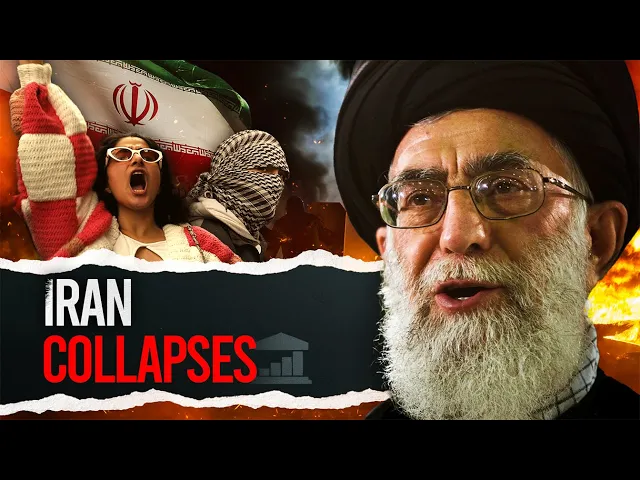
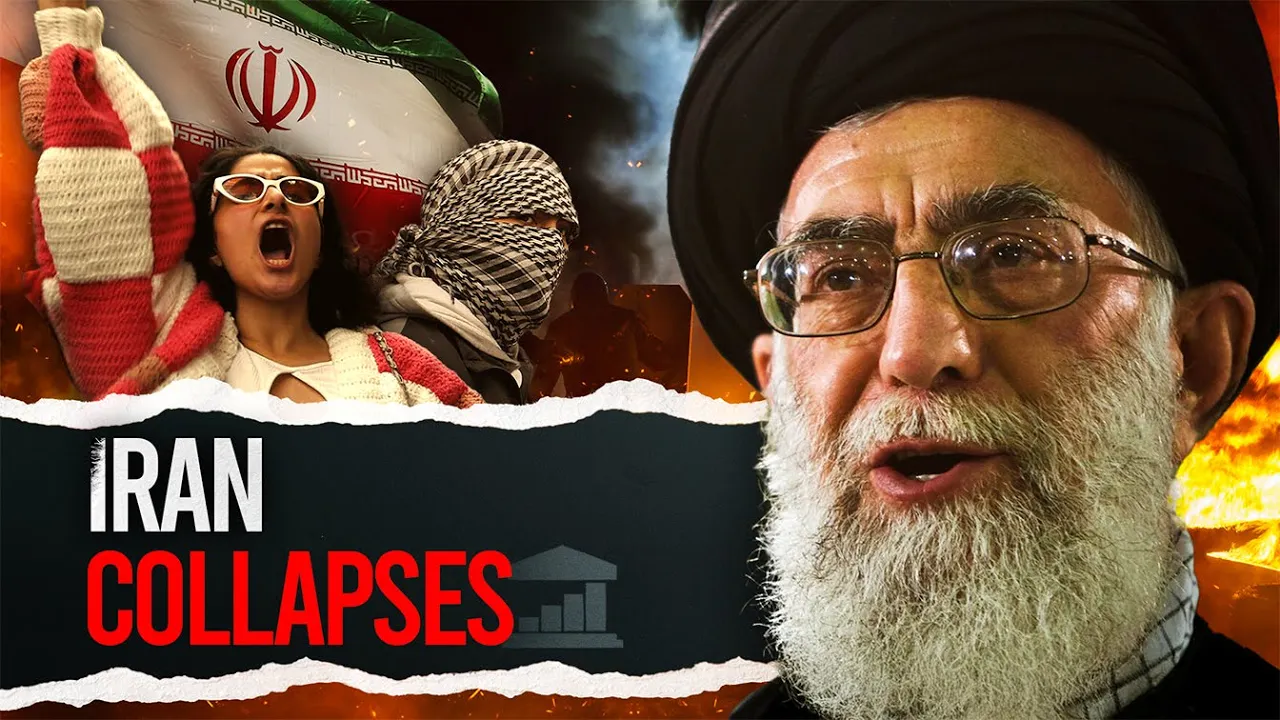
It may seem unbelievable, but just hours after Nicholas Maduro was captured, another major dictator now appears to be on the verge of falling. This time due to a massive civil uprising and in none other than the feared Iran of the Ayatollas. [music] It all began at the end of last month with a small strike, almost anecdotal, but in a matter of days, it has turned into a full-blown social explosion.
Tens of thousands of Iranians have taken to the streets to protest against what? Not only inflation or Ayatollah Kami. No, this time the cry goes further.
They want to change the entire system. The very system that has led the country into decades of poverty, repression, and obscurantism. They are going through a runaway crisis.
And water shortages have been the final straw that broke the camel's back. And no, we're not talking only about Tehran. The protests have erupted in more than 108 cities covering twothirds of the country.
Sectors that were previously apolitical or even loyal to the regime are now out on the streets. Protests erupt in Iran over currencies plunged to record low. Monday's protests were the biggest since 2022 when the death of 22-year-old Masajina Amini in police custody triggered nationwide demonstrations.
For now, most protests consist of groups of between 50 and 200 people. I know it doesn't sound like much, but it's the best way to avoid the brutal repression of the Ayatollah's regime, which has already left more than a dozen confirmed dead due to reprisals. Visual politic, Iranians have taken to the streets to demand what some already see as even the imminent fall of this theocratic regime.
Of course, the regime has held on from the massive protests of 2019 to the freedom movement, especially for women that shook the streets just 3 years ago. Remember, in the end, Kam and his associates did not hesitate to settle the matter with hundreds of deaths. However, there are reasons to think that this time it could be different.
The protests broke out between December 7th and 28th, but on January 3rd, something happened that changed everything. We're talking, of course, about the extraction of Nicholas Maduro by Donald Trump. Is the world's police force back?
Well, what we can say is that they seem to be watching Iran very closely. If Iran shoots and violently kills peaceful protesters, which is their custom, the United States of America will come to their rescue. We are locked and loaded and ready to go.
Now, be careful. This is nothing new. Not long ago, Trump also publicly spoke about repeating the bombings from last June if Iran continues its nuclear program in pursuit of an atomic bomb.
And as if that weren't enough, in recent days, we've been seeing very suspicious movements involving several US military strategic transport aircraft. among them seven Boeing C17s that made a stop in the United Kingdom with no one really knowing why. But what we do know is that a similar deployment hadn't been seen since the bombings of Iran's nuclear program last year.
Moreover, there are reasons to believe that the 160th Special Operations Aviation Regiment, the famous Nightstalkers, who worked with Delta Force in the extraction of Nicholas Maduro, could be involved. By the way, as a curiosity, Donald Trump also ordered the drone strike that killed Casim Solommani, a general and one of the most important figures of the Iranian regime on January 3rd, 2020. So now, with all of this on the table, put yourselves in the Ayatollah's boots.
An elderly leader whom many describe as paranoid, who spent the war against Israel locked in a bunker and suffering from health problems. You're facing massive protests that go far beyond tyrann. An economy in crisis.
Israel threatening to return to arms in 2026. Assad is no longer in Syria to support you. Hezbollah is on the ropes.
And you're not even capable of controlling the Houthies. This cocktail can only be defined in one way. Explosive.
Yes, the regime has survived protests even harsher than this. But the problem for them is that with each passing day, they grow weaker and weaker. And meanwhile, protests in Iran are escalating like a snowball rolling down a mountainside.
Because let's not forget that even though Iran is ruled by a nearly 90year-old religious fanatic, the Iranian people are mostly secular young adults around 30 years old. So before this in mind here at Visual Politic, we've been asking ourselves a few questions. Why are there massive protests in Iran again?
What role does the United States play in all of this? Are we really this time facing the end of the Ayatollah's rule? Well, let's take a look.
>> [music] >> But first, if you're interested in the world of investing, if you want to learn how to manage your savings, protect yourself against inflation, and figure out how to make money beyond your day job, I've got some news for you. At Visual Factory, we've created the Visual Factory Club, a newsletter where every week we send out free content focused on essential financial education, the ABC of what everyone should know to understand the stock market, financial markets in general, investment platforms, how to assess investment opportunities, and which markets may have more or less potential. Because, of course, if you want to invest your money so you're not at the mercy of your country's economic instability, you at least need to understand the basics of the financial world.
In the Visual Factory Club, you'll learn all of this completely free of charge. Through the link below and this QR code, you can sign up for the club and start receiving the upcoming [music] editions. What's more, when you sign up, you'll receive a dossier where I explain in a clear and simple way the most essential investment concepts.
What multiples or the PE ratio are, what indices are, ETFs, derivatives, [music] funds, EPS, you get the idea. After that, every week, you'll receive additional materials and market analysis to help you stay informed about what's going on. And by the way, the sooner you sign up, the better.
Since we send each episode of the series by email, and every edition is unique, if you're not subscribed, you might miss some of them, and you won't be able to access them later. But with that said, let's get into the video. [music] As we've already told you, these protests didn't start out as the tsunami they are today.
Not at all. In fact, they began as a simple strike by merchants on Aladin Prominard, a place best known for selling mobile phones and then spread to Tran's Grand Bazaar. The reason for the strike, the terrible economic crisis the country is going through and especially the depreciation of the realale, the local currency.
And the thing is, in just one single day, $1 went from buying 1. 38 million realals to 1. 42 42 million, an exchange rate that in 2022 stood at 440,000 realals per dollar.
In other words, a massive collapse in value. Between the war with Israel and sanctions on Iranian crude oil, the central bank's coffers have been left empty. So, the currency has lost more than half of its value in barely 6 months.
And of course, this has been followed by year-on-year inflation of over 40%. And the worst part is that not all goods have risen in price equally. Food is now 70% more expensive than it was a year ago.
And visual politic community, when it comes to food, there's no room for games. The situation is so critical that some shops have started displaying the prices of basic products like milk in dollars. Yes.
Yes. Prices in dollars in the heart of one of the most anti-American countries on the face of the earth. But of course, one thing is what the Ayatollah's inner circle thinks, and quite another is what ordinary Iranians actually do.
And we could go on. Power outages have become routine. Fuel is increasingly rationed in the purest Soviet style.
And to make matters worse, Iran is now in its sixth consecutive year of extreme drought with its main reservoir at just 8% of capacity. This has caused water shortages to reach the point where the evacuation of Thran is being considered. And no, this is not a joke.
We already talked about this recently in a previous video here at Visual Politic. Now then, there's something important we need to keep in mind. Iran's GDP was growing at 4.
5% during the 2022 protests. Protests that put the regime in a very very tight spot. However, in 2025, GDP grew by just 0.
5% onetenth as much. And that's according to optimistic estimates because according to others such as the World Bank, the Iranian economy actually contracted by at least 1. 5%.
And all forecasts point to 2026 being even worse. So, it's no surprise that it was precisely merchants, those who have to buy goods on the international market with a currency that's no longer even worth using in a game of Monopoly, who were first to take to the streets. And pay attention because this could be key.
In 2019, there were also very harsh protests over the economic situation. But back then, merchants played a very secondary role. Generally speaking, this is a fairly conservative group and in a sense aligned with the Ayatollas.
Let's say there's a kind of tacit pact. merchants don't cause trouble and in exchange the regime protects them from foreign competition. Although honestly looking at how they've managed the economy, it's clear the merchants haven't exactly come out ahead.
And most importantly of all, even though this group has kept a low profile over the last few decades, it was absolutely key in driving the sha of Persia out of the country. After all, they control capital and wield a great deal of influence. So now the protests are not only large in number, they also have a broader and stronger social base than in previous cases.
And how is the government reacting to the economic situation? Well, the truth is surprisingly well. To begin with, they're not denying that there's a problem.
I am told salaries are low. That is true. I am told taxes are high.
That is also true. But then I am told to raise salaries. Can someone tell me where the money is supposed to come from?
Massud Peshkian, president of the Islamic Republic of Iran. >> What's more, back in March of last year, the economy minister's head already rolled figuratively. Because with Iran, it's always worth clarifying precisely because of the country's dire situation.
And now, just as these protests have broken out, the same thing has happened to the president of the central bank. That said, don't think a radical change is coming. The new president is the economy minister who replaced the previous minister, the one who was dismissed a year ago.
But it doesn't end there. Even Ayatollah Kamune himself has said that the reasons for protesting are valid. Yes.
Yes. This was said by the very same Supreme Leader under whose rule more than 300 demonstrators were killed during the last major protests against the regime. And this is not an isolated case.
We hear the same thing from figures like Muhammad Movi Azad, the country's attorney general. And that's because this isn't a coincidence. It's the official line.
The script followed by all authorities. Of course, this narrative clearly comes with a catch. >> This is the work of the enemy.
Protest is legitimate, but protest is different from riot. We can speak with a protester, but speaking with a rioter is pointless. A rioter must be put in their place.
Ayatollah Ali Kame. Of course, you can protest as long as it's against the terrible conditions imposed on us by Israel and the United States of America. It sounds like a Ronald Reagan joke about the USSR, but this is the government's official narrative.
That said, it must be acknowledged that Masud Bzeskian, the current president and a self-described moderate and reformist, has been much clearer when it comes to admitting fault and not deflecting blame. But unfortunately for the supreme leader, the Iranians who have joined the protests are very clear about who the real culprits are. Chance against the Ayatollah are omniresent at the demonstrations.
And worse still, the protests are not focused solely on Kamei, but on the very idea of the Ayatollas as supreme leaders and the entire regime built around them. At the University of Tran, for example, students could be heard chanting death to theat e fakir. We're not talking about a specific individual, not even about a group like the Revolutionary Guard, but about the very principle that religious authority must be more powerful than political authority and that the Ayatollah, the Pope of all Shiite Muslims, must be the supreme leader of Iran.
And of course, this is precisely what they most wanted to avoid. That complaints about the economic situation would turn into criticism of the system itself. And that explains why things didn't take long to get serious.
>> [music] >> Shortly after it became clear that the protests were growing, the government ordered universities and shopping centers to be closed. The official excuse that it's going to get very cold and there's no money for heating. And no, this is not a joke.
And the excuse to justify where internet traffic has suspiciously dropped by 35%, well, none has been given. It's not exactly new either. The same thing happened during the 12 days of war with Israel last year or during the 2022 protests.
The point is that despite speeches projecting apparent normality, the Iranian state's repressive apparatus has not taken long to hit to the streets. Even though the protests have been even more peaceful than previous ones, where there were more than 70 incidents involving Molotov cocktails, the official death toll already exceeds a dozen and detainees number in the hundreds. They have even arrested Najes Mohammadi once again, the Iranian activist awarded the Nobel Peace Prize in 2023.
That said, this happened a few days before the protests began, so perhaps it was just a coincidence. The atmosphere has already been very tense since the war against Israel, largely because of the Gaza issue. But even so, the scale of these protests has taken almost everyone by surprise.
It was by no means easy to predict. Be that as it may, one thing is clear. The Ayatollah's regime is not at ease.
For now, its fall does not appear imminent, but the regime is being worn down with every new protest. And to make matters worse, this time we've seen something new. Something that for some analysts could be the trigger for regime change.
The monarchist sun and lion flag, the symbol of the sha of Persia, is once again being seen on the streets of Thran, accompanied by the chant, "Bring back Palavi. " June 23rd, 2025. Iran's exiled crown prince says he is ready to take over from Kam.
Raza Palavi, son of the Sha deposed in the 1979 revolution, offers to lead Iran's transition to democracy after regime change. Raza Palavi himself, the son of the last sha of Persia, says he is ready to lead a constitutional and democratic monarchy to replace the Ayatollah's regime. Until just a few days ago, if you had told an Iranian that the Pavis could return to power, they most likely would have laughed and replied with something along the lines of saying that it's more likely Ayatollah Kami would convert to Christianity.
And do you know what it means that those flags are now appearing that things are escalating and fast? Of course, the heir to the sh of Persia is not the only one who has spoken about regime change in Iran. Pay close attention to Trump's words this summer when the conflict with Israel was at its height.
It's not politically correct to use the term regime change, but if the current Iranian regime is unable to make Iran great again, why wouldn't there be a regime change? Mega, we told you at the very beginning of this video. For now, it's all highly hypothetical speculation.
But it cannot be ruled out that emboldened by success in Venezuela, Washington might consider a new intervention in the Middle East. on his social network, Truth. The Republican president has also shared an article with a very striking headline.
Obama failed to support the protests in Iran, but Trump has just corrected that. Yes, it's true that Iran is not Venezuela, but it's also true that just 6 months ago, we saw Israeli forces roaming through Iranian airspace as if they owned the place. And be careful here because it was the United States itself that reinstated the sh in power after a coup d'etatar in 1953.
And well, you surely already know that history doesn't repeat itself, but sometimes it rhymes. But no, even with everything that has happened in recent days, seeing the sha of Persia back on the throne is still almost as unthinkable as it was before the protests. Remember, the sha didn't leave.
He was overthrown. And he wasn't overthrown by a single group, but by a very broad and diverse coalition. He was ousted because he was a despot corrupt to the core.
A ruler who used his own secret police in much the same way as the revolutionary guard. In fact, if there's one thing much of the Iranian opposition agrees on, unfortunately a very divided group, it's that they want neither the Ayatollah nor the sha. What's more, some suggest that at least part of the promony chants being heard at the protests are something like false flag operations.
agents of the regime itself acting with the sole intention of delegitimizing the protests. Some journalists claim to have identified people carrying these flags as members of the Bas, something like a volunteer branch of the Islamic Revolutionary Guard Corps, which is the Ayatollah's personal force. It's still too early to know whether or not this is true, but it's not entirely far-fetched.
After all, the Palavi's popularity remains very low. And of course, the Crown Prince's closeness to Israel doesn't help either. Israeli minister endorses Raza Palavi for Iran regime change.
We truly believe Iranians and Israelis must return to cooperation dating back 2500 years when Cyrus the Great allowed Jews to build the second temple. That said, there is one thing we need to make absolutely clear here. The Iranian people do not think the same way as their rulers and they do not share that hatred towards the mere existence of the Jewish state.
In fact, according to a recent survey, 60% of Iranians are in favor of putting the conflict with Israel behind them. in order to focus on domestic issues. Neither Gaza nor Lebanon, my life for Iran.
This has been one of the most widely discussed slogans seen at the protests in Thran. Iranians don't want to spend what little money they have on missiles, and they have even less interest in getting dragged into a war just so missiles can rain down on them. That said, one thing is wanting to stop interfering with Israel.
And a very different thing is being explicitly in favor of Netanyahu and his circle. Israel has bombed Iran and nobody likes having missiles launched at their country. So the closeness between BB and Resa Palavi is not in and of itself an argument in favor of the sha returning to the throne.
If anything, quite the opposite. In short, as much as we are seeing banners in favor of the old monarchy, and it's clear that not all of them are regime infiltrators in general, Iranians are not in favor of the sha, quite the opposite. Even in the extreme but increasingly plausible scenario in which the United States and Israel used force to impose or at least accelerate a regime change, current president or someone from his inner circle would have far better chances of governing than the char's heir.
basically Venezuela deli style. >> The leaders of Cuba and Iran should also be very worried. There's a new sheriff in town.
If I'm the leader of Iran, I'm going to go pray in the mosque. >> Still, visual politic, let's not start ringing the victory bells just yet. As things stand today, the truth is that it still seems unlikely that the Ayatollah's regime has its days numbered, at least in the very short term.
Even despite the fact that we're seeing headlines like these. Ayatollah Kam plans to flee to Moscow if Iran unrest intensifies. Benny Sabti who served for decades in Israeli intelligence after fleeing the regime eight years after the Islamic revolution told the Times that Kame would flee to Moscow as there is no other place for him.
This news has spread like wildfire, but it comes from a not very clear source and without evidence. In any case, there are two things that cannot be denied. First of all, these protests show that the struggle continues in the streets of Thran.
The women life freedom movement that shook the regime in 2022 was not an isolated case. And today everything points to the fact that as long as the Ayatollas remain in power, the protests will not stop. But beyond that, more and more groups are joining the fight.
We're not talking only, I don't know, about university students in Thran. No, more conservative sectors such as bizaar merchants or people in rural areas far from the capital are mobilizing more than they did in other protests like those of 2019. And let's be clear, we shouldn't forget that the economic crisis didn't happen by accident.
It's the result of this regime's disastrous policies, both economic and geopolitical. So, the most likely outcome is that discontent will not calm down anytime soon. And we mustn't forget that the United States or Israel could greatly accelerate events if they choose to do so.
Of course, be that as it may, having reached this point, now it's your turn. Do you think the protests will continue to grow, or will the regime dissolve them by force, as it has done many times before? Are we really facing the end of the Ayatollas?
Will the United States or Israel dare to intervene as has already happened in Venezuela? Leave us your thoughts in the comments and tell us how you see things. And you know, don't forget to subscribe to the Visual Factory Club and hit like if this video has helped you understand what's going on.
Thank you so very much for being there. I'll see you in the next video.