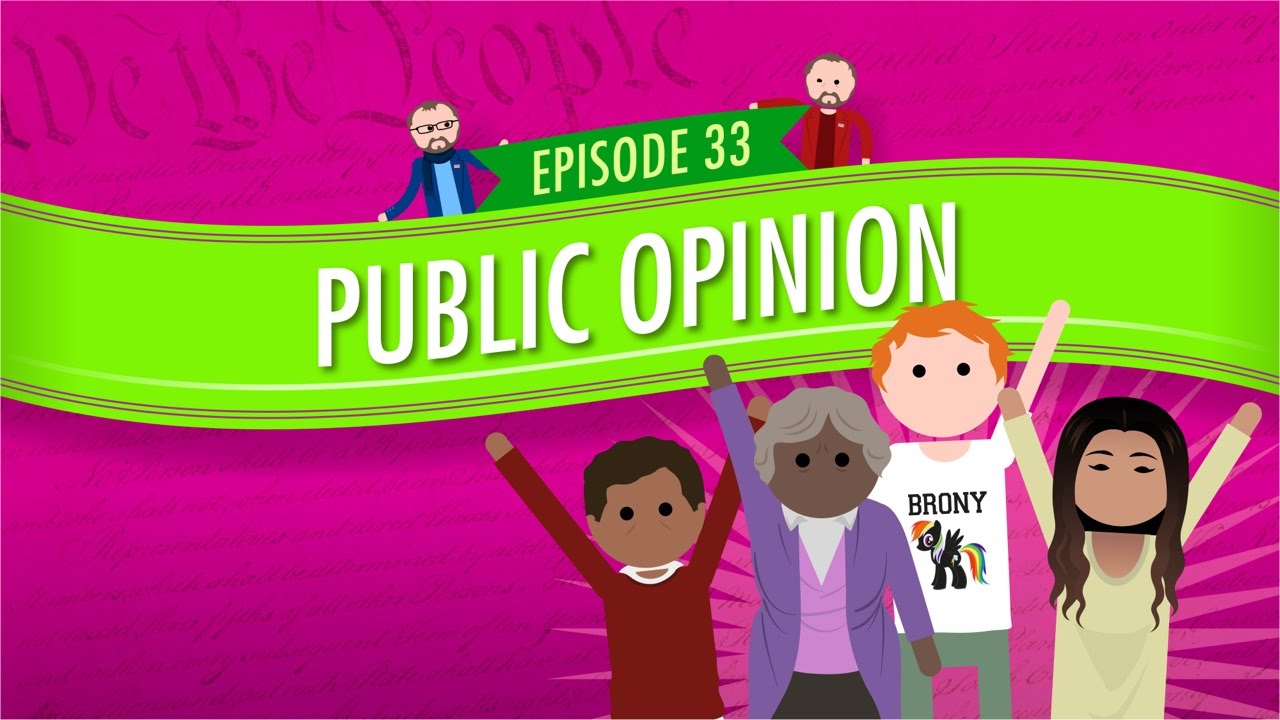
Hi, I'm Craig, and this is Crash Course Government and Politics, and today we're going to talk about where public opinion comes from. It comes from my mind brain! And yours!
And Stan's! Although no one really cares to hear from Stan's mind brain. .
. Just kidding Stan. You're crying?
Political ideologies are specific to individuals, but right now we're gonna try to explain the factors that shape public opinion in the aggregate, which is a fancy word for, like, all the people. [Theme Music] A person's opinions on politics are very much grounded in their ideology: whether they consider themselves liberal or conservative, but that doesn't mean they aren't susceptible to outside factors. I get my opinions from PewDiePie.
Three of the main influences on our political opinions are the government, private groups, A. K. A.
interest groups, and the media. A. K.
A. my T. V.
and my Internet. There's a lot of debate about which of these is more effective, and like anything a lot depends on the individual and the circumstances in which the group is trying to move public opinion. Probably the biggest thing that the government can do to shape public opinion is to do things.
Whether it's raising or lowering taxes, or invading other countries, when the government does stuff, we got opinions about it. More recently government inactivity, at least in terms of congressional lawmaking, has also had an impact on public opinion. It seems like Congress' approval ratings have gotten lower and lower as they pass fewer and fewer bills.
But aside from doing, or not doing, their jobs, the government actively shapes public opinion by engaging in public relations maneuvers and manipulating the news cycle. Let's go to the Thought Bubble. The President is especially good at controlling the news cycle since he can go on television whenever he wants.
The idea that the President might be at the center of the news started in the 20th Century. Probably with Theodore Roosevelt, who saw the office of the presidency as a "bully pulpit". But it really picked up steam with Franklin Roosevelt, who began the trend of presidents speaking directly to the American people with his "fireside chats".
These were direct appeals to Americans to support the president's policies, and a classic example of presidential P. R. Since then, the government has gotten more sophisticated with its public relations, although perhaps not more effective.
President Clinton was known for having a war room to coordinate his P. R. apparatus.
But all the spin in the world didn't make Americans support his healthcare initiative. Presidents Bush and Obama have continued this trend, using public opinion polls to polish their images, even trying to figure out what sort of vacations they should take. But as with Clinton, there's not a ton of evidence that their P.
R. activities worked. This probably has something to do with the changing media landscape, which we will discuss in greater future episodes.
One innovation that has not worked all that well are policy commercials known as video news releases. President Bush in particular tried to sway public opinion by paying for P. R.
pieces that looked and sounded like news stories which made his policies sound good. This was especially true of his education policies. I'll leave it to you to decide whether you think "No Child Left Behind" was a success, but the point is that you need to be very careful when watching news stories about actual polices these days.
There's also a historical explanation for why government efforts to create positive public opinion are less successful than we might think. In the 1960's and 1970's, the Vietnam War and then the Watergate Scandal put a massive dent in the people's trust in the government, which is understandable since government officials were lying about the war and using the C. I.
A. to spy on Americans. I bet if you ask your parents, or maybe your grandparents, you'll hear a story about how much better the government was back in the '50s and early '60s, but that might be a reflection of the generally robust economy, and a Cold War consensus that criticizing the government was unpatriotic, you communist sympathizer!
And if you're African-American the 1950's and early 1960's probably don't look so rosy either. Thanks, Thought Bubble. This brings us to another point about public opinion generally: It's highly reactive to current events, especially the economy, or eagles being in your vicinity and you wanting to punch them.
I don't think it's a coincidence that presidential and congressional approval ratings have been pretty low during the aftermath of the 2008 financial crisis. I mean, Americans love to complain, but the six years following 2008 have seemed pretty awful. Or maybe it has a lot to do with the other two primary influences on public opinion.
Private groups, especially organized interest groups, but also less-formally-political organizations like churches, can have a significant effect on the way the public views government and its polices. Any group with a particular interest in legislation can mount an advertising campaign for or against a law, provided that they have the money to do so. Sometimes these groups exist already, like the National Rifle Association, which works hard to ensure that stringent regulations on firearms don't get passed.
Other times an interest group will grow up around a specific issue, as often happens in states like California that feature ballot initiatives. The growth of the Internet as a source of news, information, and advertising has lowered the cost of public relations and makes it easier for specific interest groups to get their messages out. Like the time I Tumbled about how the dress was totally black and blue!
Often the group that's better at swaying public opinion has more money. A great example of how an interest group with a lot of money and a single issue can shape public opinion was the "Harry and Louise" ad campaign sponsored by the Health Insurance Association of America. Or, hiyaah!
Over the course of a year in 1993 and 1994 the group sponsored 14 television ads featuring a fictitious couple, Harry and Louise, who fretted over the potentially calamitous consequences of President Clinton's health care proposals. The ads cost between 14 and 20 million dollars, and are widely credited with helping move public opinion against the Clinton health policy. Some groups don't have as much money.
Public interest research groups often use volunteers or very low paid interns to go door to door or stand in the street handing out information about issues that concern them, such as the environment. Both liberal and conservative groups sponsor "think tanks" that produce research intended to change people's minds. On the right are groups like the Heritage Foundation and the American Enterprise Institute.
On the left you might have heard of the Brookings Institute. All the information that's put out by various think tanks and interest groups probably wouldn't have as big an impact if not for the third factor shaping public opinion: the media. Of the three, the media tends to be the most powerful force in shaping public opinion because it's everywhere, and it's easy to access, and people look all nice with their makeup and the flashy graphics make them seem real smart.
For most of us the news media is the lowest cost way to get our information that shapes our opinion. The main way that the media shapes public opinion is by choosing what stories to cover and not cover. It's pretty hard to have an opinion on a topic if you know nothing about it.
Although many would say it's getting easier and easier, at least on Twitter. One way the media shapes what we know is through what is called "priming". That's when you put a coat of primer on the house before you paint it.
The paint sticks real good. No. This is when the media prepares the public to take a particular view of an issue, often through the amount of coverage it gives.
For example, if media outlets chose to focus on crime, they do a crime-prime, then crime will become a greater concern to the public, and this might translate into more political action. Closely related to priming is "framing", which is the way the media outlets choose to interpret an event for us. The launch of Obamacare is a good example.
Some media outlets focused on the numbers of people who signed up for healthcare who didn't previously have it, and some focused on the failure of the initial launch of healthcare. gov. The point is the stories the media decides to tell about an issue inevitably change the way the public thinks about that issue.
So that's a brief introduction to the way that government, private groups, and the media can attempt to shape public opinion, and I know a lot of this seems like common sense, but I think it's good to look closely at our opinions and to question where they come from. This is especially true when it comes to the media, which is changing so fast the political scientists are struggling to figure out what its effects on our political thinking might be. This is good news for political scientists because it promises future employment, but difficult for those of us trying to create videos that explain how the world of politics works.
Much of what I've told you here will probably change over the next few years, but your ability to think about it shouldn't, as well as your ability to click on the video and play it. And watch it again. Even though it's two years old.
Thanks for watching! See you next time! Crash Course Government and Politics is produced in association with PBS Digital Studios.
Support for Crash Course US Government comes from Voqal. Voqal supports nonprofits that use technology and media to advance social equity. Learn more about their mission and initiatives at voqal.
org. Crash Course is made with the help of all these nice public opinion-havers. Thanks for watching.