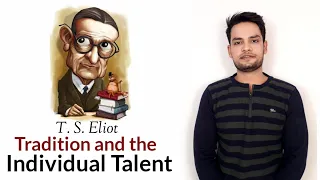
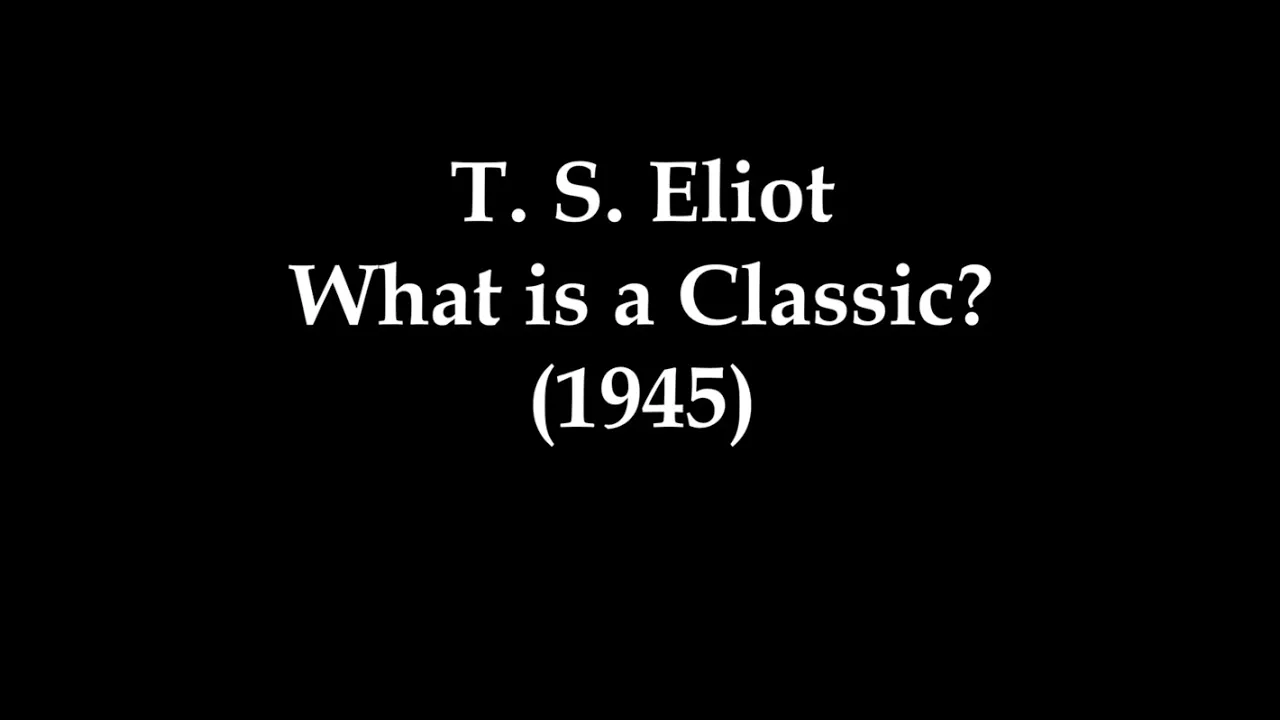
in 1944 as president of the Virgil Society TS Elliot delivered an address titled what is a classic this essay published by Faber and Faber in 1945 and later included in on poetry and Poets in 1956 declared our classic the classic of all Europe is Virgil by this Elliot did not mean to suggest that Virgil was the greatest European poet but rather that Virgil's work represented a maturity of Mind manners and language achieving such Perfection of common style that it set a benchmark against which contemporary poets could be measured according to Elliot a classic can arise
only when language and literature are mature and it must be the work of a mature mind Elliot devoted to 27 pages of his lecture to demonstrating that Virgil embodied these qualities however it is only in the final five pages that he addressed Virgil's specific relationship to the Roman Empire and its spiritual continuation throughout European history Frank kermode suggests that Virgil's importance for Elliot lay primarily in his role as a proponent of an imperialist myth of Latin and Christian cultural continuity Elliot Begins by defining a classic as a work that reflects the maturity of a culture
he asserts that a classic can occur only when a civilization is mature when a language and a literature are mature and it must be the work of a mature mind during this period Elliot was concurrently drafting the preliminary essays that would culminate in his 1948 notes towards the definition of culture he also discussed the integral relationship between a people and their national language in his 1943 essay the social function of poetry these considerations underpinned his identification of a classic with the maturation of a people and their language as embodied in a singular work produced by
a mind capable of fully embracing this cultural maturity given the context of his address to the Virgil Society it is fitting that Elliot along with acknowledging William Shakespeare should cite the first century BC Roman poet Virgil as his Exemplar Virgil's epic the Enid is a masterpiece of the classical age however it is not just the subject matter matter that makes Virgil's poem a classic using the Enid as his primary example Elliot emphasizes that a classic cannot be manufactured with such an name in mind it is only by hindsight and in historical perspective that a classic
can be known as such a classic must emerge from a substantial historical backdrop literature and culture of a people must reach a level of sophistication that provides the tools and traditions necessary for a genius to create a classic furthermore Elliot observes with Virgil's Rome as his model that a common literary style must have emerged from a society that has achieved a moment of order and stability of equilibrium and Har Harmony from such a culture can emerge the final ingredient maturity of mind which requires both history and the consciousness of History thus Virgil equipped with these
conditions was able to produce a work that transcends provincial limitations and stands ready to engage with the broader World stage this is illustrated by the expansive scope with which Virgil handles his material which never appears to be According to some purely local or tribal code of manners it is in its time both Roman and European the result is not merely great poetry but a classic while a great poet like Shakespeare or Milton might exhaust a particular literary form a great classic poet such as Virgil exhausts not a form only but the language of his time
and the language of his time as used by him will be the Lang language in its Perfection therefore a great classic poet expresses the maximum possible of the whole range of feeling which represents the character of the people who speak that language for a work to achieve the status of a classic it must transcend purely literary values and encapsulate the historical moment and the language's possibilities if Virgil is thus the consciousness of Rome and the Supreme voice of her language he must have a significance for us that cannot be expressed wholly in terms of literary
appreciation and criticism such a poet leaves behind a Criterion by which other works may be judged this defines a classic it is so quintessentially a product of its time place and cultural linguistic and historical conditions that it sets a new standard for what that form might achieve given the right conditions Elliot does not stop there with Virgil because Latin the language of Virgil became the universal means of communication across diverse cultures due to the Roman Empire's influence Virgil wrote in a language that no modern language can hope to match in universality thus Elliot asserts no
modern language can produce a classic on the order of virgils he confidently States our classic the classic of all Europe is Virgil Elliot concludes by implying that in celebrating Rome and placing Roman culture values and language at the center of human history Virgil paved the way for a new Epoch his vision of a common order and ideal Harmony led Europe toward a Christian culture which he himself could never know Elliot's rationale for these broad claims is elaborated in his subsequent essay Virgil and the Christian World presented as a BBC Radio address in 1951 there Elliot
convincingly argues that Virgil's Roman virtues found a conducive environment in the ethics inspired by Christian teachings although Elliot begins what is a classic with modest claims he ends with expansive assertions he moves from arguing that a classic must encapsulate an entire people to establishing that Classics summarize even greater cultural and historical developments Elliot likely understood that any reference to Classic might evoke memories of the Romanticism versus classicism debate that engaged English literary thought during the 1910s and 1920s in which he was a passionate advocate for the classicist agenda this debate most famously involving his opposition
to Jay Middleton Murray revolved around the importance of tradition amidst rapid social change in works from the 1923 essay the function of criticism to his 1934 book after strange Gods Elliot excoriated those he perceived as opposing this view even from this perspective the issue remains significant the debate between valuing long-established Traditions or contemporary needs continues to incite intellectual Conflict for Elliott who declared himself a Catholic classicist and royalist in 1928 defending tradition was a moral imperative by 1944 with Europe engulfed in World War II such intellectual animosities seemed less pressing the exigences of global conflict
likely tempered Elliot's intellectual and moral positions regarding principled conflicts if Elliot's definition of a classic as a summarizing work holds true then no classic can rival virgils ened in European history and culture because Europe will never again experience such cultural and linguistic cohesion as during Caesar augustus's Reign Elliot writing amidst a conflict that left 50 million dead by 1945 understood this deeply Elliot provides extensive assessments of European literature particularly English literature highlighting the criteria he developed for defining a classic he considers the definition of a classic to be beyond the D otomy of Romanticism and
classicism enumerating specific qualities that a classic should possess Elliot differentiates between a universal classic and a classic within a particular language in his own words in relation to other literature in its own language or according to the view of life of a particular period a classic can only occur when a civilization is mature it is the importance of That civilization and of that language as well as the comprehensiveness of the mind of the individual poet which gives the universality Elliot argues that it is easier to discern the maturity of a language through Pros rather than
poetry he States one of the signs of a classic approach towards a classic style is a development towards greater complexity of sentence and period structure he further asserted that maturity of manners and vision must be conveyed through a language that is not crude Lou menand places Elliot's literary criticism at the intersection of the non-academic critics who preceded him and the new criticism movement of academics that followed as men and observes Elliot's Work Bridges these critical Traditions positioning him as a pivotal figure in the evolution of modern literary thought Elliot articulates that the development of a
classic Pros is synonymous with the evolution towards a Perfection of common style he contends that a period of classic Pros transcends mere conventional writing akin to the uniform style of newspaper editorialists and instead represents a community of refined taste for Elliot the maturity of a language encompasses qualities tied to a nuanced understanding of time including a critical sense of the past confidence in the present and a lack of conscious doubt regarding the future in his own words consciousness of History cannot be fully awake except when there is another history than the history of the poet's
own people there must be knowledge of the history of at least one other highly civilized people whose civilization is sufficiently cognate to have influenced and entered into our own this historical consciousness he argued was an essential attribute for both the poet and his language moreover Elliot underscores that the writing of a classic work Demands a particular atmosphere a moment of order and stability of equilibrium and Harmony he applies this Criterion to the 17th century observing that although the finest English Pros might have emerged in that period it lacked the equilibrium of pros and poetry while
Elliot Praises Milton and dun for their individual Brilliance he points out their shared limitations specifically Milton is critiqued for employing a Pros style that hued closely to his poetic expression while Dunn's approach to Pros is deemed ineffectual due to its lack of consistent quality and overreliance on oratory Elliot's insights offer profound contributions to literary Theory and criticism particularly his examination of the qualities that Define a classic work his perspective on the maturation of language the import of historical consciousness and the necessary conditions for the creation of a classic remain essential considerations for contemporary Scholars and
literary enthusiasts in analyzing his criteria for a classic one gains a deeper understanding of the complexities and nuances that contribute to the enduring significance of literary masterpieces [Music] [Music] [Music] [Music] [Music]