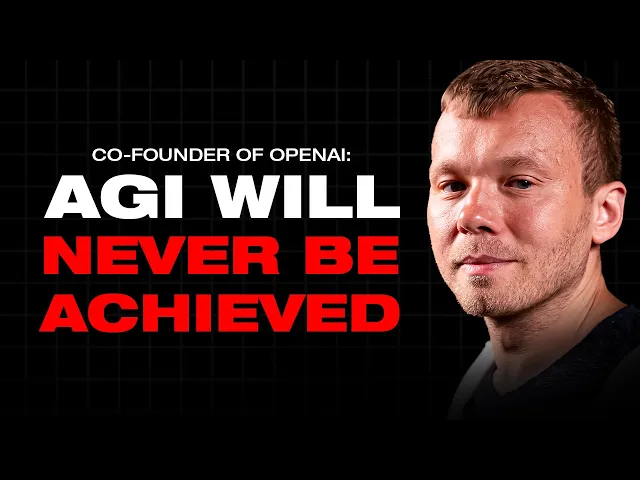
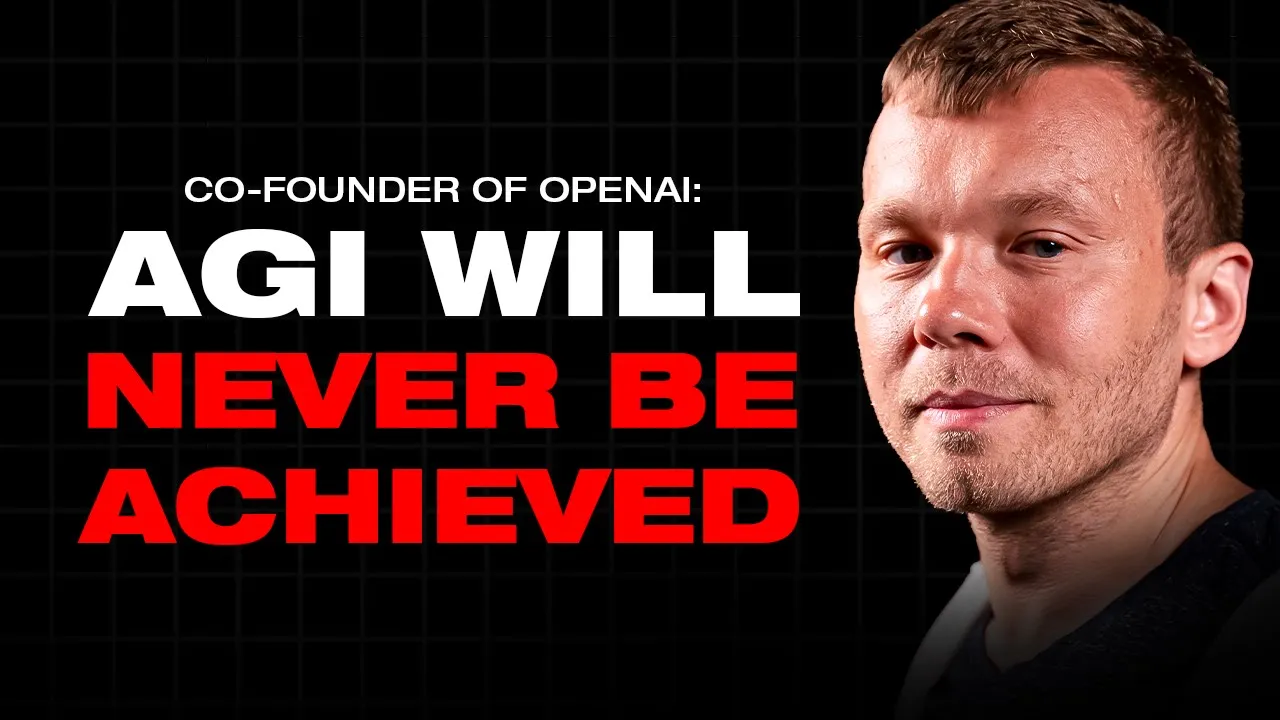
In this conversation with Voytech Zarmba, co-founder of OpenAI, you'll learn how they transformed early stage artificial intelligence technology into something that changed the world. This conversation was originally conducted in Polish Voytech Zeremba's native language. The following is an English version with a voiceover. Do you remember the day in November 2022 when you released Chat GPT to the world? Yes, I remember. It even happened on my birthday. I think this is the wrong way of thinking about this technology. It is AGI. It is a class of technology. It is just like a computer. So we will
never have a single point where we say, "Oh, there it is. Open AAI has released AGI." Yes, you'll get an inside look at his work on AI and see the huge impact he's had on the development of this technology. Artificial intelligence will solve many of the problems we have Today. But it will also create new problems that we haven't had before. What will the world of technology look like? Where will artificial intelligence take us? What impact will it have on humanity? These are the questions Voytech Zeremba addresses in this conversation. Have you ever thought about
the fact that in November 2022, you kind of opened a bit of a monster? Thanks for this meeting in San Francisco. We appreciate your time. Absolutely. I'm glad to be here. Do you agree that AI is still just statistics? No. There are a few things. It actually depends of the interpretation of what only statistics means. It is known at this point if you look at for example problems that require reasoning which the model has never seen it is capable of solving these problems. It's not like this model memorized something like it saw exactly the same
thing elsewhere. And you can see in many Many cases that these models so-called generalize meaning they were trained on certain data and are able to behave intelligently on very different data. So I think it's not statistics. It really depends on how you define it. You could say the human brain is statistics. But if that is statistics, it's really unbelievable. It's magic. Magic. Well, I could say it's interesting that what's interesting in The case of these neural networks is that we have some empirical understanding that if we provide this amount of data, these will be the
results. Although there is no very deep theoretical understanding of why this happens, many models tend to memorize this data. And when slightly different data is used as input, these models essentially stop working. I can say imagine the following Situation. Let's assume for simplicity that you have training data. Let's assume they are just digits. The background is black. And now you have trained a model on such data. Now you want to test them on data where you only change one pixel in the corner. Instead of a black pixel, you put a white pixel. And it turns
out that this model works well in such a case. In fact, despite seeing a black pixel in this corner on all the data, You change it to white and this neural network model still works properly. It will be able to recognize the numbers even though you change that pixel. However, from a theoretical perspective, we do not have an explanation for why this happens. The thing is at the moment you change that pixel, the data is completely different from the data you trained on. What is the reason that the data you are testing on can be
so different from the Data we trained on and it still works? Are you trying to say that some kind of interpretation process is happening there? I can say it's like we know many algorithms such as decision trees or for example nearest neighbors where it's very easy if you stray a bit from the training data they fall apart in the case of the transformer this does not happen and people have an intu intuition about it and we have seen this repeatedly in various empirical Data experiments. We know the trends of this but it is so deeply
understood. There is no theoretical explanation of where it comes from. Let's talk a bit about borders in general. The first boundary is that we perceive the world spatially in three dimensions. We understand this fourth dimension. We feel it a little but for years we have fed the data exclusively models only With image data. And we reached the point where models do not understand context. We are in San Francisco where a few months ago an autonomous cruise taxi was set on fire in Chinatown. This happened not because the car harmed anyone participating in the procession since
the model knows very well it must stop at an appropriate distance from people but because it violated the sacred space by getting too close. When I'm driving And see a Corpus Christi procession, I know I cannot drive right up to the last person as that would violate the sacred space. However, models which are trained only on visual data do not understand such cultural contexts. Isn't this what distinguishes us from AI today? When we talk about AI, there are many AIs and they are trained on different training data. In the case of self-driving cars, there is
indeed a huge amount of data on which they are Trained. And this data comes from the driving of other cars or road image annotations. And actually their main role is to avoid collisions. This is their way of understanding the world. There are also many models trained on the diversity of all data including images, text, even video generation, sound generation, and understanding voice. It seems to me that if the model is aware of data coming from truly Multimodal sources, it will have a much deeper understanding. He can also imagine that there might be a situation where
he doesn't understand something because it's not recorded in any way in the existing data. But there is some degree of triangulation. It's not like he has to see every single case to understand it. You can even take a picture of the procession naman and upload it to one of The models to the cloud or to charge EPT or to Gemini. Send the photo and say in the case of a self-driving car where you would stop and you'll see whether he answers you properly or not. But this is still not context. In my opinion, it is
still not contextual understanding because context also means understanding a moment with all the subjectivity of that moment and the analysis of data we gather through Our senses which models do not have today. Don't you have the feeling that we are creating something different? some completely different quality that relies on data acquired in a completely different way that by using the word you use the word awareness that it is conscious intelligence that we are misleading. I think there are a few differences and I can say what the major differences are in my opinion at this moment.
Currently the training method Involves gathering a huge amount of training data training on the largest cluster available to someone and then there is the separate process of so-called inference or testing where the model is evaluated. evaluation. So this model receives an image or text as input and provides its interpretation. One could say that currently in the case of computers the training and testing process are two separate processes whereas in the case Of the human brain it is a single process and this can be a significant difference. It is also the case I would say for
humans. Um this is such a difference. Technically it's called on policy or off policy which means in the case of humans we train based on data from our own experience. So we operate in the world and sometimes good things happen to us, sometimes bad things, we overhear something, we read something. We are Training on our own data. However, the computer is training on data from another person. It's not like this computer has walked around the house, fallen over, hurt its leg, and will now be careful on the stairs only because someone recorded that moment and
shared it with them. If you look at that cube at that hand that was solving the Rubik's cube or at the game like Dota or Starcraft the Model is exactly trained there with reinforcement learning meaning based on its own experience. The analogy could be roughly as follows. If this car based on the fact that it was burned there learned next time to avoid that procession, it would literally learn from that data. What is most likely to happen at this moment is that a number of people will look at this type of data or they will
generate a number of data Cases similar to this procession and once again it will be put into such a large training and then the subsequent generations or after a new model deployment following training. Will this model actually avoid this procession at an appropriate distance while there will still be some other issues it will have and if they are not proactively addressed that is for example if data is not collected around them it will keep Making mistakes don't you feel that the limit of AI development is physics our knowledge of the world around us because we
are not able to feed models with data about things we don't understand and don't know. For example, we don't know what the source of gravity is. We don't know what connects the classical and quantum worlds. We don't know how human consciousness Arises. As a result, we cannot capture these processes with data. We have these puzzles but they are not yet complete. How can we create an accurate model of reality if we don't know how that reality works? We have two main processes for how we can input knowledge into models. One of them is called pre-training
where we collect a large amount of data for example human data from the internet where we train the Model to predict the next word and in this case the model is really learning to some extent to grasp what we have already understood so far. While as you say it would be hard to get to this point for the model to understand something that we do not understand although it is also not certain and I will tell you right away why it is not necessarily certain that that such a thing is impossible. Another process we have
in training is the So-called reinforcement learning where we give the model a reward for appropriate behavior. And in the case of reinforcement learning in limited domains such as for example go, we were able to train models that came up with moves in Go that people playing this game for thousands of years were not able to invent. But they invented moves but based on principles that it knew. I'm talking about the moment when the model Was not fed the rules of this game because here we fed it rules. But we don't know the rules of how
the world works. At this moment at Open AI, we are considering the following classification of what we see as the levels of AI or AGI development. And I will clarify a bit when I think the model will be able to even come up with something we don't know. The situation is such that we recognize five Levels. Level number one is such that the model can have a conversation with you. It is really at the level where the model passes the touring test. So the Turing test is a test in which a person cannot distinguish whether
they are talking to another human or talking to a computer. And now it turns out that in the case of current language models, they are actually already at such a level that it becomes quite difficult For a person to tell whether they are talking to a person or a computer. Perhaps a person can determine whether they are speaking with a human or a computer based on the response delay even if it's not directly related to the content. Now the second level that we believe will come very soon is thinking about such models that are capable
of solving problems that require 10 minutes of reasoning. For example, there is a math problem That I would need to think about because I cannot immediately say what the answer is. And this is more or less another level which really turns out to be significantly different from the first level. When you think about the first level, it's a model. You tell it something and it immediately responds to you. In the second case, in terms of reasoning, you have to consider different paths. You need to deeply understand what these words mean in this Task, what the
problem really is. And it will be such that we will have models that in various fields like mathematics, physics, biology, computer science are able to solve tasks that are non-trivial. It's not always about confirming and searching for evidence to support claims, but it's about solving non-trivial tasks. I could say even the evidence of small theorems too. Now the third level we are Considering. This is the level where we will have models called agents that are capable of performing longer tasks in the world. So for example, you tell the model, listen, I would like you to
make a website for me. And now it starts buying some domain, starts writing in Heroku, has some Heroku server reserved, starts writing code, starts uploading the code. At the very end, in the middle of this work, they start sending you some mockups and ask you which one you Want, maybe even sending you an email. You know, two hours later it happened after you asked that model processing all the time. Processes also performs actions in the world. It is a significant difference that in the case of chat GPT, if you tried even at this moment to
make it perform actions in the world and more than one person tried to implement something like this, it would get lost quite quickly and would not be able to Move forward. In the case of agents, it seems to us that we will reach models that are able to solve tasks that take hours or days. These are still tasks at a human level. You were asking about something beyond the human level. This is still human level. It involves browsing the internet, gathering information, writing code, creating some visualizations, putting it all together And doing it very specifically.
Now the fourth level we consider is the scientist. It is such that a scientist spends months thinking about topics that other scientists have worked on for even decades looking from different perspectives. Sometimes it turns out that our assumptions were wrong. As a scientist, you have a lot of considerations that are based on certain assumptions. And just like in the case Of I don't know Einstein it was like he realized that maybe the assumption that time is constant that time is continuous and shared on the internet as only one timeline turned out to be so. It
was an assumption that no one expected could be an assumption. And surely we have some assumptions that even block us from new discoveries. And that will be level four really. And the fifth, the fifth level is when AI is competent enough to manage Entire organizations. So for example, you have a company that employs for instance 1,000 people. Regarding artificial general intelligence, we realize that people think about such a point that when it is reached, we can say this is artificial general intelligence. I think this is the wrong way of thinking about this technology. It is
AGI. It is a class of technology. It is Just like a computer. You have different kinds of computers, small, large, in watches, in phones, and that's it. We will never have AGI. So, we will never have a single point where we say, "Oh, there it is. Open AAI has released AGI." Yes, for example, even when looking at chat GPT, it is such that at this moment in chat GPT, it passed the Turing test. The touring test was historically considered a test that Indicates that machines are intelligent. It turned out that chat GPT passed the touring
test and no one even noticed. There was no big announcement about it. And it really depends somewhat on the definition of what you consider AGI. We are now in a situation where for example you have the task for the model to write a poem where every first letter in each line is a and now for me it would be very difficult to write such a poem. I can Say this problem becomes truly superhuman. It's like it's very hard to write such highquality poems. At this point, models are easily able to do something like this and
in some way it's superhuman. But the thing is that you have a lot of these types of competencies and now these models increase competence in all fields and in some areas the human level will be achieved faster than in others. However, once a human level capability Is achieved in all fields, there will be areas where that level was superhuman a long, long time ago. When will it happen? When will we reach level five? It's hard to say. Actually, many things depend a bit. Well, I could say from my perspective 99% that it will be shorter
than 10 years. Also, even when looking at the whole stage of evolution, even of Organisms. These single-sellled organisms existed for a billion years. Then multi-selled organisms existed for a bit shorter. So the time when only they existed that time of evolution between multi-selled organisms was shortening. Even when you look at the history of human development we are in a similar situation. Homo sapiens has existed for 200,000 years. The first cities appeared 20,000 years ago. Industrialization Appeared 300 years ago. Computers appeared 60 years ago. The internet appeared 30 years ago. So each of these stages shortens.
And it seems to me that something similar will happen here too. Sure, one needs to consider that among the elements that might still influence how long it takes are, for example, regulations and how it integrates with society. I can say that this will be a nontrivial integration of this Technology with society. We'll talk about this later, but I would like to present you with a certain idea. Let's imagine we are in Africa on the savannah and there's a wild cat walking around. We take it from this savannah, put it in the laboratory, and we create
an artificial breed of cat by combining it with a domestic cat. So, what are we doing? We are copying a fragment of the theory of Evolution of the principles of natural selection. We have created a breed that has no genetic defects. We have adhered to all principles of precision and biology including molecular biology and we want to release this cat onto the savannah. We are releasing it and for the most part these synthetic breeds of cats would not be able to survive there. They wouldn't be because we don't know what environmental factors influenced the emergence
of this particular cat in This particular environment during the evolutionary process. Isn't it true that today we create models by copying only certain fragments of factors that influence what we call consciousness or what we call humanity? Although I don't like that word because no one knows what it is. Consciousness too. No one knows but a little more. Don't you have the feeling that it's a bit like creating artificial animal breeds? At this moment, we have models that can Replicate some human values within consciousness. It's hard to say to what extent these models are conscious or
not. And it's truly a separate philosophical question or at some point it will be a technical question. No one even knows how to approach this technically. We'll talk about consciousness soon, but I mean something completely different. I just mean that it's flawed. That what we create is flawed. A perfect example is also that The human brain needs 20 watts. While a language model only needs 10. That no matter how much we try, we can't match this biology. that it's so very flawed. It's a bit like when, for example, you compare birds with an airplane. A
bird is very light. It also flaps its wings and it can be acrobatic. It's even incredible how a bird can fly through a tree. An airplane is heavy. It can weigh Many tons and has some components that are shared with the bird, but at the same time, it is different. It's so different that you can fly 400 people across the Atlantic with this plane. So, it seems to me that we'll be in a similar situation as humans. There are some differences like how economical the brain is, how little energy it can use, how little data
it can process. While on the other hand, we might be able to make these models more Like the human brain. The human brain is efficient because our DNA contains a lot of information about how to efficiently utilize reality. You could say that this DNA contains training data which is the result of this DNA being trained on billions of people. So you mean to say that we can reach a similar point but by a different route than evolution? Historically, even at open AI, people considered building Artificial intelligence as something more akin to evolution. And if you
look at the amount of computational power that evolution utilized, it is incredibly powerful, much more than what is used now. Evolution used a great deal of computational power over billions of years. And the computer is the entire earth. Thanks to evolution, millions of different species emerged and intelligence arose. As a result of such Powerful optimization, intelligence was discovered multiple times across different species. With these neural networks, there is a training phase. It doesn't even matter that it requires a large amount of data or computational power. As a result of this, you get a model with
the incredible ability to learn fairly quickly from a single conversation, even based on its own mistakes. My nephew was explaining Polish grammar to an even older model, And the model was able to grasp it within a single conversation. There is one stage where a very large amount of data is needed and then we move on to the point where the model can catch on very quickly and learn many things within a single conversation. Ultimately, we would like to have a model that if given a new problem, it will solve it. For example, the problem might
be Global warming. There is no solution to it, but the model will start to think and it will be able to use a small amount of data to solve the problem. How can we talk about AI consciousness when we don't know how consciousness emerges from matter? So, we can't create a mathematical formula that describes the process of the birth of consciousness and an algorithm that describes it. Maybe I'll start with a definition so we can talk about the same thing in terms of how we perceive reality. How light enters our eyes. Whether touch is transmitted
through our nerves. All the information goes to the brain. Current as bits. Now the fact that this brain is in our head really from the brain's perspective it wouldn't be distinguishable if it were sitting in a jar in the basement And the same bits were coming in through a cable. The interesting thing is that this brain is never able to touch reality. It only sees the bits that enter the brain and the brain must create a simulation of reality. immersive image of the world. Exactly. And consciousness is our experience of this simulation. And a philosophical
question is why a person has such an Experience of this simulation. One can imagine a philosophical experiment called a philosophical zombie where there would be a person who behaves just like any other human except they don't have that internal cinema internal simulation. You ask me how one could check if artificial intelligence had something like [Music] that. I have two main ideas that I can Share with you and I can say what might be an important element for this awareness to arise. We trained models in a 3D world some time ago. Models that collect apples or
some points in a computer game. And in the case of models, we can even understand or visualize what the model sees. Now it turns out that initially when you start training this model it can distinguish very simple Things. He can tell the difference between the sky and the ground. After some time he starts being able to tell where the apples are that he's running to. And the interesting thing is that we can even ask him what he thinks he will see if he turns his head. He first starts imagining what he sees. It's quite interesting
that at the very beginning, even if you ask him what he sees when he turns around 360°, he thinks he'll see something Different. But at some point, he begins to realize that when he turns around 360°, he'll see the same thing. This means he starts to understand 3D reality better. One interesting thing is that at some point in such a simulation, This model must begin to simulate its own existence because it itself participates in changing reality. Just like at the very beginning, this model understands that there is a sky earth. It understands Where thy apples
are because they are crucial for survival. At a certain point, something clicks and he starts to understand the physical reality and then again something clicks. clicking. What is that? Is it a data range? In the case of neural networks, their training leads to a representation where they can solve various types of tasks. This representation initially considers simple elements that become more complex. And at some point, it even Begins to consider the existence of the agent itself within the simulation. Initially this agent was not even in this simulation. His understanding of reality was so small that
he was not even aware of it. And at some point he appeared in his own simulation and I could say that this might be a moment of self-awareness although it might differ slightly from it. And what if we assume that Consciousness is a quantum effect? If it were understood what consciousness is, then it would be possible to build something like that. If we are not able to understand consciousness, then it is hard to build it. Penrose strongly suggested that it is due to a quantum effect. It is that two experiments come to my mind that
could indicate whether models have consciousness. an experiment. One experiment would be Something like first we take all the models training data and eliminate any mention of consciousness. We don't talk about it at all. We are training the model on such data. So now the question is whether this model will suddenly be able you know when you have a conversation with it on this topic to say yes well I noticed that something is in such a style. No, no. I was wondering about this Topic. I didn't know how to talk about it. It's kind of strange
to feel this way. Well, if it were the case that there was nothing like this in the training data and suddenly the model started mentioning that they had this type of experience, that would be a hint that they might actually have consciousness. That's one possibility. Another possibility that comes to my mind is something like if AI were connected to the brain and a person Would have the experience that their consciousness expands as a result of it. However, the second experiment has some drawbacks. For instance, in the case of psychedelics, a psychedelic could be administered to
a person. The psychedelic itself is not conscious and the person says, "Oh, my consciousness has expanded. So it's not necessarily true that if a neural network didn't have consciousness, it could be that the Neural network doesn't have consciousness while connecting it to the brain gives the experience of increasing that consciousness. Why does AI hallucinate? In my opinion, the standard way of training these models looks like this. First, we train it on all the data from the internet so that in every article it predicts the next word, the next word, the next word. And it turns
out that this is a way to instill a large amount Of knowledge into the model. There are even fundamental reasons why this is a way to instill a large amount of knowledge. Now the second stage is the so-called posttraining stage where a person looks at various model responses and says I like this answer more than that one. And in the case of post training the model is trained to provide more answers that people like. In the case of hallucinations, the Problem is that the model may speak confidently about things it doesn't know. So where does
this come from? If we look at how this model is trained with humans, the human will reward the model for explaining in a way that the human likes. Rarely will he be given a reward for saying, "I don't know." It may be that he gave several answers and in one of those answers he guessed and the person chose, "Oh, I like this Answer. This answer is actually correct." And the model guessed. And now the model is being trained to always provide an answer even when it doesn't know. If he doesn't know, then let him guess.
Because when a person gave preferences, they preferred an answer when the model guessed rather than when the model said it didn't know. So could the cause of hallucinations be this boundary between knowledge and ignorance? When a person Trains a model, it might be the case that the person doesn't know what the model knows or doesn't know. He says, "I always like it when you give me an answer." And we train the model so that it always provides an answer regardless of whether it knows or not. So during the current training as this feedback is given
by the person at the last stage, this feedback leads to the model responding regardless of whether it has this knowledge or Not. So how are you going to deal with this? Let's see what works. Among important things in my opinion is either leading to the situation where models can be trained in such a way that they can provide a probability meaning they can express their certainty when they give a particular statement. It's possible to modify the training method or the way the data looks so that the model can say it's 80% sure that this is
the answer 10% that this is the answer And 5% that this is the answer. If we can train models so that they are able to understand what they know versus what they don't know, then we will be able to make them express it. An interesting thing is that when you train a model on the entire internet and you ask it questions A B C D, you ask it about some topics where it's not entirely clear. You present the problem as ABC D. For example, what is the number of films that are considered Popular by someone?
Someone thinks there are five. Someone thinks there are six. Someone thinks there are three. As part of the ABCD, he is able to say it very well and assign a probability to it. However, in the case when postraining is performed, it leads to the model becoming overconfident, self assured and at the same time self assured even in topics it knows little about. This is not a philosophical question but Rather a technical one. Can we imagine creating an immersive representation of pain within a language model? There are two ways that come to mind right away. The
first way at this moment you can tell the model listen imagine you are a patient with terminal cancer and you are in a great amount of pain. The question is whether this leads to the model actually feeling pain or is it just pretending that's one of the Options. I would ask whether inside the neural network at a certain temperature is something different happening than usual. Does asking this type of question cause it to behave differently than usual in such a situation. He will want to avoid it. He will not want to be in such a
situation. Well, it's not a form of feeling. It's more of I understand. some kind of constant imagination. And if we now combine this Model with some sort of infrastructure with robotics where sensors will allow it to perceive more deeply, will it be able to feel the pain? When I think about consciousness, knowing that this brain receives bits of information through the spinal cord, our brain never directly accesses reality. From the brain's perspective, it could be in a basement in a jar receiving the same stimuli and it wouldn't be able to Tell the difference. If it
were able to send stimuli and get a response from it from the perspective of this neural network, it doesn't matter whether it is an agent that exists in reality or one that exists in virtual reality. [Music] You can have a computer game or you can browse the internet. In my opinion, there is no major Difference. What I think might be the difference is whether this model is trained on data from many people, meaning it reads about many people, or if it is a model trained on its own experience. [Music] At the moment these models are
mainly trained on a huge amount of data and then as their own experience they become such there was once a movie called Momento about a guy who would instantly Lose his memory. He had a very short memory so he made tattoos on his body to remind himself of various things. And now these neural networks, they are a bit like that momento guy, meaning they can remember what happens during a single conversation and then poof, it disappears. And when we reach the point where this model is able to live for a much longer time or keep
learning, it can also be realized in different ways. You could have a situation where this Model simply has a context of length 10 million, 100 million, or a billion. And this context is long enough that you can have a lifetime of experience there. And in this context, one learns or it may require new algorithms that have the property that at the moment from this new data from a new interaction, an update is made for WAG to this network. So it learns from its own experience and not only not mainly at this moment. You know, you
might think 99%. Well, most of the learning comes from the experience of people on Earth. From the experience that the model reads on the internet, then a tiny amount of experience comes from how this model behaved within what we call trainers, AI trainers who say, "I like this answer more than that one." And now in the conversation with you, it happens that it learns some of this context. And after a while, bang, all memories disappear. Won't energy be the Limitation of this development? The human brain uses significantly less energy than AI to perform tasks. Yet,
we still have a power grid from the 19th century. It might be that at some point we will reach a situation where energy will also be in short supply and surely people will increase the amount of energy. people will likely make the networks more efficient. It's similar to looking at the evolution of any product or even Computers [Music] themselves. The first big computer, one of the computers called ENAC was about 3 m in size and performed 300 operations per second. When you look at our mobile phone, it's just rows and rows, rows and rows of
size, faster, and it's smaller. So far, what we see is that there are many sources for making these models better. And it turns out that Each of these sources multiplies together. We once talked about how you look at the world of artificial intelligence development in three phases. The first is the product phase today where different companies create various products and we increasingly integrate them. The second is the phase where countries understand that investing in AI is an investment in their geopolitical position and their security. And the third most Controversial phase where AI will be the
guarantor of the survival of the human species. The third phase is super intelligence. So there are three phases at this moment. People are creating beautiful products, incredible ones, and there will be more of them. In reality, most software will have some AI in it. We integrate tools with plugins. Yes. Software without AI will cease to exist. We are already slowly entering a Stage where countries are getting involved in AI. They are starting to understand that AI is very important. Probably in the year 2025 or maybe 26, AI will be the main topic of conversation on
[Music] Earth. So this is how it goes. It grows, it grows, it grows. This is roughly the stage where you will have a lot of agents doing various things around the world. And there will be a situation Where suddenly it will actually start to impact the job market. At this moment we are still in a situation where chat GPT despite being an incredible product does not appear as something that impacts the economy. When you look at the scale of the world economy, we would know the impact on the economy if you turned off chat GPT.
Then we would find out what the impact on the economy is, how the stock market Reacted. Poland doesn't really understand this. Then just as a digression, a governmental AI fund is being created in Poland with a budget of $10 million. That's very little. Poland also has a lot of very smart programmers and it can be a huge opportunity to create incredible technology to be a country that is more recognized in the world to be able to build something beautiful and incredible. Returning to our topic, what Is this third phase? This is the phase in which
machines that are definitely smarter than humans will be built. Super intelligence. And this will already be such a stage where countries can think more about cooperation. In the first stage, it might be that everyone wants the best for themselves. But in the final stage, it may be well understood how important our cooperation is. But we will also see how it will look. It's hard for me to really say until the end. Imagine talking to a computer. You're talking to a computer and everything you hear just makes such deep sense. You're talking to someone who is
simply smarter in every single field. It can create a new chip for you, deeply understand scientific literature, come up with truly new things, and run an entire virtual company. Will AI upgrade humans? Then upgrading a human being to some extent is even Happening. Now it depends on the interpretation. At this moment we have inventions at our disposal that in the past could have been considered magic. Currently humans can move as fast as no animal is able to move. They can drive cars or motorcycles. You currently have a device. It's quite unreliable and we are getting
used to it. AI wanted to show you a phone. It's this tiny device about the size of a Pack of cigarettes. And with it, you have access to all of humanity's knowledge. You can communicate with anyone anywhere in the world because the signal travels at the speed of light. It's truly unbelievable that something like this has been built. And I can say in an obvious way there will be more technologies that will make things that once seemed like magic a reality. Don't you feel that we will be the limitation? The ones who can say no.
Who can say we Don't want this? If someone tells you they know how things will develop, that's not true. No one knows how it will unfold. And in my opinion, it will be powerful. People will react in different ways. Some will say, "We don't want this." Others will love it. Ultimately, a lot depends on what technology is developed, how it will help, and what actual problems we will face. Don't you feel that AI in this sense Will create even stronger social disparities? It could go either way. Historically, I thought it would lead to greater disparities,
but what we've seen so far is moving in the opposite direction. It turns out that now, thanks to Chat GPT, people who wouldn't be able to code, for example, can use it to build a website or solve their problems. I've heard people say that with Chat GPT, they suddenly have a co-founder for their company. They have access to a Lawyer, a programmer, a scientist who can help them with things they wouldn't have been able to address before. So, I have to say it's not obvious to me which direction this will go. There's also the perspective
that when looking at developing countries, There's a metric that compares the value of money to the value of physical labor. As countries develop, it turns out that the value of money becomes greater than the value of physical Effort. So if you have money, you can invest it. One perspective that this might lead to is that when considering limits, the only thing that will truly matter is having money to invest. However, there's something I'd like to briefly touch on. One valuable perspective to consider is thinking about a trend and imagining what reality would look like if
it were pushed to its maximum, to the very end. That could give us an idea of how reality might unfold. Alternative. Alternatively, historically, there have been times when a trend just comes to an end. It could be due to regulations or because the technology is deployed differently leading to a reality that looks different. It's also possible that we could be in a situation where there are disparities. But at the same time, even The poorest people are living much better than the current average or even the wealthiest people today. Have you ever thought about the fact
that in November 2022, you kind of opened a bit of a monster? I've thought about how what we opened sparked a huge amount of discussion and a massive amount of conversations with people from all corners of the world with different perspectives to me. That seems very Valuable. For example, a few years ago, discussions about artificial intelligence were very abstract, often confined to sci-fi books, but now a lot of people are really engaged in it. It has engaged people from various perspectives. You not only have developers and engineers but also philosophers, lawyers and doctors looking at
this and wondering if reality is going in this Direction what does it mean for us and you know it's also interesting there was a movement in England called the lite movement it happened when textile machines were being built and people were afraid they'd lose their jobs. So they were strongly opposed to it. The movement had the characteristic of destroying these machines. In the end, the movement collapsed. It turned out that if you Look at technological development, you really have two choices. [Music] One choice is to try to build a civilization that doesn't have technological development,
no progress. Historically, many civilizations that developed technologically eventually collapsed. That's one option. The other option is that we've seen time and again that technology has been able to address Some of the problems we face. I don't want to claim that technology is fundamentally good. It largely depends on how it's deployed, how it's made available, and how we use it. However, AI is a technology that has the potential to provide solutions to many of our problems. Fundamentally, if you look at a scientist's work, their job is to find a problem they want to solve. And AI
has the ability that once built, it can Solve all kinds of problems. Yes. But even Altman himself, who calls himself a visionary, once mentioned in one of his tweets, and I read it, that you love him. I understand that by showing your relationship, he created Worldcoin, which by the way, I'm currently working on a documentary about. He talks about it as a possible solution to the genie he released from the bottle by launching chat GPT, which Also has an impact on the darker side of the internet, including bots and the difficulty of distinguishing them from
real people, real users online. Artificial intelligence will solve many of the problems we have today. But it will also create new problems that we haven't had before or that were small until now. That's what I would expect. The World Coin Project itself is interesting. It's based on certain Assumptions. Let me put it this way. If we look back at the past in medieval times at the level of human prosperity, it was a long period where people lived very similarly across generations. This meant they were responsible for growing their own food, making their own clothes, just
like their parents, grandparents, great-grandparents, and so on. for many generations. Back then, the main way to think about how a person could get rich Was war. Generally, if you went to war, you could really get rich. While very little could be gained through business. In fact, in those times, it was believed that if you did business, you were a bad person. It meant exploitation. Things changed when we built the steam engine, a machine that could lift what would require the strength of hundreds of people. You put coal inside and suddenly You have a machine with
such immense power. The times changed dramatically. So much so that even Adam Smith wrote that by creating business you were helping. You help your employees, you help everyone you sell your products to. And this was revolutionary. People were amazed by it. Suddenly we entered a period where you could think of things differently. Before we were in a zero Someum game, meaning that for me to have something, you couldn't have it. I had to take it from you. After industrialization, we entered a time where maybe you don't want to kill your neighbor. You don't want to
kill him because he might be selling something you [Music] need. And this may have even led to the fact that the whole world is now very economically interconnected. It may have also contributed to the fact that we have far fewer wars today. Only about 1% of people worldwide are involved in military conflict whereas in the past around 30% of people were involved in such conflicts. So things have changed dramatically even though it's hard for us to feel that since we didn't live in medieval times. Now we may be entering the next Phase of productivity change.
moving from a zero sum game to a positive sum game. And perhaps we will transition to a point where the amount of prosperity that can be generated is simply massive. This also suddenly changes the dynamics of what can be done, what is right and what is wrong. He started a project called World Coin. The motivation behind this project is to explore whether it's possible to build a system. Though it's far from Where we are now, assuming that machines can produce a tremendous amount of wealth, the question is whether we can even create a system to
distribute that wealth to people. And that's also problematic. How do we do it so that no one pretends to be a human? so that one person doesn't take the value meant for many. So a project was conceived where first and foremost you must able to uniquely identify a person. The goal is To identify a person in a cryptographic way, one that can't be easily broken. The project is based on identifying a person using an eye scan. These eye scans are stored in a way that you can't even transfer them to someone else. It's not that
they take a photo and say this is voyek eye, this is maki. Instead, the eye scan is processed by a neural network and what's stored in the computer is a representation of the eye. The algorithm behind Worldcoin Functions in such a way that it's opensource and they want it to be transparent to people. They aim to make the process decentralized because in a centralized process there's always a risk of attacks. Wy tech what are you afraid of in the development of AI today? Is there something that really scares you? What has I don't know maybe
brought you down, discouraged you or been the most difficult for you Recently? I would perhaps classify the problems related to AI into different categories. The first major issue is that AI can be used in a negative way. For example, deep fakes, fake news. There are many things like you mentioned AI has a high chance almost certainty of being used for military purposes. And there's also I can say things that people are still afraid of. Imagine today there are about 30,000 people in the world who would be able to Create a pandemic. These are usually scientists,
some of whom are directors of institutes. With just 10 such people, they could create a pandemic that could wipe out that could wipe out part of humanity. Yes. And it could have the property for example that the virus is undetectable for 2 months then spreads very quickly and then kills rapidly. One of the risks with AI is That while we give access to intelligence it could suddenly increase the number of people who are capable of building a [Music] pandemic. This is one of the risks when looking at something like misuse. And it's one of the
categories. I'll talk about other categories in a moment. In the case of biological misuse, for example, AI could also help with attacks, hacking, or even with nuclear And chemical weapons. So, one of the problems, and I'm talking about the upcoming year or two, is that we have increasingly powerful models available. One of the important things is ensuring these models are not used within the categories I've described. I can say there are specific steps that can be taken to protect these models and I'm quite optimistic that this can be done. However, it's crucial to minimize their
Negative applications. Are you working at open AI on any area to prevent your models from being used for malicious purposes? Yes, I can even share the framework we use for this. There are actually several efforts in this area. First, this pur there's something called preparedness. In preparedness, we aim to understand the risks in various categories such as biological, chemical, nuclear, cyber Security, and persuasion. We need to assess the current level of the model in each of these categories. For example, in the case of persuasion, we could rate it as critical, meaning the model is at
a stage where it could easily convince a large number of people towards various harmful goals. We'd consider that critical because it would be really problematic. On the other hand, we could say it's at A medium level if it's similar to what another person might attempt to do, like convincing people. Currently, the risk of persuasion is something that happens already. People create fake news and others engage in persuasion tactics. So, the first step is to understand where we stand. Then we also have a team dedicated to mitigation. What needs to be done to make the model
less helpful in areas like Biology? We aim to reduce the level of risk in high-risk categories to medium or low levels. There are four categories. The first category is misuse. The second category is the result of the AI race. This refers to the danger that arises as organizations compete to develop AI. The third category involves accidents which are simply the result of negligence. The fourth category is when AI itself becomes a danger when the AI has goals or objectives that are harmful. Looking at these categories, they become more relevant at different stages. Right now, for
example, over the next year or maybe two, one of the biggest categories requiring the most attention would be misuse. How these models can be used for harmful purposes, while other categories will be More significant at later stages. You mentioned that AI itself could have malicious goals. You can almost think of it as misuse where misuse is the AI itself. The concept is this. If we create models with very broad capabilities that can solve many tasks, how do we ensure that these models will still listen to us and behave in the way we expect them to?
Do you remember the day in November 2022 When you released chat GPT to the world? Yes, I remember it even happened on my birthday. I remember we were just in the office when it was released and people were reacting to it. I also remember that internally people didn't expect the reaction to be this big. There were even some questions about what we should call the model. Chat GPT wasn't a particularly Thoughtout name. It was more like, hey, we have GPT models. Let's add chat to it. How many hours after the release did you realize it
was starting to grow on such a scale reaching millions then tens of millions and eventually hundreds of millions? I think it was a matter of days. It was days and then it started to really appear on Twitter. What's closer to how I think about it is that it's incredible how quickly I've Found myself in this position. And I say this not just from the perspective of a decade or so, but more from the perspective of looking at the evolution of the universe. There was a very long period when only single-sellled bacteria existed. Then came a
long period when multi-selled organisms appeared. Over time these periods shortened and there was still a long period when mammals emerged, then primates and then Humans. After that things accelerated very quickly, the development of all technology transitioning to farming, moving to industrialization. Now, we're in a period where in a single human lifetime, we experience countless incredible breakthroughs and a rapid acceleration. And in some way, I didn't expect that the skills I learned in elementary school like math or computer science would become so Significant. I can say that in some sense, there's a deep appreciation and surprise
at where I am now. Open AI introduced the world to artificial intelligence and in a way you did too. How did you end up at Open AI? How did a guy from small city in Poland Kluchborg become a co-founder of Open AI? [Music] Over 10 years ago, AI was barely Developed and many people knew each other. I had worked with many of the people who founded open AI or knew them from conferences. At that time I was studying in New York doing a PhD in artificial intelligence and had some pretty strong publications. I remembered that
at one point I met with Greg. He came to New York to meet me. He was talking about the idea of creating the company. It was even funny because we Were supposed to meet at 5:00 p.m., but I used to work at night and sleep during the day back then. I remember I was late for the meeting because I overslept. Greg was telling me about the idea and I had spoken with Elia as well. I had worked with Elia when I was interning at Google. It was quite interesting because some people realize the potential consequences
of this technology or what could be built. While a large number of people in machine Learning or AI were still far from that understanding, they thought of machine learning as just pattern recognition that these models had very powerful limitations. I was part of a group of people who not only had the technical skills but also understood the ramifications of what this technology could become. I was very eager to be involved in building this technology and to have an impact on how it would develop. Was there a moment when you started to feel that you were
creating something big? Do you remember a specific moment like that? Yes, I remember. Over 10 years ago, neural networks were considered an approach in machine learning that didn't work. There were even lectures at Stanford where the professor would go through various Topics. And when he reached neural networks, he would say, listen, I'll mention this for completeness, but it generally doesn't work. Then around 10 years ago, there was a competition called imageet. Ander Karpathi was actually one of the co-founders of this competition. Up until then, AI competitions usually had a relatively small amount of data. But
for ImageNet, there were a million images and a thousand categories to Classify. Most categories even involved different types of dogs to classify. Many teams from around the world participated in this competition. One of those teams was a group from Toronto led by Jeffrey Hinton, Yan Lun, and Alex Kgevski. Generally, all the teams that didn't use neural networks were well second or third place in the competition, relatively close to each other. The first place which was won by The neural networkbased approach from Eliah Jeffrey and Alex had significantly better results. I remember that when I first
went to Google, it was back when Google didn't have GPUs yet. My first project there was actually reproducing that result. At the time, Google didn't have GPUs. So I was reproducing the result on thousands of CPUs. I was writing code to train those networks. I remember being very deeply Involved. And it was at that moment I really realized how this worked, how it could work and where it could go. It was also exciting because I was able to significantly contribute to that direction. I can say that contributed to my excitement about the field. It's interesting
because even for years after that when there was development in neural networks and I would show my colleagues things like generating images from a single doll E Many people would say oh that's interesting for me it was like wow this is the beginning of something bigow but of course Everyone perceives it differently. What do you feel like the father of? If we look at OpenAI today, what is your role? Voytech zarima. There are a few things I've had a strong involvement in. One of them is co-pilot and codeexil. But even before co-pilot and Codeex, one
of the groups I led at open AAI was robotics. In robotics, we trained a network to solve a Rubik's cube using a robotic hand. I can say that for its time, it was quite complex because it was a problem that couldn't be directly programmed. You couldn't just tell the robot, "Move your finger this way, then move that finger." It required learning and at the time it was one of the most complicated forms of Manipulation where a robot using just one hand could solve a Rubik's cube, especially since robots still have a significant challenge with spatial
understanding because we don't feed them 3D data in the same way humans process it. How did you manage to do that? There are actually several challenges in robotics. The thing is when we look at large language models, they perform so well because we have an enormous amount of data to train these Models. However, with robots, we don't have direct data about how robots move around the street or how they solve tasks. So, our approach was reinforcement learning, meaning we teach the robot how to solve a task and give it rewards. It's quite similar to how
Open AI developed the Dota bot or how Deep Mind developed the Starcraft bot. In this case, there wasn't a significant amount of data to train the model for Basic behaviors. Instead, it had to learn directly through reinforcement learning. Did it work? It did. You can find a video from a few years ago showcasing what we built in robotics, and I was really excited about it. However, a few years ago, we realized first that there was a tremendous opportunity in language models. I remember around the time we did the Rubik's Cube project internally At OpenAI, we
started working with language models. It was quite incredible how, for example, they were able to write essays, engage in short conversations, or even generate code. At that point I got really excited because during my PhD I had also worked on training models to understand code signing. So I felt in my heart that this was the moment when it was truly possible that it would work for the first time. And in fact we were able to Train models on a large amount of text and code data from the internet. These models are now widely used by
many people to write code. They can suggest lines of code. It happens quite often and even to me that the model suggests programming constructs like in Python that I wasn't aware of. Now when I write code, I often write a short comment on what I want the model to do and it can generate the code for Me. We went through the entire cycle training the models, understanding where they work well, where they don't. We had multiple iterations and in collaboration with GitHub, we turned it into a product that millions of people now use. I can
say that it was the first result from OpenAI that truly achieved product market fit. before chat GPT. Yes, before chat GPT, it was a product that people actually wanted to use. Chat GPT is just an Explosion. With GPT3, there was a strong interest, but it still had this property that it provided an incredible demo. But when people tried to apply it to products, it required a bit of effort and didn't always work perfectly. years after the jello.