You're 19 years old, middle of [music] nowhere, Indiana, 1968. You work the morning shift at your uncle's gas station 3 days a week, and the rest of the time you're either sleeping, watching ball, or making plans to propose to your girlfriend Karen next summer. Not big plans, not complicated ones, [music] just the ordinary kind.
A ring from the jewelry shop on Maine, a small house, maybe night school to become something your father never got to be. Then the letter comes. [music] You know what it is before you open it.
Everyone does. You've watched it happened to three guys from your street already. You sit with it on the kitchen table for a full 10 minutes.
Then your mother walks in and reads your face before she reads the envelope and starts crying. There's a part of you, and you'll never admit this to anyone, that feels something close to excitement. You don't know enough yet to be purely afraid.
Your girlfriend holds your hand so tight at the bus station that you have to peel her fingers off one by one. Your street looks impossibly small as the bus pulls away. That's the part that stays with you.
How small everything looks when you might not see it again. The flight over is 20some hours. [music] At first, guys are loud, cracking jokes, playing cards in the aisle.
Somewhere over the Pacific around hour 14, the noise just stops. Nobody announces it. Nobody says a word, but every man on that plane goes quiet at roughly the same time, staring out the dark window, doing private math about their own odds.
You land in Saigon. The door opens. The heat hits you like a fist.
It's not just hot. It's a different category of hot. The kind that has weight to it, that presses down on you from every direction at once.
The air smells like diesel fuel and something rotting underneath that you can't identify and don't want to. Within 30 seconds of stepping onto the tarmac, your uniform is soaked through. Within 5 minutes, you've stopped noticing it, which is somehow worse.
They bust you to the processing camp at Long Bin, a massive sprawl of sandbagged buildings and red dirt that stretches further than you can see. There are thousands of men here. Thousands.
And the place still manages to feel like the loneliest spot on Earth. That's where you first notice the veterans. They're easy to spot, not because of what they're wearing, but because of how they look at you.
The new guys arrive in a cluster, blinking, sunburned, still carrying the faint optimism of people who don't know anything yet. The veterans stand back and watch with these flat, patient eyes, the way you'd watch a dog wander toward a busy road. No malice in it.
No pity either, just this quiet, settled certainty about what comes next. A sergeant pulls your intake group aside. He looks about 40, but is probably 26.
[music] He tells you without any particular emotion to forget everything basic training put in your head. He says it won't keep you alive here. It'll get you killed here.
Then he walks away before anyone can ask a follow-up question. That night at the edge of the processing barracks, you share a cigarette with a guy from Ohio named Marcus. Same draft class, same week of arrival, same look in his eyes, half terrified, half pretending not to be.
He's 20 years old, married 8 months. His wife gave birth to a daughter 3 weeks after he shipped out. He hasn't met her yet.
He shows you the photograph. A polaroid creased down the middle from being folded into his shirt pocket. Small face, eyes [music] closed, wrapped in a white blanket.
He holds it the way you'd hold something made of glass. I don't even know what she smells like, he says. And then he laughs because what else do you do?
You're standing in 95° heat, 10,000 m from Indiana, being processed through a camp you couldn't have found on a map 6 months ago, fighting a war you watched on the evening [music] news like it was happening on another planet. Because it was, and now it isn't. Your squad is seven men.
You and Marcus are assigned together. You learn the others names in a single afternoon and know their life stories by the end of the week. Because out here, that's just how fast it moves.
There's Thibido [music] from a small parish outside Baton Rouge who talks about food the way other men talk about women. Crawfish [music] at his mama's bread pudding. He describes dishes in such specific [music] detail that guys who've never been south of Kentucky start genuinely craving things they've never tasted.
It's annoying. It's also the only thing that makes the sea rations bearable. There's a quiet kid from Dayton named Kowalsski who always has a paperback in his chest pocket.
He reads them until the covers fall off, then keeps reading the loose [music] pages, then loses the pages one by one and reads whatever's left. Nobody knows how he always has a new one. Nobody asks.
[music] And then there's Reeves. He's been in country 11 months. He doesn't talk much.
He doesn't need to. Every movement he makes has this economy to it. This total absence of wasted motion.
Like his body solved a problem his brain stopped working on a long time ago. One evening, maybe 3 days in, Reeves sits down next to you and Marcus without preamble and says one thing. He says that orders will tell you where to walk, but your gut will tell you when to stop.
He says the guys who are still alive after a year are the ones who figured out the difference early. He says it the way you'd say the weather's going to turn. [music] Then he goes back to cleaning his rifle.
You and Marcus look at each other. Neither of you says anything. You don't [music] need to.
You're both doing the same math. The first patrol goes out at first light. Seven men, single file, moving into the treeine at the edge of the firebase perimeter.
The jungle swallows you almost immediately. Nothing in basic training prepared you for the density of it. The canopy is so thick that midday looks like dusk.
This dim greenish halflight that your eyes never fully adjust to. The vegetation presses in from every side, wet and close, and the noise of the insects is so constant and loud, it becomes its own kind of silence. You start listening through it for something different, something wrong, and the effort is exhausting in a way you couldn't have predicted.
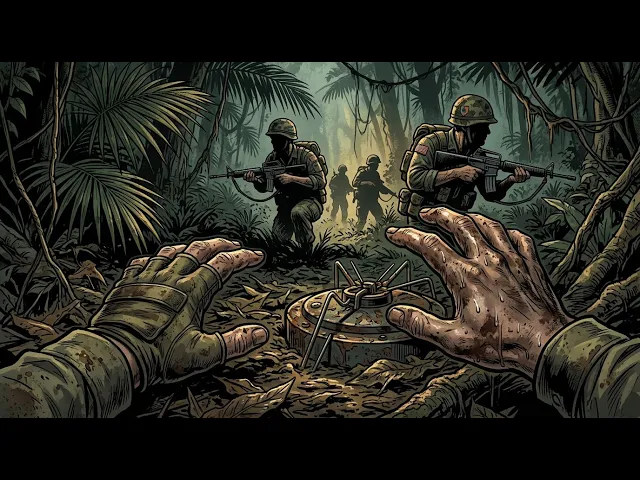
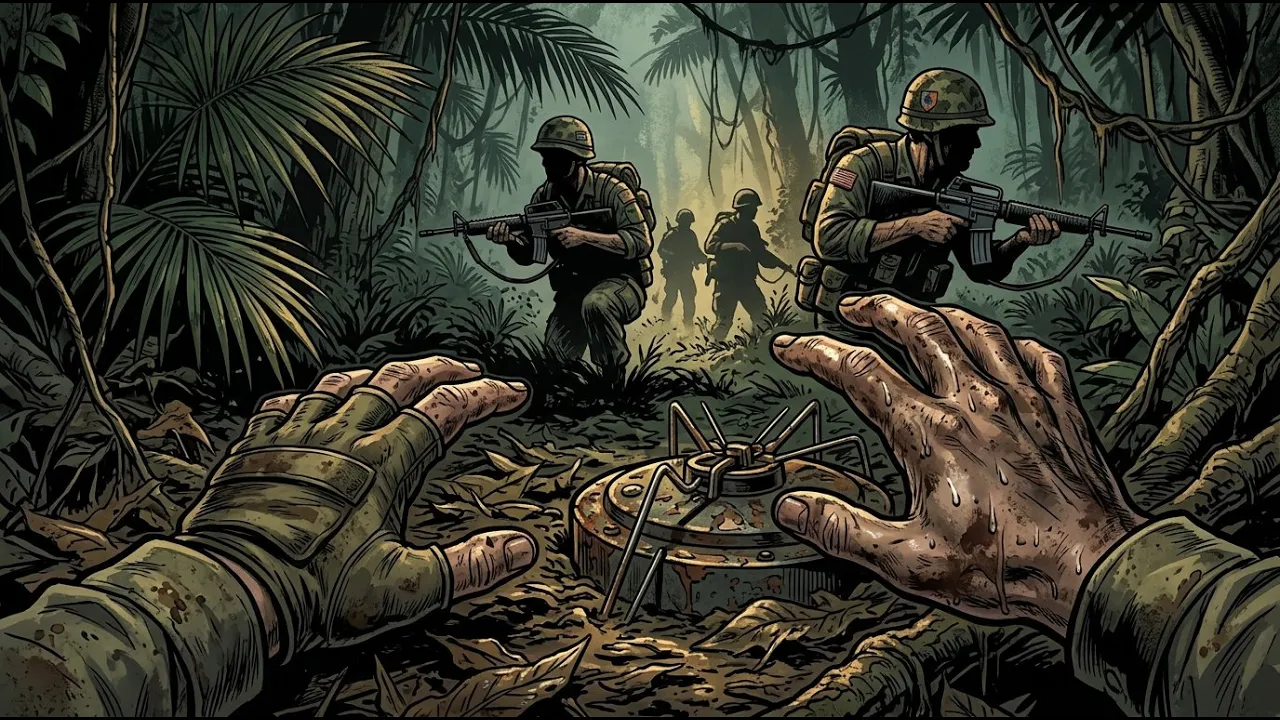
Every sound becomes a question, a branch cracking somewhere to your left, something shifting in the undergrowth that isn't the wind, your own heartbeat, embarrassingly loud inside your own skull. Reeves is four men ahead of you in the line. He stops without warning, one fist raised, the whole patrol freezing like a single organism.
You don't breathe. You watch him [music] crouch slowly and point at something nearly invisible in the undergrowth. A trip wire, thin as fishing [music] line, strung shin height between two trees, connected to something buried just off the trail.
He steps over it with the careful, unhurried motion of a man who has done this before. Each man behind him does the same. When it's your turn, [music] your knees are shaking badly enough that you're genuinely afraid the tremor is audible.
Marcus is right behind you. You hear him exhale once he's clear. A single breath that says everything.
The patrol ends without contact. 4 hours out there. No shots fired.
Nobody hurt. You get back to base and sit down in front of a plate of food and can't touch it. Tibido offers to eat [music] yours.
You let him. Marcus sits next to you, pulls out the Polaroid, looks at it for a long time, puts it back. He does this every night.
[music] It becomes as reliable as the sun going down. The days blur together, which is its own kind of warning sign that you're too new to read yet. Routine patrol.
Same trail you've walked twice before. The tree line to your left looks exactly like every other tree line. And then it doesn't.
The world explodes sideways. The sound is enormous. Not a bang, but a wall of noise that hits you physically [music] and then dirt is kicking up around your boots and someone is screaming and [music] your body is already moving before your brain has finished processing any of it.
You hit the ground, you return fire, you move, [music] you return fire again. Nobody taught you this specific sequence. It's just what your hands do when your brain whites out completely.
[music] The chaos lasts maybe 4 minutes. It feels like 40. When the shooting stops, the silence that replaces it is somehow the worst sound you've ever heard.
Because in that silence, you can hear Yido. He's down 20 ft to your [music] right in the middle of the trail. You crawl to him before you consciously decide to.
He's alive, cursing in a long, breathless stream, one hand pressed to his side. The wound is bad enough that nobody pretends otherwise. You [music] hold pressure.
Marcus appears on the other side holding Tibo's hand and telling him about the crawfish itu he's going to make when they get home. The exact recipe step by step in this calm, steady voice that doesn't match his eyes at all. The medevac bird comes in low and fast and the guys load them on and then it's gone and the jungle fills back in around the silence it left behind.
You never see Thibido again. You'll hear later secondhand that he made it. You'll never fully believe it.
That night, you write a letter to Karen. You start with what actually happened, get two sentences in and cross them out. By the end, you've written something about the weather and that you're doing fine.
[music] Every true sentence deleted. You fold it up and mail it anyway. Marcus writes to his wife every night.
[music] Three pages minimum. He never tells you what he says. But you notice he always starts by asking about the baby.
Nobody warns you about the grind. Not really. They tell you about the firefights.
They tell you about the heat and the jungle. What they don't tell you is that the thing that actually takes you apart isn't one big moment. It's the accumulation of small ones.
The slow subtraction, week after week of the same patrols, the same red dirt, the same shrinking circle of men you trust until one day you realize you've stopped flinching at things that would have destroyed you 2 months earlier. Marcus handles it differently than you. You watch it happen in real time.
the same war, the same mud, the same sleepless nights. And somewhere around month three, you notice the difference. You're going inward, quieter, harder, running math on patrol about distance and positioning and odds that have nothing to do with the men beside you.
Marcus is going outward. He talks to the new guys when they arrive, scared and blinking. He shares his rations.
He still looks at the Polaroid every night, and it still does something to him. You can see it in his face. This flicker of something soft that the rest of you lost weeks ago.
You don't understand how he keeps it. You resent him a little for keeping it. You need him to keep it.
Another man is gone by May. You don't want to talk about how. Reeves rotates home in April.
His last morning. He shakes everyone's hand, picks up his bag, and gets in the truck without looking back. The truck disappears around a bend in the road, and nobody fills the space he leaves behind.
The village is called something you can't pronounce. Intel says fighters have been moving through using it as a waypoint. The officer who briefs you uses the word suspected twice and confirmed zero times.
You go in at midm morning, spread out, moving house to house through a village that is mostly empty in the way villages are empty when they know you're coming. A few old men sitting. the usual geometry of fear that you've become fluent in reading without being able to speak it back.
Things happen in that village [music] that you will carry for the rest of your life. Things that took less than a minute and will last longer than everything else combined. You're not going to describe them.
You already know. What you'll remember is the walk back. 3 km through the patties to the fire base.
Single file, nobody talking. You walk and the mud pulls at your boots and the sun is brutal and indifferent and the men beside you are close enough to touch and completely unreachable. Marcus is walking right behind you.
At some point, he says very quietly, "That wasn't us. " You don't answer. You don't know if he means it wasn't who you are or it wasn't what was supposed to happen.
You don't know if it matters. That night, Marcus looks at the Polaroid longer than usual. You catch a glimpse of his face in the light and there's something new in it.
Not the softness [music] that's still there, but something next to it. A kind of desperate grip [music] like he's holding on to who he was before. And the photograph is the handle.
You don't file it somewhere deep and permanent and wordless in the same place the other things live that you'll never say to anyone who wasn't there. You try to, but that place is full. Your orders come through on a Tuesday morning.
Marcus gets his the same week, 365 days in country, and then it's over. A piece of paper that says you're finished, as if finishing is something that actually happens. You and Marcus fly home on the same commercial airliner, civilian seats, a stewardist offering drinks, a man in a business suit reading a magazine 3 in from your elbow.
[music] Marcus is two rows back. At one point, you turn around and he's looking at the Polaroid again. He sees you watching and holds it up and grins.
This genuine, full, unguarded thing that looks completely wrong on a face that's been in Vietnam for 12 months, but it's real. That's what scares you about it. You land in California, clear customs, walk out into an American afternoon that looks completely normal.
Jungle to airport to American street in less than 48 hours. There's no decompression chamber for what you've been carrying. You just land and there you are.
At the terminal, Marcus grabs your hand and shakes it and says, "Come visit. Meet my girl. " He means his daughter.
You say, "Yeah, sure. Of course. " You both know the handshake is the last time you'll touch another person who understands what the last year meant.
Karen meets you at the gate in Indiana. You see her face and you feel something you do, but it's [music] like feeling it through glass. She hugs you and you hold on and say the right things.
And none of it is fake exactly. It's just that the distance doesn't close the way you expected it to. [music] You thought coming home would end something.
Instead, it just changes the shape of it. The street looks identical to how you left it. The gas station, the jewelry shop on Maine, the houses, everything exactly where you put it.
That sameness hits you like an accusation. the world should have the decency to look different when you do. People ask how it was.
[music] You say fine, they nod and move on because they don't really want the answer and you don't have words for it anyway. You don't propose to Karen that summer. You don't enroll in night school.
You go back to the gas station and work the morning shift and come home and sit in a chair and try to watch the ball game. And the silence in your living room has a texture to it that nobody else can feel. Years pass.
The war ends. You see a photograph of Marcus in a letter that somehow finds its way to you through a guy who knew a guy. He's standing on a porch somewhere in Ohio.
There's a little girl on his shoulders, maybe five, maybe six, with her arms around his [music] neck and her chin on the top of his head. He's laughing full, unguarded, exactly like the grin on the plane. Same war, same mud, same nights, same village.
He found the handle and held on. You let go of yours somewhere between the tree line and the walk back [music] and you didn't even feel it leave your hand. You're 43 years old, middle of nowhere, Indiana.
You work the morning shift at a garage on Route 9 3 days [music] a week. The rest of the time you're either sleeping or sitting in a chair that faces a window that faces a street that still looks exactly the [music] same. Karen left in ' 74.
You don't blame her. You weren't there. Not really.
You hadn't been there since you came back. Some nights you still feel the heat, the weight of it, the smell of diesel and something underneath. [music] You still hear the insects, that wall of sound that became its own silence.
And somewhere inside that silence, if you listen long enough, you can hear Marcus's voice. calm, steady, talking about crawfish atufet to a man who was bleeding, holding on to something the rest of you had already dropped. You never visited Ohio.
You never met his daughter. You carry it the only way you know how. Quietly, [music] permanently, somewhere behind the eyes where nobody looks unless they've been there, too.
Same war, different man on the other side of it. That's what it cost you.