State Space Systems present us with an interesting problem that you don't see in transfer functions and that's the idea of controllability and later something called observability in controllability we are concerned with whether the states of the system can be changed with the input let me show you an example here is a system that's second order there is an input and an output relationship the two states correspond to x0 X1 and the system has two poles or two igen values and we can tell right away because the system's diagonalized that the system has a pull at
minus 2 and a pull it minus one look what happens to the system though because the system has been diagonalized the states have been decoupled and so we essentially have two State equations one x0 dot is equal to -2 x0 first order differential equation but no input the second one X1 dot is equal to to -1 X1 + U so if we put an input u in we can change the values of State one but we can't do anything to state zero the output however is affected by state zero and state one it's the combination
of the two so in this system we would say that the states are not controllable no matter what we do to you we can't affect what happens to x0 so we would say that this system is not controllable If We Had A system that was similar but now the value here is no longer zero but some value I've put two in here now the system is completely controllable because by selecting U we can change the values of x0 and X1 and so we'd say that this system is controllable a system is controllable if the input
can affect each state of the system we are going to look at two tests for controlability the first test is to diagonalize a system and look at the B Matrix this is what I did in the previous example here's another example here is a system that's been block diagonalized so it has I values at minus 2 and a complex IG value at -4 plus or - 5 I this system is controllable because U can affect the state corresponding to minus 2 I value and you can affect this block even though there's a zero right here
this two affects this bottom State and it's coupled to the state above it so again this system is controllable here's a system that has two inputs U1 and U2 in this case State 1 that corresponds to the minus1 is controllable only through U1 U1 corresponds to this column and you can see that U1 does not affect the second state U2 on the other hand will control both States because both elements in the B Matrix are non zero it's also possible to have a situation where U1 would control only the first state and U2 would control
only the second state in that case the system would still be controllable as long as we were allowed to use both inputs the second test for controllability is to calculate what's called The controllability Matrix that's that value right there so the controllability Matrix is made up of the B Matrix then a * B then a 2 * B and so on and it really doesn't matter how many of those you have but you really only need the same number of columns as corresponds to the order of the system then you calculate the rank of this
the rank is the number of linearly independent rows or columns and that rank must be equal to n where n is the order of the system Let's do an example in this example I have a system which is diagonalized it's example I did previously and we can tell right away that the answer should give us an uncontrollable system but let's go ahead and crank through the algebra here so I set up B which is right here and then this is a b and then I could continue on a 2 B but this is only a
second order system so only need two columns and rows in this system now continue on with the matrix multiplication and we can see right away that the controllability Matrix does not have a full rank because we have two zeros here so this we do not have linearly independent rows and columns that is we could multiply this First Column by minus one and get the second column by the way another way to test for full rank is to check the determinant of the controlability Matrix and if that is zero then the system does not have full
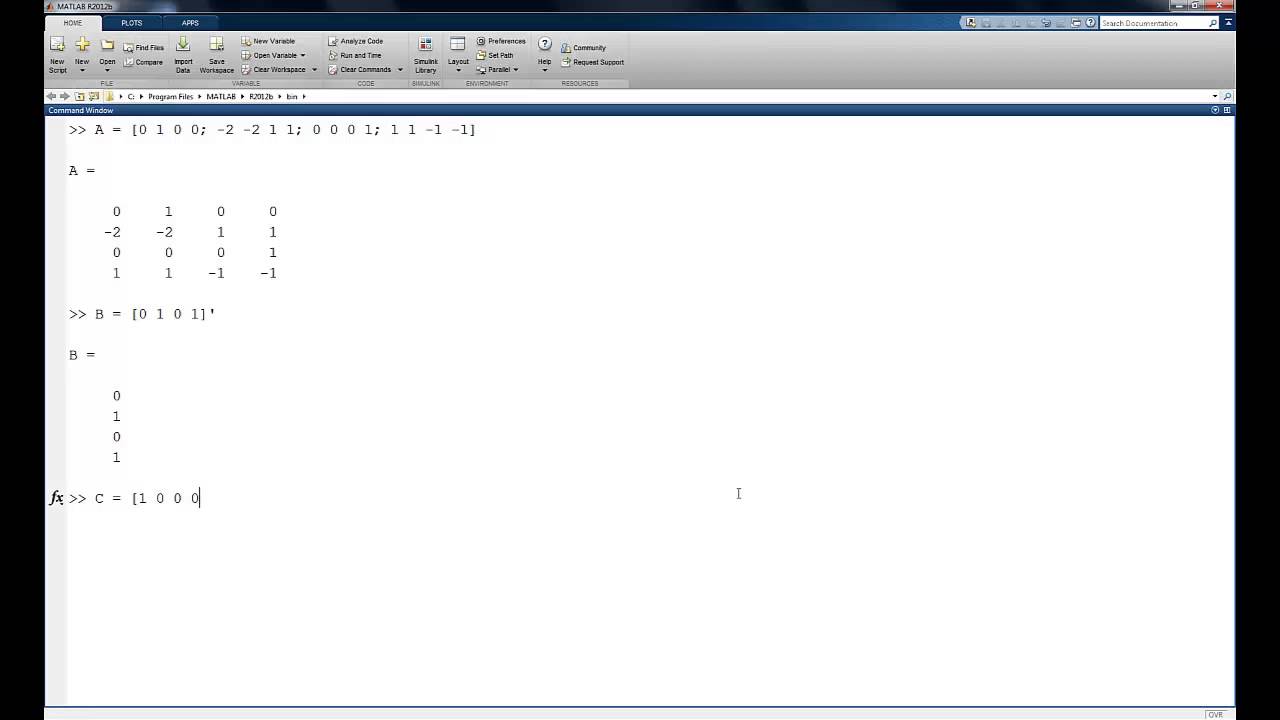
rank let's look at one more example using the controllability Matrix here's the example that we have before and it's a third order system and I picked this one because we know what the answer is but let's see what the controllability Matrix gives us so after a lot of Matrix Algebra I calculate the controllability Matrix is this value right here and now we need to know what is the rank of this system and what we're really interested in knowing is does it have full rank that is is it singular so the simple test is just to
calculate the determinant of the system and the determinant of the system turn out to be 580 it's non zero which means that this system indeed is invertible which means it's full rank which means that the system is completely controllable through the input U controllability is important when we want to be able to affect all the states of the system and we want to design a controller where the input is U if the system is non-controllable it means that no matter what control system we come up with we will not be able to affect some of
the internal states of the system with our controller that goes through you



![Controllability and the PBH Test [Control Bootcamp]](https://img.youtube.com/vi/0XJHgLrcPeA/maxresdefault.jpg)