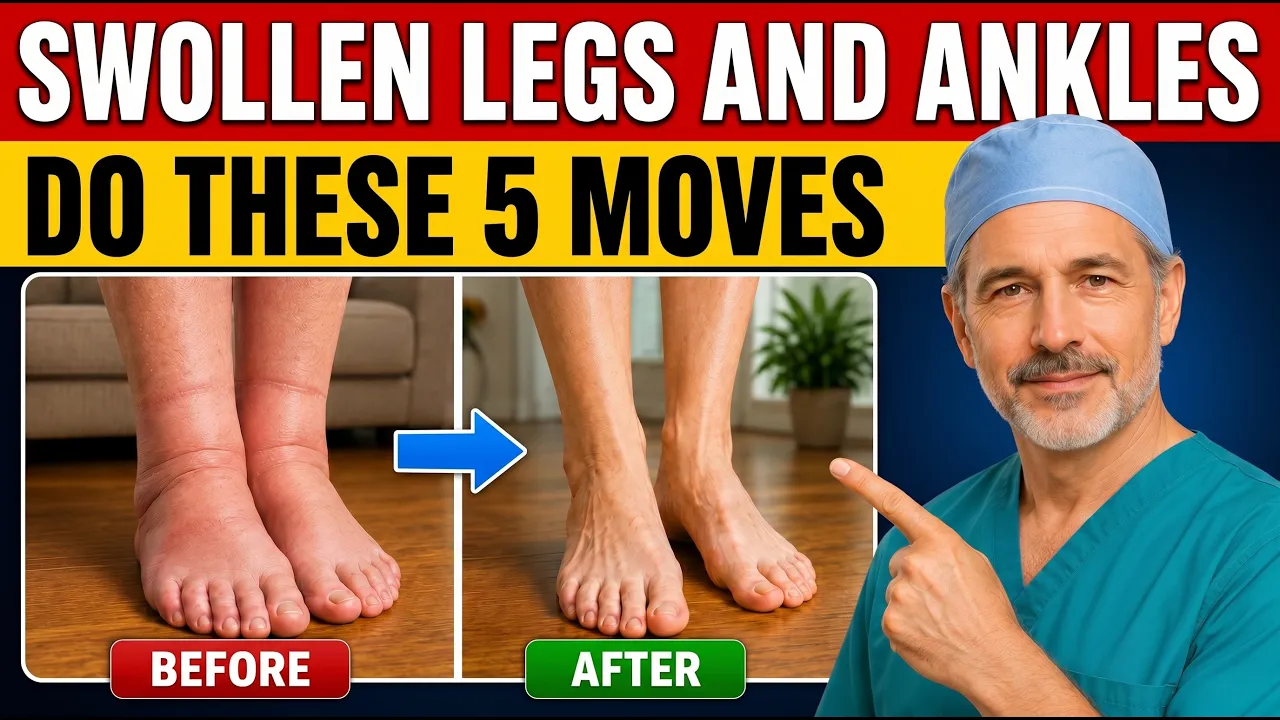
What if I told you the swelling in your legs and ankles after 60 may not be something you simply have to live with, but a sign that your lower body's natural fluid moving system is slowing down. Here's something that gets overlooked far too often. Most people notice the warning signs early.
Sock marks around the ankles. Shoes that feel tighter by evening. A heavy, tired feeling in the legs after sitting through a television show, a long meal, or a car ride.
But instead of asking what changed, they tell themselves, "It's just aging. " But the science tells a different story. Johns Hopkins Medicine explains that chronic venous insufficiency can cause swelling in the legs or ankles, and that long periods of sitting or standing, along with lack of exercise, can contribute to pressure problems in the leg veins.
The American College of Cardiology also notes that calf and foot flexion and extension can create a pump function effect in the legs. That is what really got my attention. Because the movement I'm going to show you today is not about working harder.
It is about waking up the feet, ankles, calves, and thighs in the right order, so your body can support the pump system it already depends on. And the final movement uses gravity itself to help your legs reset. Before we begin, tell us in the comments now your age and where you're watching us from.
We're reading and replying to every single comment. So, drop your comment below. Let's start at the bottom of the legs, where the swelling usually begins.
Number one, foot point and flex. This first movement is small, but it is not meaningless. And here is the important part.
You are not just wiggling your toes. You are moving the whole foot from the ankle, pointing the foot forward, then pulling it back toward your body. That difference matters.
Many seniors stop using this motion fully without realizing it. After long hours of sitting, resting, or keeping the feet still, the lower legs receive fewer movement signals. And when the lowest part of the legs stays quiet, swelling can become more noticeable around the feet and ankles.
The American College of Cardiology, summarizing a New England Journal of Medicine review on chronic venous insufficiency, notes that contraction of the foot and calf muscles helps move blood from the feet back toward the heart. It also explains that calf and foot flexion-extension exercises can create a pump function effect in the legs. So, this movement is not about force.
It is about waking up the motion pattern your lower legs already depend on. Here is how to do it properly. Sit on your bed or on the floor with your legs extended comfortably in front of you.
If your back needs support, lean against the headboard, a wall, or a stack of pillows. Keep your knees relaxed, not locked. Now, point both feet forward as if you are gently pressing a gas pedal.
Hold for about 2 seconds, then pull your feet back toward your body, bringing your toes up toward your knees until you feel a gentle stretch through the calves and Achilles area. That is one full cycle. Repeat this 15 to 20 times.
Move slowly. Do not snap the feet forward and back. Think of it like gently pressing and releasing a pump.
If your ankles feel stiff, use a smaller movement. If you have arthritis, only move within a comfortable range. Mild tightness is fine.
Sharp pain is not. This is especially useful before getting out of bed, after resting with your legs up, or before sleep if your feet feel puffy at night. Once the feet start moving again, the next step is to unlock the ankle joint itself.
Number two, ankle circles. Now that the feet have started moving, we move one level higher to the joint that often becomes stiff without people noticing, the ankle. This might not sound important at first, but think about what happens when your ankle no longer moves freely.
Every step becomes shorter. Your foot does not roll through the ground the same way. Your calf does not squeeze as fully.
And when that happens, the natural pumping action in the lower leg becomes weaker. That is why ankle stiffness and swelling often show up together after 60. A Cochrane review on exercise for chronic venous insufficiency looked at physical activity programs designed to improve ankle movement and strengthen the calf muscle pump.
The important point is this. Researchers are not only looking at walking. They are looking at how the ankle and calf work together to support circulation in the lower legs.
For someone over 60, that is not just a medical detail. It can show up when you take your first steps in the morning, when you turn in the kitchen, when you step off a curb, or when your ankles feel tight after sitting too long. To perform ankle circles correctly, sit in a sturdy chair with your back supported.
Keep one foot on the floor and gently lift the other foot just a few inches. Now imagine you are drawing a smooth circle with your toes. Rotate your ankle slowly clockwise for 10 circles.
Do not rush. Each circle should feel controlled, not jerky. Then pause, reverse direction, and make 10 slow circles counterclockwise.
After that, switch to the other foot. The detail most people miss is the shape of the circle. Do not just wiggle your toes.
Try to move through the ankle itself. Make the circle as full as comfortable, but never force it. If you have arthritis, stiffness, or limited mobility, smaller circles are perfectly fine.
Even a partial range of motion can help remind the joint to move again. This movement is especially helpful before walking, after long sitting, or before doing the stronger calf movement coming next. Because once the ankle starts moving more freely, the calf pump has a much better chance to do its job.
And that brings us to the movement most people think they understand, but often do too quickly. Number three, heel raised pump. This is the movement many people recognize, but very few people do slowly enough to get the real benefit.
After the toes and ankles have been warmed up, the next job is to activate the calf muscles, because these muscles play one of the most important roles in moving blood and fluid out of the lower legs. When your calves contract, they squeeze the veins in your lower legs and help push blood upward toward the heart. That is why the calf muscle pump is so important for people who notice swelling around the ankles, especially after long periods of sitting or standing.
Research published in the Journal of Vascular Surgery has looked at structured exercise for people with chronic venous insufficiency and found that training the lower leg muscles can improve calf muscle pump function. For someone over 60, that means this is not just a leg strength exercise. It is a movement that trains one of the systems your body uses to keep fluid from settling too long in the lowest part of the body.
Here's how to do it safely. Sit in a firm chair with both feet flat on the floor, about hip width apart. Keep your back upright and your hands resting on the chair or your thighs for support.
Now slowly lift both heels off the floor while keeping your toes planted. Rise as high as comfortable. You should feel the calf muscles tighten, but you should not feel pain.
Hold at the top for about 3 seconds, then lower your heels back down slowly, taking another 2 to 3 seconds. That is one repetition. Start with 10 repetitions.
As it becomes easier, gradually work up to 15 or 20. The mistake most people make is bouncing. Do not bounce.
Do not rush. The pump works best when the movement is controlled, like gently pressing and releasing a sponge. This is especially useful after watching TV, after a meal, after a car ride, or anytime your legs have been still for too long.
If standing feels safe for you, you can later try this behind a chair while lightly holding on for balance. But before we continue, if you have been enjoying the video so far, hit that like button so more seniors can see it and subscribe. We've got more powerful senior health tips coming every day and you don't want to miss the next one.
Now that the feet, ankles, and calves are awake, we move higher into the legs where many seniors forget circulation also needs help. Number four, seated marching. By this point, we have already woken up the feet, unlocked the ankles, and activated the calves.
But there is another part of the leg many seniors forget about when they think about swelling. The thighs and hips. You notice this most when your legs feel heavy in the middle of the day.
Not sharp pain, not cramping. Just that slow, tired feeling. Almost as if your legs are filled with sand.
That is often when people say, "I need to sit down. " But the problem is that sitting even longer can make the lower body even quieter. This is where seated marching becomes so useful.
It brings the larger muscles of the legs back into the routine without forcing you to stand, balance, or walk across the room. The National Institute on Aging explains that older adults benefit from more than one type of movement, including aerobic, muscle strengthening, and balance activities. That matters here because swollen, heavy legs are not only about the ankles.
Your whole lower body needs regular signals to keep moving, strengthening, and staying responsive. Here's how to do it properly. Sit tall in a sturdy chair with your feet flat on the floor.
Keep your hands resting lightly on the sides of the chair or on your thighs. Now slowly lift your right knee toward your chest. Only as high as comfortable.
Hold for 1 second. Then lower it with control. Now lift the left knee the same way.
Continue alternating legs as if you are marching in place while seated. Start with 30 seconds. As your legs become stronger, build toward 1 full minute.
The key here is not speed. It is rhythm and control. If you rush, you may use momentum instead of muscle.
If you move slowly, your thighs, hips, and core have to participate. If one leg feels weaker than the other, do not panic. Just notice it.
That difference tells you which side may need more gentle practice. And if you feel dizzy, short of breath, or unstable, pause and rest. This movement is especially helpful after long sitting before standing up or anytime your legs feel slow and heavy.
And now, we finish with the one position that uses gravity itself to help your legs reset. Number five. Wall leg elevation.
This final movement is different from the others because you are not trying to make the muscles work harder. You are giving your legs a chance to unload. All day long, gravity pulls fluid downward.
When you sit with your feet on the floor, stand in the kitchen, ride in a car, or stay in one position for too long, your legs are working against gravity. And after 60, when the calf pump is not firing as strongly or as often as it used to. That downward pull can show up as swelling around the ankles and feet.
This is why elevation matters. Mayo Clinic includes elevating the legs among self-care steps that may help with leg swelling, especially when fluid has been collecting in the lower body. That does not mean elevation replaces medical care, but it does mean this simple position can support the same idea we have been building through every movement.
Help the lower body move fluid upward instead of letting it stay trapped near the ankles. Here's how to do it safely. Find a clear space near a wall, a bed, or a couch.
If getting down to the floor is comfortable for you, lie on your back and place your legs up against the wall. Your hips do not need to touch the wall. Move back until the position feels relaxed, not strained.
Stay there for 5 to 10 minutes while breathing slowly. If getting down to the floor is difficult, use the easier version. Lie on your bed and place pillows under your calves so your legs are raised, or sit in a recliner and support your legs so they are comfortably elevated.
The detail that matters most is comfort. Do not force your knees straight. Do not hold your breath.
And if you feel numbness, tingling, dizziness, or back discomfort, bend your knees, lower your legs slightly, or stop. This is especially helpful in the evening, after long sitting, or after doing the first four movements. Think of it as the reset at the end of the routine.
You have now moved the feet, opened the ankles, activated the calves, brought in the thighs, and finally used gravity to help the lower legs relax. At the end, swollen legs and ankles after 60 are not always something to fear, but they are also not something to ignore. The important lesson is this.
Your body often gives small signals before bigger problems appear. Sock marks, tight shoes by evening, heavy legs after sitting too long, or ankles that feel stiff when you first stand up. These signs can tell you that your lower body needs more movement, more circulation support, and more daily attention.
Walking is still helpful. Rest is still important. But for many seniors, walking alone does not always wake up the feet, ankles, calves, and thighs in the specific way your lower body needs.
That is why these five gentle movements work so well together. Toe flex and point wakes up the feet. Ankle circles unlock the joint.
Heel raises activate the calf pump. Seated marching brings in the larger leg muscles. And leg elevation gives gravity a chance to help your legs reset.
The goal is not perfection. The goal is consistency. Start with what feels comfortable.
Move slowly. Breathe normally. And if swelling is sudden, painful, one-sided, red, warm, or comes with chest pain or shortness of breath, get medical help.
Now, I want to hear from you. Do your legs or ankles swell more in the morning, in the evening, or after sitting too long? Share your age, where you're watching from, and which movement you'll try first.
Thank you for watching.