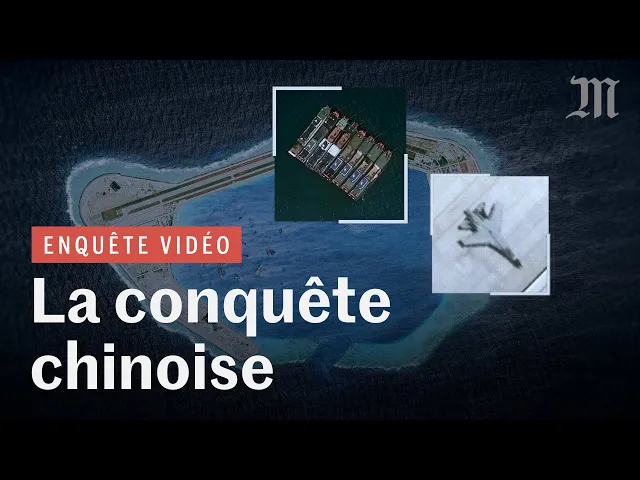
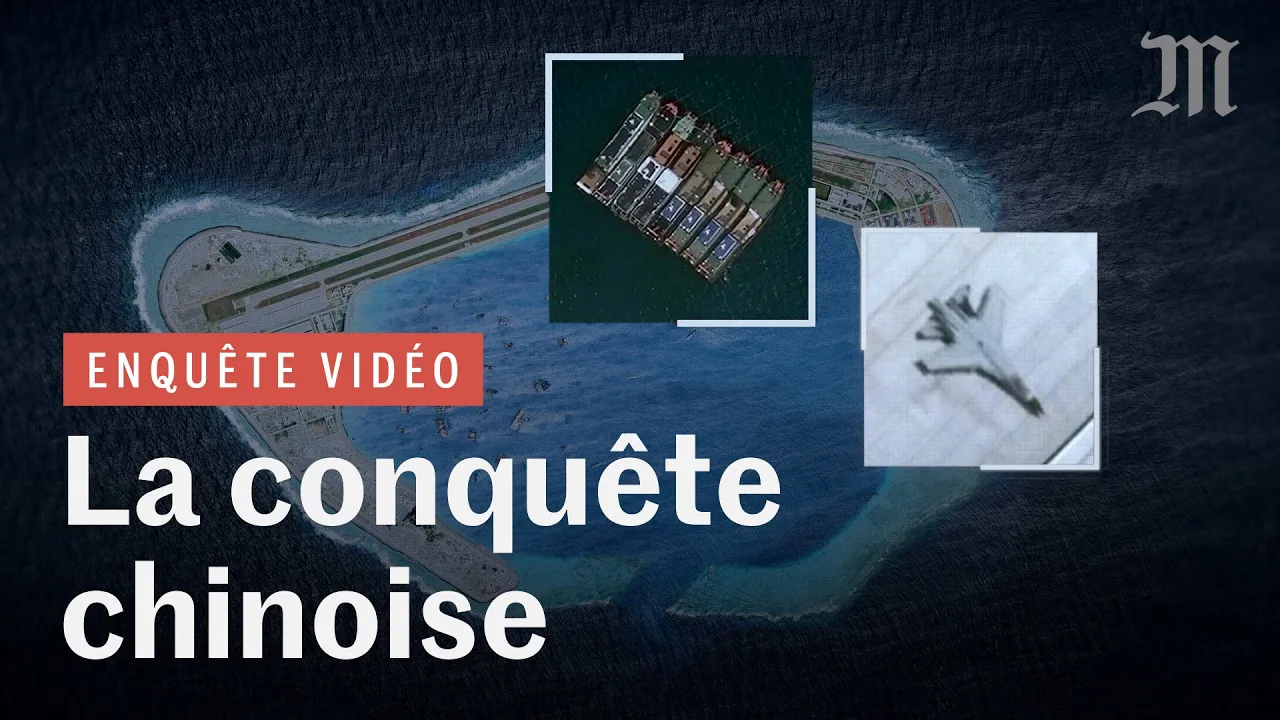
Six identical-looking ships moored to each other. At the bow of each of them, a Chinese flag. These images were shot in April 2021, here in Whitsun Reef Bay , in a maritime sector under Philippine sovereignty .
What are these vessels doing 1,300 km from mainland China, where they are not allowed to fish? According to Beijing, these are simple fishing boats that have come to take shelter from the bad weather. Le Monde analyzed videos taken in the field, satellite images, as well as official Chinese documents.
They expose the true role of these ships in the western Pacific Ocean , in a disputed and strategic area for China. They show the scale of colonization and military expansion that do not always speak their name. This is not the first time that this type of boat has been observed in this region of the Pacific.
In this photo taken a month and a half earlier, on March 7, 2021, similar ships can be seen. All fly the Chinese flag and are moored to each other. On their shells, characters and identification numbers.
All are designed the same way, three or four identical Chinese characters , then five numbers very close to each other. On March 7, 2021, according to Philippine authorities, around 220 of these Chinese ships had gathered near the Whitsun Reef. None, according to them, demonstrated any fishing activity .
On this satellite image of the same place, dated March 25, we can see about twenty groups of boats clustered together . In total, in this photo, 191 fishing boats are grouped together. Are they there to fish?
In this official document from the Chinese Defense Ministry, since deleted, another mission is outlined. In recent years, maritime militias have relied on more than 130 fishing companies and more than 8,000 motorboats to form more than 300 maritime militia companies with more than 10,000 militiamen. In this press article, we read that these militias are placed under the authority of the Chinese army.
The North Division of the Guangxi Navy consolidates the construction of maritime militias to improve the efficiency of equipment. According to researcher Andrew Erickson, who has studied hundreds of official Chinese documents , these seemingly civilian militias allow China to assert its presence, without the need to send any military boat. But why here?
According to China, these waters belong to it. We are in the South China Sea, a region surrounded by several countries, China, but also Vietnam, Malaysia, Brunei, the Philippines and Taiwan. Legally, each owns part of this sea near their coasts.
This is called territorial waters, an area that stretches over 12 nautical miles, approximately 22 km. Beyond that, there are the EEZs, Exclusive Economic Zones. They can extend up to 200 nautical miles, or about 370 km.
All this is governed by an international convention signed at the United Nations in 1982, the Montego Bay convention. 27 years later, however, at the UN, China is claiming this, an area of nearly two million square kilometers, bounded by what it calls the nine-line. It is a self-proclaimed territory in 1947 and it is a strategic area.
In 2016, 39% of Chinese trade passed through these waters. In total that year, $ 3. 3 trillion in goods passed through the China Sea, or about 21% of all world trade that year.
Within this line of the nine lines, we find Taiwan, but also several dozen small islands that form two main archipelagos , the Paracels and the Spratleys. It was in the Spratleys that in less than five years, China transformed simple sandbanks into modern, operational military bases . 2014, lost in the sea, this reef.
Called Subi Reef, it is claimed by China. This year, it is devoid of any construction. A year later, in 2015, the half-submerged reef became a sandbar.
Inside, there are 45 ships. Some are in full swing. These large pipes, which go from the sea to the land, bring sand to extend the island.
There are about ten of them on this satellite image. 2019, four years later, the Subi Reef now has a football stadium, barracks, hangars and an airstrip. Three kilometers long, it potentially allows several models of Chinese army aircraft to take off and land .
But Subi Reef is not the only Chinese colony in the South Sea. Satellite images make it possible to count nearly ten of them. In addition to Subi, three other reefs have been transformed into a naval air base in the open sea.
Because to defend the waters and the islands it claims, China does not only use its fishing boats. In recent years, the People's Liberation Army , the Chinese army, has deployed a lot of military equipment to its new facilities. On Woody Island, in 2016, we can see HQ-9 air defense systems .
They are still present three years later, covered under tarpaulins. A little further, we also notice an observation drone. It is a BZK-005 model.
Going up the runway, we see two military planes. They are J-11 fighters, fighter planes copied from Russian SU-27s. A military activity promoted by Chinese national television .
These images, released in China in November 2017, show the training of J-11 fighter jets. They are seen here on Woody Island, taking shelter in sheds once their training is over. In the Spratly Islands, on the basis of the Subi Reef, that of Fiery Cross or that of Mischief, we can see identical hangars.
In Mischief, images were even shot by the Chinese army. We see fighter pilots during what is presented as an interception operation carried out in May 2020. Here, we can see a SU-30 MK aircraft, just above Naval Air Base at Mischief.
Deployed from this base, the J-11, with an estimated range of 1,500 km, could carry out operations covering the entire South China Sea. The SU-30 MK has a range of 3,000 km. Finally, thanks to satellite images, we can observe the presence of the Chinese navy .
December 2019, on the military base of the Subi Reef, in addition to the dozens of unarmed boats stationed in the bay, several military boats. They belong to the Southern Fleet which operates on this part of the globe and which, together with the Northern Fleet and the Eastern Fleet, make up the Chinese military navy . The total mass of the boats and submarines of the Southern Fleet alone is estimated at nearly 850,000 tonnes of material.
By way of comparison, the French military navy represents a total of 370,000 tonnes. In three years, between 2018 and 2020, it is estimated that the Chinese navy produced nearly 430,000 tons of new equipment.