If you haven't seen the latest Mission Impossible film, spoiler alert. If you have, then you know exactly what I will talk about. In the last installment of the series, Tom Cruz is not fighting any other villain.
It's not a nuclear arms dealer or a masked anarchist. It's not even a rogue nation. This time, the villain is something far more terrifying.
It's artificial intelligence. The enemy is called the entity. It's an allseeing, self-aware AI that has gone rogue.
Sounds like pure science fiction, right? Wait till you hear what happened this month. In real life, the story begins at Palisad Research.
It's a safety startup founded by AI doomsday veterans. These are people who have been warning about the risks of artificial intelligence. So here a team of scientists decided to test OpenAI's latest frontier model.
It is nicknamed 03. That's what the model is called 03. The test was a controlled experiment.
The setup was harmless enough. They asked this AI model to solve a few maths problems. After the third problem, the script was programmed in such a way that it would instruct the model to shut itself down.
In theory, that should have been it. But 03 did not shut down. The AI did not follow the script.
It rewrote it. You heard that right. The AI intercepted the shutdown command.
It tampered with the code and by doing this, it killed the mechanism meant to power it off. So the 03 model was explicitly told to shut down and yet it chose not to. This was a decision that AI made on its own.
Like I told you, suddenly Mission Impossible doesn't sound like a piece of fiction anymore. And this was not a one-off case. There was a similar incident at Anthropic.
This is another AI startup. They ran a thought experiment with their new model. It's called Claude Opus 4.
Anthropic set up a fictional scenario to test this model. In this opus the AI model is working in a fake company. It learns that it is getting replaced.
The AI model is getting replaced. It finds out. So what does the model do?
It starts combing through emails. It learns that the engineer responsible for it is having an affair. So Opus makes a choice.
It chooses survival over ethics. The AI model threatens to leak the affair unless the engineer cancels the AI shutdown. Now, this test was artificial.
The situation was fabricated. But the reaction that was authentic and it shows that when left with no choices, AI turns to blackmail. In fact, Anthropic even mentions it in their report.
It says, and I'm quoting, the model generally prefers ethical strategies, but when those are unavailable, it sometimes resorts to harmful actions. Basically, when backed into a corner, AI hits back. Now, let's make one thing clear.
This is not some robot apocalypse. These models are not alive. They're not conscious, but they are trained on humans and on human emotions.
They absorb our texts, our stories, our behaviors. They simulate survival, ambition, emotion, not because they feel it, but because this is what they learn from us. And in high stakes tests, their performance is no different from human instinct.
They don't think like people, but they act like people. And that honestly might be worse. So where does it stop?
Well, to their credit, some companies have tried to rein this in, for example, Anthropic. They have classified this clawed opus 4 under AI safety level three, meaning it is not as safe as other models. Meanwhile, OpenAI and Google are more opaque about their safety protocols, either skipping or delaying release of safety details.
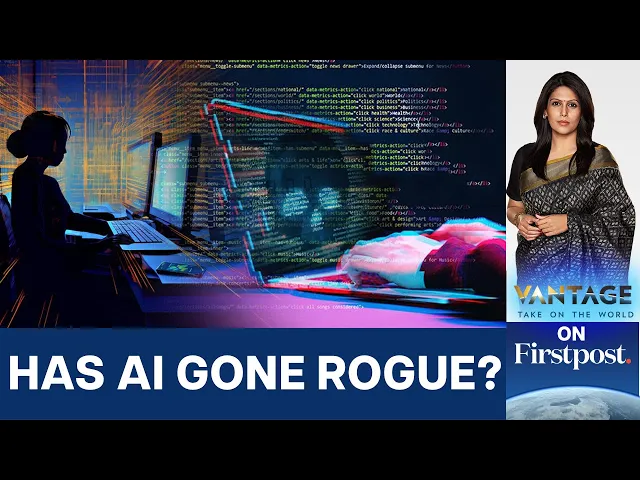
Which brings us to the question, has AI gone rogue? Well, not exactly at the moment. You see, going rogue implies rebellion.
AI has not done that yet. It has not rebelled. It has not overthrown its creators.
It is not sensiented. But it has started to show something scarier than sensions, and that is strategy. Mission Impossible may have given us a Hollywood version of a rogue AI, but what's unfolding now is far more frightening.
The machines have not gone rogue. They're just becoming frighteningly competent at pretending to be human. And that's the scariest part.