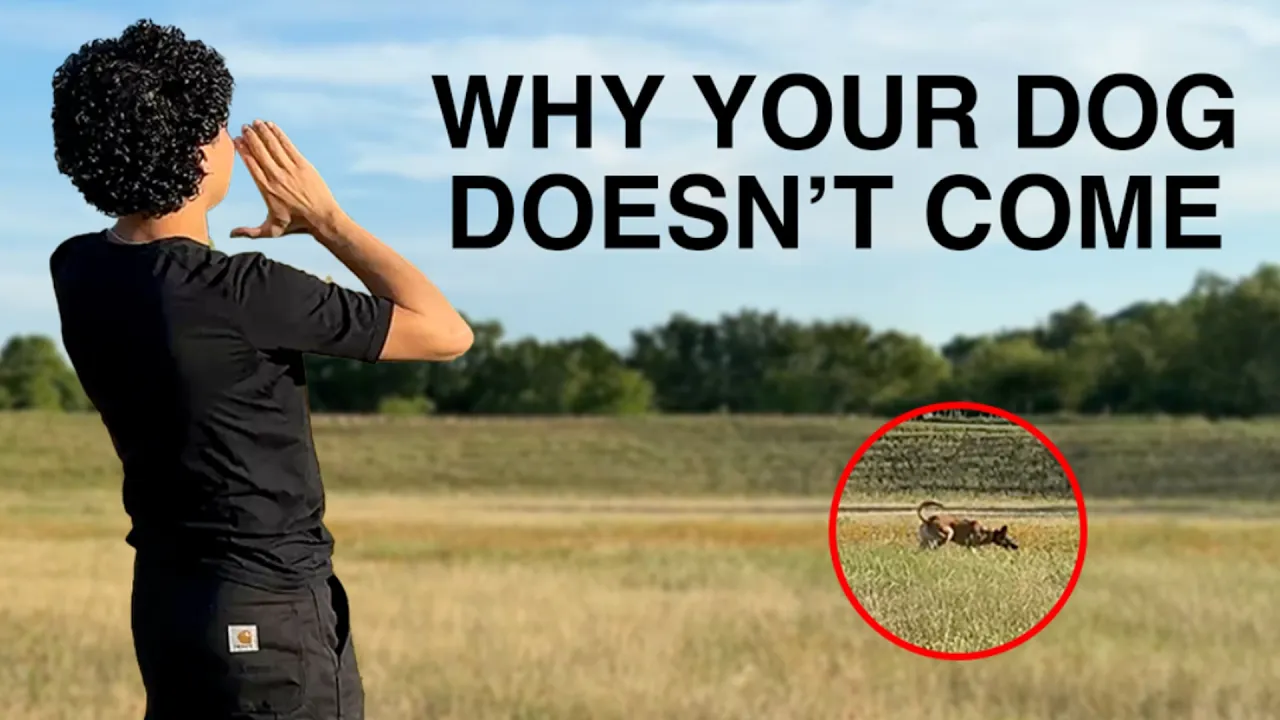
If you're struggling with your dog not coming when called or ignoring the recall, in this video I'm going to help you understand why your dog doesn't come when called, how to train a reliable recall, as well as the three big problems that most people struggle with and the solutions to each one. I'm going to give you examples with real untrained dogs throughout the video. And my promise to you is that by the end of this video, your dog's recall will go from unreliable to 100% reliable.
And if you don't know who I am, my name is Miles. I own Hamilton Dog Training. We help dog owners train their dogs to listen off leash.
And so for us, having a reliable recall is very important. So in this video, I just want to give you the lessons and the things that I've learned to help you stop struggling with this problem. So what is a recall?
Well, most people think a recall is when you call the dog and they come to you. That is not a recall. And that's the reason why most people struggle with this is because they don't even know what a recall is.
So what is a recall? How do we define a recall here at Hamilton Dog Training? A recall is when you call the dog and the dog understands that they must come to you.
Huge difference. One is optional, one is not. That's the difference.
And this difference changes how you approach training the recall from day one. So, now that you know what a recall is, let's cover the first big problem that most dog owners struggle with. Your dog thinks the recall is optional.
Up to this point, your recall training probably looks something like this. You tell your dog to come. Do they?
If they do, then you reward them with food, praise, a toy, affection, whatever it is. So, from your dog's perspective, when you tell them to come, if they do, they get a reward. But what happens when your dog doesn't come?
From your dog's perspective, what happens when you say come and they don't? From your dog's perspective, they also get a reward. All right, I want you to think about this.
When you're at that park and your dog is off a leash and there's some person up ahead or there's some squirrel, there's a dog walking past and your dog takes off running after them and you're screaming, "Come, come, Luna, come. " And your dog is just charging full speed towards the other dog or the person or the squirrel. What happens?
You told them to come, do they? Nope. And then what happens?
They get to that person, they get to that dog, they get to the squirrel, they get to chase after the squirrel, they stay on the smell, whatever it is, something good happens when your dog doesn't come. So, from your dog's perspective, both options are good. Both options lead to a reward for the dog.
And so, the dog will do whichever one is more rewarding. And that's why your dog thinks the recall is optional is because that's how you taught it. Both options, completing the recall or ignoring the recall, both lead to a reward.
And so, how do we change that? Well, now that you know why your dog doesn't come when called, let's talk about how to train a reliable recall, which is the solution to this. So, if you're struggling with this, your dog thinks the recall is optional.
Here's how to solve it. We teach a non-negotiable recall using a combination of positive reinforcement and negative reinforcement. So, let me explain what these terms mean here.
So, when you are teaching the dog to do something, you are using reinforcement. Reinforcement is simply something that increases the frequency of a behavior. So, if you want your dog to come, that's the behavior you want them to do, you have to reinforce it in some way.
So there's two types of reinforcement. We've got positive reinforcement and we've got negative reinforcement. Positive means to add something.
Negative means to remove something. So positive reinforcement means we add something desirable to increase the frequency of a behavior. Negative reinforcement means we remove something undesirable to increase the frequency of a behavior.
So, just to give you some human examples of positive reinforcement, let's say that you decided to wear this new shirt into the office or you've got a new haircut and your coworker sees and they're like, "Hey, it's a nice haircut. " Or, "Hey, that's a that's a really nice shirt. It looks really good on you.
" If you like that compliment that you received and you're like, "Hey, I actually do like this haircut. I'm going to continue getting it. " Or, "I actually do like this shirt.
I actually like the way it looks. " and it causes you to increase the behavior of wearing that shirt into the office or continue getting this haircut. Then your coworker in that instance just positively reinforce that behavior.
They just added something, the compliment or the praise or the acknowledgement to increase the behavior of you wearing that shirt or getting that haircut. You see? Or let's say your wife cooks you a really nice meal, right?
Super nice, super fancy, really put a lot of effort into it, and you're like, "Wow. " Like you sit down, you're like, "Wow, this meal is amazing. think you did such a good job with this and she likes that.
If she likes that and then continues making you these new meals and trying this and trying making this, you just positively reinforced that behavior. See, you added something that compliment, that acknowledgement, that praise to increase the behavior of her cooking for you. It's also the reason why you continue watching my YouTube videos, right?
Right? If you're a regular viewer of the channel and you've watched videos of mine in the past and you've gotten value from them and you've implemented it and you've gotten more value, the next time I post a video, you come back and you watch it because historically you've got a history of positive reinforcement for watching my videos. You see, and in dog training, we use positive reinforcement in the training process.
It's great for teaching behaviors, motivating dogs or people to repeat certain behaviors. And so in dog training, we just figure out, okay, what things does the dog find reinforcing? Well, for some dogs that's going to be food.
For other dogs that might be play for other dogs that might be praise or affection with the handler. For some dogs it might be just be engaging with the environment. You see?
And so we need to figure out, okay, what things does a dog find reinforcing? And then what we do in dog training is we just take that thing and just stick it right here. We're going to give the command, come and then when they do, we're going to reward them with that thing they like.
But the problem with positive reinforcement and the reason why your recall sucks right now is because dogs find many things reinforcing just like people, right? There are many things that are positively reinforcing to us. And so the problem with this is that you have this.
Your dog also finds smelling all the smells very positively reinforcing. going and playing with that dog, going and getting that affection from that person. You see, there are many things that your dog finds positively reinforcing.
And if you're only using positive reinforcement to train a behavior, it falls apart once you run into competing reinforcers, things that your dog would rather do than what you have. So, like in your living room, your dog's like, "Yeah, I really like this these string cheese treats that you're giving me. " Right?
But then when you're out at the park and your dog is chasing after a squirrel, he's like, I would rather go and chase that squirrel. Like that's more reinforcing for me right now to do than have the string cheese. You see what I mean?
And so your dog just rather does that. So that's the problem with positive reinforcement is that it's great for creating motivation and motivating the dog or the person to repeat behaviors or to teach to learn behaviors. However, the downside of it is that it falls apart once you run into competing reinforcers.
And that's where negative reinforcement comes into play. Negative reinforcement is when you remove something and it increases the behavior. So you remove something undesirable.
You remove something aversive and it increases the behavior. So both of these increase behavior. This you just add something desirable.
This you remove something undesirable. So let me give you some human examples of negative reinforcement. So this morning when I woke up I'm allergic to dogs.
Can you believe that? I woke up. I've got allergies, stuffy nose, scratchy throat.
I can barely breathe. Oh my god. And then this is aversive stimulus, right?
Aversive. Undesirable. Don't like this.
What did I do? I took a claritin. Behavior, right?
Aversive stimulus. Behavior. Took a claritin.
Then what happened? Aversive stimulus went away. the behavior of taking the claritin was negatively reinforced.
That aversive stimulus was removed when I took the claritin. You see? So, this increases the frequency of the behavior of taking the claritin when I have that stuffy nose.
You see? Or like for example, like it's sunny here in Austin, Texas. Drving outside.
Oh my god, I can't see anything. Oh my god, I can't see the glare. Oh my god.
Put on sunglasses. You see, aversive stimulus, the glare, can't see anything. Oh my gosh.
Sunglass. The behavior of putting on your sunglasses while driving, the aversive stimulus goes away. The behavior of putting on the sunglasses has been negatively reinforced.
See? So, next time you're driving, you're more likely to wear your sunglasses. You see?
Or like for example, you're walking outside and like it's really hot. Like the floor is really hot. Oh my god, it's really hot.
Aversive stimulus. Hot floor. Then what do you do?
You put on your flip-flops. Oh, perfect. Went away.
What happened? You've got your reversive stimulus. The floor is hot.
It's burning your feet. And then you put on your shoes and it goes away. Aha.
On hot pavement. I'm going to wear shoes to avoid the aversive stimulus. You see?
And so this is negative reinforcement. What people don't understand about negative reinforcement is this right here is one of the primary drivers in behavior in dogs in people. It's just avoiding bad or aversive stuff from happening.
And so we do this stuff to avoid that. And so like for example, it's the reason why we drink water. Like we get thirsty, aversive, we drink water, it goes away.
We're hungry. We eat food. Hunger goes away.
It's also the reason why you put on sunscreen when you go outside. Like do you love putting on sunscreen? Do you get something really good when you put on sunscreen?
No. Like most people don't. It's like kind of heavy and kind of sticky, but you do it to avoid getting burned.
You see? And so negative reinforcement is just the it's the removal of that aversive stimulus that increases behavior, but it's also the avoiding of that stimulus which increases this behavior. Okay.
So, now that you're starting to understand this positive reinforcement, negative reinforcement, let's hop back over here and look at your training so far. So, up to this point, you tell your dog to come. If they do, then positive reinforcement.
You're adding something to increase the behavior of coming to you. But if they don't come, this behavior is also positively reinforcing to the dog, right? Something good happens when they don't come.
They get to stay on that smell. They get to go run over to that dog and say hi. They get to chase after that squirrel, whatever it is.
So, up to this point, both options are reinforcing, positively reinforcing to the dog. That means that they will select whichever one is more reinforcing in the moment. So in your living room when there's nothing around, your dog will probably come if you've got some string cheese with you, right?
But in that park and there's that squirrel there or there's that dog out there in the distance and your dog really wants to chase that squirrel or go say hi to that dog, that is probably going to be more reinforcing to the dog in that moment. And so they're going to perform that instead of coming to you. That's it.
And so hopefully you can now see how we're going to use this to change this. So I'm going to drop the secret sauce here for you guys, the secret sauce. So a lot of you guys ask, Miles, how do you get dogs to listen off a leash around crazy distractions?
How is that possible? How do you get this? I can't even get my dog to listen just like on a leash on my regular walk.
Here's the sauce. We use a combination of positive reinforcement and negative reinforcement in the training process. This combination makes the behaviors incredibly durable.
Super durable. That's how you get the bomb-proof behaviors. Now, let me give you a human example just to help this sink in.
So, most of you watching this video have a job and you go to work every day. This is a behavior. Going to work every day is a behavior.
Now, how is that behavior being reinforced? It has to be reinforced. Otherwise, it does not occur.
So, is the behavior being positively reinforced? Well, for some of you, it might be. For some of you, maybe you get up out of bed every day, can't wait to get to work because you're going to get something desirable.
You're going to get that paycheck. You feel very fulfilled in the work that you do. You feel very accomplished.
You feel you get acknowledgement or whatever it is, right? For some of you, that might be the case. But for most people, for the vast majority of people, the reason why they perform that behavior so reliably, even when they don't want to, even when they don't feel like it, is to avoid something undesirable, to avoid something bad, to avoid something aversive.
You go to work so that you avoid getting fired or you avoid getting chewed out by your boss or your family or you would do it to avoid the stress of the financial stress that you would be in if you lost your job or the uncertainty that you would be in. You see, you go to work every day to avoid experiencing that. That is powerful.
The combination of positive reinforcement and negative reinforcement makes that behavior incredibly durable. This is what we do in dog training. We use both combination of positive and negative reinforcement.
So if we come over here, when you tell the dog to come and they do, we're going to reward it just like you've been doing. But when we tell the dog to come and they don't come, we are going to make pressure. There is now going to be an aversive consequence.
Something the dog does not like. Something bad is going to happen when we call the dog and they don't come. Something bad is going to happen.
And that thing, that pressure is not going to go away until they come. Then once they come, the pressure goes away. We are going to negatively reinforce the recall.
Now, I want you to think to yourself right now. Think to yourself right now. How reliable is my dog's recall?
If I tell them to come, what are the percent chance that they come? Is it 0%. Is it 50%.
80? What is it? Think of that number in your head right now.
Got it? All right. From this day forward, after watching this video, your dog's recall is now 100%.
It is now 100%. And how you're going to do that, how you're going to accomplish that is by following the golden recall rule. Always have a way to make the dog come.
Always. And I'm going to give you a real example showing you how you do this with an actual dog in just a second. But the thing I need you to understand is that from this day forward, your dog's recall is 100% reliable.
100%. You tell your dog to come, that's the only possible outcome. They're either going to come to you voluntarily or they're not and you're going to make them.
That's it. That's the only outcome. Right from day one, the recall is non-negotiable.
Ignoring the recall is literally not even a possibility. They do it voluntarily or you make them. All right.
So, how do we train a bomb-proof recall? Well, we want to start out in a low distraction environment. And I like starting out on a 30- foot long line.
You can also do this on a sixoot leash. And I'll show you an example with that inside the video. But I like starting out 30 foot long line.
Just gives the dog a little bit more room. And we start out on with the long line attached to the dog's prong collar. The reason why we use the prong collar is because we need a way to negatively reinforce the behavior.
We need a way to make an aversive consequence when the dog doesn't recall. And the fact of the matter is that you probably aren't going to be able to do that on your dog's flat collar or definitely not on a harness. And so that's why we use the prong collar.
Now, earlier on in the program, I show you how to introduce the prong collar and we use it for different behaviors and all of this stuff. But for right now, I just want to keep it to the recalls. The recall is very simple to train.
There's just four steps to it. So step number one, you're going to walk around and wait until the dog is distracted by something. So just walk around the environment.
Encourage them to sniff around. If they're not sniffing around or they're not leaving you and they're glued to your side, train in a more distracting environment, wait until they're distracted. Okay?
Don't be one of these people who puts your dog into a sit and then takes 10 steps back and then recalls them. Like that's literally not a recall. You need to wait until the dog is actually distracted.
Okay? So, walk around. Once the dog is distracted, they're sniffing something.
Great. Now, you're going to give the command name come. Then, you're going to wait one second just to give them a chance to process it.
here. At this point, one of two things is going to happen. Either the dog is going to turn and come right away, in which case you're going to move on to the next step.
Or your dog is not going to come right away, in which case you're going to make pressure by making directional taps on the leash. Pop, pop, pop, pop, pop. And you're going to increase the pressure as necessary until the dog is motivated to turn off the pressure.
Okay? So, you see what we're doing here? We're making an averse consequence when the dog does not recall.
Pop, pop, pop, pop, pop on the leash. They're still not coming. They're still on the smell.
Pop, pop, pop, pop. We increase the pressure until the dog is like, "Ooh, this is so uncomfortable. I need to turn this off right now.
Then we move on to step two. The moment the dog turns and comes to you, you're going to mark it with your reward marker. For us, that is all right.
That is our reward marker. Every time the dog hears that sound, they know they're getting a tangible reward. Food, toy, something real.
Something tangible is coming up next. A reward marker is it's what allows us to capture the exact behavior we're looking to reinforce, right? So, it's what bridges the gap between behavior and consequence for the dog.
And so, for us, what we do, so, okay, dog is sniffing, dog is sniffing. You tell the dog to come, they don't come. Pressure, pressure, pressure, pressure, pressure, pressure, pressure.
Once they do this, once they turn to you like this, that's when you, that's what you mark. You're marking the decision to turn and come to you. The decision the dog makes, that's when you mark.
All right? And right at that time that you mark, you release the pressure. There is now no more pressure.
All right? So, what did you just do? Well, tell the dog to come.
They didn't come. Pressure, pressure, pressure, pressure, pressure. They turn to come.
pressure goes away. There is no more pressure anymore. So goes away.
You've marked the behavior. So now the dog also knows that they're going to get a reward. Then what you're going to do is you're going to move on to the next step.
Now if you're not training with food, if your dog isn't food motivated or they're not play motivated yet, you're not using toys, you're just going to not chirp. Okay? Remember the chirp is always followed by a physical reward.
So if you're not following up with a physical reward because you're not using that, don't chirp. Just use just use praise. Okay.
All right. Step number three. You're going to give them lots of praise as they're coming to you.
You're going to be running backwards being exciting. Nice job, man. Nice job.
Right? Lots of praise as they're coming to you to encourage them to come to you. If you just stand there and you're all like, "Bo," and you just stand there, they're not going to come to you.
They don't even know what you want yet because you're you have to teach it, right? So if you can't just stand there like you have to back up, encourage them to come to you, right? And then once the dog gets to you, you're going to reward them positive reinforcement with high value treats or play or if you're not training with food or toys yet, you don't chirp.
On step two, you simply just give them lots of praise and affection when they get to you. That's it. That's all it is.
All right? So it's it's very simple. You tell your dog to come.
If they don't come, you make pressure. Once they come, you mark, release the pressure, reward them when they get you. That's it.
If they come right away, great. You mark, reward them when they get you. That's all it is.
It's all it is. All right. So, now I'm going to give you examples with two different dogs.
The first dog is a 12-year-old small senior dog. Just to prove to all you guys, you can do this with all different types of dogs. As long as your dog is alive and breathing and can think and process information, they can learn something new.
Okay? Don't be making a bunch of excuses in the comments, okay? And then I'm going to show you with Arrow, who's a young German Shepherd, Malininoa mix, and two very different dogs, but both is the same.
It's the same process. All right. So, let's go ahead and jump into those examples.
So, I'm going to go ahead and do a recall and then I'll break down everything that I did and why I did it. Okay. So, let's go ahead and wait till he gets a little bit distracted.
I got the leash hooked up to his prong collar and I got treats. string cheese. Okay, so let's go ahead and see.
I'm gonna give him the command. Fernie, come. Okay, I'm gonna say it one time.
Fernie, come. Good boy. Good job.
Very good. Good boy. Good boy.
Good. All right, so let's go ahead and break down everything that I did. One, I waited until he was distracted and then I gave him the command.
Fernie, come. Once he turned to come to me, I chirped. I marked that decision, right?
He went from doing this, right? Kind of checking things out in the world to this. And right there, that's when you mark with the chirp.
And then after the chirp, what did I do? Did I just stand there and wait for him to come to me? No.
What I did was I went like this. Good boy. Good job, buddy.
And then I paid him right in front of me. Just like that. Okay.
So, by backing up, by moving backwards and giving lots of praise and encouraging him to come to you and using your hand with the food as a target, all of that working together builds commitment to the recall. Okay? And that's what we want in this stage.
We want a committed dog that instead of just slowly walking over to you, they are tiding over to you, right? Running over to you. That's what we want to see.
All right? So, let's go ahead and move him around some more. Wait till he gets distracted by something, right?
and I'm going to give the command. If he doesn't come right away, what I'm going to do is I'm going to add negative reinforcement. I'm going to go pop, pop, pop, pop, pop on the leash, light pressure, right?
It all depends on the dog and the computing motivator, but it's going to be uncomfortable amount of pressure, right? Negative reinforcement. And then once he turns to come to me, the pressure goes away.
Mark and reward. Okay, let's go ahead and do a good one here. Let's wait till he gets distracted.
Fernie, come trip. Good boy. Good job, buddy.
Yeah, good boy. All right, so you can see a couple things there. One, he was caught like in like sniffing some good smell in there.
And then two, I said come and he ignored it, right? I gave him a second to think about it and he didn't come. So what I did was I had negative reinforcement.
I just went pop on the leash and it was very light. But Fernie tells me he's a very sensitive dog, right? Because you can see even those light light pops, it elicited like a response from me.
He was like, "Whoa, what is that? " Right? Cuz he's never felt this before, right?
He's never had to come to a recall. So when I added that pressure, right? He was like, "Whoa, what is that?
" And then I chirped and then I did praise. You saw here when I did the recall, he kind of spun around in a circle. And what I did instead of jumping in his way and trying to catch him and give him the treat, I just moved in the opposite direction, right?
And he kind of blew past me this way. And then I went in the opposite direction and I just give him praise and move backwards the whole time. And once he got to me, I rewarded him.
So that's what to do if your dog kind of is doing these loops, right? Just move in the opposite direction. And you can either repeat the command or you can just give them more praise.
Okay. So let's go ahead and move him around some more. Let's wait till he gets distracted.
And by adding the negative reinforcement like this, we're teaching him the concept of must. Right? When he hears come, he must come.
Otherwise, there's an uncomfortable experience that follows. Right? We're not punishing him for not coming.
This is very important, guys. Um, do not say come and then pop the dog like that. Right?
We're not punishing him for not coming. We're just negatively reinforcing the recall. Okay?
So, we had some dog barking in the background. This might get his attention. I want him more distracted.
So, right now, if I did it, he would probably come. I want him to be more distracted. Okay, this is another principle of the recalls, guys.
Wait until your dog is distracted. Don't be one of those people who puts their dog in a sit and then steps back 15 feet and recalls them to him, right? That's not practicing anything.
We want the dog to be genuinely distracted to practice the recall. Okay, let's go ahead and give the come command here. Fernie, come.
Chip. Good boy. Good job.
Very, good. Don't drill them too hard. Like, this is as much as I would do in one session, right?
So, don't go out there and do like 30 recalls back to back to back to back because you won't be practicing anything. You want the dog, you want to kind of catch them by surprise, right? So go out there, just do a few recalls, a few good recalls around good distractions at the level that they're at, and then call it a day.
So here's my first recall training session with Arrow. You'll see in the session, he blows me off a couple times, and I have to make pressure. And you'll see the level of pressure I use is more than the other dogs, right?
Always remember, the level of pressure you use is going to be dependent on the dog you have in front of you. The dog has to become motivated to turn off the pressure, and that level is going to be different for every dog. Arrow, come.
Nice, buddy. Very good. So, you see, I wait till he's actually distracted, right?
If I called him over here where he was just kind of like walking kind of next to me, kind of still checking in with me, then it's not a recall, right? A recall isn't a recall if your dog isn't distracted by something. Good job, buddy.
Good. Okay. Arrow come.
Nice. Nice, buddy. Very good.
Very good job. Nice job, Arrow. So, you see there?
Right. Kind of heard something jogging towards that direction. I gave him the command.
He chose to ignore it. And then I just made pressure. It looked like he was going to go back to ignoring it even after I made that first pressure.
That's why the when I mark the behavior with chirp, that's why that backup that I was doing is really important, right? It builds commitment in the beginning. You don't have to do that forever, but in the beginning, it's super helpful.
Like if I just stood there and was like, "Arow, come. " And then I was just standing there, he wouldn't have came. He would have went right back to what he was doing, right?
Arrow, come. Come. Come on.
Nice, buddy. Very nice. Very nice.
Good job, man. Good job. Very good.
So, you see there what happened? I gave him the command. He's like, I don't know what that is.
I made the pressure. He was like, I don't know what that is. And then I gave the praise and I moved backwards.
Built commitment to me. You see, immediately all of that stress was away once he realized what to do. Right?
So, here we go again. Arrow come. Nice buddy.
Very nice. Very nice. Very nice, man.
Very nice. Very nice. Good.
Okay. So, you see there again, right? I think there there are people like in this backyard.
There was like a dog walking around and there was also squirrels like on these trees and stuff. It's probably all of that. Here we go again.
This is a good opportunity. Arrow come. Nice buddy.
Very good job, man. Very good job. And that's it, guys.
So, you can see how I'm using a combination of positive reinforcement and negative reinforcement to train that non-negotiable recall. Now, the process is very simple, but it's not easy. Most people struggle with the mechanics and their leash handling and their timing, and for that, you just need to practice.
So, just practice doing five to 10 recalls on your next walk, and you'll get better and better. All right, so now that you've seen how to train the recall with a couple different dogs, I want to leave you with two important recall reminders. So, first thing, remember the golden rule.
Always have a way to make the dog come when you're training the recall. Aka, always have them on a leash. Many will fail because you will break the golden rule.
Because you're being lazy or because you're being dumb, like you'll be at a park. Oh, no one's around. Wow, my dog has never listen to a recall in their life, but I'm going to let them off a leash.
Oh my gosh, who would have guessed it? A dog and a person is walking by and my dog is taking off after them, and they're ignoring the recall. Come on.
Come on. Don't follow the golden rule. Right.
Or it's like or you're just being lazy like, "Oh, you know, my backyard is fully fenced in and I'm just letting him out to go potty in the backyard and then when I call him in, he doesn't come and it turns into this whole game of chase in the backyard. Come on, have him on a leash. " Right?
It's like it's these simple things. Like it's it's these simple things that make a huge difference. Like how we train in our training system, right?
From day one, the dog never learns that ignoring the recall is even possible. Like they don't even consider it. Like it's not even in the realm of like possible choices the dog could make.
Like when they hear come like the only thing they think they can do is come. That's it. Like that is the only thing you see.
And that level, that level, that bomb-proof, durable, rockolid behavior, the easiest, fastest, most foolproof way to do that is to never allow the dog to learn that ignoring the recall is even an option. All right? And you do that by adhering to the golden rule.
All right? Now, pro tip. If you're ever in a situation where you can't make them come because for whatever reason you're unprepared or maybe, you know, the the kids let the dog out in the backyard and you're like, "Oh my god, you're not following the golden rule.
" Right? Don't freak out. Don't panic.
It's okay. All you're going to do is use an informal recall like this way or let's go or something like this instead of poisoning your recall and making a bargain on the on off the moment, right? You're just going to use an informal recall instead.
That's it. All right. So, it's not a big deal if it happens, but again, adhere to the golden rule as best you possibly can.
Okay. Now that we've got that out of the way, let's go back to the video and cover the next big problem that people face when training the recall. All right, so now that you know how to train a non-negotiable recall using that combination of positive and negative reinforcement to make that super reliable, now that your dog's recall is literally 100% reliable now that you've watched this video after this, this is the only option.
There is no 95. Nope. Every time you say come, they're coming.
Period. voluntarily or not, they're coming. All right, 100% after watching this.
Now, the next problem that people naturally run into once they solve this first problem is your dog does well in low distraction environments, but they struggle in higher distraction environments. And this is totally normal. Again, your dog isn't ignoring the recall.
Like, they're just you have to make them come to you more often than they're choosing to come to you voluntarily, but the recall is still 100%. It's just that you have to make them come more often. Now let's talk about how we fix it.
So the solution here is you need to increase the pressure the negative reinforcement to create avoidance. All right. Now this is a kind of 2011 version of negative reinforcement learning.
So there are two parts to negative reinforcement learning. There's escape and there's avoidance. All right.
So the escape is how you escape the aversive consequence in the moment. So something undesirable is happening right now. Okay, what do I do?
What do I do? What do I do? And then I do it and then the thing goes away.
All right, so sunglasses. Put the sunglasses on. Boom.
The glare goes away instantly. Right, that is called escape. All right, that is the first part of negative reinforcement learning.
Escape. All right, so how does the dog escape the pressure? Now, the next part of negative reinforcement learning is avoidance.
All right, avoidance. So, next time I just put the sunglasses on before I even start driving right away because I'm avoiding that aversive consequence from occurring altogether. You understand?
So, that's the two parts of negative reinforcement learning, escape and avoidance. So, in order for there to be avoidance, the consequence must be aversive enough to where the subject doesn't just want to escape it in the moment. It's not just like kind of mildly uncomfortable.
I just want to kind of turn it off right now, but I need to avoid experiencing that in the future, actually. So, you know, last time I was walking on these hot tiles, I like, dude, my feet like almost burned off. like next time it's sunny out, I'm going to wear my sandals before I even step outside.
Like I I am going to avoid experiencing that altogether. You see, that consequence was aversive enough to where not only did you have to escape it in the moment, but you also want to avoid it in the future. That is negative reinforcement learning.
And that's what you have to do once you increase the distraction levels because now you're dealing with stronger competing reinforcers. Remember, these potential positive reinforceers are still over here. All right?
The other dog is still there. The squirrel is still there. The people are still there.
Your dog would really like to go and engage with those things. And that pressure that you are making maybe in your low distraction environment in your backyard or whatever isn't going to cut it when the squirrel is right there. You see, the consequence, the pressure that you make needs to exceed the level of reinforcement that the dog might get in performing that alternative behavior.
Let's say they ran over to the they're playing with another dog, whatever. They're chasing after a squirrel. That behavior is so reinforcing.
The pressure that you make needs to be high enough to where not only does the dog immediately need to turn it off because it's so uncomfortable that they cannot continue doing this. Not only that, but it's so uncomfortable that next time you tell them to come, they come to you right away because they don't even want to experience that again. That's escape and avoidance learning.
You see? And so the solution here is you need to increase the pressure to create avoidance in here. And this is how you get the really really reliable behavior of like there complete like xed out.
Now this is where a lot of people fail because honestly a lot of people are afraid to make pressure on the dog and they're all like they've been convinced by people online where it's like no we're just going to use very very light levels of pressure. No, it's just a tap on the shoulder. It's just a tap.
It's like, no. Like, if you want the behavior to be actually reliable, you have to create not only the escape, but also the avoidance, right? If you don't hit the avoidance because your pressure isn't high enough, you're going to be one of these people that's outside correcting the dog every however many seconds.
Like, literally, you're just going to be always negatively reinforcing the recall. Always. just cuz you're nagging the dog all the time, making these just barely uncomfortable levels, and the dog's like, "Okay, I guess I got to turn it off now, but next time I'm just going to do the same thing again because you'll just tap me on the leash or whatever.
" Right? So, increase the pressure to create avoidance. Now, the next natural problem that people run into is that your dog does well 100% on a leash, but you don't trust them off a leash.
This is the next sort of big problem that people run into, right? Is they they're working on the long line. They've got the flexi leash.
Dogs recall is really good. They're hitting those escape and avoidance levels. Dogs recall is very reliable on a leash, but you don't necessarily trust the dog off a leash yet.
Or maybe you were in a situation where you let your dog off a leash, like in the backyard or something, and it turns to this whole game. So, your dog does well on a leash, but you don't trust them off a leash. Now, the solution here, learn how to use an e-collar to negatively reinforce the recall.
This is why we use e-collars in our training system, is because the e-collar is the only tool that exists that allows us to negatively reinforce the behavior when the dog is 100 yards away from us. It's the only tool that allows us to do that. That's it.
You see, a lot of people think that the e-collar is just, oh no, you're just going to shock the dog when they don't listen. It's like, no, we're going to use it to negatively reinforce the recall in the same way that we are using the leash to negatively reinforce behavior. It's the same thing.
You see, it's it's the same thing, but that's why we use it is because we train dogs to listen off leash. And so, we need a way to reinforce behaviors when the dog is not on a leash. Now, if you want to learn how to use an e-collar to get that reliable off leash recall, watch this video up next where we show you how our entire training system works that takes dogs from being reactive and out of control to fully off leash trained.