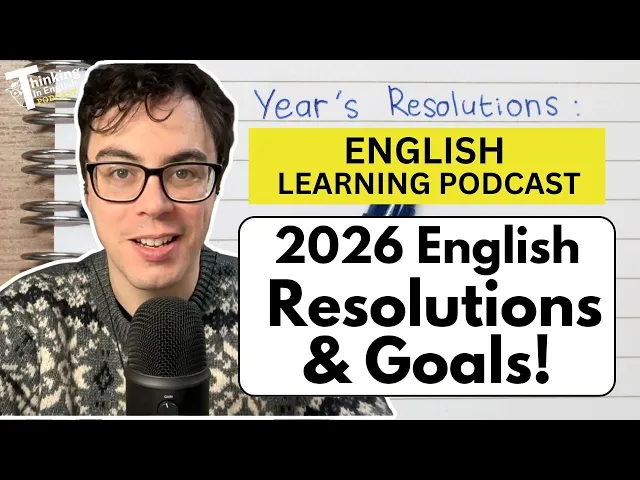
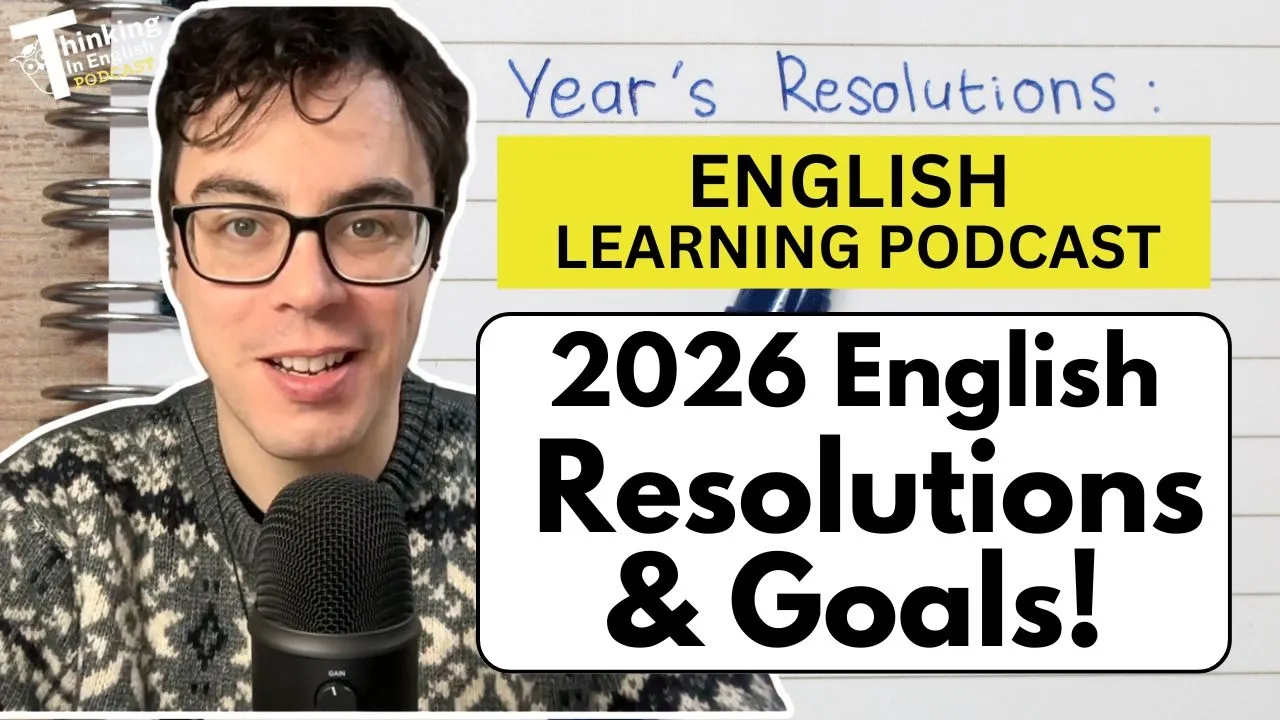
Last year, I made a podcast episode where I openly shared my goals and New Year's resolutions for 2025. Now, it's time to look back and see how I did. In this episode, I'll review my 2025 goals.
I'll talk about what I achieved, what I only partially achieved, and where I failed. And there were definitely some failures. I'll also share my personal and professional goals for 2026 and give you all some ideas for your own New Year's resolutions.
Remember, I'm not perfect and neither are you, but we can try. Let's take a look at what I learned last year and what's coming next and hopefully motivate all of you listening as well. You can listen to this episode with no adverts or sponsors on my Patreon.
And if you go over to Patreon, use the code 2026 and you'll get 20% off an annual membership next year. Links in the description. Here is today's vocabulary list.
Resolution. Resolution. A decision to do or not do something in the future.
as in my resolution this year is to exercise three times a week. Goal goal a result or achievement you aim to reach. For example, her goal is to pass the IELTS exam by December.
Achieve. Achieve to successfully reach a goal or result. For example, he achieved his target of reading one book per month.
Tracking. Tracking. Monitoring progress over time.
As in, tracking my daily habits helps me stay focused. Consistency. Consistency.
Doing something regularly over a long period. As in, consistency in studying is the key to improving your English. Priorities.
Priorities. The most important things you focus on, as in family and health are my main priorities this year. Motivation.
Motivation. The desire or reason for doing something. For example, setting clear goals increases your motivation to work hard.
[music] I want to start this episode by giving you some practical advice you can use to set meaningful, realistic goals for 2026 and also actually stick to your goals. Writing goals is easy. Achieving them is the hard part.
You'll see this later in the episode where I talk about my 2025 successes and failures. Let's start with a simple framework that I always recommend. Smart goals.
This means choosing goals that are specific, measurable, achievable, relevant, and timebound. Instead of vague resolutions like I want to get better at English, try something more concrete, something more specific. I will complete three listening exercises each week or I will learn 10 new words every Friday.
When your goal is clear and achievable, you're far more likely to follow through and keep your goal. I'd also recommend that you try setting both personal and professional or academic goals. Maybe you want to improve your health or learn a new skill and at the same time push forward in your studies or career.
Having a balance between the two gives you a more complete sense of progress. One of the biggest challenges is sticking to your goals over time. And I think the secret here is tracking.
You need a system that regularly reminds you what you're working toward. Tracking your goals helps. You write your goals down in a notebook or maybe a calendar.
And then you regularly review and adjust your progress toward that goal. Ask yourself, what worked this month? What didn't work?
What small change could I make next month to make it easier? Tracking keeps you honest and it keeps you motivated. Another important tip is to break your goals into smaller actions.
Big goals, massive targets often fail because we feel overwhelmed, but small steps can help you build momentum. Also, create an environment that helps you succeed. Remove any obstacles or friction.
Make your habits obvious. For example, if you want to study English in the morning, put your notebook or your listening headphones on your desk the night before. If you want to exercise more, pack your gym bag ahead of time or lay out your clothes.
Make the goal as easy as possible to start. For example, last year I wanted to eat out less. I wanted to eat my lunch at home every day.
So, one of the easiest ways to do this is to make my lunch the night before. So, when I'm making dinner, I also make lunch and then I don't have to worry. It's so easy just to eat my lunchbox every day.
The most important tip I want to give you though is to be flexible. Life will change. Your goals will change.
You will have weeks where nothing goes to plan, but it is also okay if your goals change or adjust slightly. You'll see in a few seconds that I had some unexpected success this year in certain areas which refocused my plans and my priorities. And all of this is okay.
Be flexible. So, now we know how to set goals for next year. I want to take a moment to review how I did with my 2025 goals.
I publicly exactly a year ago set both personal and professional targets. I achieved some of these. I partially reached some of my goals and some I didn't reach at all.
I think looking back is really important. looking back and reviewing the past can help you will help me understand what worked and what didn't work and also maybe what I can do differently next year. So let's start with my personal goals from last year.
Last year my first personal goal was to pass the Japanese language proficiency test N1 level. This is the highest level of the exam available. I passed the N2 version in July 2024.
So, I thought it was a reasonable target to try and step up a level in 2025. Unfortunately, I didn't dedicate enough time to study at all. So, I failed.
I have been so busy with thinking in English and other parts of my life and this year, Japanese study has not really been one of my priorities. I think the big lesson here is the importance of realistic planning. I set myself a very ambitious goal like passing an exam and that is a good thing.
Setting ambitious goals is good. But you also need a clear plan and enough time to achieve your plan. I made myself a plan, but I just didn't stick to it because other things kept happening.
My second personal goal was to maintain a consistent gym schedule. I set myself the target of attending the gym at least twice a week and following a workout plan. I had actually started going to the gym in September 2024.
So, I was still quite new when I set the goal last year, but I really wanted to keep going. And I'm happy to say that I have achieved this goal. In fact, I think I averaged three times a week at the gym over the summer months.
The only times this year that I have been absent from the gym for over one week is in February when it was really heavy snow. It made it impossible for me to get to the gym. It's too far away.
It was really hard to get into the habit of going to the gym early in the morning three or four times a week. But once I started doing it consistently, it became easier to stick with. I also want to make an honorable mention here as well.
I finally learned to drive this year, and I made an episode discussing my experiences earlier this year as well. This wasn't a goal I set publicly last year, but it has been something that I have been setting as a vague goal every year for about 13 years now. So, I'm proud I achieved it.
But learning to drive probably did negatively affect my Japanese study because I was learning to drive instead of studying. And then I had to catch up making Thinking and English content because I was too busy learning to drive in August to make anything. On the professional side, I aimed for Thinking in English to reach 20 million total podcast downloads this year and 650,000 Spotify followers.
This was a partial success. We reached over 20 million downloads, but only got to 600,000 Spotify followers. This year has actually been quite tough for the show on Spotify.
Downloads and plays on Spotify are lower than I anticipated or expected this year. So, if you're listening on Spotify, please listen to a few extra episodes today. But I also experienced unexpected growth on other platforms.
At the time of recording this episode, Thinking in English has about 70,000 YouTube subscribers. I started the year with less than 20,000. So, this is a massive 50,000 new people.
Most of you have come since July. And also, I reached a 100,000 Apple podcast followers, and I've had some of the best months ever for thinking in English on Apple. This year has, I guess, shown me or taught me that growth is not always expected.
It can come from unexpected places. I also set myself the goal to launch a YouTube exclusive series for English learners this year. While it wasn't completely exclusive to YouTube, I have achieved this goal by turning thinking in English into a video podcast in May this year with subtitles and vocabulary pop-ups throughout the episode.
Some of you will be watching this video right now on YouTube. These videos have attracted a brand new audience of amazing people, and I'm very happy and proud of the YouTube videos I've been making. Finally, I plan to create and launch a physical product.
This one failed. I realized that product design is really not my strength. I spent far too many days trying to design a t-shirt or a mug or a notebook to sell on my website, and I've not liked anything I've made.
I guess sometimes it's better to outsource or collaborate with others when you're not good at doing something. The takeaway from this section for you guys listening is that success isn't always simple or binary. It's not always success or failure.
Some of my goals were clear successes like going to the gym. Some were clear failures like not passing my Japanese exam, but other goals changed along the way. Sometimes growth happens in unexpected ways.
Setting goals publicly like I did really helps with accountability and motivation. I told you all what I wanted to do and now I'm telling you how I did. So now we've looked back at what went well and what didn't go well last year.
It's time to look forward. I want to share my goals and thinking in English's goals for 2026. These are the personal challenges I'm preparing for and maybe some professional milestones I'm aiming at and I guess the mindset I hope to bring into 2026.
On the personal side, the first goal is taking the JLPTN1, the Japanese test. My aim is simple, try and pass it this year. I'm going to approach it with a clearer study plan and a more focused attitude.
So, I don't want to do anything dramatic. My hope is simply make steady and deliberate progress. I might actually look for an online Japanese teacher to help me stay more consistent this year.
Then there is the biggest personal challenge I will face in 2026. Becoming a father. In the next few weeks, maybe already by the time you're listening to this, we will have welcomed a new member into our family.
My intention is to be a present and supportive father in my child's life while also continuing to provide for my family. It's a life-changing transition and I want to kind of face it with balance and patience. I want to balance thinking in English with my personal life.
Professionally, I'm setting some ambitious but achievable targets. I'd love to continue growing the thinking in English audience. 650,000 Spotify followers, 100,000 YouTube subscribers is what I'm aiming for.
I would love really love to have a silver play button from YouTube. The plan there is as clear though. Keep making things you want to watch and you want to listen to.
I also want to launch an affordable course or a learning challenge, especially for my Patreon supporters. This would be something practical and accessible. I have some plans already, but it just depends on how much time I have in the next few weeks.
And finally, I'm hoping to collaborate more. I think working with other podcasts or creators could open some new doors for me and bring some new ideas or push me more creatively. I've never really done this before, but I think 2026 feels like the right time to try and seek out some collaborations.
You've heard about my goals for 2026, so remember them and ask me about them next year. But I think it's your time to think about your goals. What are you planning to achieve or do or stick to next year?
I know it can be really difficult to set goals for yourself. So, actually, I've made 10 possible resolutions for a English learner that hopefully should or could be relevant to some of you listening. So, I'm going to give you these 10 resolutions.
See if any of them are useful for you. First, here are two readingbased resolutions. Read an English news article twice a week, for example, on a Tuesday and a Friday, and make a list of five useful vocabulary items each time.
Or read one English book every two months by reading a chapter or two chapters every Saturday and every Sunday. Next, here are two listening resolutions. Listen to two episodes of the Thinking in English podcast every week.
I release them on Mondays and Fridays. And leave a comment in English on at least one of those episodes. Practice writing every week or watch at least one English documentary or YouTube video or TV episode every week.
If you need to use English subtitles until you no longer need them. Here are some writing resolutions. Write a one-page journal entry every week reflecting on something you learned or did in the previous week.
Or write a review of a restaurant or a shop or somewhere else you visited in English once a month. And if you're brave, post it publicly on Google Maps or something. Next, speaking resolutions.
Record yourself speaking for two to three minutes about any topic once a week. Review your previous recordings every month or so, or join the thinking in English conversation club once a week and aim to share your opinion five times in the session and ask two questions to other members. Also, here are some general learning resolutions I thought of.
Choose one English sound each month. for example, th or R, L or vowel contrasts and then practice it for 10 minutes twice a week using any online tool you can find. Or spend 10 minutes every Sunday planning your English study for the next week.
What you're going to read, what you're going to listen to, when you're going to study, what you're going to practice. Hopefully, one or two of these resolutions will fit into your situation and motivate you to make your own goals for next year. [music] So, here is today's final thought.
I want to leave you with a simple message. Your goals only matter if they matter to you. I've shared my failures, my successes, and my hopes for 2026.
I haven't done this because I think you all should copy them. I've done this because I hope they inspire you to think honestly about your own direction for the year ahead. Setting goals isn't about being perfect.
Some of my goals from last year went exactly as planned and some went in an unexpected direction. That will happen to you too and that's absolutely fine. But it's your turn.
What do you want to achieve in 2026? What skill do you want to improve? What habit do you want to build?
What challenge do you want to finally face? Take a moment today or this week to write down one or two clear, realistic goals for your English, your studies, or any part of your life. And if you feel comfortable, share them in the comments for this episode.
I'd love to read your resolutions, encourage you, and keep you accountable throughout the year. You can leave a comment on Spotify or on YouTube, or if you're a Patreon subscriber, you can comment on Patreon, too. In fact, there is a discount right now on Patreon.
20% off if you use the code 2026 while buying an annual membership to my Patreon. Next year, you can join conversation clubs, listen to bonus episodes every Friday. There's my film club, and maybe, like I said earlier in this episode, I want to introduce some new kind of courses for my Patreon subscribers.
I can't guarantee they'll come out soon, but hopefully in the next few months, there will be some new things coming. But anyway, we have our conversation clubs, bonus episodes, grammar study packs, so much more as well. So, go over to patreon.
com/thinkingglish. Link is in the bio. Use the code 2026 and get a discount.
But thank you all so much for listening. In fact, thank you all so much for supporting Thinking and English over the past year. And here is to a motivated and successful 2026 for all of us.
Thank you all. Goodbye.