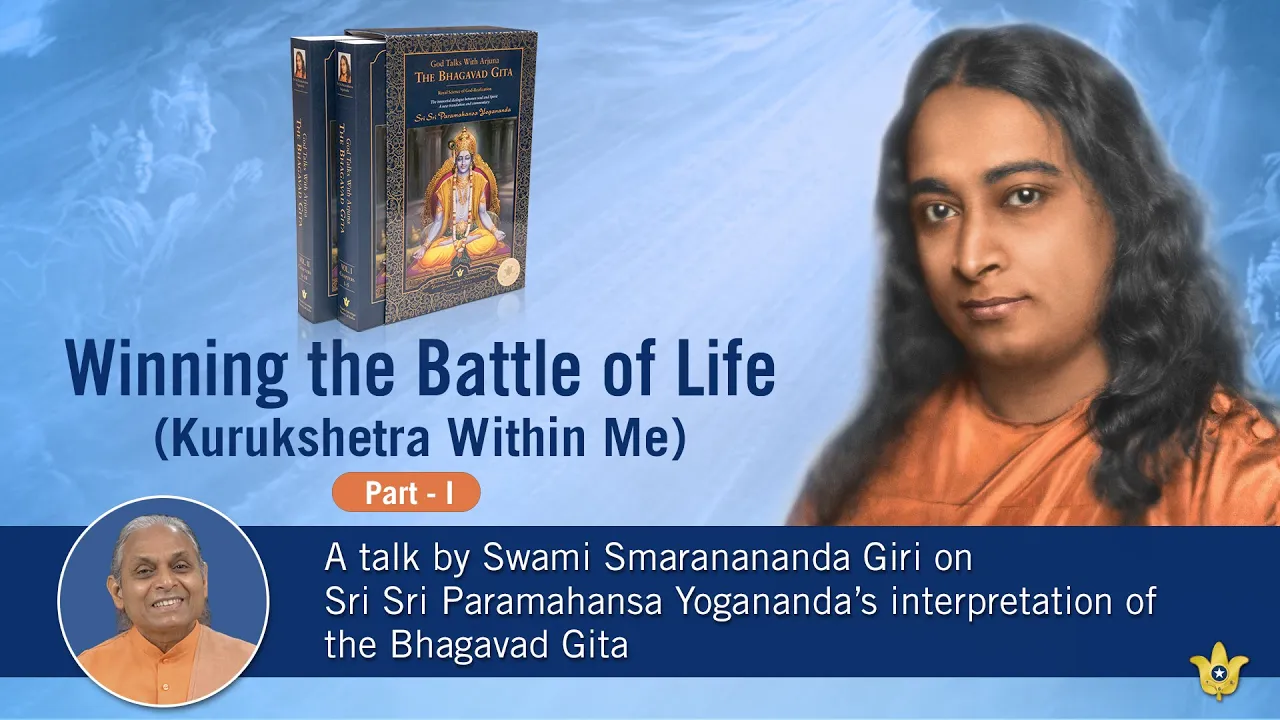
Jai Guru. Love and greetings to each one of you. I'm so happy to join you all in the study of the Bhagavad Gita.
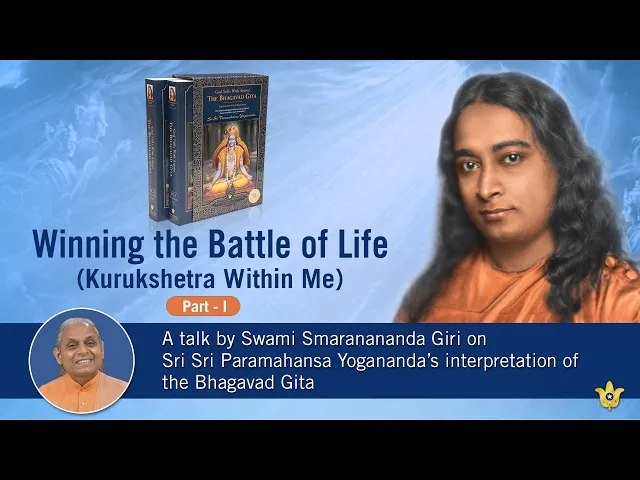
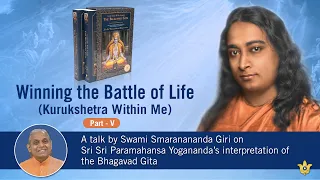
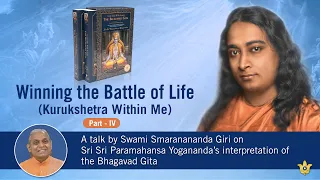
Today, we have the first talk in a series of discourses on the wisdom of the Bhagavad Gita. The specific topic for today is, "Winning the Battle of Life: The Kurukshetra Within Me" based on the book "God Talks With Arjuna" the interpretation given by Sri Sri Paramahansa Yoganandaji. As we all know, Bhagavad Gita has been a perennial favourite scripture of many, many saints of various religions down the centuries.
There have been many interpretations of Bhagavad Gita. If so, is there a need for yet another translation, interpretation, "God Talks With Arjuna"? I would say that, yes, there is a need because "God Talks With Arjuna" is not yet another interpretation.
It's a very unique interpretation, as we will see during our series of lectures. This is a yogic interpretation. We have two volumes.
Volume One and Volume Two running into around 1200 pages. In these two books, Guruji has dealt so much in detail, especially in terms of Yoga. In the words of Guruji, "Yogoda Paramgurus bequeathed the world, along with the long lost Kriya Yoga, a new revelation of the Gita, relevant primarily to the science of Yoga and to 'Kriya Yoga in particular'.
" The world knows, that it is through Yogoda Guru Parampara, the long lost Kriya Yoga was revived and spread among humanity in this age. But one more thing Guruji is saying that this interpretation of Bhagavad Gita, this is also a unique contribution of Yogoda Gurus to the world. To understand Bhagavad Gita, let us first understand the context of Gita.
When Gita was delivered by Bhagavan Krishna. For this, Mahabharata in a nutshell. Pandavas lost their kingdom in the game of dice.
As a result, they had to go into twelve years of vanvasa in the forest, followed by one year of ajnyatavasa, in exile. And they fulfilled the conditions. 13 years they were away from their kingdom.
And they came back after fulfilling the conditions and demanded their kingdom, which is morally and legally theirs. Their own kingdom, they demanded. But Kauravas sitting in Hastinapur said, "No.
We won't give your kingdom. " Then, having left with no other option, Pandavas declared a war against the Kauravas. On the eve of the war, when Arjuna saw the people he had to fight to regain his kingdom, he went despondent.
It's not worth fighting friends and relatives to get back this material kingdom. There is an analogy with my life and with your life. "Aham Brahamasmi" is a fundamental truth.
Meaning - I am a spark of Divinity. Brahman is in me. God is in me.
I'm a spark of Divinity. All religions proclaim this. All saints declare this.
We are a part of that Divinity. Divine kingdom is my birth right. Divinity is my birth right, but I lost my divine kingdom in the game of delusion.
Playing with delusion, I lost my divine kingdom and I am in exile, living like a mortal. A mere mortal being, subject to all the experiences, suffering, pain of this material world because I'm a mortal now, I lost my kingdom. After many, many, many incarnations, having gone through many hard knocks, I realize that my kingdom is elsewhere, that is inside, I want that kingdom.
For Pandavas, it was only 13 years away from their kingdom, but for me, it is many, many incarnations to understand that I lost my divine kingdom. I have to get that back. So now, I would like to have my own divine kingdom.
That's mine. Divinity is mine. I'm heir to this divine kingdom of love, joy, wisdom because I'm a spark of God.
I want to realize that, that I am the son of God, spark of God. Pandavas, although it was their own kingdom, their mere asking was not enough because Kauravas denied them their kingdom. Similarly, my mere understanding that I want my divine kingdom is not adequate because there are some Kauravas sitting in me.
These Kauravas are preventing me to have my own kingdom. Who are these Kauravas? My desires, anger, pride, jealousy, ahankara, ego, habits.
These are all there in me. These are all Kauravas. As long as these Kauravas are in me, I cannot get back.
As long as Duryodhana, Duhshasana and other Kauravas were there, Pandavas could not get back their kingdom. They had to be annihilated. Then only they could get back their kingdom.
Same thing. Even I have to overcome my own material desires. My own anger, pride, ego, habit — I have to overcome this, conquer this.
Then I will taste my divine kingdom. Just before the war, when Arjuna saw the people, Bhishma, Drna, Ashvatthama, his own uncles, father, grandfather and his own Guru, people like that, he felt that it’s not worth it. It's not worth killing my own people to get back this kingdom.
Then Bhagavan Krishna gives the advice, "People whom you are thinking "are your friends and relatives are not your real well-wishers. "They are the ones who are denying you your rightful kingdom, "so, you have to fight, you have to fight. " Same thing with me.
I want to get back my kingdom of divinity, but I understand that to get that back I have to fight my own ego. I have to conquer my own anger, pride, jealousy, my own laziness. I have to conquer these.
No, it's not worth it. I don't know what is the divine kingdom. When I will get it?
It's okay. But you know, I take pride in my position. In my possessions.
So, do I have to give up this? Is it worth it? They are my own.
They are my own. Laziness, sleep, joy that comes in sleep These are all very happy-giving habits to me. It's not worth it.
“God Talks with Arjuna" explains that. These qualities which you are thinking are so close to you or too difficult for you to give up, are not there for your welfare. They are not there for your welfare.
You have to conquer them so that you will get your real Divinity within. You will realize, God-realization. Atma Sakshatkar.
What you are, you will realize only when you get rid of what you are not. My anger, anger is not me. That is sitting in me.
I have to remove it. I mean, that is the analogy. So, I am also fighting a Kurukshetra war within me.
And who are the Kauravas I have to fight? Duryodhana stands for material desire. He is there.
Duhshasana is there, here. Duhshasana stands for anger. Karna stands for greed.
Shalya stands for pride. Bhishma represents the ego in me, and the habit is represented by Drnacharya. So, these are all there.
But fortunately, I also have some Pandavas in me. They are helping me. Self-control, I have.
I have some degree of self-control. That is Arjuna in me. Arjuna represents self-control in each one of us.
Similarly, I do Pranayama. Pranayama is Bhima. The calmness I practice, that is Yudhisthira, eldest brother of the Pandavas.
And I practice the moral principles, Yama-Niyama, represented by Nakula, Sahadeva. They're all there in me. The good qualities are there in me.
So, it's a fight between Pandavas and Kauravas, evil and good tendencies. So, that Kurukshetra is going on within each one of us, whether we realize it or not. Because everyone wants to be good.
And he knows that he has to fight, even if he's not a spiritual aspirant. Explicitly, he is not trying for that. Meditating.
But still, he is fighting his lower nature, these Kauravas in him. Now, before we go further, I want to express my personal appreciation for this interpretation, "God Talks With Arjuna. " As a child, I liked Mahabharata story, very deeply.
I always liked it because there are so many characters and there are plots and counter-plots and always exciting, thrilling, you know. I have seen so many books and I have seen so many movies and even children's books. Many books I read on Mahabharata because I used to like it.
Later, as I became an adult, especially after stepping my foot on spiritual path, I found, Mahabharata is the most saddest story, one can think of. Very sad story. What is it?
From the beginning, even young children, fighting each other. That jealousy, that pride, that anger. Even young children, Kauravas and Pandavas.
And then it went on and on. Eventually, what? A terrible war broke, Kurukshetra.
And son fighting father, friend fighting friend, teacher fighting his student, like that. It was so sad for me. But, after I read "God Talks With Arjuna", then my ideas changed.
And my good feelings about Mahabharata came back. The reason is this. See, why Bhishma was killed?
Bhishma was probably the most venerable person in Mahabharata. Blameless. Bhishma-- Sacrifice and commitment, dedication to his kingdom.
Such a great personality. Why he was killed? And earlier, it was pain for me.
But, now I can understand. No doubt, Bhishma was a very great person. So much sacrifice, so much will-power.
But he had one bad quality. One bad quality. That was, he always wanted Kauravas and Pandavas, his own grandchildren, to live together in peace.
There is nothing wrong in having that desire, to have his children live in peace. Nothing wrong with that. But, he has, you know, so many times he saw the Kauravas trying to disturb and cause problems to the Pandavas.
All along, from childhood all the way, when they grew up, grew up, grew up. And by wrongful means they snatched their kingdom. And they don't want to give back their kingdom.
Like that many, many, many things. They tried to kill them, in many ways. So, they were erring and Bhishma knew that.
If only he wanted justice. If only he wanted real peace. With one arrow, he could have annihilated the entire erring Kaurava clan.
He didn't. Till the end, even after the war was declared, still he was wanting both to live peacefully. It doesn't happen.
It won't happen. Same thing with me. See, I have Pandavas in me.
I have the habit of meditation, I have the devotion, I have the desire to serve God and love God. All these good qualities are there, definitely. But I also have some beautiful negative qualities.
Like anger, laziness, pride. These things I don't want to leave. I want to hold onto them and I want to hold onto good qualities and both should co-exist and I should get God.
You know? Without leaving these evil tendencies, I want God. Like Bhishma, he didn't want to leave Kauravas, but he wanted peace.
Same thing. It will not happen. My ego, if it doesn't leave that pride, it doesn't leave those evil habits, laziness.
I can't get back my Divinity within. That is why for Pandavas to win, first, Bhishma had to go. He had to go.
Then one by one, they conquered other warriors. Drnacharya, Karna, Duryodhana, Duhshasana. Everyone was conquered afterwards.
Ego had to go. Bhishma had to go. Similarly, in me, I have to subdue my ego.
My pride, my desire I have to subdue if I want Divinity, which is mine. So, now I got interested. This is what Guruji explained.
Kauravas are in you. This is Mahabharata. So, now I am not so interested in that Kurukshetra which took place 3000 years ago out there in Haryana.
I'm more interested in the Kurukshetra that is taking place here, within me. All the time. I'm more interested in this.
One more point. Who killed Karna? Karna was supporting the erring Kauravas.
He eventually was killed. Who killed him? The immediate and most natural answer is Arjuna.
Arjuna killed Karna. But it's not true. It's not a full statement.
I would say that Arjuna killed Karna with the help of Krishna. Without the help of Krishna, Arjuna could not have killed Karna. It was the help of Bhagavan Krishna, till the last moment.
He helped. Otherwise, Karna would have killed Arjuna. You know, you remember the Ghatotkacha story.
You remember the Nagastra. Bhagavan Krishna saved Arjuna. Same thing in me, I have self-control or Arjuna.
I also have greed. So, my greed cannot be conquered by my self-control that easily, but I can definitely conquer my greed, with my self-control, with the help of my Guru. My Guru in this life is Bhagavan Krishna to Pandavas.
Guru, now my Guru, spiritual Guru is Krishna for me in this Kurukshetra that is waging inside my own being. So, now when I understood that, also gives the importance of a true guru in one's life. With his grace alone, with his blessings and guidance, I can conquer.
I can conquer my lower nature, evil tendencies within me. So, when I understood Mahabharata like this, the Kurukshetra, now it's becoming very interesting. Because it's a daily Kurukshetra in me.
It is very interesting. Now, about the author. This book, "God Talks With Arjuna" this was written by Paramahansa Yoganandaji.
And any book, with any book we read, first, we see who is the author. Isn't it true? We would like to know who is the author?
So, now let us see who, and his qualifications to write this book. That will give us, you know, trust in the material contained in this. Daya Mataji, our third President of our organization, she wrote, "In him", meaning in Paramahansa Yoganandaji, "the world had been given a true exemplar of the essence of the Gita.
In his active life of service for the upliftment of humankind and in his constant intimacy with God-- A beloved God of unconditional love. " There are two qualities which made his life exemplary. Rather, his life, Paramahansa Yoganandaji’s life was the essence of Gita.
One, that unconditional, selfless service to mankind. Two, the intimate love for God. Both, these are the ultimate qualities a devotee would like to cultivate.
And he did. That's the essence of Gita. Service to mankind and intimacy with God.
He had those two. Now, while working on the Gita interpretation, in seclusion in a small ashram in Mojave Desert, one monk said, "There was a look of incalculable remoteness in his eyes and Guruji said to me, "The three worlds are floating in me like bubbles. " “The sheer power radiating from him actually moved me back several steps away from him.
" Now, that was the state of his mind when he was interpreting the scripture, Bhagavad Gita. He was in a different world, complete in attunement with God, Krishna, Vyasa. He was.
So, the sheer power radiating it was such that, that monk had to go back. Another monk entering the room where Paramahansa Yoganandaji was working, remembers, "The vibration in that room was unbelievable. It was like walking into God.
" That was the environment that was created when he was thinking about Bhagavad Gita, trying to understand and put on paper the message of Bhagavad Gita. Guruji wrote to a devotee during that period, "I dictate scriptural interpretations and letters all day, with eyes closed to the world, but open always in heaven. " That means you're away from this materialistic world.
But he was awake there, in God's presence. Swami Anandamoyji, with whom many of us are familiar, he said, "Several times I had the opportunity to be in the room where Guruji was working on his writings. I could see that Guruji was in a deep state of inner communion, as he put his sublime inspirations into words.
So, I knew that his words did not come from intellect. They came through his direct communion with God. " Guruji was in communion with God.
He was one with Bhagavan Krishna. He was one with Vyasa, and then interpreted. Guruji said, in all his humility after finishing this book, "God Talks With Arjuna" he said, "The work is not mine, it belongs to them, Param Gurus.
"belongs to God, Krishna, Arjuna and Vyasa. " That is why he said that when he was writing this book, interpreting Gita, he was one with Vyasa, Veda Vyasa. So, he could understand what Veda Vyasa meant when he wrote this Gita, shlokas.
So, that is how he was one with Vyasa. That's why in all humility he said that it belongs to him. The interpretation.
Paramahansa Yoganandaji has a dual role in this world. First, to all Kriyabans of Yogoda Satsanga Society and Self Realization Fellowship. He is their personal guru, a satguru.
He's their personal guru. And at the same time he is also a Jagadguru, a world teacher. His teachings, his message was beneficial for the upliftment of this mankind.
And his spiritual legacy, is a blessing offered to the entire world, even if they're not his direct disciples, even not their Kriyaban disciples, practicing Kriya yoga, still they can be benefited. To them he's a world teacher. But Kriyabans, he is their personal Guru.
In "God Talks With Arjuna", now, it's vast, it has covered so much, so much. Now, from the subtle causes of everyday thoughts and actions to the grand design of the cosmic order now, daily, how I think and act, that is there in this book. Guruji represents a sweeping chronicle of the soul's journey to enlightenment.
That is your journey and my journey. To enlightenment. Clearly outlining the Gita's balanced path of meditation and right activity, Paramahansaji shows how we can create for ourselves a life of spiritual integrity, sincerity, simplicity, serenity and joy.
Through our awakened intuition, we come to know the right course to take at every crossroad on the path of life. I mean that's the beauty. This interpretation of "God Talks With Arjuna" is not only for God realization, Self-realization.
It is also for day-to-day living, my day-to-day living, today, here and now. Guruji wrote, "Those who study sincerely the message of Gita will find it a faithful travel companion that will not only guide and encourage, but also caution and protect. " And we'll see that later, the truth behind these words.
And Guruji said, "I have, throughout this manuscript, endeavoured to give sufficient theoretical explanation to satisfy any intelligent layman, that yoga is indeed a science. Perfectly organised by the sages of ancient India. " Yoga is really a science, science of yoga.
And in preparing the interpretation of the holy Bhagavad Gita, my intent and prayer is to awaken new hearts and minds to the physical, mental and spiritual blessings available through right knowledge, and the application of yoga science and to encourage and hasten the progress of those devotees who are already steadfast on the yoga path. " Meaning, the intent behind this book is not only to encourage new people to practice yoga, but also help those who are already on the path of yoga, newcomers as well as veterans. It's useful for both.
And any discussion on this book, "God Talks with Arjuna" is not complete without recollecting the grand assurance Paramahansa Yoganandaji gave us. This is the grand assurance; "As God talked with Arjuna, so will He talk with you. As He lifted up the spirit and consciousness of Arjuna, so will He uplift you.
As He granted Arjuna supreme spiritual vision, so will He confer enlightenment on you. " What an assurance! "As God talked to Arjuna, so will He talk to you.
" Meaning, He will talk to you and He will talk to me, because God has no favourites. He chooses those who choose Him. Meaning?
He, God doesn't want to impose Himself on anyone unless that person wants God. If we want God, we have to follow the path. He will definitely talk to us.
Confer that enlightenment which He conferred on Arjuna. And Guruji goes on, "Each person has to fight his own battle of Kurukshetra. " We all agree without any dispute.
Isn't it true? Each person has to fight his own battle of Kurukshetra, which we are doing. "It's a war, not only worth winning, but in the divine order of the universe and of the eternal relationship between the soul and God, a war that sooner or later must be won.
" Beautifully worded, to give that assurance. Each one has to fight it. Each one has to fight his own battle of Kurukshetra.
And it's a war, not only worth winning, it's a war that must be won sooner or later. Let it be sooner! That means it is not a question of whether you are going to be successful in your quest for Self-realization.
It's a question of when? Each one of us, as our life is going on, we're all seeking that Self-realization-- directly or indirectly, consciously or unconsciously. Every human being is looking for that permanent joy within, that unconditional love within.
Everyone! But some do that consciously, some do it unconsciously. Everyone will win, eventually.
It's a question of when, not a question of whether. Now, some of you must have seen this book already, because it has been in publication for twenty years in India. Do you know to whom this book has been dedicated?
It is a dedicatory-- Words are here, to whom it has been dedicated? I'll read out. "To the Arjuna devotee within every seeker.
" Contemplate on these words. Gurudeva has dedicated this book to the Arjuna devotee within every seeker. That means this book has been dedicated to you, and to me because that Arjuna is in us, each one of us.
So, we should be so grateful this book has been dedicated and we should take advantage. Be benefited by it. Guruji said, "The words of Lord Krishna to Arjuna are at once a profound scripture on the science of yoga and a textbook for everyday living.
" "Krishna's message is the perfect answer for modern age, or for any age. The underlying essential truths of all great world scriptures can find commonality in the infinite wisdom of the Gita. Gita's mere seven hundred concise verses.
The entire knowledge of the cosmos is packed into the Gita. Wherever one is on the way back to God, the Gita will shed its light on that segment of the journey. " So, the Gita is useful for everyone.
Beginners, veterans, or somewhere in between, Wherever you are, Gita will shed light there. Now, one more description. One point from the introduction and then we go to the actual Gita.
The three-fold meaning of the Gita. Material, astral and spiritual. Three-fold meaning.
Material interpretation, astral interpretation and spiritual interpretation. So, man has three bodies. Physical body, astral body and then causal body.
Man has three bodies. That is why three-fold meaning of the Gita, pertaining to each of these bodies. To understand what are the three bodies, in concise form, "Incarnate man is encased in a physical body of inert matter, "which is animated by a subtle inner astral body "of life energy and sensory powers.
" "And both his astral body "and physical body have evolved from a causal body of consciousness. " I mean to understand, in simple words, the physical body is there, this animated, operated by astral body which is inside. Astral body of life energy and sensory powers.
Sensory powers do not belong to this physical body, that's astral body. And behind that, is causal body of consciousness. To explain this, I'll give you a demonstration.
Here, I'm wearing a glove. Now, do you see the movement of the glove? Glove is moving?
No doubt, glove is moving. But glove is moving because the fingers are moving. That means, glove by itself cannot move.
Fingers operate. (Under) the glove, fingers. But how my fingers are moving?
It's because of the instructions it's received from my thought. My thought has given instruction to the fingers and fingers moved and hence, glove moved. The glove is the physical body.
On its own it can't move, but for the sensory powers and life energy which belongs to the physical body. Here, glove is the physical body. Fingers, represent the astral body.
But fingers also act on the thought from the mind, which is causal body. So, thought is causal body. Fingers, astral body and glove, the physical body.
They are three bodies. And Gita interpretation, "God Talks With Arjuna" deals with all three bodies. In this overview, the material interpretation of the Gita pertains to physical and social duties and well-being of man.
See, as long as I have this body, I have some physical duties. I have some social duties. And Gita interpretation here, deals with that.
How to take care of my physical duties, social duties and well-being of this body. That is on a physical plane, Gita gives guidance. Next, the astral is from the moral and psychological standpoint, man’s character, resulting from the astral nature-born sensory and life energy principles that influence the formation of habits, inclinations and desires.
See, this physical body moves around. But inside that the habits, inclinations, and desires, they come from astral body, inclinations, samskaras. And "God Talks With Arjuna" deals with that also.
How to handle those samskaras? How to eliminate bad tendencies? And finally, the spiritual interpretation is from the perspective of the divine nature and realization of the soul.
That is Self-realization, meditation. That is also dealt with, in the same book. Guruji said, "Hence, while I have emphasized the spiritual aspects of the Bhagavad Gita, the material and psychological import has also been interwoven, to stress the need for practical application of the Gita wisdom in all phases of life.
" Truth is of all-round benefit to man. " So, physical, astral and spiritual interpretation. It is all-round benefit to man.
Now, we'll go to the first shloka. All this explanation so far, is only introduction to "God Talks With Arjuna". Now, we'll take shloka after shloka and understand the meaning.
First, let us listen to the first shloka of the first chapter, sung by Swami Vasudevanandaji. [Swami sings Gita Shloka. ] [Swami sings first Gita Shloka.
] [Swami sings Gita Shloka. ] [Swami sings Gita Shloka. ] The plain meaning of this shloka is, Dhritarashtra spoke, "On the holy plain of Kurukshetra, gathered together, eager for battle, fought my children, the Kurus and the Pandavas.
What did they, O Sanjaya? " It's a very simple meaning. You know, Dhritarashtra, who was the father of Kauravas, was blind.
He wanted to know what's happening on the battlefield of Kurukshetra, but he cannot see. Vedavyasa was ready and offered divya-drishti to him, by which he could see what is happening on the battlefield. But, Dhritarashtra refused to have that gift, saying that, "Even if you give me that gift, I will not be able to recognize who is who, because I'm born blind.
" Then Vedavyasa gave that power of divya-drishti to Sanjaya, who was a charioteer of Dhritarashtra, who was his companion. So, Sanjaya would see, from wherever he was, in the palace, what was happening on the battlefield and narrate to Dhritarashtra. Now here, there is an analogy.
Dhritarashtra represents the blind mind in me. Because my mind is blind, it depends on senses for information. Whatever is brought through eyes, mind tries to process.
Whatever it brings through ears, mind tries to process. It depends on senses for its information. If senses bring wrong information, it interprets wrongly.
For instance, I see some horse somewhere. But it may not be a horse. It may be a cow.
From a distance, I could not distinguish. But mind thinks it's a horse. So, mind is blind, it depends only on senses for all information.
Here, Sanjaya was given that power, divya-drishti, and Sanjaya represents, introspection. In daily life, we have to introspect. Not only Dhritarashtra is in me, the blind mind, I also have Sanjaya in me, that is introspection.
The capacity to introspect, that is there in me, Sanjaya is in me. So, we have to ask Sanjaya, "Today, in the battlefield of my life, how did my good tendencies and bad tendencies fare? What did they do today?
" Like Dhritarashtra was asking, "How did Kauravas and Pandavas do today on the battlefield? What did they do? " Similarly, my mind every day has to ask my introspection, "How did you fare?
" Your evil tendencies, rather, my evil tendencies and my good tendencies. See, this shloka, is very simple. Dhritarashtra is asking "What's happening?
" And many interpretations of Bhagavad Gita dismiss this shloka in one paragraph or one page. This is what Dhritarashtra asked and go to the second shloka. But Guruji has taken 45 pages to explain the import of this.
The Kurukshetra within. The first shloka tells us a fundamental truth. "That life is a series of battles between Spirit and matter, between knowledge and ignorance, between soul and body.
Battle between self-control and temptation, discrimination and the senses. " Each one of us is going through this battle inside, between knowledge and ignorance. The human body is a veritable battleground.
It's a Kurukshetra field, human body. War between wisdom and ignorance, between wisdom and conscious delusive forces. "Every spiritual man wants to defeat rebel, King Ego and its powerful sense allies and establish the rule of King Soul in the bodily country.
" Now, the import is this. Every night before sleep, a sincere sadhaka, like you, must honestly introspect, "How did I do today? " Your own introspection, that has to be invoked and it has to guide you.
People write diaries. Normally diary gives, "What did I do today? " But a spiritual person goes into minute detail.
He will write, "Why did I do what I did? " Why did I do, with the reason behind my actions, is also important. Sometimes, actions may appear to be very polite or very genuine, you know.
But behind, the motivation, the motive behind the actions also have to be analysed. You only can analyse your motives. I can observe my motives.
That is important. Then only, the introspection is genuine. Now, there is one question.
We are all Divine. "Aham Brahmasmi. " We are all different expressions of the same Divinity.
If we are Divine, if Divinity is within us, why this trouble? Why would I go through this battle? Why would I even do anything which is not acceptable to God.
Why would I? I am Divine. Then why would I go through this battle?
No doubt, that is the ultimate truth. You are Divine. But our soul is covered by layers of ignorance.
Layers, not one. One after another. There are layers of ignorance covering this spark of Divinity.
Only when these layers of dust are removed, then only the Divinity comes out in its full glory. So, that is sadhana. Sadhana is to remove these layers of ignorance.
And we all know, from Guruji’s teachings, and the other spiritual literature, that the soul's journey starts from the mineral kingdom. First, soul exists for some time, as a mineral. And slowly, it progresses to human being, and then enlightened human being.
When soul is in the mineral kingdom, that soul as a mineral is covered by five sheaths. You can say five covers, five sheaths. Topmost cover is annamaya kosha.
Then pranamaya kosha, then manomaya kosha. Then jnanamaya kosha and then anandamaya kosha. There are five layers.
When soul's journey starts in the mineral kingdom, it has got all five layers. Sheaths are there. After living in the mineral kingdom, slowly, slowly the topmost layer, annamaya kosha is rolled out.
You know, soul, even as a mineral sparkles. There is a difference between mineral and soil. Mineral has soul.
That is why it sparkles. It has an existence. It may not have life, but it has existence.
And when the soul lives for many, many, many. . .
I mean, whatever time, years, or decades or whatever. After living for so long, the topmost layer is rolled out and what comes to surface is pranamaya kosha. Life force sheath.
Then, soul enters the kingdom of plants, plant kingdom because plants have life. Not existence, they also have life because it sparkles with life. And hence the beauty of plant kingdom, because there is life.
For the first time soul is sparkling with life, not only existence, it is sparkling with life. After living in plant kingdom, plant after plant after plant, for many, many, many incarnations, the life force sheath is unfolded, removed. Then comes to surface, manomaya kosha, mind sheath.
Then soul enters the kingdom of animals, animal kingdom. Because animals have not only existence and life force, but they also have a mind. Animals have mind.
Plants do not have, but animals have the manomaya kosha. It sparkles with manomaya kosha, that’s why animals, you know, they become so dear to us because they have a mind, they respond. But animals do not have discrimination.
That jnana is not there. They go by instinct, as directed by the mind, instinct. Okay.
And after many, many incarnations in the animal kingdom, the manomaya kosha is dropped, then comes to surface, is jnanamaya kosha. When jnanamaya kosha is exposed for the first time, the soul enters a human body. Human body is not only existence, not only life, not only mind, but also discrimination.
Jnana is given. And with that comes the responsibility to use that discrimination, jnana. And man, after living many, many, many incarnations and doing sadhana he progresses further and he removes that jnanamaya kosha.
When that is rolled back, what comes to surface is anandamaya kosha, enlightened man. That man lives in happiness, all the time joy. That God's joy he expresses, not only wisdom, not only that jnana, he also expresses that joy, always living in that joy.
Enlightened man. And further, further sadhana, this is removed anandamaya kosha and the soul merges with God. That's how soul's journey progresses.
From mineral kingdom to plants to animals to human beings to enlightened human beings and then Divinity. Now, the question is, does it mean that all of us human beings, we're all already progressed to that extent? We have removed all these covers of annamaya kosha, pranamaya kosha, manomaya kosha, and we're all sparkling with jnanamaya kosha?
No. Guruji said, "Man being the microcosm of the universe has within him all five sheaths "matter, life, mind, intellect and bliss. " All the sheaths are there.
No? It was so interesting earlier that I am progressing, progressing, progressing, progressing. No.
I have all these sheaths because man represents the entire universe. He's a microcosm of the entire universe. If universe is covered by so many layers of ignorance, even I am covered.
And man alone is capable by his self-effort to remove these sheaths, to remove and get back to Divinity. Man has the capacity. Man is a special creation.
He has the capacity to remove. And meditation is the most effective way to remove these layers of ignorance. Meditation is the most effective method for sheath removal.
The sheaths are removed. How? Beautifully, Guruji explains, "By the correct practice of meditation the accomplished yogi, through pranayama, or life force control, unfolds the life energy sheath.
" I mean, that's understandable. When I do meditation, I'm essentially practicing life force control, pranayama. When I practice pranayama, as we become adept at it, with the help of pranayama, we get control of pranamaya kosha.
The pranamaya kosha is unveiled. That's removed by practicing pranayama, sincerely and regularly. "With mastery of the life force through meditation, man realizes the true nature of matter as a delusional objectification of Spirit.
" That means the true nature is only delusion. That means annamaya kosha is under control. He understands the nature of annamaya kosha and that is removed.
Again, through pranayama. And then what is life? Life force goes through the spine downwards and at every chakra it goes outwards to the senses.
That's how senses are energized by the flow of the life force downward and outward. Downward along the spine and then each chakra of the spine, outward to all the senses. Downward and outward.
Pranayama, meditation techniques help us to reverse this direction of life force. That means, inward and upward. From senses the life force is withdrawn to the chakras in the spine.
And once it comes here it is more up, up, up, up to sahasrara. Inward and upward. That is pranayama.
That’s when we practice Kriya Yoga and when we practice Aum Technique and Hong-Sau, this is happening, this is happening actually. And when life force is reversed away from senses into the spine and up, the senses are subdued. They don't receive the life force to keep them active.
They are subdued. When senses are subdued, the senses would not give any information to the mind. Mind is blind.
It passes information only that's coming from senses. When senses are subdued, they don't send any information to the mind and mind comes in our control. Manomaya kosha is also removed by proper practice of pranayama.
That's how manomaya kosha is conquered. When it's conquered, then what is predominant? Jnanamaya kosha.
"The cultivation of discriminative qualities through right spiritual action and yoga meditation gives man ultimately the ability to roll back the jnanamaya kosha, to reveal the bliss sheath, anandamaya kosha. " So, when we use jnana, discrimination, in daily life, discrimination-- slowly, slowly, slowly jnanamaya kosha comes under control, that is conquered. When it is conquered out comes to the surface, anandamaya kosha.
That is why people who are advanced on the spiritual path are, most of the time, joyful. Because anandamaya kosha is expressing so much in him. Anandamaya kosha.
And further, deeper sadhana removes even that anandamaya kosha and the soul merges with God. This is sadhana. This is yogic sadhana.
And we should remember that it is not automatic that I would like to meditate and these sheaths are removed one by one. It's a struggle. It's a battle at every stage.
There is a battle. Only through battle we conquer, one by one. Mind control.
Mind, how do we can conquer? It's a battle. How do you conquer our lower nature?
It's a battle. So, at every stage there is a battle. No doubt we are Divine but it's a battle to remove the ignorance.
Just one more thought. The battle of Kurukshetra described in the Gita is the effort required to win the battles in all portions of the bodily kingdom. See, there is material and moral struggle between good and evil, right and wrong actions and the sensory plain of Kurukshetra.
That we all know, you know, our good and evil actions on this bodily plane which is Kurukshetra, field of body, Kurukshetra. We have to be very careful so that we don't do wrong actions. Physical actions, I mean.
Wrong actions, evil actions, we should not choose. That is the sensory plane. Through senses, we don't make a mistake.
Because I can make a mistake with my eyes. I can make a mistake with my ears. Or I make a mistake with my tongue.
So, that battle we have to conquer. Sensory plain of Kurukshetra. "Then psychological war waged in yoga meditation on the cerebrospinal plain of Dharmakshetra Kurukshetra.
" When meditation is taking place, we are reversing the flow of current in the spinal and cerebrospinal. The spine and then cerebrum. So that is psychological warfare.
All the psychological likes and dislikes and samskaras that we are to fight. "And the spiritual battle fought in deeper meditation and the cerebral plain of Dharmakshetra to overcome the lower states of consciousness and dissolve all egoity and sense of separation from God. " So, there are three battles.
One is sensory plain of Kurukshetra, second, cerebrospinal plain of Dharmakshetra and Kurukshetra. Third, cerebral plain of Dharmakshetra. All three plains we have to-- that Kurukshetra is going on.
See, it is frightening to hear all these words which are not familiar in our daily life. But, if you are just meditating, following the sadhana given by a sadguru, like Paramahansa Yoganandaji, all these things are happening and we’ll be victorious without much trouble. We'll be victorious.
But this is happening behind. The guidance given in the Bhagavad Gita is not only for God-Realization, to find God it's also for physical and mental well-being. How to be happy now and here and lead a joyous and purposeful life.
That is the beauty of Gita. it's not only for self-realization out there, sometime later. No, right here, right now.
How to be happy on physical and mental levels to lead a smooth and purposeful life. And it's useful, Gita’s guidance. First thing we are to do is identify your friends and foes.
Especially, those foes in disguise. Within, my good habits and my bad habits. Friends in disguise are things like laziness.
We never think that it's an enemy because it's harmless. But that laziness may be delaying your Self-realization. Over sleep, harmless, but that may be delaying your sadhana.
Give up some of these things. I have two stories and then we'll end for today. One, giving up ego, other bad tendencies.
And sometimes they're holding us, we don't realize. One engineer designed a beautiful and very efficient car. And it was built.
In all respects it was fantastic. And the owner of the company, the car company, was so pleased with his engineer and everyone who built it. And after it was assembled in the workshop, next thing is he planned to take it out and display in his sales shop.
And they were trying to bring the car out of the workshop but then they came to the exit door of the workshop, they found that the car was two inches above the entrance. Two inches above. So, it couldn't come out.
Car is two inches taller than the entrance way. Then they were thinking, how to bring, how to bring it out? It has to go to the showroom.
Then, someone advised, just somehow you drive it. It will go through it. There will be a dent on the top.
Once it comes out, we'll fix the dent and paint it. But the engineer wasn't happy. No, I don't want my new car to be dented in the beginning itself.
That's not the correct solution. Owner also was not happy. Then someone else advised, it's very easy to remove the chaukhat, the door frame, you know, lintel of this entrance.
Once you remove it, there is some clearance, let the car go and then we can fix it back. But the workshop manager did not allow. No, no, I won't allow my door to be broken.
This discussion was going on. Then the watchman, who is not a technical person at all, he was watching all this. Then he came to the owner and said, sir, if you allow me, I would like to give a suggestion.
They ran out of ideas and said, okay, now tell me. No one had any confidence in him. What this man is going to tell when experts could not.
Tell me. He said, sir, it is two inches above, taller than the entrance. You remove the air in all four wheels, let it go down by about two inches.
Then take it out and then you refill the air in the tires. Brilliant, isn't it? Everyone clapped and they did that.
Car came out. Release the air. Two inches down.
Smooth, easiest, economical solution. Release that air of ego in daily life. Your life will be very smooth.
Release the air of pride which each one of us has. Each one of us have you know, to some degree, pride. Just release that pride.
Life will be smooth. Anger, jealousy. .
. release a little bit. So, we don't have to think about our God-realization and Self-realization and everything to conquer this jealousy and pride and ego.
Even for daily, smooth life, these negative traits have to be conquered. We have to conquer. And the assurance.
Pandavas were only five and Bhagavan Krishna. Six on this side, plus some allies. But, Kauravas were hundred.
Plus, they have powerful Bhishma with them. They had Drnacharya, Karna. I mean, battalions.
They're very powerful in numbers and strength also, very powerful compared to Pandavas. But eventually Pandavas won although they were low in numbers, low in strength. Because Pandavas represent the eternal truths.
Similarly, I may see many, many, many negative traits in me, negative inclinations and habits. For years, I have bad habits. But still, some few good habits are required to conquer them.
One of them is interest to improve, interest to do sadhana, interest to meditate. These few qualities are adequate, eventually to win with the help of a Guru. That is possible that Pandavas eventually could win the war, although they were few in numbers.
With the help of Bhagavan Krishna, they won. We'll also win this, in spite of all of our negative tendencies, all inclinations for incarnations we are carrying. But still, we will win because that is God's design.
Let me recall the words of Guruji, "Each person has to fight his own battle of Kurukshetra. It is a war not only worth winning, but in the divine order of the universe and of the eternal relationship between the soul and God, a war that sooner or later must be won. " A war that will be won.
It's never a question of whether to win, just a question of when to win. So let it be sooner. No?
The bad habits we have, they can also be conquered one by one. I would like to stop here. And there will be a slide showing you how to purchase this book, "God Talks With Arjuna" if you wish.
We have this book available in English, Hindi and also e-books. The details will be given in the slide. Okay, a few moments of silence and then we depart.
Aum, shanti, shanti, shanti.