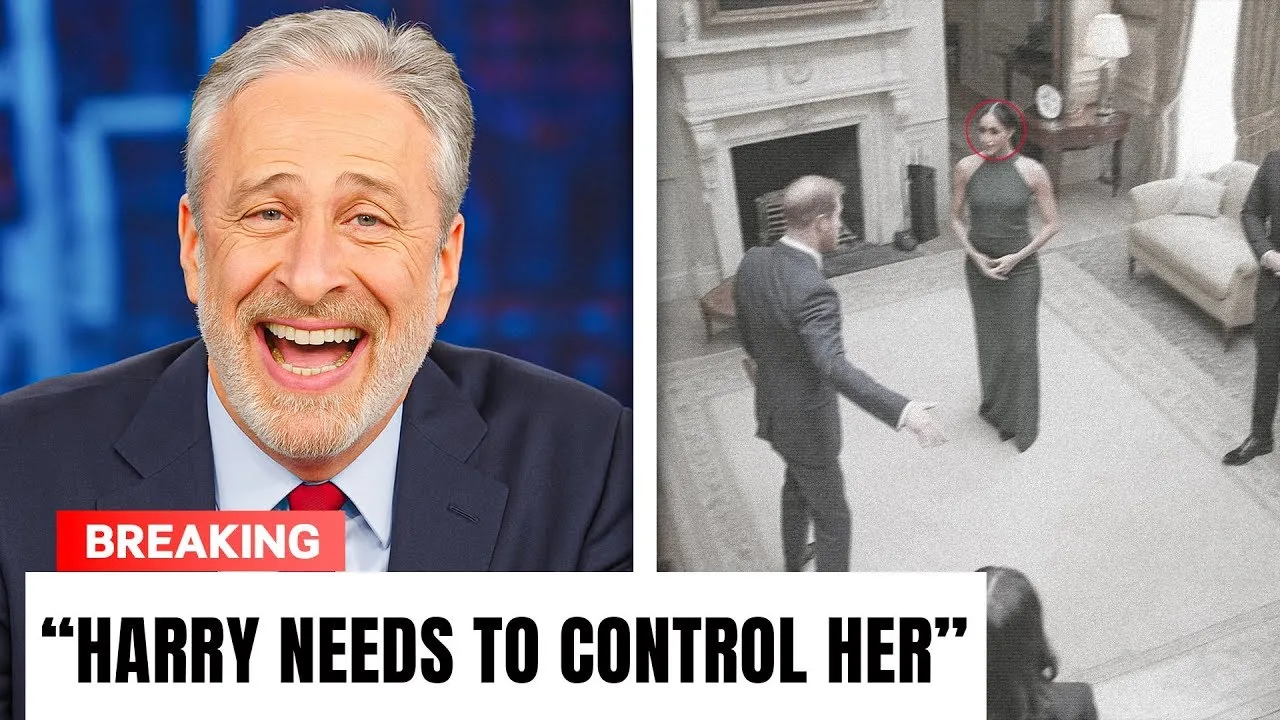
The internet rarely agrees on anything, but when John Stewart dropped that infamous line comparing Meghan Markle to mini Bridget Mcronone during a live segment of the Daily Show, it felt like the entire online world paused. For those unfamiliar, Breijit Mcronone is the French first lady known across Europe not just for being married to President Emanuel Mcronone, but for her strong presence and occasional icy public moments. When Stuart made the joke, he wasn't just cracking a punchline.
He was pointing a satirical spotlight at a very real perception that had been simmering beneath the surface for years. And it landed harder than anyone expected. Megan's team reportedly went into full panic mode behind the scenes.
Insiders say she was furious, not just because of the comparison itself, but because it came from someone like Stuart, a liberal icon whose audience had once been among her most vocal supporters. This wasn't just another tabloid quip or late night roast. It was a cultural reckoning.
From that moment on, something shifted. Memes exploded across social media. Headlines followed and suddenly one of the most recognizable names in the world became the subject of ridicule instead of admiration.
That's where we begin this story. Not with scandal or conspiracy, but with satire so sharp it cut deeper than most people expected. John Stewart didn't just throw out the joke randomly.
He built an entire comedic bit around it. He introduced the concept with his signature smirk, paused just long enough to let the words sink in, and then delivered, "Meghan Markle is basically a mini Breijgit Mcronone, great at slapping her man into place. " The studio crowd erupted instantly.
But beyond the laughter, there was something else happening. Recognition. People got it.
Not just the humor, but the truth nestled inside the punchline. Stuart's brand of comedy isn't about cheap shots or viral bait. It's rooted in sharp cultural critique.
And by drawing that parallel between Megan and Bridget, he tapped into a sentiment that many had quietly held for years. The idea that Megan wasn't just a royal rebel or a misunderstood figure, but someone who often seemed to dominate the narrative and even her husband's role within it wasn't new. But coming from Stuart, it carried weight.
His words weren't just funny. They were validating a growing shift in public opinion. Within minutes, clips of the segment were everywhere.
Reactions poured in. Memes flooded timelines, and what started as a single joke quickly turned into a defining moment in how the world now sees Meghan Markle. The internet doesn't waste time.
As soon as Stuart's words hit the airwaves, they exploded across digital platforms like wildfire. Twitter, now X, became a battleground of reactions. Some users laughed openly, others tried to defend Megan, but the overwhelming trend was clear.
The joke stuck. It resonated. Soon, visual jokes followed.
One of the most popular memes showed Megan standing next to Bridget Mackan under the caption, "Boss babes or bossy babes. " Another depicted Prince Harry awkwardly reaching for Megan's hand while she brushed him off in a way eerily similar to the infamous Macron clip. These images spread fast, and with them, a subtle but powerful change in tone toward Megan began to take shape.
For years, she had carefully crafted a persona that balanced empowerment with vulnerability, independence with compassion. But now that image was being mocked, not just for its style, but for its substance. The viral response wasn't just about humor.
It was about perception. Suddenly, the woman once hailed as a modern feminist icon was being compared to a European political figure known for being cold and overly dominant. The joke may have been simple, but its impact was anything but.
Behind closed doors, Megan was said to be absolutely livid. According to insider reports, she viewed the joke not just as mean-spirited, but as deeply unfair and even sexist. She and her team immediately scrambled to assess the damage.
Trying to determine how such a seemingly small comment could cause such a massive ripple in her already fragile public image. The Sussex camp has always prided itself on maintaining control over the narrative, but this time they were caught off guard. Satire, especially from someone like John Stewart, doesn't just fade away.
It echoes. It gets dissected, repeated, re-shared. And in today's media landscape, that kind of exposure can do more damage than outright criticism.
What stung even more was that the backlash wasn't coming from conservative critics or tabloid columnists. It was coming from the very demographic that had once championed her. Progressive liberals, feminists, and young creatives.
This wasn't just a PR problem. It was a credibility crisis. Megan's carefully curated image of strength and empowerment suddenly felt performative, almost ironic.
The more her team tried to downplay the joke, the more it reinforced the idea that she took herself too seriously. And in a world where authenticity rules, that's a dangerous position to be in. Satire has long been one of the most powerful tools for shaping public perception, and John Stewart's career has been defined by it.
He doesn't target celebrities for easy laughs. He zeros in on cultural figures and institutions using humor to expose contradictions, hypocrisies, and unspoken truths. That's exactly what happened here.
By comparing Megan to Breijit Macron, he wasn't just making a joke about age or fashion. He was tapping into a broader narrative about power dynamics, image management, and the fine line between empowerment and dominance. The brilliance of his punchline was that it didn't need exaggeration to land.
It was rooted in observation, and that's what made it sting. Unlike other late night hosts who rely on shock value or viral trends, Stuart's commentary feels earned. He builds his segments with precision, layering context and nuance before delivering the final blow.
In this case, the blow wasn't just aimed at Megan. It was aimed at the entire system that props up celebrity narratives. The fact that the joke resonated so widely suggests that people were already primed to question the authenticity of Megan's messaging.
Satire works best when it reflects reality. And in this instance, Stuart didn't create the perception. He simply gave it a voice.
Megan's brand has been on a slow decline for some time, and Stuart's joke only accelerated what was already in motion. Once hailed as a trailblazer, the biracial actress who broke royal tradition and redefined modern monarchy, she now finds herself struggling to maintain relevance in a space that no longer seems interested. Her podcast, Confessions of a Female Founder, was supposed to be a major step forward, a platform to showcase her intellect and leadership.
Instead, it became exhibit A in the unraveling of her carefully constructed image. Critics described it as polished but shallow, filled with vague affirmations and soft questions that never truly dug into the messy realities of entrepreneurship. There were no hard-hitting interviews, no raw honesty, just well prodduced fluff.
And when Stuart joked that the show was less about female founders and more about a foundering female, it landed precisely because it rang true. The optics weren't helping either. Public appearances increasingly looked staged.
Interviews lacked spark and even her Netflix projects failed to generate buzz. Deals were quietly dropped. Partnerships fizzled and attention began slipping.
It wasn't just that people were turning against her. It was that they were losing interest altogether. And in the world of celebrity branding, indifference is far worse than hate.
Prince Harry's role in all of this has also taken a noticeable hit. While much of the focus has been on Megan, the way Stuart framed Harry as an unemployed immigrant who gave up his family home and now carries his wife's handbag at charity dinners struck a nerve. It wasn't just cruel.
It was surgically precise. For years, Harry had been positioned as the emotional heart of the Sussex story, the royal rebel fighting for mental health awareness and personal freedom. But lately, he's become more of a background character.
At public events, he rarely speaks anymore. When he does, it's often brief and overshadowed by Megan's statements. On red carpets, he walks behind her.
In interviews, she answers the tough questions. And in their joint docu series, the dynamic felt more like performance than partnership. The irony is that both of them built their post-royal brand on authenticity and transparency.
They left the palace claiming they needed freedom. Yet outside of it, everything still looks orchestrated. And when satire starts poking holes in that illusion, the audience notices.
Stuart didn't invent the perception that Harry has faded into the background. He just gave it a name. And once a joke like that lands, it's nearly impossible to erase.
In the end, the fallout from John Stewart's joke isn't just about a single punchline. It's about a shift in how the public sees both Megan and Harry. For years, they've relied on a carefully managed image, one that emphasized struggle, progressivism, and authenticity.
But satire has a way of stripping away the polish and exposing the core. And in this case, what was revealed wasn't malicious intent or scandal, but fatigue. People are tired of being told to admire someone who always seems just out of reach.
They're tired of seeing empowerment packaged like luxury skin care. They're tired of scripted vulnerability and endless cycles of polished victimhood. The laughter in Stuart's studio wasn't cruel.
It was tired. Tired of pretending the strings aren't there. Tired of buying into a brand that no longer feels genuine.
And that's the real danger Megan now faces. Not defamation, but irrelevance. Hollywood is noticing.
Media executives are stepping back. Public interest is waning. Not because she did something unforgivable, but because she stopped being compelling.
And in a world where satire moves faster than sincerity, sometimes all it takes is one joke to remind everyone that the emperor might not be wearing clothes after Bob.