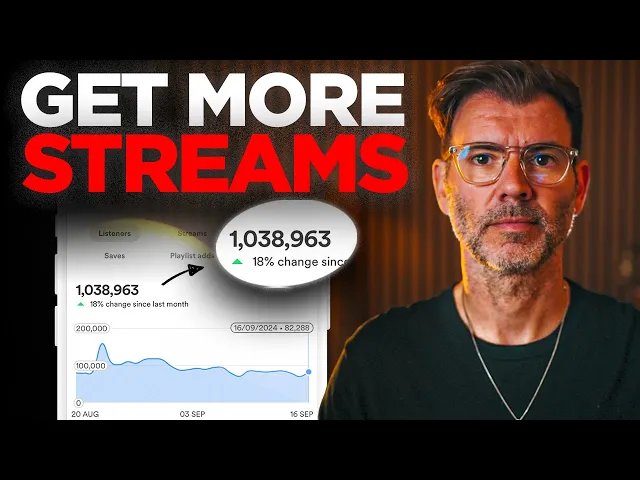
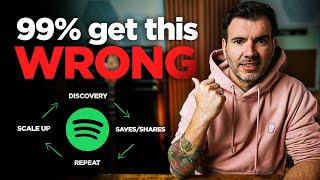
Real growth on Spotify comes from Spotify radio and autoplay, not so much around playlists and ads. And I'm going to tell you exactly what you need to do to get Spotify radio to start recommending your songs. My name is Damian Keys.
I was a founder of BIM, the British and Irish Institute of Modern Music, the second largest music university in the world, which helped artists uh understand the music industry. And now I work with artists and labels from around the world on getting their music heard. Okay, so real growth on Spotify doesn't really come from ads or playlists.
That's not to say they're not important, but your real goal here is Spotify radio. That is where exponential growth really starts to happen because Spotify radio and autoplay is where the algorithmic discovery happens. Did you know around 60% of new artist discovery uh comes from Spotify algorithmic recommendations, not so much from editorial playlists?
But did you know this? Spotify's own data shows that artists getting consistent Spotify uh like radio tractions have five times higher listener retention and also three times higher growth in monthly listeners than those relying on just playlists. So how do you make Spotify trust your song enough to recommend it automatically?
Well, there are benchmarks that you need to hit. For example, you need a thousand plus streams on your track. Uh they need to be real listeners.
Your save rate needs to be between five and 10% at least. Uh, and your save rate is the percentage of listeners who save the song to their library. Your skip rate needs to be under 30%.
Okay? So, that means people who are skipping the song within the 30 seconds, but then saying that Spotify probably isn't appreciating it if someone's skipping your song after 40 or 50 seconds, so it's always watching. Playlist ad rates um, needs to be around 3%.
Now, this is people adding your song to their own playlist. That's three people in every hundred need to be adding a song to their playlist. Now, um your listener to stream ratio, which is basically how the average of how many times someone has listened, needs to be at least 1.
5, ideally over two, which means that someone has to listen to your song more than once, which is what they want. So once this track hits those data points, Spotify algorithm starts testing it for radio and autoplay. It doesn't guarantee anything but it will test it.
Now because Spotify is machine learning, it needs data and the first 48 hours is crucial. So it's kind of giving us the answers. So what does this tell us?
Well, it tells us that when you drop a track, Spotify runs a test, right? It's watching who's listening and how long they're staying. if they save it, if they skip it, um if they replay the song, Spotify is effectively u Ros from Monsters, Inc.
going always watching, right? Most artists will go hellbent for leather trying to promote a song, but that doesn't actually feed the right data all of the time, right? Your job is to feed the data.
Basically, it's to feed Spotify the correct data. The interesting thing here is Spotify doesn't really know what correct data is. to Spotify, everything is just data.
You're the one who has to dictate what good versus bad data is. So, because you're the one who dictates what good looks like when it comes to data, it means you're the one who has to dictate who gets to listen to your songs. Who's most likely to listen to your song three or four times within the first 48 hours, right?
The the audience who loves you, it's your fan base, is even your friends. The mind shift in the first 48 hours isn't my song's out, go and have a listen. It's how do I get 1,000 listens from three or 400 people, which is a different mind shift.
Now, be careful of ads too early on. I see a lot of people putting songs out and then plowing ads in because they're, you know, they're trying to promote it. But this is going to have a high bounce rate, right?
Unless you have a a specific and effective retargeting campaign, but that comes from a lot of releases and building data over a long period of time. Otherwise, your ads are going to be driving in poor data at the time when you need the most pure data. Now, be even more careful of adding your song to random playlists because we know that you can buy onto playlists.
We know that you can go and get those numbers if you want to. The problem with that is you are feeding more poor data at the time you need the purest data. Now the best thing that you can do on your release day or the 48 hours from when it releases is the onetoone approach, right?
It's talking to people. It's asking them to play your song a few times, a few times in the day to see if it's a grow. And the way you do this instead of saying, "Hey, my song's out.
Give it a listen. " Right? Is not is to say, "Hey, do me a favor.
Can you give this a couple of goes because I think this song gets better with time. I promise you if you listen to this a couple of times, it will really start to grow on you. So, I'd love to hear your thoughts on that.
Now, if someone sounds positive and they just go, "Yeah, sure. I can do that for you. " Then go a step further and say, "Do me a favor.
Can you save this into your library? " Because it really does make a difference. It's like asking for, you know, for a like or a follow on YouTube.
It kind of it's it's driving that treasure home. And saves are absolutely the treasure. So, you're not chasing numbers.
You're I guess you're training Spotify. And what you're training Spotify to say is this song belongs in the radio of people that will actually listen to it, right? Spotify will connect the dots.
It doesn't just analyze your track. It looks at who listens and what else they play and what kind of artist you are. So, this then becomes about, you guessed it, my favorite word, momentum.
Right? Don't forget the data from momentum doesn't just come from that song, right? it.
It's artists who release regularly. They build a rhythm that Spotify will then reward. This is not just about your song that's being released.
It's about your future releases and your past releases are basically playing into this release and your future releases. Which is why socials and content are so important because they are the jabs. Probably not going to win you the fight, but a thousand jabs over 12 rounds, well, that just might.
And that's how you start building that routine and that momentum. Now, Spotify can find your audience a lot easier than you can, believe it or not. So, you need to define exactly who should listen to this track so that Spotify feels that trust and understands that Spotify needs to find the people that will listen to this song.
Now, this is called algorithmic trust. And every platform that uses algorithms will have this sort of version of algorithmic trust. Now what happens if you have released a bunch of songs and you are not getting any of this momentum?
What can you do? So we're trying to feed the data into the platform. So, a couple of things that you could do, like if it were me, what I would do is I would forget my ego and I would plan three collaboration songs with artists who could combine forces with you, ideally in your genre.
All right, more hands make less work. Now, if you start showing up in their radio as well as, you know, have help with the promotion engine and the marketing side, it will start to feed that positive data into Spotify. Now, this might not artistically be what you want to hear, but think of it in 2 years time when you have all of the context in the platform and things are a lot easier.
Your job is to build that context into Spotify. It basically Spotify is saying, "Why should I recommend you to my friends? What's the reason?
" But imagine this, right? Imagine you get a thousand streams on Spotify. Okay, good.
But who cares? Like, nobody we don't. Nobody cares if you get under under a thousand stream.
Nobody gives a But if you get a,000 streams on Spotify on one song in the first 60 seconds, Spotify is going to lose its It's going to go, "Hey, this is amazing. This is going crazy. I need to start recommending.
Everybody wants to listen to this. " That's the power of context. And Spotify doesn't just care about, you know, how many.
It cares about how fast and who and how engaged were those people and how many times do they return. So instead of just attention, it's retention. Okay?
So we need to stop chasing numbers and we need to start feeding the the algorithm proof, okay? The the algorithmic trust. That's how you end up on Spotify radio.
But more importantly, that's how you build momentum into your next release. I had someone message me this week who was ranting about Spotify. And don't get me wrong, I can rant about Spotify just like everyone else.
But in this instance, what they were saying was I was getting plenty of uh spins on Spotify, but I wasn't getting any kind of sort of momentum. And I was like, well, let's go and have a look. Let's go and have a look at the data.
And when you start to analyze the data, you say, oh, it's incoherent. Like this, the patterns aren't working for you. So, we talked about the strategies of what they had done in order to try and kind of like promote the song.
And I was like, what you're trying to do here is you're trying to make the starter, the main, and the dessert all at the same time in one meal. and you now you're looking at it kind of go it's disgusting and I'm like well that's because you've done so many different things which will do different things every action has an equal and opposite reaction Newton's law so when you're promoting in five different ways there's a good chance that you will get five different types of uh of audience or five different results and that's what we've got to be really really careful of and that is where Spotify says look I'll do what you want if it suits me so what we've got to do is we've got to say I can make that work Right. What I will do is I will feed you the purest data especially in that first 48 hours.
Really in the first 7 days but in that first 48 hours so Spotify understands. Now if that helps or you want to come and work with me then you the usual links are down below. Um but otherwise come and leave me a comment on the video cuz I I read every comment and I try and reply to as many as possible and um it you know it really does brighten my day when I get some comments from you guys and let me know what you're doing.
Feel free to drop links uh for your music as well. Otherwise, thank you so much for listening. Let's go and take over Spotify radio.