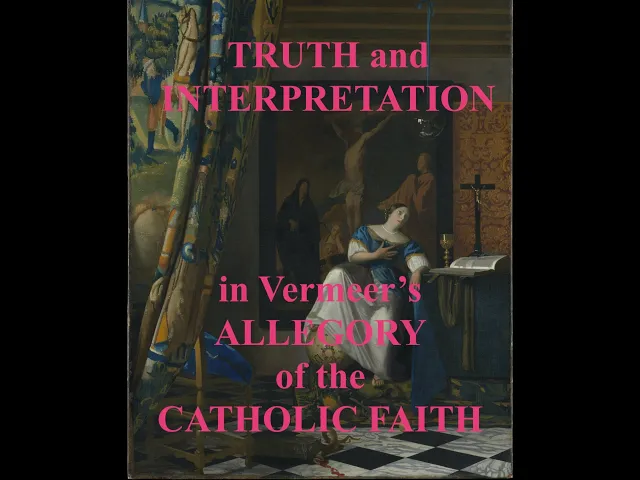
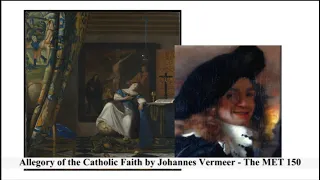
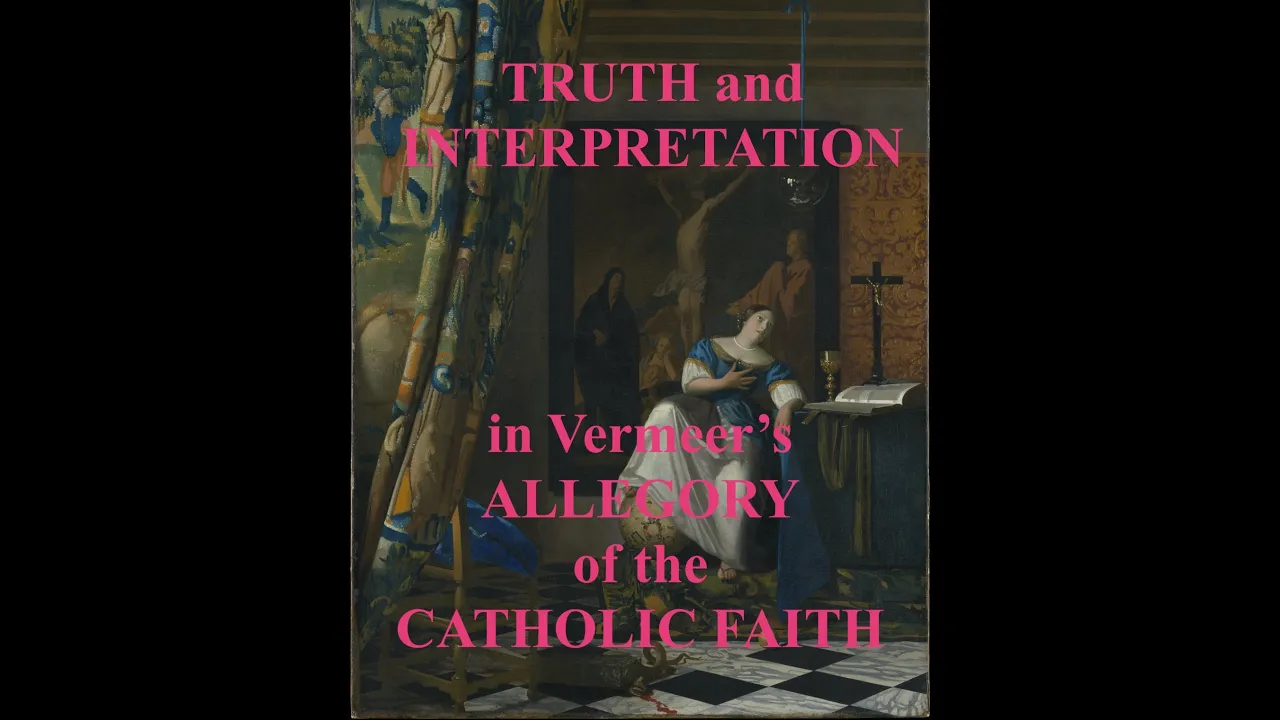
a footnote to a painting by Johannes Vermeer the allegory of the Catholic faith many details could be explored but here we shall focus on what is of the essence in this painting what we have is an allegory and this means that we have multiple planes that mirror each other we have a literal plane and that which it refers to of course an allegory is a metaphor or it involves a metaphor we are to read this painting therefore in terms of metaphors now we have explicitly at least two layers in this painting we have a muse
who is reclining with one foot over the globe the physical Globe the geographical globe she is leaning with one arm on an altar and looking upward in a posture of devotion toward the crucifix now the crucifix she is looking up to is of course an artifact this artifact is mirrored in a painting in the back in the background of of the painting that we are facing the physical we could say the physical crucifix is reflected in the painting that is in the back of the Muse she doesn't see the painting there is a background to
the physical on the other hand we have a snake that is crushed by a slate of stone over this precious marble flooring the snake of course is that of the Garden of Eden and as a reminder we have a fruit that is bitten what does this refer to the snake is crushed in the Garden of Eden it is um merely chaste out of the garden and cursed here it is crushed the notion of a crushed snake serpent is not novel too it is a integral to the iconography of especially of the Baroque where sometimes or
often Jesus in fact is pressing on Mary's foot which in turn is squashing the the snake killing the snake so this is the question of um triumph over evil now the Slate is killing the snake there are thus two deaths in the painting one is that of Jesus crucified the other that of the serpent the serpent is the Antichrist theologically speaking of the anti-jesus is the um the Antichrist and therefore Satan even though of course in the in the account of Genesis the serpent is not explicitly satanical he is the the most uh cunning of
all the animals of the fields that God had created so here we have two mirrorings on the one hand the crucifix presumably in Wood the one that is sculpted the physical tangible one that the Muse the lady uh sees in devotion and the one that is in the background now if there were any question about this mirroring that is also reproposed in that between the death of the Christ and the death of Satan all we need to do is look up at the globe the glass globe which is indeed mirroring there is a mirroring of
among other things of a window that has four panes although we can only see three which is not accidental one is covered there is a trinity um reference right there but what is important here is that that the Muse and so the lady the poetic figure that we have here is um on the one hand of course um referring to and indeed is integral to this allegory of the Christian faith of the Catholic faith in in particular and we'll get to the reason why this is important um this lady is standing over the physical globe
the physical globe refers to what is apparent um so poetry transcends physical appearances toward what is beyond them and what is beyond them is a question why then is this allegory about the Catholic faith well as we know in the uh with the with the um Protestant uh shall we say Revolution we have a tendency to uh appeal to the Bible quite literally um without need for uh well uh rational interpretation shall we say so we have a tendency to emphasize um Jerusalem versus Athens so here there would be a Vindication of the importance of
interpretation we're moving beyond the letter but how are we to transcend appearances this is the crucial the most crucial question involved here are we to transcend appearances and thus Ascend to the Divine through sentiment through sheer devotion and and this would would be represented by this lady who is leaning um toward this crucifix as a matter of fact this crucifix is somewhat turned away from her she is not facing the crucifix uh and the Jesus on the crucifix straight on or should we Ascend and in fact is the proper true Ascent to the divine mediated
for Man by interpretation and so is it uh logical dialogical um and so we could even say rational this is uh a matter of great importance not of course only in terms of uh local diatribes between Protestants and medievalis of which then are Catholic but um for for all of us for all human beings and of course Vermeer is uh siding with the well formerly Catholic position at any rate as he understands it and so sees that um the physical is somehow mirroring mirroring the divine but not in um in a straightforward we might even
say romantic manner but through a special mediation and therefore we have an appeal to allegory hence the role of poetry so it is through a poetic discourse and here it is through the painting um this kind of painting is not hmm clearly yeah not something that protestantism would uh appreciate as no not nearly as much as Catholicism would why well for the reason that should be obvious namely that with medieval on the basis at any rate of the medieval understanding of things of The Human Condition of human nature the poetic life has a great in
fact Cardinal importance in mediating shall we say the physical and the divine which is not altogether Heavenly in the respect that it is not something that is requiring a departure from the physical the death of the snake has here a precise significance for there is a context to that Serpent's death the death is provoked by this rough Stone dark stone that is pressing over the snake which however is um not on dirt had the serpent been on dirt it might have survived but it is pressed between this rough slate and a stone and the Beautiful
marble the the very refined marble what is more its head its is and of course the blood that is um that is Flowing out of it is lying over a white pure slate of marble so what we have here is something precious something that uh calls to mind of course the beautiful art and it is through and thanks to beautiful art that we can appreciate or in any case in the sense of um see fully the death of the serpent Now what is this death all about the death of well um the corrupt nature and
this death uh properly understood points to the death of the Christ now the death of the Christ of course on the cross is a death that points to a return an Ascent to God so of course the resurrection for otherwise the death on the cross would simply um be an exercise in masochism so the death of the snake as such relapses is in retails of relapse into the Earthly there is no Ascent the death of course of the Christ involves a return to the divine so it is thanks in this case to art that we
can see the true nature of the blood that is spilled when we die we don't die or we're not to die certainly as this serpent and so um simply be reduced to the Earthly we are to die as able in the account of Genesis where it is said that his blood Cries Out to God and so our death is unto Divine Perfection it is not merely an Earthly death and this message is conveyed of course by Art the uh precious character of art is emphasizing we have the tapestry that lets us see that introduces us
to the scene what of course is most important ultimately is in the background uh the apparent is an invitation to reflect upon in fact it is a reflection of the background that we don't see directly we see the background through what is apparent and the apparent is in this case not merely physical but a metaphor so therefore we could say that the physical itself is understood as a metaphor of the poetic therefore entity a metaphor of the spiritual and so this is the way we are to read the Bible itself as Vermeer suggests by keeping
the the book a wide open on the altar that in some which points to the Divine is not merely the physical but the poetic so the lady lady poet who we might say the Muse is pure she has a dignity she is in white dressed in white and blue the colors of Mary sometimes and she is stepping over the merely geographical physical quantifiable the globe um which has its instability yes on this altar she's keeping it in check without crushing it nevertheless it is she who points to the Divine and of course the colors that
that constitute a juxtaposition are the white and blue of her dress and the gold that um of the panel that is um right behind the crucifix she is admiring as if from the back however so in this case poetry is a vehicle to the Divine but it is we who are to interpret this painting it is we who see the painting that is behind the muse and so interpretation is needed interpretation of poetry interpretation of paintings and this is the way to Ascend to the divine as Johannes Vermeer reminds us so graciously