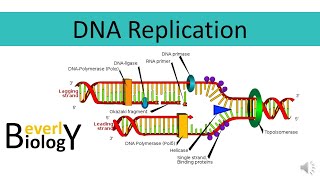
so now we'll go through a detailed stepbystep illustration of DNA replication and what I've done here is I've listed all of the enzymes and proteins that are involved in this process all of them serve an important purpose and so we'll go through step by step in order to see how each of them comes into play so the first step that happens is something called DNA helicase comes and what it does it's a six piece protein structure you probably don't have to remember that but essentially what it does is it unwinds the double helix so here
we have the two strands of DNA and the helicase comes in and it essentially separates these strands when it does that these two strands serve as template strands and the process is semiconservative that's an important vocabulary word and what it means is that when we build new strands we're going to build a new strand here and we're going to you to build a new strand down here as well the original DNA becomes the template strand for each of these pairs and it's semiconservative because each new double stranded DNA segment contains half of the original DNA
and half of the new DNA so it's not fully conservative because you build new components but it is semiconservative because half of the new double stranded DNA is the original DNA strand so when helicase comes in it separates the two strands and this forms what is called a replication fork the replication fork is obviously Fork shaped like that and what will happen is the replication will now be allowed to proceed on these strands because we have separated them and thus allowed other enzymes to have access so helicase it unwinds the Helix essentially it takes the
Helix and breaks it into its two substituent components and those two components then serve as the template strand for the rest of the replication process next come single stranded binding proteins or ssbs ssbs are necessary because remember that there is a strong favorable interaction between the base pairs on one strand and the base pairs on the other strand remember these are complementary to each other and so there is an incentive for them to get back together and bind with those hydrogen bonds so in order to prevent that from happening we have these small tetramers called
singl stranded binding proteins ssbs and the ssbs essentially stabilize these so that they don't end up annealing joining back together and that's very important they prevent the annealing so that these two stay separate and some of them will show up down here like this essentially they just bind to each template strand each single stranded template component and this is important because it prevents the a kneeling and thus allows these two strands to be separate and allows the replication process to continue to move forward and so ssbs are there to stabilize the strands and prevent the
analing as the process continues as the primas and polymerase come along they'll Simply Be displaced as soon as the polymerase shows up but these are necessary in the earlier Parts in order to make sure that these two strands don't come back together after they've been separated by the hilic case so we've gotten the first two out of the way the helicase separates the strands and then the ssbs come in and they maintain them in separate components so that they don't come back together and anal or reanneal and then what happens is that DNA polymerase doesn't
just start out of nowhere what it needs is a primer and a primer is a short segment of of RNA it's a it's a small segment of RNA that will show up and and it will be small numbers it could be five it could be 15 base pairs long but essentially a primer is a short RNA component that allows the polymerase to come and bind and so here we'll draw a primer here as well so the primase shows up in order to produce these short RNA primer segments and these primer segments then allow for the
polymerase to come and start the replication process so primas creates these RNA primers they're required to start the replication and then the big player which is DNA polymerase will come along remember that the directionality of replication is read up and write down and so when it's reading from the template strand it's going to be reading in the 3 to five Direction so this primer here will allow replication to continue in this direction this one because this this is the three end and this is the five end on this strand will allow replication to continue in
that direction so replication always starts at the three end and moves toward the five end of the template strand The Next Step then is that DNA polymerase arrives and this isn't an exactly faithful depiction of DNA polymerase but you get the essential idea that it it is uh it's something that connects to the template Strand and what it will do is it will essentially move along and produce more and more DNA and so the polymerase will move in this direction and it will add bases that are complementary to our template strand every time that it
encounters one of these ssbs the SSB will simply be displaced and move away so here's our polymerase on this end and it will come along and it has a little attachment there and essentially this will come along and it will continue to produce nucleotides that are complementary to the parent or template Strand and again when it encounters the ssbs they start to disappear and this process will continue for a while and uh so it will just continue to move remember that it reads in the 3 to five Direction but the New Strand will be produced
in the 5 to3 Direction so this will be the five Prim end of this and the New Strand will have a thre Prime end over here that it will continue building toward whereas here the five Prime end will be first and it will continue to build toward the three prime end of the New Strand remember that this new strand will be anti-parallel to the template strand so what is the three Prime direction of the New Strand it will be going in the five Prime direction of the template Strand and so this will continue to happen
and it will build on more and more bases for quite some time and then we'll get to a point where we encounter one difficulty and so we'll just build this up to the end or so like that what is happening here is that as this moves along the helicase will continue to unwind the two strands and as it does that what you'll notice is that it will separate so now let's just say that our parent strand is is getting wider notice that this polymerase can continue to build into the Strand it will continue to produce
new bases and because the unwinding is simply going to be opening up further components this top strand can just have the polymerase continue to move and it will just be producing more bases the issue is that this other strand as the fork continues to open and it continues to separate these two components notice that the polymerase is moving this way and it will expose all of these base pairs that the polymerase isn't able to encounter and so what will happen is we'll open it up more and we'll need to build a new primer and a
new polymerase will need to come in and so we'll get into this discussion of the leading and lagging strand but recognize that there's a strand that is leading and what that means is that one primer is necessary and the polymerase can continue to build as the replication fork opens the lagging strand is going to open but notice the polymerase is building in the opposite direction so these new ones as it opens will not get dealt with by this polymerase and so this is called the lagging strand and what it requires is will require again another
primase to lay down a primer and then to continue that process and so next we'll get into a discussion of the leading and lagging strand and that will then bring us into a discussion of RN H which is also known as DNA polymerase 1 and DNA ligase and these are pretty much only necessary for this lagging strand strand that cannot continuously build as the replication fork opens and so we'll discuss that we'll draw this component we'll redraw it so that the lagging strand becomes clear and then the discussion will be complete and you'll understand the
replication process how it's fairly continuous in this way but it's discontinuous in that direction so what we've done here is we've now Advanced this replication fork so the helicase has continued to unwind these strands and so it opens up a new region of these two template strands that can now be replicated and so on the leading strand it's clear that because the polymerase is moving in this direction remember it reads from 3 to five it can just continue to move in that direction into the replication fork and lay down more and more nucleotide bases the
issue emerges with the lagging strand the lagging strand has a polymerase that's moving from the three Prime end to the five Prime end but what's being opened up is further toward the three prime end than our primer is and so what we need to do here is we will need to lay down another primer in the lagging strand and then from that primer we'll end up getting a new polymerase that shows up and this polymerase will build on these bases up until it gets to the point where it meets the previous primer this is called
an okazaki fragment and it is something that only occurs with the lagging strand because the replication fork is opening and exposing bases from the template strand that are on the opposite side of the direction that the polymerase is going and this is a discontinuous process whereas the leading strand can continuously build more and more nucleotides that are complementary to the template strand as the fork opens the lagging strand is unable to do that and so you end up with a lot of okazaki fragments and this necessitates two other enzymes that we will encounter and so
the first one that we'll deal with is RNA H or it could be called DNA polymerase one and the job of that is to Simply remove the primer as the DNA polymerase 3 approaches this new this old primer and so what it will do is the RNA will then essentially eliminate that primer and then the polymerase the DNA polymerase 3 will continue to move forward up until it reaches the existing part of the DNA strand but DNA polymerase 3 by itself is in capable of joining with an already existing strand of newly made DNA and
so what that requires is when the polymerase reaches here you now need to find a way to link the sugar phosphate backbones of this already existing DNA with the newly synthesized DNA on this lagging strand and so you need DNA ligase ligase is the same root word as ligature and it essentially means to fasten or tie things together and so you bring in a DNA ligase and what that does is it simply in an ATP dependent manner joins these two components together and so now you're building a continuous strand based off of your template DNA
strand and this will continue to happen as the helicase keeps unwinding this DNA what will happen is now we will need to lay down an another primer and then we'll build another okazaki fragment and it will continue to happen so the lagging strand requires the use of RNA H and DNA liase and that is a consistent theme with the lagging strand it's a very discontinuous process the leading strand will only need uh RNA remember that's also DNA polymerase 1 it will only need it once because the polymerase 3 is just continuously laying down bases in
the direction of the replication fork so that's the big distinction between the leading Strand and the lagging strand and notice that the process of DNA replication is semiconservative because we're building a new strand but we're conserving the parent or template Strand and so it's semiconservative half of this new doubl stranded DNA comes from the original doubl strand Ed DNA there's also another word that we have to use and this is semi discontinuous what that means is that the synthesis of the leading strand is continuous it just keeps going the polymerase can continue to move from
the three to five Direction remember that it's producing this New Strand starting over here with the five Prime end and going over to the three prime end here it can continue to do this and so it's continuous there but the other half of it is discontinuous it has to lay down new primer produce an okazaki fragment get rid of the previous primer and then join the newly synthesized strand with the previously synthesized one using a DNA ligase and so that is a discontinuous process so half of it is discontinuous and half of it is continuous
and so that means that the DNA replic is called semi discontinuous because half of it is discontinuous and the other half is continuous and as long as you understand that the lagging strand necessitates laying down more primer having polymerase build more of these okazaki fragments and eventually joining them to the other bases we've produced with a DNA ligase then you'll be able to understand the semi discontinuous nature of DNA replication and remember this this is what happens when cells are dividing in for example mitosis and so DNA replication is something that you use not when
you're trying to move from DNA to protein but instead when you're trying to replicate DNA and usually that is when you're forming new cells or having cells divide and thus more DNA will be necessary but remember the leading and lagging strand remember the different enzymes that can be involved and remember the semi discontinuous nature of it that one of them is discontinuous and the other can just continue producing new bases all the way as the replication fork opens and opens and exposes more of these template strands