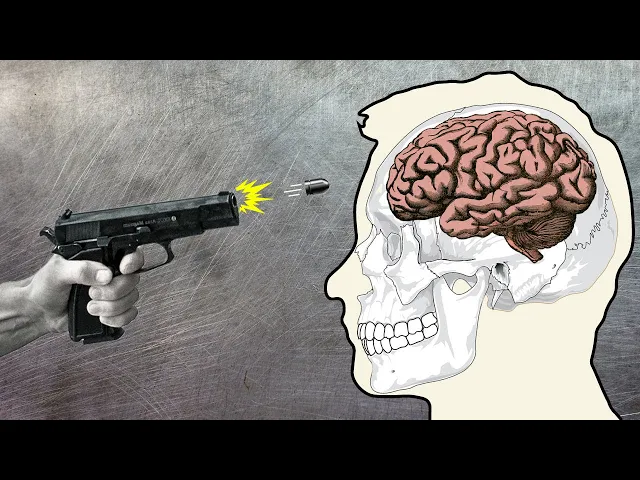
This video was voted for by patrons of Questions for Science. You already know what happens when someone is shot in the head. "You get what you fucking deserve!
" They die. On the surface, yes - a headshot is a fatal wound, but beneath the gory reality, there's a lot that goes on when a bullet enters someone's skull. First things first, in terms of firearms, we're talking strictly pistols and rifles, not shotguns - because a shotgun to the head is pretty self-explanatory.
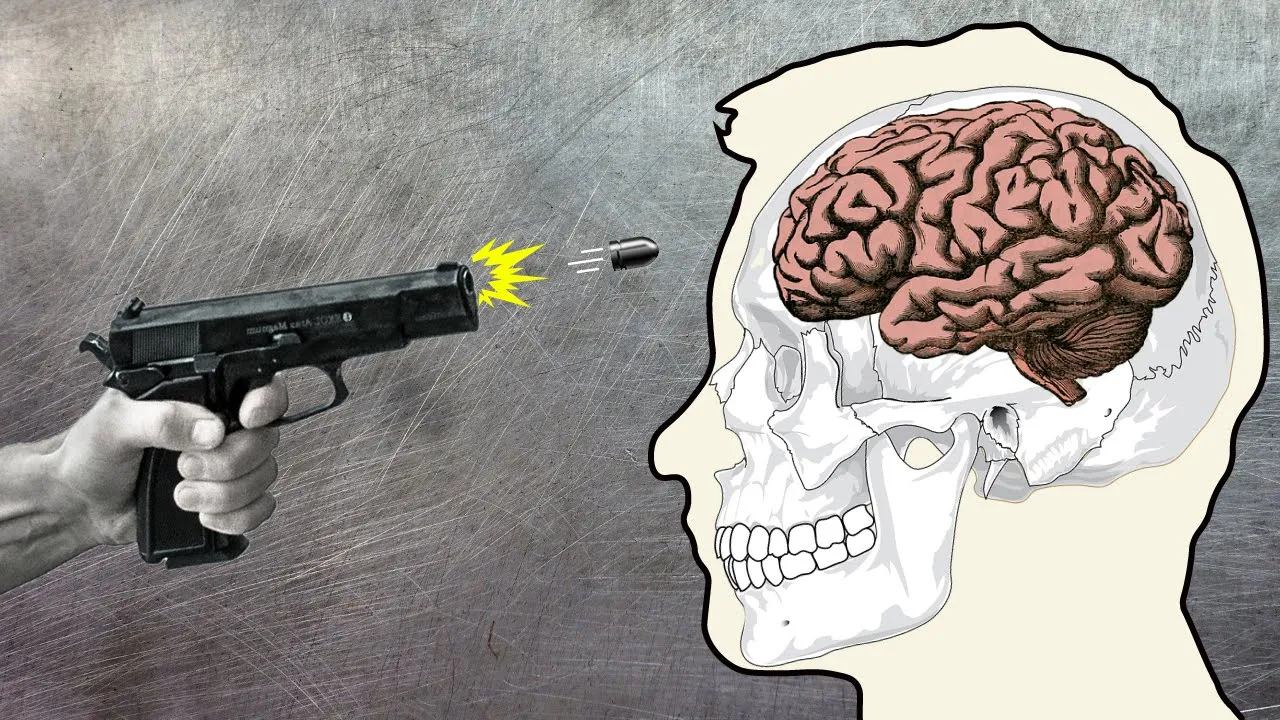
[ dead ] Let's start at the firearm, shall we? When a bullet is fired from a pistol or rifle, the bullet travels through a rifled barrel. A rifled barrel has grooves in it that cause a bullet to spin.
When this spinning bullet penetrates the skull, it's rotating motion flings cranial tissue outward. Tissue then expands to about 12 and a half times the diameter of the bullet, but is only de-stretched for about 5 to 10 milliseconds, and then shrinks back down to normal size. For instance, a 22-caliber bullet produces a wound of 2.
7 inches. A 38-caliber bullet creates a 4. 4 inch-wide wound, and a 45-caliber bullet creates a five-inch wide wound.
Though it's very short, the expanded cavity does a remarkable amount of damage to the skull. This wound creates a vacuum effect, causing air to rush into it, making the cranial cavity expand, causing secondary fracture lines that spread out from the wound. Most fractures occur at soft locations like the temples and orbital plates behind the eyes.
The higher power the firearm, the more secondary fracturing of the skull, especially at more thick and hard locations like the front and back. Speaking of high-powered, what factor do you think contributes to making a bullet more damaging to the human body? Its length, its velocity, or its weight?
The answer is velocity. To understand why, let's look at this equation for kinetic energy. In this case, the kinetic energy of a bullet is equal to the weight of the bullet times its velocity squared, divided by the gravitational acceleration constant times two.
This may seem like a lot, especially if you haven't taken physics, but allow me to make this insultingly simple. More kinetic energy equals more ouch. The higher the kinetic energy of a bullet, the more damage it does.
And we can prove mathematically how velocity does this. So let's make everything a value of 10. Okay, so the weight is 10, the velocity is 10, and the gravitational constant is also 10.
We run the equation, and the kinetic energy is 50. Okay, great. When we double the weight of the bullet, the kinetic energy also doubles to 100.
Now, if we double the velocity, the kinetic energy does not double - it quadruples. When there's more kinetic energy, there's just overall more damage. We're talking a stronger pressure wave through the skull, more external gases going into the head, more secondary fracturing, and even splitting of the skull itself.
This is why rifles are more lethal than pistols, not because of the weight, but because of the velocity of the round. Now, let's look at what happens inside the skull. When the bullet punctures the skull, it creates an entrance wound about the size of the bullet.
If it exits the skull, it creates an exit wound many times larger than the bullet itself. This happens in nearly all mediums a bullet passes through - whether it be plastic, metal, wood, or bone. This is because as the bullet passes through the medium, it creates a shockwave in front of it, which widens.
Additionally, the bullet may rupture or mushroom, increasing its surface area. As for the interior of the skull, the bullet causes the bone to bevel. The best way I can illustrate this process of beveling is with a piece of Swiss cheese.
This side of the cheese is where the bullet enters, and is very clean and small. This side is where the bullet exits, and is very wide and flared out. This flaring chips pieces of the skull and launches them into the brain, causing more damage.
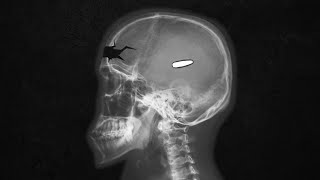
Once in the brain, three things can happen to the bullet. One, it can slow and stop. If it loses enough of its energy when it pierces the skull, it will stop in its path inside the brain, probably at the other end of the skull.
Two, it passes cleanly through, or three, a ricochets inside the head. Of the three, the least common is the third, accounting for about 20% of all bullet paths. If the round was fired from a high-powered rifle, it will most likely pass through.
If it's fired from a pistol, it will likely stop in the brain or ricochet. Also, interesting fact: Most skull ricochets aren't like this, or the bullet bounces off at an angle - though it does happen, but not frequently. In the majority of ricochets, the bullet follows the round groove of the skull.
The skull is actually very strong, and the bullet, having lost so much energy passing through, simply glides along the groove, sometimes sitting just beneath the scalp. Finally, what happens to the brain in this whole ordeal? Well, it's bad.
The brain is a solid, inelastic and incredibly soft organ. Unfortunately, these properties do nothing to reduce the damage the brain receives from a gunshot. [ gun clicks and fires ] In contrast, elastic organs such as your intestines, stomach, and bladder receive less damage from gunshots.
The energy from the pressure wave is dissipated because the tissue stretches. However, solid inelastic organs like your liver, pancreas, kidneys, heart, and brain receive full damage from the pressure wave because the tissue does not stretch. Finally, the distance the bullet travels from the barrel to the head can also determine how damaged the brain is.
If the shot is far enough away, the bullet may actually bounce off the head. It'll still cause a wound similar to getting hit in the head with a baseball bat or a hammer, but again, it won't actually penetrate the skull, but will still do severe damage. Of course, these shots are well over 100 yards away and are from low-powered firearms like a pistol or a .
22. Contact shots on the other hand where the muzzle of the firearm is placed on the victim's head and then fired, turns the brain into a literal pulp. This happens for two reasons: Firstly, the bullet has the highest velocity when it strikes the skull, delivering the most energy possible.
Remember this equation? Secondly, the hot, expansive gases that are behind the bullet follow it into the wound. These gases then expand in the victim's brain, pulpifying it, as well as causing the skull in some cases to split open.
With all this being said, believe it or not, headshots are not 100% fatal. On average, they're 90% fatal, given the right circumstances. In my next video, I'll discuss how and why some people have managed to survive a headshot and still live to tell the story.
Also, recently, a lot of you have been asking me what my background is in, and I work in immunodiagnostics, which is really fun. But being a scientist and just reading research papers sometimes isn't enough research for my videos, especially when I talk about medical procedures, and I work in a totally different field. Um, that's where my dad comes in.
He's a retired ICU nurse of 37 years, and he's seen a lot of stuff. He's been a big help for me, especially in some of my medical videos that get down to real specific concepts and cases. I'd be lying if I said I did all the research myself, so this is a shout out to my dad for all the help he's given me on my channel.
Thanks, Dad.