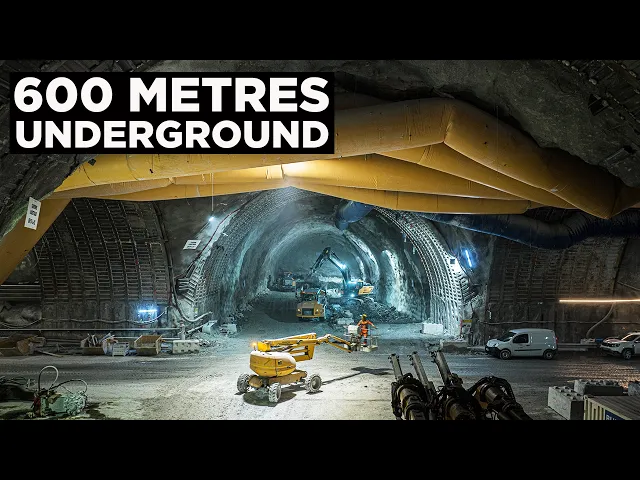
I'm currently standing in a massive tunnel deep beneath the Alps. When it's finished, this incredible feat of construction is going to stretch for more than 50 km and bring two major European countries close together. It's because the tunnel forms the main section of a new railway [music] that will literally cut journey times between these two places in half.
In a few years from now, it'll become the longest single rail tunnel [music] in the world. But how exactly you build a train line through a mountain range? [music] I've come to one of the world's biggest construction projects to see how teams are pulling it off.
We're digging through the middle of a mountain [music] and to discover the incredible impact it's going to have not just for the countries either side, but for this wider continent, too. Wa! Look at this.
[music] This is quite literally my deepest dive yet into one of this planet's biggest mega belts. >> [music] >> So, I'm currently on a little road trip between France and Italy. I'm driving from Leyon, which is back there behind me.
You can see it here on the map. And I'm going to be going along this road all the way here to Trin in Italy. Now, that road is the quickest and easiest way currently to get between these two places, but it's not straightforward because what you can't see on this map is that sitting between these two cities are the mighty Alps.
Now, don't get me wrong, it is a beautiful drive, but it takes you about 4 hours, and it would be the same if you were to go by train. However, it's not going to stay that for much longer because construction teams are now working on a new railway underneath this natural border, and they're doing it with a record-breaking tunnel. France and Italy are two of the largest economies on the planet, and they're situated right next to each other.
But despite that, and the fact they're both part of the EU, moving people and goods between them isn't exactly straightforward. And it's because of those mountains. It's a difficult place to build a road, let alone a railway, which is why 92% of all freight movement between Italy and France is done by truck.
Now, I probably don't need to tell you that road transportation is both worse for the environment and slower than going by train. So, something is finally being done about it, but it means going to some pretty extreme lengths. Now, as I said earlier, there already is a way to get from Lyon to Trin by train, as long as you don't mind traveling on a line that was built in the 1800s and is nowhere near highspeed because it's full of winding curves and steep slopes.
Not to mention the landslides, which are a very real threat here. The one that happened in 2023 was so severe it caused the whole railway to shut down for a year and a half. Now, obviously, the way we build our railways has changed massively since the 19th century.
Trains today are not just faster, safer, and more comfortable, but they can get across difficult terrain that just wouldn't have been possible all those years ago. Now, a lot of it is down to new tunneling techniques. But here in the Alps, engineers have been perfecting an approach that takes underground construction to a whole new level.
They're called base tunnels, which comes from the fact that they burrow right through the base of a mountain. It means the tracks can be laid almost flat and that enables faster trains and short journeys. And that's exactly what's been under construction here.
Halfway between Leon and Serin across the French Italian border. Stretching for 57. 5 km, it'll become the longest single rail tunnel in [music] the world.
A fraction longer than the Gotard base tunnel in Switzerland. Although that one is almost a decade old, it remains one of the only base tunnels to have been completed on this planet. Thanks to this, the Monsani base tunnel, as it's known, travel times between the two cities are going to be cut from 3 hours and 47 minutes down to just 1 hour and 47 minutes.
It's not just about speed, of course. Once the new railway is complete, driving will no longer be the best way to get from A to B. Those road and rail movements are expected to become a lot more balanced.
Quite literally 50/50. It'll take around a million heavy vehicles off the road every year, or at least that's the aim. If achieved, it would mean an annual reduction of a million tons of CO2, which is roughly the same as 400,000 homes produce every 12 months.
Freight trains are going to be able to carry 2,000 tons instead of 700 like they can now. And for passengers, there are going to be 22 long-distance rail services every day. That's up from the six there are right now.
France and Italy won't be the only countries to gain from this project. The new line is going to fill a crucial gap in the Mediterranean corridor of the TransEuropean Transport Network. It's going to make traveling between the east and west of Europe a hell of a lot easier, boosting economic growth and helping sustainability.
But before that dream can become a reality, there's a few challenges to overcome. So this is the start of the massive Montene base tunnel on the French side. Trains are going to enter through a rectangular shaped cut and cover section down there and then come into this 3 km section which passes through some particularly tough geology.
Tests revealed that the ground here is full of fractured and sheared rock, which meant they had to do this section the old-fashioned way. We're referring to the traditional tunneling method, otherwise known as drill and blast. So that, as the name suggests, involves drill and blasting your way through the rock.
Process is quite simple. You basically drill holes in a circle, fill them with dynamite, hit a big red button and blow them apart, clear the rubble out the way using trucks, then put some steel ribs in to reinforce the rock around you. Then spray that with shockrete, kind of like a mix of sprayed concrete, basically, which you can see around me right now.
And so up there is the rock face of the mountain. The really cool thing with this type of tunneling method is you actually get to see your adversary. You get to see the rock in front of you, the mountain that you're battling.
[music] More holes, more explosions, more rubble cleared away, more shock, and then the same again step by step, bit by bit. On this small part of the project, we had 550 m of loose ground excavation. And then we continued with the drill and blast method.
We have outside works and inside works. We have special foundation works and tunneling works. And at the end of the project, we need to do 140 meters of a cut and cover section, which is also particular for this site.
So, this right here is where you really feel like you are digging through the heart of a mountain. I'm surrounded by these cold, craggy rock surfaces which have been left behind by the drill and blast process. And you can see where the shock crew has been applied to help stabilize the walls.
a bit further along now. This is the process of converting a tunnel from that craggy drill and blast surface you saw something that looks like a much more conventional tunnel. It took a couple of months to design to imagine and then to manufacture this uh this country which is a prototype.
It's quite unique in the world and we pour a bay of 10 m long every day, 5 days a week. >> You can see ahead of me here. They're doing this process, this waterproof membrane going in, this kind of thick sheet on the walls, followed by that kind of brownish red steel reinforcement that's going to sit inside the concrete.
And then following that, that thick concrete slab, that tunnel lining system is being laid 10 m a day, every day for 3 km under the Alps in just this section. But it has to be said, 3 km is a long way, especially when you're working in 10 m segments. But that is a mere fraction of the journey from France to [music] Italy.
Another thing that's very visible down here is how wet everything becomes before a section of the tunnel is fully waterproofed. In some places it looks like a lot but never enough to concern those in charge of the build. We face in the Alps water ingress which is normal.
Basically, this is not bad for us because we have long distances for the logistics and we we like the water on the on the surface on the on the piston to avoid the dust problems which is a a severe problem for health and safety. So basically water is is nice for us. The water which is is too much we pump it.
We have different uh pumping systems. We put it out in a treatment plant. We recycle it and we reuse it on the front for the drilling and excavation process.
One thing mega bills like this are always guaranteed to do every single time is [music] generate headlines. And they're not always entirely positive. When you're borrowing through the heart of the mountain, it's easy to get caught up in the insane construction and overlook the voices of those who have unfortunately objected to it.
Which is why I find straight arrow news so useful. A lot of news algorithms prioritize clicks over everything else, which can prevent us from getting the full picture. Articles from different sides of the political divide often report things very differently and most of us are only served one side of the story.
Straight Arrow News cuts through all of this. You're shown content from a wide spectrum of media free of bias, filter, or spin. Meaning you can stay informed without all that unnecessary noise.
One of my favorite features is [music] media landscape, which groups sources reporting on a particular story from left to right according to their bias rating. It [music] makes it much easier to assess which stories are being ignored or overly pushed by different groups. So, if you like the sound of skipping the drama and just getting straight to the facts, go ahead and download the Straight Arrow News app.
It massively helps us here at the B1M when you guys take the time to go and check out our video sponsors. [music] And this is one you definitely don't want to miss. Now, let's get back to the Alps.
The railway is going to be 270 km long. 70% of it sits in France and 30% of it sits in Italy. Now it's divided into three main parts.
There's the crossber section that consists of the main base tunnel and the bits either side that connect to the existing railway. That part of the project is being overseen by tunnel Europan Leonin or Telt. It's the public promoter in charge of the construction and management with ownership split 50/50 between the French and Italian states.
Then you've got the segments that'll run to the two cities, which include several more tunnels, albeit much, much shorter. In total, the crossber section features 162 km of galleries and tunnels, including access shafts and safety bypasses. Over a quarter of the tunnels, nearly 50 km worth, have now been completed.
The base tunnel starts in Sanjon de Maran and ends in Susa. 45 km of it are on French soil or rather in French soil and the remaining 12. 5 km are in Italy.
And because trains are going to need to travel in both directions, there are actually two tubes, one on the north side and one on the south side. There's loads to be done, which is why when construction's at its peak, some 4,000 workers are going to be involved in this project across its multiple sites. So in years to come, if you was to take a train journey from Lyon to Trin, this town is the last you'd see of France, the last you'd see of daylight before you headed down and went deep underground.
It's this town right here. Now, there's already a pretty big train station here, but in years to come, it's going to be replaced by a much bigger international one. And it's the same story down at the other end in Italy as well.
A quiet, peaceful valley like this is going to become home to one of this continent's most important infrastructure projects. Speaking of which, it's about time we got back inside the tunnel to find out how the rest of it being constructed. That drill and blast method is only being used to excavate around a quarter of the overall tunnel.
Another technique, arguably even more dramatic, is needed for the rest. In total, seven tunnel boring machines are going to be working away under the Alps at the same time. And one of them, the first of them called Bivana is just ahead of me down there.
It began its journey in September 2025. And its job is to dig a 9 km stretch of the overall route. That's the part between San Laor and La Pra.
Access tunnels have already been built in both of these locations, so it's now a case of joining them together, which, as you might have guessed, is not as easy as it sounds. I've been offered the chance to step on board the tunnel boring machine or TBM, which has already been making noticeable progress. So, welcome on board Viviana.
So, it's our first TBM on the project launched 6 weeks ago. It's a unique machine. So this machine is a hard rock TBM.
>> And what's the diameter of the cutting head of this TBM? >> This TBM is 10. 4 m excavated diameter 2,000 tons in nominal mode.
>> Yeah. >> Half of this uh weight is at the moment is at the front. >> What do we mean by the cutter head?
Well, it's another name for the face of the machine, which is made up of 61 cutters that break up the rock as the machine moves through the mountain. It's fixed to the section at the front which is known as the shield. This was transported into the tunnel at a 90° angle to the direction it needed to travel.
That meant it had to be rotated before the rest of the TBM could be fully attached. Because it's not all about the bit that does the actual digging behind the cutter head, another part of the system lays the concrete segments that form the lining of the tunnel, giving it extra stability. [music] We uh have as a target to cast 100,000 segments.
>> 100,000 of these concrete segments. >> Yes. >> Wow.
>> So each of them are 50 cm thick. They are reinforced. >> Yeah.
>> With rebar. Eight of them are sufficient to uh are needed to to form one ring. Yes.
>> It shows you how long the tunnel is, isn't it? If you need eight in a ring, you're making 100,000. That's crazy.
Further back still, a series of trailers help carry the excavated soil and rock back to the surface via a conveyor belt. More than half of that material is being reused on the same project. Some of it in the tunnel linings, but it's also finding its way into railway embankments and the new train stations.
So, it does a lot more than just dig a big hole. It's essentially like a giant mobile factory, which is why it requires an entire team to operate it. There are 15 people all working together to run and supervise this machine's various functions.
[music] >> The red button. >> Yeah. Can I press it?
>> Dangerous. >> Can I press it? >> You from be.
>> So, here we are in the control cabin. So, that's where the TBM pilot operates. >> This is where they basically drive the TBM, control where it's going.
a series of of monitors for different devices. For instance, here are the the guidance >> of the of the machine and we can see the pressure into the jacks. So here at the moment the pressure is low because we are now in ring build mode.
>> Each of these jacks is in ring build mode at the moment. But when it comes [music] to pushing forward, that's where the pressure comes cuz they're pushing back on the tunnel to push the cutting head through the ground. >> Yes.
>> And some of that is really tough ground. So you have to push [music] quite hard. >> Yes.
>> Yeah. Constructing a base tunnel isn't just drilling in parallel lines. The north and south tubes are linked at several points.
Every 333 m, you'll find a small passage connecting the two sides of the main tunnel. They'll be used for maintenance and emergency escape routes in case one of the tunnels needs to be evacuated. But the problem with building such a lengthy tunnel and doing it through the base of a mountain is the uncertain geology.
You might think they would have known from the beginning what kind of soil, rocks, and even fault lines they're going to find as they bore through. But you can never be absolutely certain, even with all of today's tech. The last thing you want to do is drill all that way and then encounter a major issue that could cause delays, put your teams at risk, or even stop the project entirely.
And that's why teams have incredibly spent years digging exploratory tunnels to try and work out what's here before they go ahead and construct the main routes. >> One such tunnel was completed in 2022 to give planners a [music] better idea of what to expect. >> Each moment, each phase of excavation, it can present some new surprise.
We pass 80 different geological domain. So a lot of different type of rocks from the aluvial deposit at the entrance of the tunnel on the French side to the nice one of the oldest rocks in the west Alps. These rocks they have also a different behavior and response to our excavation.
Wa! Look at this. Size of this space.
So, we were driving down here. The guys were like, "Get ready for the cathedral. " And I was like, "What do you mean the cathedral?
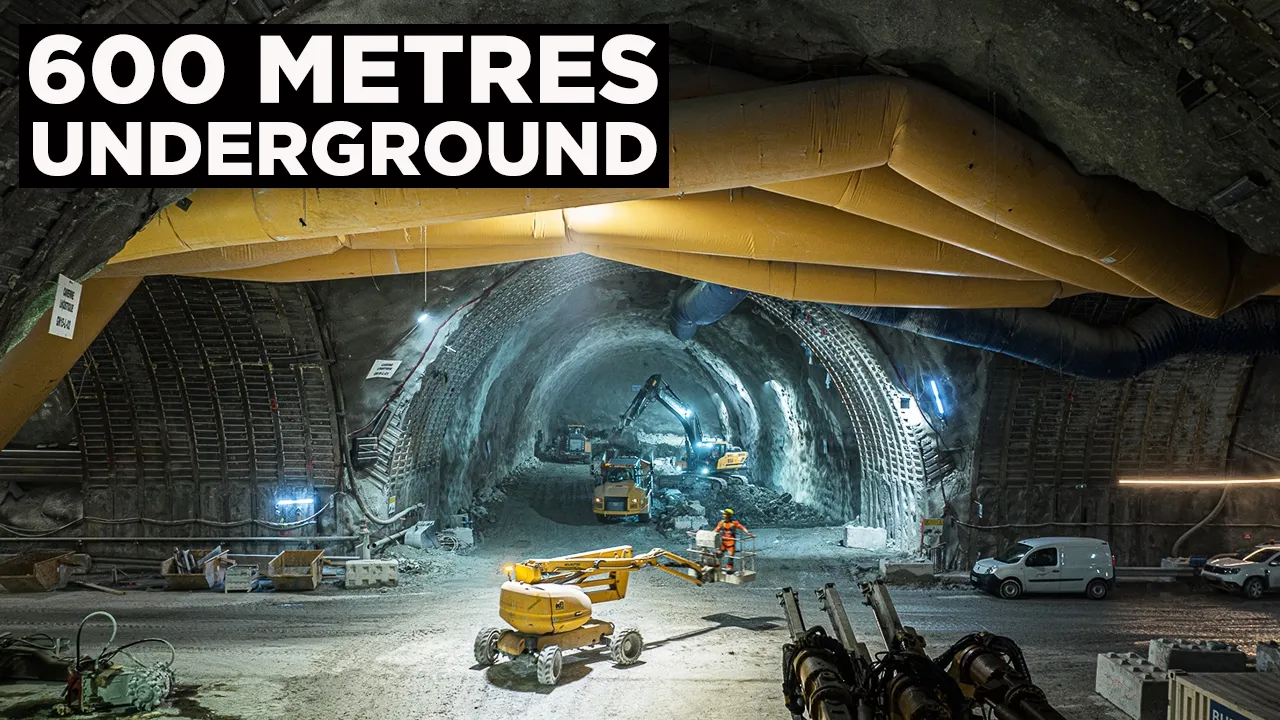
" Now I see exactly what they mean. So incredibly, I am now halfway along the base tunnel, kind of halfway between France down there and Italy down there. Up ahead of me is where the tunneling technique changes again.
So we're going from drill and blast, this huge cavern around me was created by drill and blast. And that concrete face you can see ahead of me up there is where the TBM is going to start drilling for 17 kilometers in this instance and actually break through across the border from France to Italy connecting these two countries to give them access to the base tunnel. Seven huge caverns up to 22 m high and 23 m wide are being excavated.
The TBMs are then going to be assembled inside. Once completed, they'll be tasked with digging the long section from the center of the tunnel all the way across the Italian border. Now, the machine that's going to be setting off here quite soon is pretty different from the one we saw earlier.
Basically, it's what we call gripper TBM. These TBMs are specially designed to mine and to go through hard rock condition. So, there is no precast segments elements like you have on the other project.
On this one, we are going to mine and depending on the geology, we are going to either shutret or install like bolts or steel frame to support the ground. >> Despite buzzing with excitement to check out [music] this incredible project. >> Wow.
Look at this. >> Look at this. >> Wow.
This is amazing. >> I've got to say that traveling into a space so far underground was seriously daunting. At some points, there were 600 m of solid rock above my head, [music] equivalent to the height of Medca 118, the world's second tallest building.
Heading into the tunnels, you encounter all kinds of signs that this is an extreme environment, including a strict protocol where people are counted in and out of the surface and have to wear location tags in case the worst happens. Then it's an eerily quiet drive down through rock that in a way hasn't seen the world since its formation nearly half a billion years ago. And then when you finally get down to where the action is deep under the mountains, things are anything but quiet.
It's remarkable. It is absolutely remarkable. I'm stood under a mountain.
Doesn't really think about there's all that stuff above my head. I'm down here. There's a hive of activity.
There's men and women working away to connect two countries, boost economies, and change the world. It's epic, epic stuff. Further down the line is where boring machines have once again been put into action.
But these don't look anything like the ones we've already seen. Instead of going sideways across the rugged landscape, these teams have been drilling straight down. Four vertical shafts are under construction which will go all the way from the surface 1,300 m above sea level to the base tunnel under the mountain.
They provide ventilation which is especially important when you're tens of kilome inside a mountain. Without it, the air wouldn't be breathable, either for the people working on the projects or if passengers need to be evacuated once the tunnel's in service. First, a pilot hole roughly 40 cm in diameter is bored into the ground just big enough for a long metal bar to be slotted in all the way down to the tunnel.
Where cavities occur, a cylindrical metal formwork is placed inside, allowing the gaps to be filled with concrete. Then a cutting head is attached to the bottom which is used to excavate back up to the surface. It's a technique borrowed from mining and they're known as raise boring machines, a kind of vertical TBM.
The first of these shafts has already been excavated and covered with a temporary lining using [music] this new type of robot that's placed in sight. While most of the activity on this project has been happening in France, things have started to ramp up on the Italian side as well. Preparations are in place for the facilities that will handle the making of the tunnel segments as well as the processing [music] of the excavated material.
A new junction of the elevated highway in Kiamonte is also in progress, which vehicles are going to use to access the sites. Now, one thing you can't help but notice with this mega build is that it's happening in a breathtakingly beautiful, peaceful, and serene valley. But that's not going to be the case for much longer.
And because of that, many locals here have been against the [music] railway. Since the very beginning, the projects faced a backlash from protest groups looking [music] to put a stop to its progress. 2023 saw more than 3,000 demonstrators descend on the area I'm in now, resulting in injuries to both participants and police.
They're unhappy with the environmental damage that they feel the new tunnel will cause, especially as there's already a railway connecting Lyon and Trin. So, in other words, they feel it's not really needed. That's despite the new line being a lot faster, promising green benefits, [music] and having less vulnerability to further landslides.
The cost of all this is another sore point for a lot of people. [music] Current estimates put the price tag at around $25 billion, which is approximately 29 billion US. Almost half of that is being covered by EU funding, while Italy is providing the larger portion of the remaining money.
It's largely because it's committed more of its funding up front than France has, but also because the Italian side is more complex. The terrain is tougher. The access routes are tougher.
It's genuinely a lot more difficult despite being shorter. When you visit here today, you can clearly see that this is a mega build in full swing. But that hasn't always been the case.
There have been delays, opposition from politicians as well as protesters, and financial uncertainty caused by gaps in the budget. That was until July 2025 when a new document was approved that set out the actions and timetable for the project, a joint commitment from France, Italy, and the EU. It confirmed the remaining schedule for the base tunnel, which is expected to be commissioned by the end of 2033.
It also resulted in all segments of the new railway securing EU funding for the first time. As for what remains on the schedule, it's a lot. There's almost three quarters of the tunneling work still on the to-do list.
There are, of course, several years [music] to go until that target completion date, but in the world of big infrastructure projects, that could roll around fast. But now that all the civil works contracts for the base tunnel, which are worth several billion have all been awarded, the rate of excavation is set to increase significantly. We have awarded all the contracts for the construction parts in France but also in Italy and we are awarding right now the final global contract for the the equipments.
So we are now construction all the civil works and we have to to imagine some some difficulties that that are on the table about the regulation about the constraints. There is some construction difficulties of course but there is a human challenge also. One decade from today, this charming Alpine region is set to get a lot busier than it's already becoming with the construction work.
By then, we should hopefully know whether sacrificing some of that tranquility so the whole of Europe can prosper was the right call to make to work on a project that is a benefit for the future generation that is a benefit for the environment and that will also serve Europe. And for me, I'm really proud to to work on this project really. >> [music] >> I've been truly blown away by what I've seen on this project.
Like so many big infrastructure projects, there are questions here about its immediate impact and whether or not it's going to be worth it in the long run. For whatever you think of that, what's undeniable is that this project is going to change our world. And the amazing men and women working deep beneath my feet at the minute [music] are playing a huge part in making that happen.
in the future when the the tunnel will be open when I hope I will attack the TGV and to to say uh I work on this site. I'm very proud of it. They're going to bring two huge countries closer together.
They're going to cut journey times. They're going to take almost a million trucks off the road, cutting emissions. The impact of this is going to be felt by millions of people far beyond those actually using [music] the tunnel itself.
For me, this project really does speak to the best of construction. It shows what we can achieve and the incredible impact that our work can have. Most of all, [music] it shows that whenever this industry is confronted with something that feels impossible, we prove the world wrong.
A huge thanks to Straight [music] Arrow News for sponsoring this video. Don't forget guys, if you want to improve the way you get your news for the better, go ahead and download the Straight Arrow News app today. The link is down there in the video description.
And as always guys, if you enjoyed this video [music] and you want to dig deeper into the definitive video channel for construction, the channel that takes you into some of the world's [music] longest tunnels, make sure you're subscribed to the B1M. Well, that fold that fold's clearly correct, isn't it? Cuz that was that looks like it was meant to be there.
We want to end up in there. So, what have you done, Adam? Oh, this is a joke, isn't it?
That must be Oh, no. That must be right. You could have You could say there's a million quid riding on this.
I couldn't do it. I tell you what, I think I've done better than it was. No, that's not it, is it?