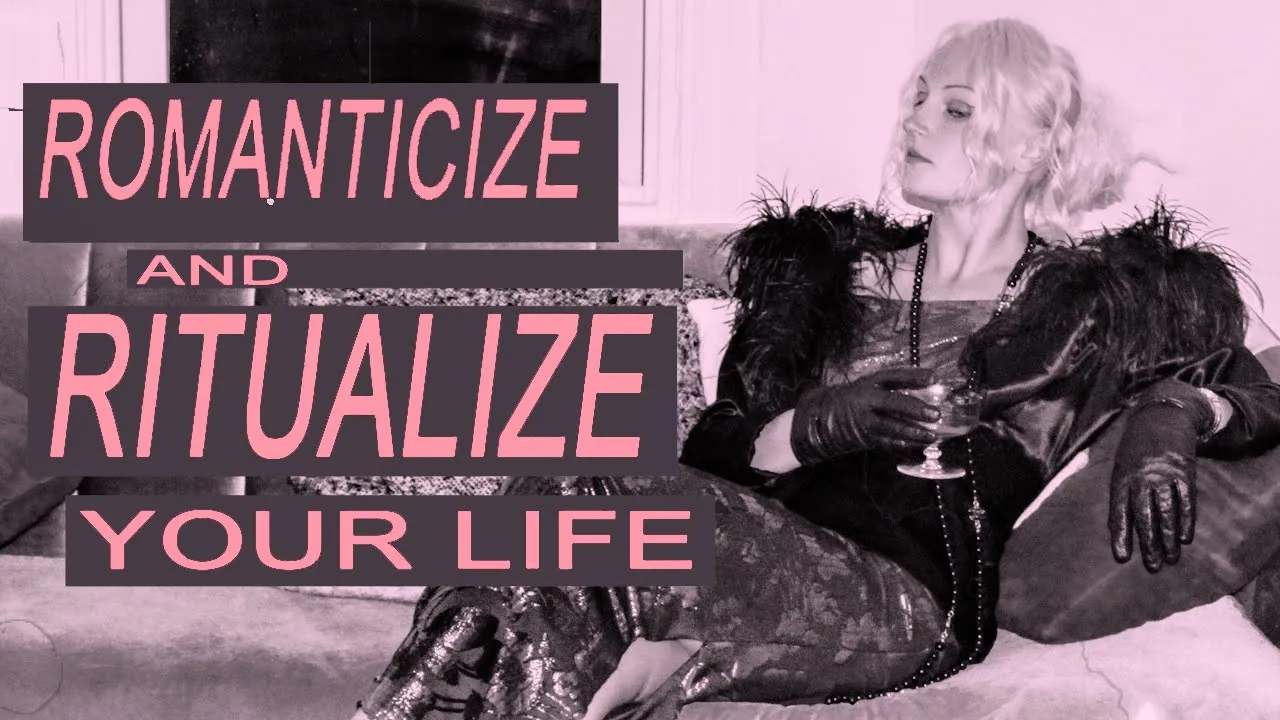
Hello everyone! Welcome back to my channel, or welcome if you're new here. In a life so short, where you could be delivered to death at any moment, there should be no excuse for looking upon your own life with disdain.
Every day you wake up is a gift; every moment of cognition is a gift, and especially your ability to be creative and imbue your life with meaning. Romanticization of your life is simple, I'd say, but it's not always easy. Romanticism requires a rewiring of your brain—reteaching yourself how to process the stimulus around you.
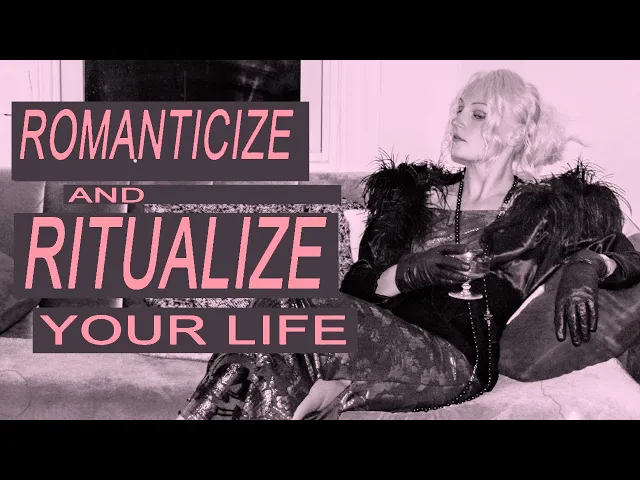
It's training yourself to tighten your focus from the broad to the detail-oriented. In this video, I want to discuss how ritualizing even the most mundane moments in your day will increase the value of your day-to-day life, as well as increase the contingency for beauty. So let's proceed, shall we?
The first step to romanticizing your life is to stop disregarding the mundane moments in your day. Almost no part of your day should be something you need to get through or get out of the way before you get to the more romantic or better moments. The key to Romanticism is that the moments you are choosing to disregard or minimize are actually the moments you need to highlight in your life.
This can be anything—making and plating a meal, taking a shower, brushing your teeth, getting a coffee, reading a book, choosing your outfit for the day—whatever. All of those are what I'm going to label here as supportive moments, and the moments that you're always waiting for, preparing for, hoping for are what I'd call the main moments. The supporting moments of your life are not just the foundation for the main moments; they are not to be forgotten, belittled, or hidden.
Now, here is the major switch that you need to make in your brain: supporting moments are just as important as main moments. They're just as beautiful. Now allow me to expand on that, so I can solidify that a little bit more for you.
A supportive moment might be putting on your outfit and doing your makeup before a party, while the party is the main moment. You discard and belittle the supportive moment because you’re so wrapped up in getting to the main moment, to the party. Wrong!
The even larger revelation here is that the supportive moments are actually, in fact, rituals in preparation for the main moments. That's why they're just as important. They’re supposed to prime you properly for the main moment so that you can enjoy its beauty to the fullest extent.
So now we're going to switch the terminology again: the supportive moments are not, in fact, supportive; they are rituals. Start calling them that. Start emphasizing them.
The rituals help you prepare for the main moment—the experience you're about to have, this thing you're building up in your head. But they are also this ceremonious act of paying respect to that event, to that moment. Getting ready for a party, doing your hair, doing your makeup, putting on music, having a little drink, picking out your outfit—those are all the buildup of the anticipation and the potency of the experience at the party.
It’s going to be so much more enjoyable if you aren’t rushing through the motions of getting ready. Be religious with it. Now, how do we construct a ritual?
What are the cornerstones of ritual? Consideration of time is primary when it comes to the ritual. Time should be holy.
Give yourself enough time to conduct your rituals. Elongate that time; give yourself three hours instead of one hour. Soak up every second of that pleasure.
This is why I say that romanticization of your life can be simple but not easy, because you need to realign your perception of time and its relationship to your life when it comes to the whole scope of your romantic life and all the events in it. The virtue of time lends itself to simplicity. Have fewer experiences and more time to enjoy them.
We have to stop, as a society—we really have to stop rushing around. It’s not a race! Stop clogging up your schedule with things you don't even really care that much about.
Time can be the enemy. Time can be a very insidious force in your life if you allow it, and I have conveyed this message ceaselessly on my channel: when it comes to living, you need to make time to enjoy living, and that means you have to make more time for fewer things in your life. We are always racing through our lives because we want to get through as many events as possible.
We're told to get the most out of our day, and somehow that translates into doing more things in your day. Not if you want to romanticize your life. Getting the most done, being everywhere all at once—that's a load of garbage!
That mentality is a surefire way to make each thing you do in your day less valuable than the last. If you cram a bunch of things together in your day, no matter how amazing they are, each one can be the most incredible thing ever in your life; your processing of those moments starts getting kind of spotty. Your brain becomes overwhelmed with the stimulus, and it just kind of goes on autopilot.
Your brain is not designed to keep all of these small details to which beauty calls home, and so if you are cramming your schedule filled with things and you're just going one after another, your brain is going to completely, if not forget those things. You don't want that! If you want your life to be a dream, baby, it's got to be in slow motion.
That dreamlike state that… Everybody wants from their life. You need it to be slow; you need your life to be perceived in slow motion. It requires that element: give your brain the space to breathe, and all the little details that you generally overlook will then come sharply into focus and radiate meaning.
So, when it comes to the ritualization of your activities, please take your time. Now, what else do we think of whenever we think about ritual? Beautiful objects.
You conduct rituals with beautiful things—objects of assigned sanctity. So, my other piece of advice to all of you is to stop having ugly things around you. Ugliness is a seriously unchecked disease.
Coming into contact with ugly things all the time changes your perception of the world around you, believe it or not. And when it comes to beautiful objects, you become more beautiful by being near beauty. You can ruminate on that if you'd like.
Rituals require fine objects—objects that are sacred, made of noble materials, and crafted with care. Or if you can't, let's say if you don't want to shell out the money for things like that, they should just be objects that have a lot of sentimental value to you. Either way, in your perception, they should be beautiful.
In fact, you should be taking just as much time looking at and admiring the object that you're using as you would for actually using it. That's a good practice. Utilitarian objects can be decorative and beautiful.
If you don't know what utilitarian objects are, they're just objects that you use in your everyday life: a toothbrush, a coffee mug, a towel, a beret, whatever. Those everyday objects should become sacred if we are going to turn a supportive moment into a ritual. Instead of using really horribly ugly toothbrushes—because toothbrushes are always so ugly; it bothers me so much—use a $2 toothbrush from the drugstore, sure, or you can get one from AAAA, like I have.
It's made in Italy, and it actually looks really beautiful. It's a toothbrush, but you can make the effort. I love my toothbrush; I've never felt better about brushing my teeth in the morning.
Instead of a cheap, ugly plate from Target or whatever, that's barely noticeable in your cabinet, find a plate that you think is visually beautiful to you. You like the weight of it, you like the markings on it, and you like where it's made and by whom. When you start to replace utilitarian objects in your home with finer, more artful ones, then the use of those objects becomes more enjoyable, and so does the activity you use them for.
Just like how giving yourself enough time to conduct a ritual pays respect to the main moment, so do the objects you use. These objects are not just objects; they're not just things that you touch every day and forget about. They leave an impression on you.
These objects are part of the class of things—of details—that people choose to disregard or think are not important, but they are everything. Everything you do, everything you touch, your brain is documenting that in your subconscious, and it's going to affect you at some point. Make an effort; make it mean something.
Basically, we're piling things up here. If we're saving up money in a piggy bank for your beautiful life, then every penny counts. Every ounce of effort and attention to detail adds to the sum.
Does that make sense? And when it comes to effort and making every last detail count, we arrive at the last cornerstone of ritual: meaning and symbolism. You are not just a speck of dust in this universe, and if you are, you certainly should not talk to yourself that way.
No matter how insignificant you feel in this world or to other people, that does not mean that you should say that to yourself in the mirror. You're the main character of your life, right? You should be important to you.
As a human being with the ability to create and make art and make something out of nothing, you have every damn right to attribute meaning and beauty to everything that you do. Or, at the very least, everything that you do should hold value. You should feel the weight of the meaning in the things that you do, and it should bring you joy as well as a sense of fulfillment that you are using your precious time to cultivate beauty from your human experience.
Every moment in this life is a dedication to you. How you choose to live your life is a reflection of how you view yourself. If you believe that your life has meaning, even if you choose the most simple life imaginable, then the actions that you take will never be in vain.
Remember that! After all I've said in this video, you should not find it surprising when I say that when you have mastered time and beauty, the ritual and main moment are not just equally important, but they are the same. The preparation for the main moment is the main moment.
They're all main moments. That is how you make your whole life romantic. What I plead to you all, what I'm saying in this video is: please make an effort for your life.
If you only have one, why not savor it and make every moment count if you can help it? It just takes a little bit of discipline, and it just takes, you know, looking out and watching, paying attention. All right, that's all I have for you guys this week.
I'm going to be making a YouTube short as well, which I don't know how that's going to go, but I'm kind of excited about it. So, yeah, let me know if you liked this video. Please leave a comment, please like.
And subscribe! As always, share your thoughts, please, and I will see you guys next week. Bye-bye!